KSSR Mathematics Year 3 & 4: A Parent's Guide to Topics, Skills and How to Help
Learn Math8 min read
Learn Math

Nurul Izzati
Math Curriculum Team, Algonova Malaysia

The fastest way to help your child memorise sifir (times tables) is 5 to 10 minutes of daily practice using skip-counting, number patterns and a printed sifir 1 to 12 chart, not long weekend cramming. Most Malaysian children master sifir 1 to 12 within 8 to 12 weeks this way. This guide is for parents of children aged 6 to 12 who want a calm, proven routine that fits the KSSR syllabus.
Sifir, the Malay word for times tables, is one of the first real memory challenges in KSSR Mathematics, and it worries a lot of parents. Here is the reassuring part: memorising sifir is a skill, not a talent. With a small daily routine and a few simple patterns, almost every child can recall sifir 1 to 12 with confidence. Algonova is a live online school for mathematics and coding with more than 1,000,000 students across 97 countries and a 4.9 star parent rating over 10+ years, and this guide shares the same step-by-step method our tutors use with children in Malaysia. Below you will find the full sifir 1 to 12 table, seven memory techniques that actually work, an 8-week practice plan, and clear answers to the questions parents ask most.
The December break is a calm time to start the routine, because there is no homework competing for the 10 minutes. Our school holidays 2026 Malaysia guide has the exact break dates for every state.
In the Malaysian KSSR Mathematics curriculum, children first meet sifir in Tahun 2 and Tahun 3, beginning with sifir 2, 5 and 10, then building towards the full sifir 1 to 12 by upper primary. Fluent recall of times tables is the foundation for almost everything that follows: long multiplication, division, fractions, ratio, and later algebra in Tingkatan 1. When a child still counts on fingers for 7 x 8, every harder problem takes longer and feels heavier, and UPSR-style word problems turn into a race against the clock instead of a test of thinking.
That is why teachers ask children to hafal sifir early. A child who knows sifir automatically frees up mental space to focus on the actual problem in front of them. Researchers call this automaticity, and it is one of the strongest predictors of confidence in primary maths.

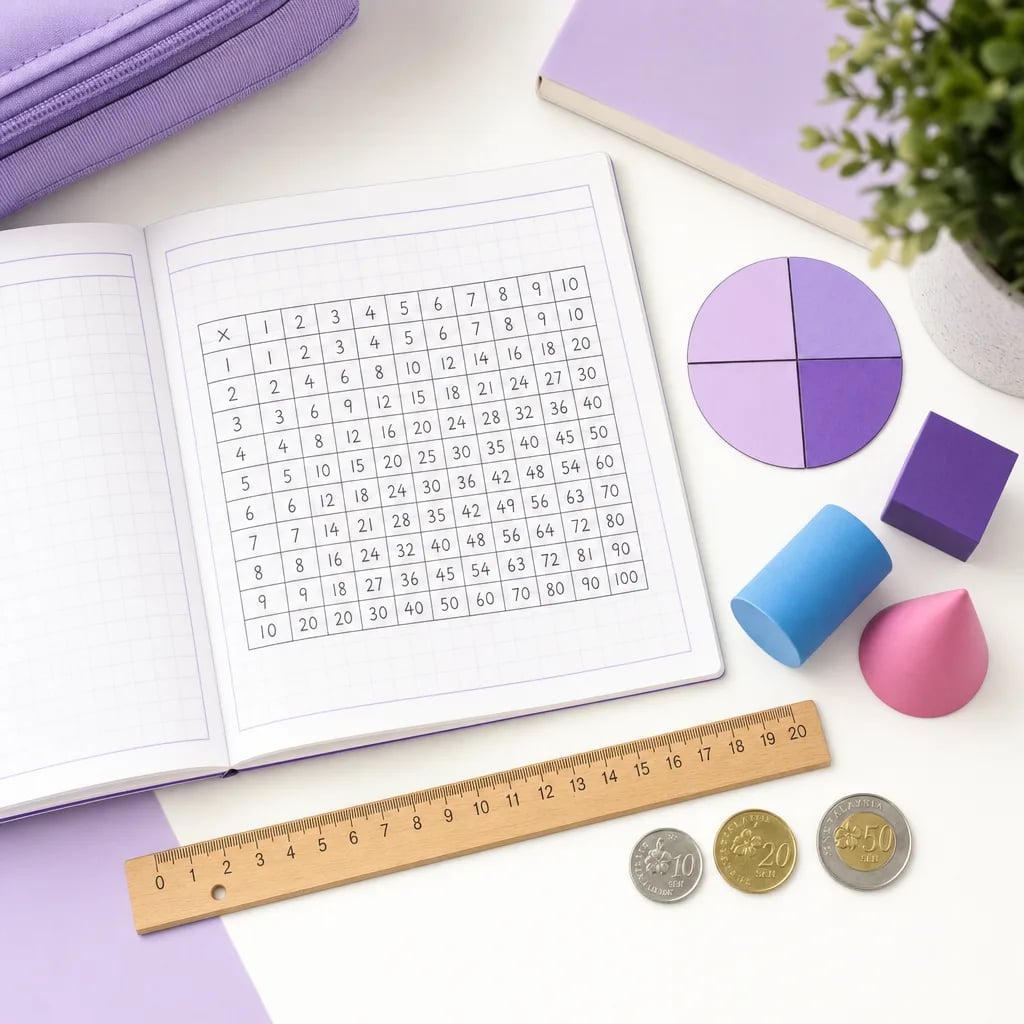
Print this table or keep it on the fridge. Reading it aloud together for two minutes a day is one of the simplest ways to build familiarity before any formal drilling begins.
| Sifir | Multiples (×1 to ×12) |
|---|---|
| 1 | 1, 2, 3, 4, 5, 6, 7, 8, 9, 10, 11, 12 |
| 2 | 2, 4, 6, 8, 10, 12, 14, 16, 18, 20, 22, 24 |
| 3 | 3, 6, 9, 12, 15, 18, 21, 24, 27, 30, 33, 36 |
| 4 | 4, 8, 12, 16, 20, 24, 28, 32, 36, 40, 44, 48 |
| 5 | 5, 10, 15, 20, 25, 30, 35, 40, 45, 50, 55, 60 |
| 6 | 6, 12, 18, 24, 30, 36, 42, 48, 54, 60, 66, 72 |
| 7 | 7, 14, 21, 28, 35, 42, 49, 56, 63, 70, 77, 84 |
| 8 | 8, 16, 24, 32, 40, 48, 56, 64, 72, 80, 88, 96 |
| 9 | 9, 18, 27, 36, 45, 54, 63, 72, 81, 90, 99, 108 |
| 10 | 10, 20, 30, 40, 50, 60, 70, 80, 90, 100, 110, 120 |
| 11 | 11, 22, 33, 44, 55, 66, 77, 88, 99, 110, 121, 132 |
| 12 | 12, 24, 36, 48, 60, 72, 84, 96, 108, 120, 132, 144 |
Here is a comforting fact: your child does not have to memorise every square above. Because 3 x 4 gives the same answer as 4 x 3, once they know one fact they know its twin, which cuts the real workload almost in half.
These seven techniques work because they replace blind repetition with patterns, play and short daily reps. Pick two or three that suit your child instead of trying all of them at once.
1. Skip-count first. Before drilling 3 x 7, have your child count 3, 6, 9, 12 out loud. Skip-counting turns a table into a rhythm and builds the multiples into memory naturally. Start with sifir 2, 5 and 10, which are the easiest.
2. Teach the patterns, not just the facts. Sifir 9 hides a lovely pattern: the tens digit rises by one while the ones digit falls by one (09, 18, 27, 36), and the two digits always add up to 9. In sifir 5, every answer ends in 5 or 0. For sifir 11 up to 9, just repeat the digit (11 x 3 is 33, 11 x 4 is 44).
3. Use the finger trick for sifir 9. Hold up ten fingers. To find 9 x 4, fold down the fourth finger. The fingers to the left of the gap are the tens (3) and the fingers to the right are the ones (6), so the answer is 36. Children love this one, and it quietly removes the fear of the nine table.
4. Sing lagu sifir. Songs and chants stick in memory far longer than silent reading. Many Malaysian parents use nasyid-style sifir songs on YouTube, or make up a simple tune at home. Music engages a different part of memory and makes practice feel like play.

5. Flashcards, two minutes a day. Write a fact on one side and the answer on the back. Keep the cards your child gets right in one pile and the tricky ones in another, and revisit the tricky pile more often. This is spaced repetition, and it is how the brain moves facts into long-term memory.
6. Play games, not tests. Roll two dice and multiply them. Use card games, snakes-and-ladders with a multiplication twist, or free apps. A child who is laughing is a child who is learning, and games strip away the pressure that makes sifir feel scary.
7. Practise in real life. Ask multiplication questions while cooking (6 eggs in 4 boxes), shopping (3 packets at RM4 each), or driving. Real context shows a child that sifir is a useful tool, not just homework.
A child rarely fails at sifir for lack of talent. They fail because they practised for one long, stressful hour on Sunday instead of five calm minutes every day. Change the rhythm and almost every child succeeds.
Aina Rashid, Education Specialist at Algonova Malaysia
The most common mistake is drilling the whole sifir 1 to 12 at once until the child is frustrated. A far better approach is to master one or two tables a week in short daily sessions, always ending on a success. Here is what to avoid, and what to do instead.
Three mistakes to avoid:
Not sure which sifir your child keeps missing? An Algonova tutor pinpoints the exact gap in a single free lesson. Book a free Masterclass
A simple 8-week sifir plan you can start this week:
| Week | Focus | Daily routine (5 to 10 min) |
|---|---|---|
| 1 | Sifir 2 and 5 | Skip count aloud, then 5 flashcards |
| 2 | Sifir 10 and 11 | Spot the pattern, then a dice game |
| 3 | Sifir 3 and 4 | Doubling trick, then flashcards |
| 4 | Sifir 6 | Mix with 2 and 3, real-life questions |
| 5 | Sifir 9 | The finger trick and the 9 pattern |
| 6 | Sifir 7 and 8 | The hardest tables, extra games |
| 7 | Sifir 12 | Build on 10 plus 2 |
| 8 | Mixed review | Random quiz across all tables, small reward |
Keep sessions short, consistent and positive. Most children who follow a rhythm like this recall sifir 1 to 12 comfortably within two to three months. If one table is especially stubborn, slow down and stay there an extra week. There is no prize for rushing.
The parents who see the fastest progress are rarely the ones who buy the most workbooks. They are the ones who turn sifir into a two-minute game at breakfast and simply never skip a day.
Aina Rashid, Education Specialist at Algonova Malaysia
At Algonova Malaysia, mathematics is taught live by certified tutors in small groups or one-to-one, never as recorded video. For sifir specifically, a tutor does three things a worksheet cannot: they spot exactly which table a child stumbles on, they switch technique on the spot when one approach is not clicking, and they keep the child motivated with games and quick wins. Every lesson follows the KSSR syllabus, so what a child practises with us matches what they meet in school.
Because the classes are online and small, a child in Kuala Lumpur, Johor Bahru or Kota Kinabalu gets the same attention as one sitting right next to the tutor. Progress is easy to see: parents watch their child move from counting on fingers to instant recall over a single term, and that new confidence usually spreads to the rest of their maths.
The best way to know whether this suits your child is to watch one lesson. Book a free 60-minute masterclass with an Algonova tutor. Your child works on real sifir practice, you see how the teaching feels, and you decide with no pressure.
In the KSSR syllabus, children usually meet sifir in Tahun 2 and Tahun 3, starting with the easy tables of 2, 5 and 10. Most children are ready to begin around age 7, though a curious 6-year-old can start with skip-counting games. By age 9 or 10 most children should be working towards fluent recall of sifir 1 to 12. If your child is older and still not fluent, that is completely normal and easy to fix with a short daily routine. There is no missed window, only the day you start.
The single most effective method is 5 to 10 minutes of practice every day rather than one long session a week. Combine three simple tools: skip-counting aloud (2, 4, 6, 8) to build rhythm, a few flashcards that revisit the tricky facts more often, and the number patterns inside each table. Always end on a fact your child gets right so the session feels like a win. Consistency beats intensity every time, and a calm, playful tone matters more than any single trick.
Most Malaysian children find sifir 7 and 8 the hardest because they have the fewest obvious patterns. The fix is to lean on facts your child already knows. For 8, teach doubling: double, double, double (8 x 3 is 3 doubled to 6, to 12, to 24). For 7, anchor to friendly facts like 7 x 10 and 7 x 5, then count up or down. Spend an extra week on these two tables, use more games, and keep the pressure low. They always click with patient practice.
With a steady routine of 5 to 10 minutes a day, most children recall sifir 1 to 12 comfortably within 8 to 12 weeks, or about two to three months. The tables of 2, 5, 10 and 11 often come within the first two weeks because their patterns are so clear. The 7 and 8 tables usually take longest. What matters most is consistency: six months of steady daily practice beats a school-holiday cram followed by nothing. Slow down on any table that resists rather than rushing ahead.
Yes. Music and rhythm are among the strongest memory aids we have, which is why children can sing along to songs they have heard only a few times. A sifir song sets the multiples to a tune, so recall becomes almost automatic. Many Malaysian parents use nasyid-style lagu sifir on YouTube, or simply chant a table together in the car. Songs work best as a first step to build familiarity, then pair them with flashcards and real-life questions so the child can recall facts out of order, not only in sequence.
Blog
Start your child's tech journey
Book your free 60-minute trial class with an Algonova certified tutor. No payment, no obligation, just discover what your child can build.

Algonova worldwide
Contact us
Email: int_legal@alg.team
Visit us
Suite 8634, 1021 E Lincolnway, Cheyenne, WY, Laramie, US, 82001
Algonova online LLC International tech school for kids and teens