
Abacus vs Kumon vs Conceptual Math: Which Is Right for Your Child?
Which Is Better?6 min read
Checklists & Calendar

Nurul Izzati
Math Curriculum Team, Algonova Malaysia
To choose a maths tutor in Malaysia, check 10 things before you pay: the tutor knows your child's syllabus, explains one topic well in a trial lesson, sets a goal you can measure and reports to you every week. Expect about RM 45 to RM 50 an hour for a primary home tutor in 2026. Give any tutor 4 weeks, then compare a short test with the first one.
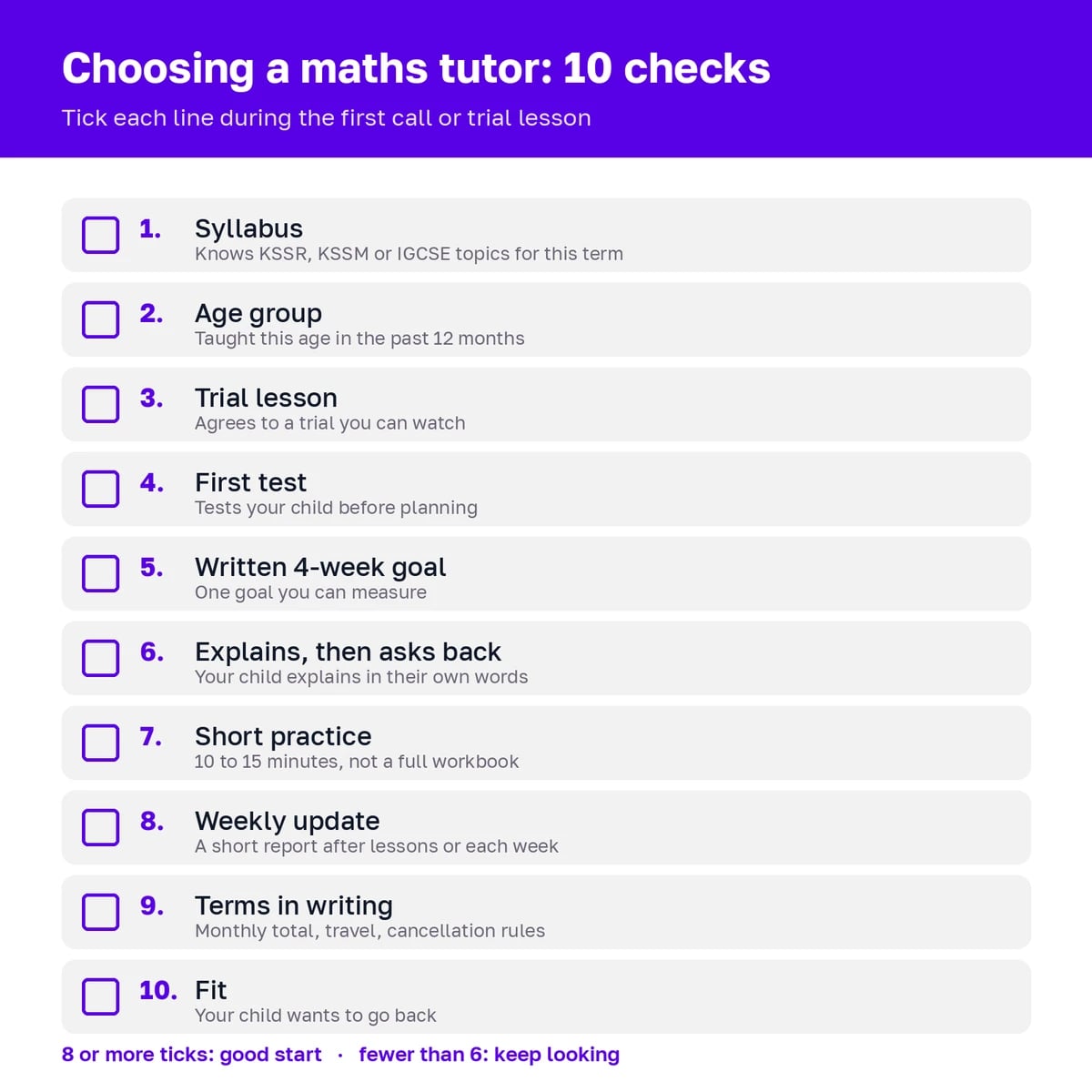
A good maths tutor passes all 10 checks below, and you can do the first 5 before you pay anything. Keep the table open during the first phone call.
| # | Check | What a good answer looks like |
|---|---|---|
| 1 | Syllabus | Names your child's syllabus (KSSR, KSSM or IGCSE) and the topics for this term |
| 2 | Age group | Has taught children of your child's age in the past 12 months |
| 3 | Trial lesson | Agrees to a trial and lets you watch or listen |
| 4 | First assessment | Tests your child before planning lessons |
| 5 | Written goal | Writes one goal for 4 weeks, for example "adds and subtracts within 100 without fingers" |
| 6 | Explaining style | Uses objects, drawings or real examples, then asks your child to explain back |
| 7 | Homework | Sets 10 to 15 minutes of practice, not a full workbook a night |
| 8 | Feedback | Sends a short update after every lesson or every week |
| 9 | Terms | Gives the monthly total in writing, with travel, materials and cancellation rules |
| 10 | Fit | Your child is willing to go back after the trial |
Take check 5 seriously. A goal like "improve maths" can't be tested. "Scores 8 out of 10 on the times tables for 2 to 5" can.
If we could keep only one check, it would be the trial lesson. A CV says what a tutor studied. A trial shows how they talk to your child when your child gets it wrong.
The best questions make a tutor show you how they teach, so ask for examples rather than promises. Eight questions cover most of it:
Question 3 tells you the most. One tutor may write the rule on paper. Another will cut a roti canai drawing into 4 pieces and ask your child how many pieces 2 people get. The second answer shows a tutor who checks understanding instead of handing over a method to copy.
If your child is far behind, also ask about gaps from earlier years. A Year 4 child who struggles with division may still be shaky on times tables. Our guide on why a child is weak in maths lists the usual causes.
A red flag is anything that makes progress impossible to check or money hard to get back. Walk away, or at least slow down, if you see these:
One red flag is not always a dealbreaker. A university student tutor may not have a written plan, but if they agree to write one after you ask, that is fine. Two or more together usually mean the arrangement won't improve on its own.
A primary school maths home tutor costs about RM 45 to RM 50 an hour in 2026, and online one-to-one lessons cost about RM 25 to RM 30. The figures below come from two public guides: the 2026 recommended rates published by the tutor platform GoLearn, and the Malaysia4u tuition guide updated on 9 August 2026. We checked both on 21 October 2026. They are guide prices for the Klang Valley, not quotes.
| Format | Typical 2026 price | Source |
|---|---|---|
| Home tutor, primary (Year 1 to 6) | RM 45 to RM 50 an hour | GoLearn |
| Home tutor, Form 1 to 3 | RM 50 to RM 60 an hour | GoLearn |
| Online one-to-one, primary | RM 25 to RM 30 an hour | GoLearn |
| Online one-to-one, Form 1 to 3 | RM 35 to RM 45 an hour | GoLearn |
| Tuition centre, small group of 5 to 10 | RM 150 to RM 300 a subject a month | Malaysia4u |
| Online group class or platform | RM 60 to RM 200 a subject a month | Malaysia4u |
Here is a worked example. A Year 3 child with a home tutor 2 hours a week needs about 8 hours a month. At RM 48 an hour that is RM 384 a month, before any travel charge. The same 8 hours online one-to-one at RM 28 comes to RM 224.
For a full breakdown by level, see home tuition costs per hour in Malaysia. If you are weighing a worksheet centre, our guide to Kumon fees in Malaysia and whether it is worth it does the same maths for Kumon.
The right format depends on what your child needs right now: one-to-one attention for a single gap, or steady weekly practice with other children. Use this as a quick guide:
| Your situation | Format that usually fits |
|---|---|
| One stubborn topic, exam in 6 weeks | Home tutor or online one-to-one |
| Child works better with classmates | Small group, at a centre or online |
| No good tutors near you, or late working hours | Online class |
| Child aged 6 to 8 who finds maths boring | Small online group with visual, hands-on lessons |
We compare the first two formats in detail in group vs private tuition in Malaysia and in online maths class vs private tutor.
At Algonova, maths for children aged 6 to 8 is taught live online by a real teacher in groups of up to 10. The Math Starters course follows the KSSR topics for Darjah 1 and 2, and it starts with a free diagnostic of about 60 minutes that ends in a written report. More than 1M students in 97 countries have studied with Algonova. Course details are on the online maths classes page, and you can read what parents say.
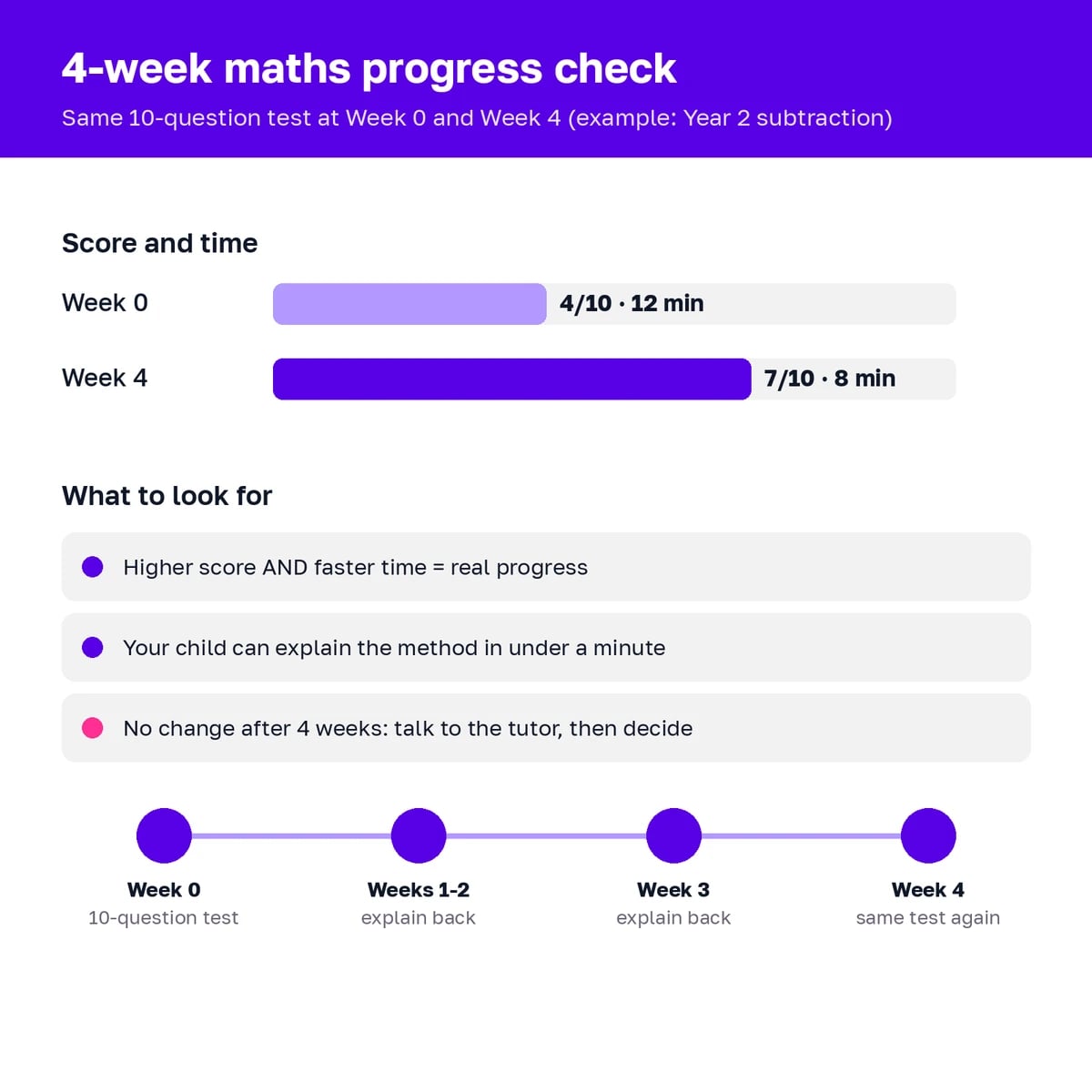
Four weeks is long enough to see a change on one goal and short enough to switch tutors without losing a term. Run this simple test:
Say your Year 2 child scored 4 out of 10 on subtraction with borrowing and needed 12 minutes. After 4 weeks, 7 out of 10 in 8 minutes is real progress. A score that stays at 4, or a child who still can't explain the method, means it's time to talk to the tutor or try a different one.
Also check the softer signs. Does your child start homework without a fight? Do they say "I get it" about at least one topic? Those count too, especially for a 6 or 7 year old.
Print this page or save the checklist image, then tick each line during the trial lesson:
Eight ticks or more is a good start. Fewer than 6, keep looking. To see which topics your child should know by now, check the Ministry of Education curriculum pages.
Individual home and online tutors in Malaysia don't need a licence (tuition centres must register with the Ministry of Education), so look for teaching experience with your child's age group and syllabus rather than a single certificate. A trained teacher, a maths graduate or a university student can all do well. What matters more is whether they can explain a topic in a way your child understands. Ask how many children of your child's age they have taught in the past year and which syllabus they used, KSSR, KSSM or IGCSE. Then watch a trial lesson. A Year 2 child needs someone who uses objects and pictures, while a Form 2 student needs someone who knows the exam format. Ask for a recent reference from another parent if you can. One honest reference tells you more than a certificate on the wall.
Ask questions that make the tutor teach in front of you. Start with the syllabus: which topics your child covers this term and what comes next. Then ask how they will find your child's gaps, what your child should be able to do after 4 weeks, and how they will report progress. One useful test is to ask them to explain a topic, such as fractions, as if to your child, in 2 minutes. Finish with money: the monthly total, travel charges, materials and the rule for cancelled lessons. Write the answers down so you can compare 2 or 3 tutors side by side. If a tutor avoids a question or gets impatient with it, note that as well, because your child will meet the same reaction. A tutor who answers with a short demonstration is usually a safer choice than one who lists past students' grades.
A maths home tutor for primary school costs about RM 45 to RM 50 an hour in 2026, and RM 50 to RM 60 for Form 1 to 3, based on GoLearn's published 2026 rates. Online one-to-one lessons are cheaper, at about RM 25 to RM 30 an hour for primary. The Malaysia4u tuition guide, updated in August 2026, gives a wider range of RM 40 to RM 150 an hour for private tutors in the Klang Valley, because experience varies a lot. A university student charges less than a full-time tutor with years of exam results. Outside the Klang Valley, Malaysia4u expects prices about 20 to 30% lower. Treat all these numbers as a guide and ask each tutor for a written monthly total, including travel. Ask too whether the rate goes up in exam years, since Form 4 and 5 lessons usually cost more.
Online maths tuition can work as well as a home tutor when the lesson is live, the group is small and the teacher asks your child to talk and show their working. It works less well when a child just watches videos or when a group is so large that nobody checks each answer. The format matters less than the teacher's habits: a first assessment, a clear goal and regular feedback. Online also solves practical problems. You don't need a tutor who lives nearby, and a working parent doesn't have to host lessons at 6 pm. For a child aged 6 to 8, a small live group with visual activities often keeps attention better than a long one-to-one session. Try one trial in each format and compare your child's reaction.
Most primary children need 1 to 2 hours of maths tuition a week, plus 10 to 15 minutes of practice on most days. More is rarely better at this age. A Year 1 or 2 child often loses focus in a long session, and long sessions can make maths feel like a punishment. If your child has a large gap, such as not knowing number bonds to 10 in Year 3, 2 shorter sessions a week usually beat 1 long one. Keep the weekly total steady for 4 weeks so you can measure the change fairly. Then adjust. If the Week 4 test shows clear progress, you may be able to drop to 1 hour a week and keep the gains with short home practice. If there is no progress, more hours rarely fix it; a different approach usually does.
A tutor is not working out when your child's results and confidence stay the same after 4 to 6 weeks of regular lessons. Compare a 10-question test from before the first lesson with a similar test at Week 4. No change in score or speed is the clearest sign. Other warning signs are a child who still can't explain the method, homework that gets harder to start, and a tutor who gives no updates or blames your child. Before you switch, talk to the tutor, ideally without your child in the room. Share the test results and ask what they will change in the next 2 weeks. A good tutor will adjust the plan. If nothing changes after that conversation, look for someone else. You lose one month of fees, and your child still has the rest of the school year to catch up.
For most primary children, choose a tutor who follows the school syllabus first, because homework and school tests are what your child faces each week. In Malaysia that means KSSR for primary and KSSM for secondary, or IGCSE for international schools. Once your child is comfortable with school topics, extra puzzles and harder problems can build interest. A tutor who jumps ahead too early may leave gaps underneath, such as place value or times tables, that cause trouble later. Ask the tutor to show you how their plan lines up with this term's topics. The Ministry of Education publishes the KSSR and KSSM documents, so you can check the topic list for your child's year yourself. If the tutor's plan and the school list share almost no topics for the next 4 weeks, ask why before you agree to it.
A free trial lesson is enough to judge whether a tutor explains clearly and whether your child feels comfortable, but not enough to judge results. In one lesson, watch three things: does the tutor test what your child already knows, do they explain with examples, and do they ask your child to explain back? Afterwards, ask your child one simple question: "Do you want to go back?" Results need longer. Agree on a 4-week goal and pay month by month, so you can stop if the Week 4 test shows no progress. A good trial costs you an hour and tells you more than any advert. Some providers start with a diagnostic instead of a trial lesson. Algonova, for example, begins with a free online diagnostic of about 60 minutes and a written report for parents.
Blog


Start your child's tech journey
Book your free 60-minute trial class with an Algonova certified tutor. No payment, no obligation, just discover what your child can build.

Algonova worldwide
Contact us
Email: int_legal@alg.team
Visit us
Suite 8634, 1021 E Lincolnway, Cheyenne, WY, Laramie, US, 82001
Algonova online LLC International tech school for kids and teens

