
Abacus vs Kumon vs Conceptual Math: Which Is Right for Your Child?
Which Is Better?6 min read
Checklists & Calendar

Nurul Izzati
Math Curriculum Team, Algonova Malaysia
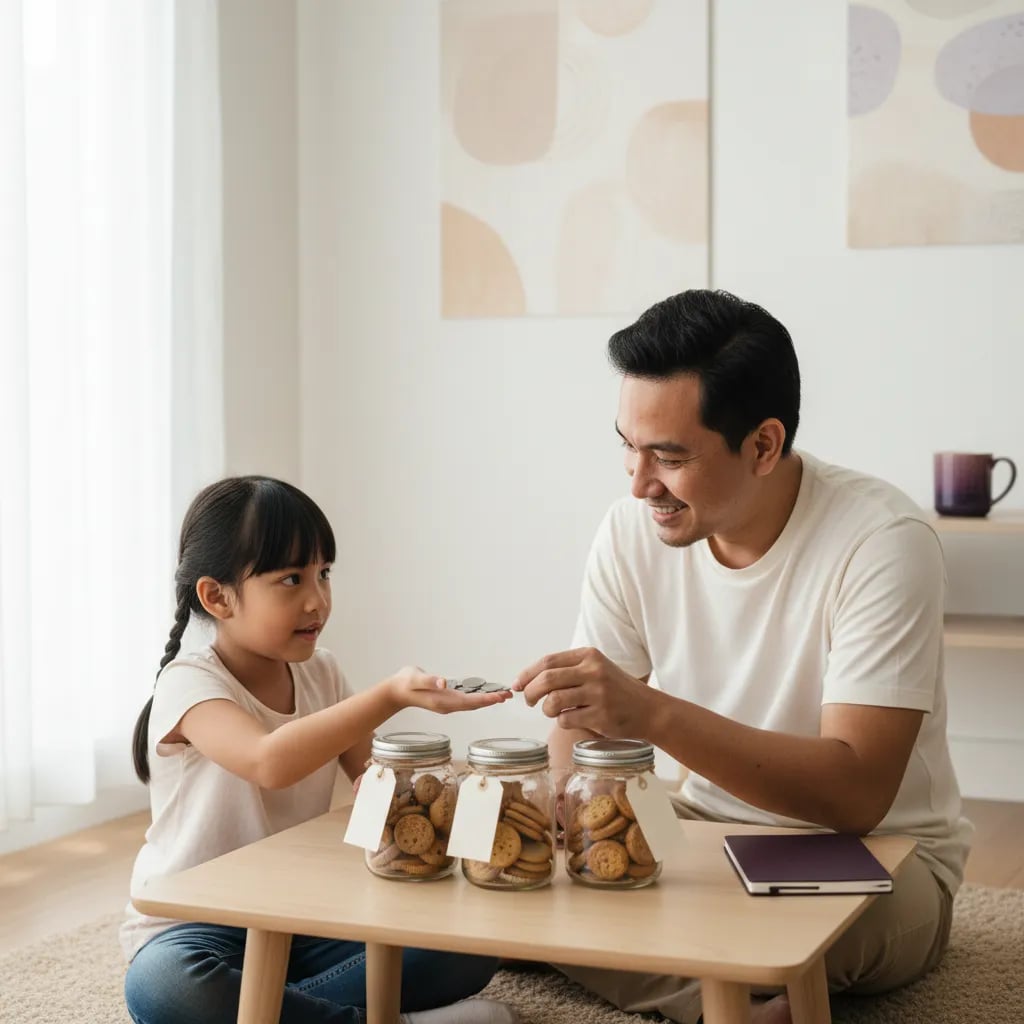
The easiest school holiday maths activities for Year 1 are a 4-week plan with one topic a week: numbers to 100, adding and subtracting, RM and sen, then time and the calendar. A child aged 6 to 8 needs only 15 to 20 minutes a day, 4 or 5 days a week, with no-screen games. That adds up to 18 sessions, about 6 hours across the December 2026 holiday.
The plan splits the December 2026 school holiday into 4 study weeks, each on one KSSR Year 1 and 2 maths topic. The holiday starts on 4 December for Group A (Kedah, Kelantan, Terengganu) and 5 December for Group B, and ends on 31 December 2026 for both, per KPM circular Surat Siaran Bil. 3/2025 on the KPM academic calendar. State dates are in our school holiday 2026 guide.
| Week | Dates | Topic | Main activities | Time |
|---|---|---|---|---|
| 1 | 7-13 Dec | Numbers to 100 | Number cards, skip counting by 2s and 10s, 100 chart | 15 min x 5 days |
| 2 | 14-20 Dec | Adding and subtracting | Dice, "number 10 house", marble stories | 15-20 min x 5 days |
| 3 | 21-27 Dec | RM and sen | Living-room shop, working out change | 20 min x 4 days |
| 4 | 28 Dec-3 Jan | Time and the calendar | Paper clock, 2027 calendar, daily timetable | 15-20 min x 4 days |
The first three days stay empty for rest. Weeks 3 and 4 have only 4 days because of Christmas on 25 December and New Year on 1 January. The topics follow the Year 1 and 2 KSSR maths syllabus: Year 1 children usually work with numbers to 100, Year 2 children go up to 1,000.
The sum: 5 + 5 + 4 + 4 = 18 sessions. At 20 minutes each, that is 360 minutes, or 6 hours for the whole holiday.
Keep each session short and stop before your child gets bored. Pick the same time every day, such as right after breakfast, before outdoor play wears them out.
A 20-minute session runs like this:
The games are screen-free on purpose, since a long holiday usually means more phone time. Age-based limits are in our screen time guide for kids.
15 minutes a day for 4 weeks gives a child time to forget and remember again. Three workbooks in the last week of the holiday do not.
The first week is about place value: 47 is 4 tens and 7 ones. Skip it and week 2 turns into memorising.
Example: your child shows 63 with 6 bundles and 3 loose sticks. Ask, "If we add one more bundle, what number is it now?" The answer 73 shows they understand the tens digit. More in our article on what place value means.
For Year 2, raise the range to 1,000 and treat "one hundred" as 10 bundles tied together.
Adding and subtracting are linked: if 6 + 4 = 10, then 10 - 4 = 6. A child who sees this does not need to memorise subtraction facts separately.
Year 2 children can try regrouping, such as 38 + 15. Split 15 into 2 and 13, do 38 + 2 = 40, then 40 + 13 = 53, saying each step out loud. Times tables are left out on purpose. In our view, 4 weeks is better spent making adding and subtracting solid, because school introduces times tables step by step from Year 2, starting with 2, 5 and 10.
If your child cries or dodges every subtraction question, read our guide to maths anxiety before adding more practice.
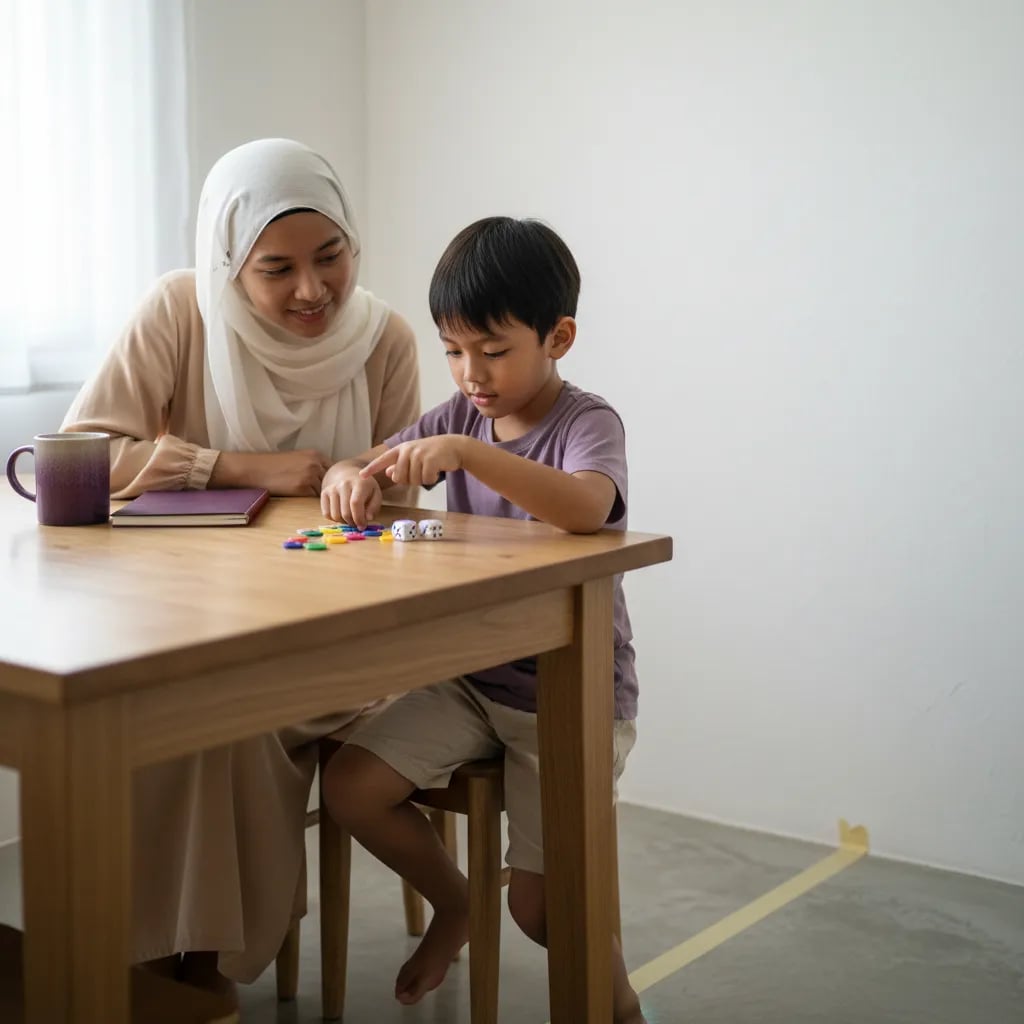
This week covers Malaysian money: 5, 10, 20 and 50 sen coins, RM1, RM5 and RM10 notes, and 100 sen = RM1. Children tend to like it because they hold real money.
Try this: "An eraser costs 70 sen. You pay with RM1. How much change?" The answer is 30 sen. For Year 2, combine two items: RM2 + 80 sen = RM2.80, pay with RM5, change RM2.20. More money and kitchen games are in our list of maths activities at home.
Let your child pay at the shop counter. One 70 sen purchase with real money sticks better than 10 change questions on paper.
The holiday ends with time: o'clock and half past for Year 1, 5-minute steps for Year 2. The calendar joins in because 2027 is about to start.
On 28 December, counting the days to 4 January 2027 on the calendar gives 7: counting and calendar reading in one question. KPM confirmed 4 January 2027 as the start date for Groups A and B, as reported by Berita RTM.
A 10-question quiz on 2 or 3 January shows what the 4 weeks achieved, with one or two questions per topic. Do not help. Just note where they hesitate.
A sample quiz:
A score of 8 or more means your child is ready for the new term. Below 6 means a topic needs repeating, often place value from week 1.
The other option is Algonova's free diagnostic. A teacher on the Math Starters course for ages 6 to 8 checks your child against the KSSR syllabus and writes up the gaps. Lessons run live online in groups of up to 10 children, and parents rate us 4.9 out of 5 (see reviews from Malaysian parents). For holiday ideas beyond maths, see our school holiday activities for kids.
The year-end school holiday starts on 4 December 2026 for Group A and 5 December 2026 for Group B, and ends on 31 December 2026 for both. Group A is Kedah, Kelantan and Terengganu. Group B is every other state plus the Federal Territories. Group A gets 28 days off and Group B gets 27, according to KPM circular Surat Siaran Bil. 3/2025. The 2027 session starts for everyone on 4 January 2027. That leaves about 4 full weeks, enough for 4 topics, so start on Monday 7 December and let your child rest first. Check with your child's school, because some private and international schools follow their own calendar. If school ends earlier, use the extra days to repeat the weakest topic.
Most 6 year olds can focus on one maths activity for 10 to 15 minutes, especially when they hold real objects. After that, attention drops and mistakes pile up. Stop while your child is still enjoying it, and they will want to play again tomorrow. A child starting Year 1 in January 2027 can do weeks 1 and 2 with a smaller range: numbers to 20 and adding within 10, using buttons or ice-cream sticks. Two 10-minute sessions, one in the morning and one in the evening, suit a restless child better than a single 20-minute block. Tired children start guessing or ask when they can stop. At that point, finish with one easy question they are sure to get right.
Year 1 KSSR maths usually covers whole numbers to 100, adding and subtracting within 100, Malaysian money, time, basic measurement, 2D and 3D shapes and simple data. The focus is understanding ideas with real objects. Children count forwards and backwards, read and write numbers in digits and words, and learn tens and ones. For time, a Year 1 child usually reads o'clock and half past. This plan uses the 4 topics that come up most at home: numbers, operations, money and time. Shapes and measurement can be weekend extras, such as a shape hunt in the kitchen. The full list for Year 1 and 2 is in our KSSR guide. If you are unsure of the order at your child's school, ask the class teacher or look at the Year 1 maths textbook that came home at the end of the year.
Year 2 maths uses the same ideas as Year 1 with bigger numbers: whole numbers to 1,000 and adding and subtracting with regrouping. Year 2 children also meet multiplication and division as repeated adding and equal sharing, usually starting with the 2, 5 and 10 times tables. In money they add and subtract RM and sen and give change. In time they read the clock in 5-minute steps. A Year 1 child answers 8 + 5, while a Year 2 child answers 38 + 15 by splitting the numbers into tens and ones. Every week of this plan has a harder Year 2 version. If your Year 2 child gets stuck, go back to the Year 1 version for 2 or 3 days. A small gap is easier to close in the holiday, when no new homework is waiting.
No. Workbooks are optional, and for a 6 to 8 year old, games with real objects usually stick longer. A worksheet shows whether a child can write an answer, but rarely whether they understand why. If you want one, limit it to a page a day after the main game. After 10 minutes of playing shop, for example, give 4 change questions on paper. A child who has just held the coins answers faster and guesses less. Avoid cramming 3 or 4 workbooks into the last week, because children then link maths with stress. Fifteen minutes a day for 4 weeks, about 6 hours in total, beats 6 hours in 2 days. If school sends holiday homework, do a little each day and finish it before week 4 so the last week stays light.
Shrink the session to 5 minutes and turn it into a game. Many children push back against the word "study", not against maths itself. Give your child a job, such as shopkeeper or dice scorekeeper. A child who refuses subtraction questions is often happy to work out change when holding real money. Praise the thinking rather than the answer, for example "nice, you split 15 into 10 and 5", and never compare with a sibling or classmate. If your child cries or gets angry every time numbers appear, that may be maths anxiety, and it needs gentle handling before more practice. Restart with something they already do well, such as counting to 20, so they feel successful first. After 2 or 3 calm days, bring back the question they were dodging.
Use real coins. Start with sorting, then make RM1 from small coins. Your child needs to see that 100 sen equals RM1 before working out change. Malaysia uses 5, 10, 20 and 50 sen coins, and notes start at RM1. Begin with only two coin types, such as 10 sen and 50 sen, to keep counting simple. Then play shop with round prices like 50 sen, RM1 and RM2. Once your child is confident, price something at 80 sen and ask them to pay with RM1, so the change is 20 sen. The last step is a real purchase at a nearby shop. In this plan, those steps fill the 4 sessions of week 3. A Year 2 child can go straight to mixed prices like RM2.80, since their syllabus already covers adding and subtracting RM and sen.
Run a 10-question quiz at home on 2 or 3 January 2027, with questions from each topic you practised. A score of 8 or more means your child is ready. A 6 or 7 means one topic is still wobbly, so repeat it for 15 minutes a day in the first week of school. Below 6 often points to a place value gap, where the child does not yet grasp tens and ones. A child who answers 52 - 18 = 46 may be subtracting the smaller digit from the bigger one, 8 - 2, without thinking about position. For a more exact picture, the free Math Starters diagnostic, about 60 minutes, checks a 6 to 8 year old against the KSSR syllabus. Parents get a written report on the gaps and suggested next steps.
Blog

Start your child's tech journey
Book your free 60-minute trial class with an Algonova certified tutor. No payment, no obligation, just discover what your child can build.

Algonova worldwide
Contact us
Email: int_legal@alg.team
Visit us
Suite 8634, 1021 E Lincolnway, Cheyenne, WY, Laramie, US, 82001
Algonova online LLC International tech school for kids and teens

