Abacus vs Kumon vs Conceptual Math: Which Is Right for Your Child?
Which Is Better?6 min read
Which Is Better?

Arjun Menon
Education Analyst, Algonova Malaysia
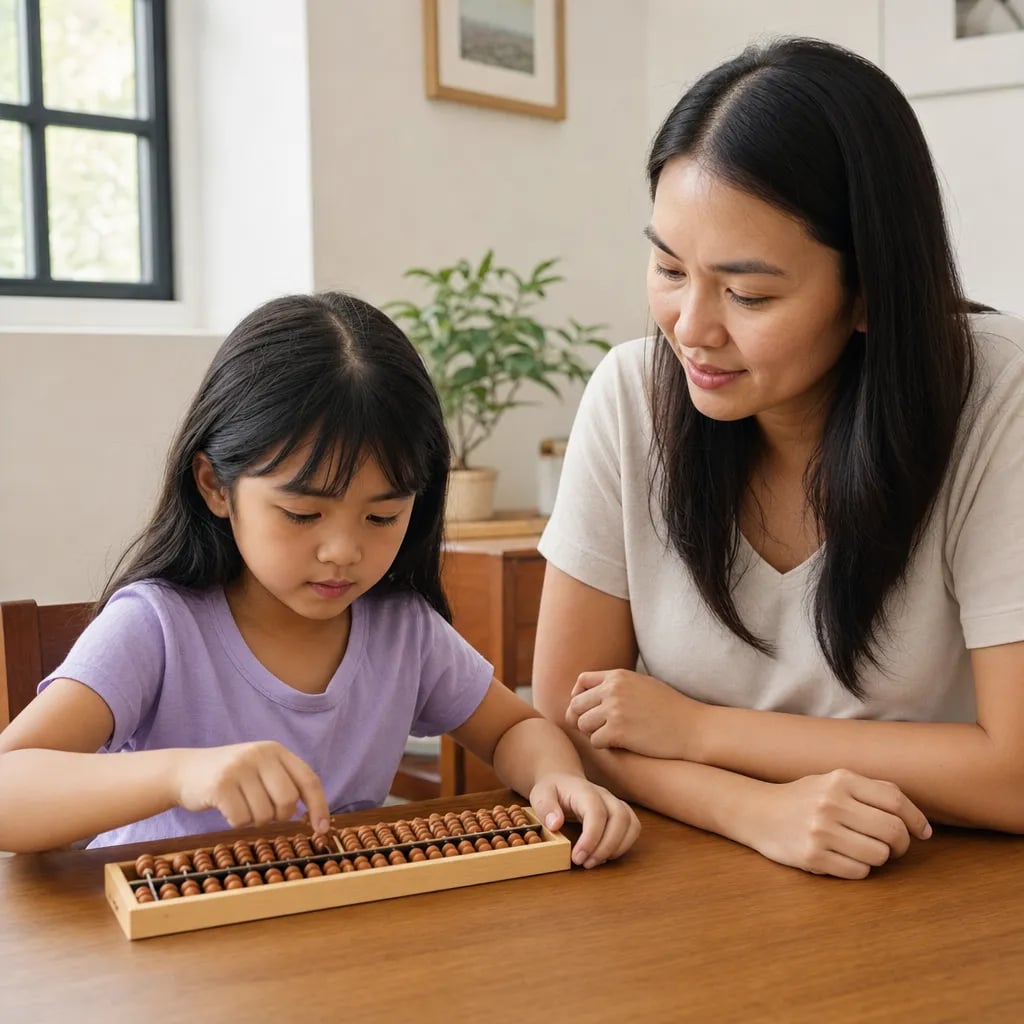
A mental arithmetic class in Malaysia teaches children aged about 4 to 12 to calculate on an abacus and then in their heads, usually in weekly group lessons at a centre. It builds speed with sums. It does not cover the rest of primary school maths, such as word problems, fractions or explaining an answer. If your child loses marks there, maths tuition or a live online class fits better.
A mental arithmetic class teaches a child to add, subtract, multiply and divide with an abacus, and later to picture the beads and calculate without one. In Malaysia you will see it sold as abacus, sempoa or mental arithmetic, by chains such as UCMAS and CMA and by many independent centres.
Courses run in levels. A child starts with the physical abacus and moves bead by bead through addition and subtraction. Later the teacher reads numbers aloud and the child works from a mental picture of the frame. Each level ends with a grading test, and many centres also enter children for competitions.
A 7-year-old a few levels in hears "35 plus 48 minus 19" and says 64 within seconds, with no paper.
What the class does not try to teach is the reasoning side of school maths. A child can be quick with beads and still freeze on a Year 2 word problem about change from RM 10, because that task asks which operation to use, not how fast to do it.
Start your child's tech journey
Book your free 60-minute trial class with an Algonova certified tutor. No payment, no obligation, just discover what your child can build.
Abacus fees in Malaysia are set by each centre, and neither UCMAS nor CMA publishes a national price list. In October 2026 we found only one public abacus figure, so the table puts it next to tuition rates from published guides. Treat every number as a starting range, not a quote.
| Option | What public sources show | Source, checked October 2026 |
|---|---|---|
| One UCMAS centre in Bukit Jalil, KL | fee range RM 200 to RM 500, period not stated; ages 4 to 12 | Kiddy123 listing |
| Tuition centre, small group of 5 to 10 | RM 150 to RM 300 per subject per month | Malaysia4u guide, August 2026 |
| Tuition centre, large group | RM 80 to RM 150 per subject per month | Malaysia4u guide |
| Home tutor, primary school | RM 45 to RM 50 per hour | GoLearn 2026 rate card |
The strongest evidence comes from a 3-year randomised trial with 204 children aged 5 to 7 at the start, published in the journal Child Development in 2016 by David Barner and colleagues. Children who learned mental abacus beat the comparison group on arithmetic tasks. The training did not change basic abilities such as working memory, and children who began with stronger spatial working memory learned the method best. You can read the abstract of the abacus trial on PubMed.
So abacus can make many children faster at sums. Claims that it "develops the whole brain" or lifts every subject go further than this trial found. If a centre makes such claims, ask which study they mean.
Abacus answers the question "how fast?". School maths keeps asking "which operation, and why?"
The best window for abacus is about 5 to 8, when a child is learning number facts anyway and enjoys moving up through levels. Most programmes take children from 4 or 5, and the UCMAS centre in the table above lists ages 4 to 12.
After 9 or 10 the case gets weaker. Year 4 to 6 maths moves into fractions, decimals, measurement and multi-step word problems, where speed with whole numbers helps less. An older beginner may spend a year on levels a 6-year-old clears, while the real gap sits somewhere else.
Take a Year 5 child who loses marks on fraction word problems. Abacus level 1 will not bring those marks back. A teacher who explains fractions step by step will, and so will steady work on
Look at where marks are lost, not at what classmates are signed up for. These 5 checks take one evening and your child's last school test.
Say a 7-year-old scores 14 out of 20 on a school maths test. If 5 of the 6 lost marks come from word problems, faster sums can win back 1 mark at most. The other 5 need someone who works through word problems with her. If you suspect the problem runs deeper, our guide to why a child is weak in maths lists the usual causes.
Yes, but rarely both at full load. A common pattern is abacus from 5 or 6 for a year or two, then a maths class from 8 or 9, when school topics get harder. Two full programmes at once often wear a young child out within a couple of months, and you pay twice.

Algonova worldwide
Contact us
Email: int_legal@alg.team
| Online group class |
| RM 60 to RM 200 per subject per month |
| Malaysia4u guide |
The monthly fee is rarely the whole bill. Ask each centre about the registration fee, the abacus kit, books for every new level, grading fees and competition entry.
Suppose a centre quotes RM 160 a month for one 2-hour lesson a week. Over 12 months that is RM 1,920, before the kit, books and grading fees. Ask for those extras in writing on your first visit. For the cost of a tutor who comes to your house, see our breakdown of home tuition rates per hour.
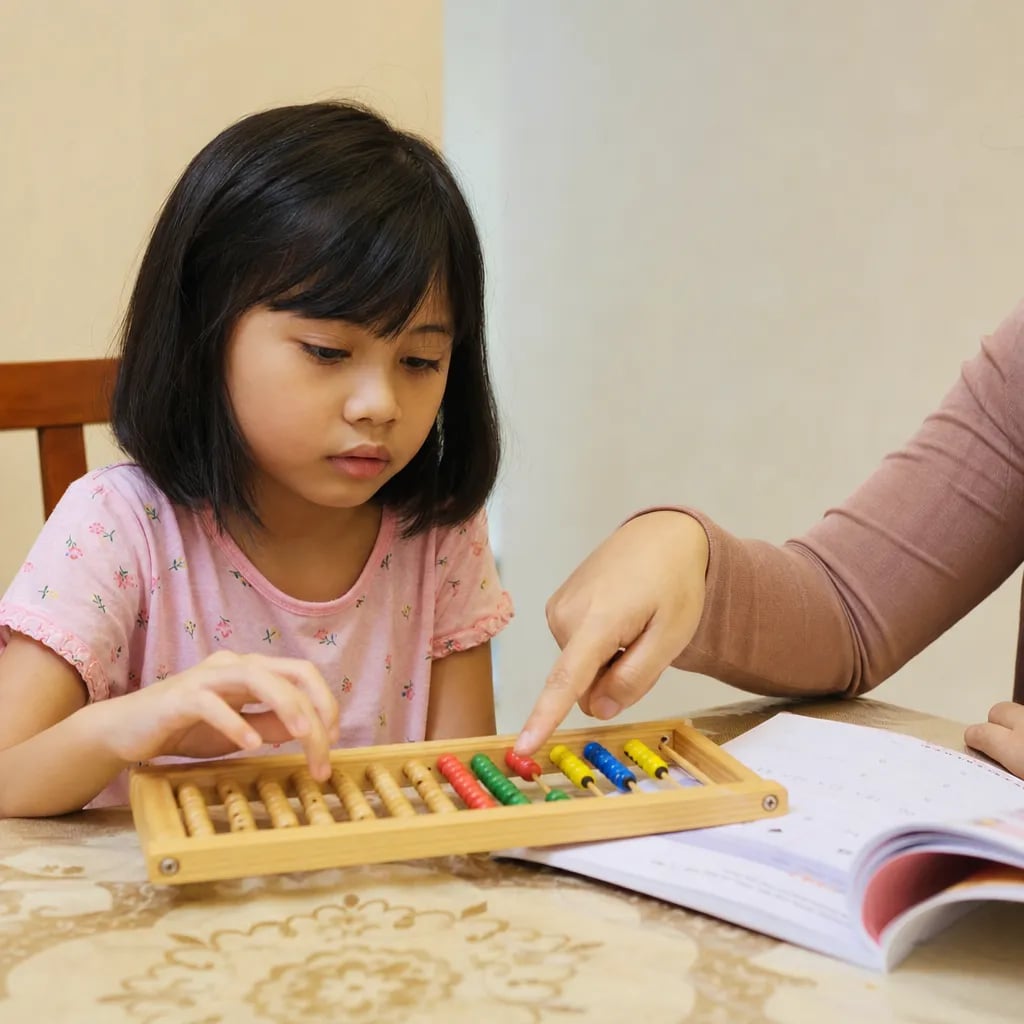
Abacus trains calculation speed. Maths tuition follows the school syllabus.
| Mental arithmetic (abacus) | Maths tuition, centre or home | Live online maths class | |
|---|---|---|---|
| Main goal | Speed and accuracy with sums | Keeping up with school topics | Understanding school topics and word problems |
| Typical start age | 4 to 7 | Any primary age, often when marks drop | 6 and up |
| Covers the KSSR syllabus | Arithmetic only | Yes | Yes |
| Teacher explains a new topic | No, drills one method | Yes | Yes |
| Travel | Centre visits | Centre, or tutor comes home | None |
| How progress is shown | Level gradings, competitions | School tests | Teacher reports, school tests |
Abacus centres also differ from each other in teacher experience, class size and how fast children move between levels. We compare the method with worksheet programmes in Kumon vs abacus in Malaysia, and with concept-first teaching in abacus vs Kumon vs conceptual maths.
If you already pay for abacus and it works, keep it, and add help only for the gap you can name. Whether that help should be a group or one-to-one is covered in group vs private tuition in Malaysia.
Algonova is an online school with more than 1,000,000 students in 97 countries. Its online maths classes for kids, Math Starters for ages 6 to 8, run live in groups of up to 10 and follow KSSR topics. The first step is a free trial maths class, a diagnostic of about 60 minutes that shows which gaps from earlier years hold your child back.
There is no single price, because each abacus centre sets its own fees and most do not publish them. The one public figure we found in October 2026 is a Kiddy123 listing for a UCMAS centre in Bukit Jalil, Kuala Lumpur, with a fee range of RM 200 to RM 500 that does not say which period it covers. So the only reliable way is to ask the centre near you for its monthly fee. When you get a quote, multiply it by 12 to see the yearly cost. Then add the registration fee, the abacus kit, books for each level and grading fees, which many centres charge separately. Ask for all of these in writing before you enrol, and compare the yearly total across two or three centres, not only the monthly fee.
Most children start abacus between 5 and 7, and many centres accept children from age 4. At that age a child is learning number facts anyway, and moving up through coloured levels feels like a game. The 2016 randomised trial on mental abacus also started with children aged 5 to 7. After 9 or 10 the benefit shrinks, because school maths turns to fractions, decimals and word problems, where raw speed matters less. An older child can still learn the method, but it will not fix gaps in understanding. If your child is already in Year 4 or above and struggling, check which topics cause the trouble before you choose abacus. A short diagnostic or a careful look at the last school test usually shows whether the issue is speed or understanding.
Neither is better for every child, because both teach the same core method: abacus first, then calculation from a mental picture of it. The difference that matters to your child is the individual centre. Compare the teacher's experience, the number of children in a class, how often levels and gradings happen, and the total yearly cost including books and fees. Visit two centres and sit in on a lesson if they allow it. Watch whether the teacher corrects each child, or only the fastest ones. Ask what happens if your child stays on one level for months. The brand tells you the method. What your child gets each week depends on the teacher and the class size. A centre that welcomes these questions is usually a safer choice than one that only talks about competitions.
Abacus helps with the calculation part of school maths, and much less with the rest. A child who trains for a year or two usually adds and subtracts faster and makes fewer slips. The 2016 randomised trial in Child Development found better arithmetic scores for abacus learners than for children given ordinary extra maths. KSSR primary maths, though, also asks children to read word problems, choose an operation, work with fractions and measurement, and explain their answer. Abacus training does not cover these. So it can lift marks for a child whose mistakes are mostly calculation slips. It will not do much for a child who reads a question and does not know where to start. Check which kind of mistake your child makes most before you decide what to pay for.
Yes, in everyday use they mean the same thing. Sempoa is the Malay word for the abacus, and in Malaysia "kelas sempoa" usually refers to a mental arithmetic class built on it. The tool most centres use is a frame with one bead above the bar and four below in each column. Children first calculate by moving beads, then learn to picture the frame and calculate in their heads, which is the "mental arithmetic" part. Some centres teach in English, some in Bahasa Malaysia or Chinese, so ask which language your child will hear. The name on the signboard matters less than the method and the teacher. If a centre calls its course brain training, ask what exactly the lessons cover, and you will usually hear the same steps: bead work, then mental calculation.
Yes, some providers teach abacus online, with the child using a physical abacus at home while the teacher watches on camera. It saves travel, which matters if the nearest centre is 30 minutes away in traffic. The limit is supervision: in a large online group the teacher cannot always see every hand on the beads, and young children aged 4 or 5 often need a parent beside them. Ask how many children join each online lesson and how the teacher checks bead work. If your real goal is school maths rather than speed, an online maths class is the more direct route, because the teacher explains topics and word problems instead of drilling one method. Try one lesson first and see whether your child stays focused for the whole session at home.
The choice depends on what you want to fix. Abacus trains speed with arithmetic through bead work and mental calculation, and suits children of about 5 to 8 who enjoy levels and drills. Kumon uses daily worksheets that run from counting far into secondary school topics, and needs a family that can keep a short routine every day. Neither method has a teacher explain a topic your child has never met, so a child who is lost in a new topic may still stall. If your child is slow but understands, either can help. If your child does not understand the topic itself, a class with a live teacher is the better fit. Our blog has a separate side by side comparison of Kumon and abacus in Malaysia if you want the details.
Maths tuition is the better choice when your child loses marks because they do not understand a topic, not because they count slowly. Typical signs are blank answers on word problems, mistakes with fractions or time, and the phrase "I don't know what to do". These problems need a teacher who explains, asks questions and changes the approach, which an abacus class is not designed to do. Tuition also suits older primary children from about Year 4, when the syllabus turns more abstract. A tuition centre in a small group costs about RM 150 to RM 300 per subject a month according to Malaysia4u's 2026 guide. An online group class costs about RM 60 to RM 200. Start with a diagnostic so you pay for the gap your child really has.
Visit us
Suite 8634, 1021 E Lincolnway, Cheyenne, WY, Laramie, US, 82001
Algonova online LLC International tech school for kids and teens