Best Drawing Apps for Kids in Malaysia (Free, Phone and Tablet)

Learn Design9 min read
Which Is Better?

Arjun Menon
Education Analyst, Algonova Malaysia
Abacus programmes train calculation speed, while Kumon trains procedural fluency across a much wider syllabus. Neither is built to teach a topic your child has not understood yet. In Malaysia the abacus side of the market is dominated by chains such as UCMAS and SIP Abacus, and the choice between them and Kumon comes down to one question: is your child slow at arithmetic, or lost in the actual school syllabus? Those are different problems with different answers.
Algonova is an online school for maths, coding, AI, and design for children aged 5 to 17, with more than 1,000,000 students across 97 countries since 2016. Classes run live with certified teachers in small groups of up to 10 students, and the first trial class is free.
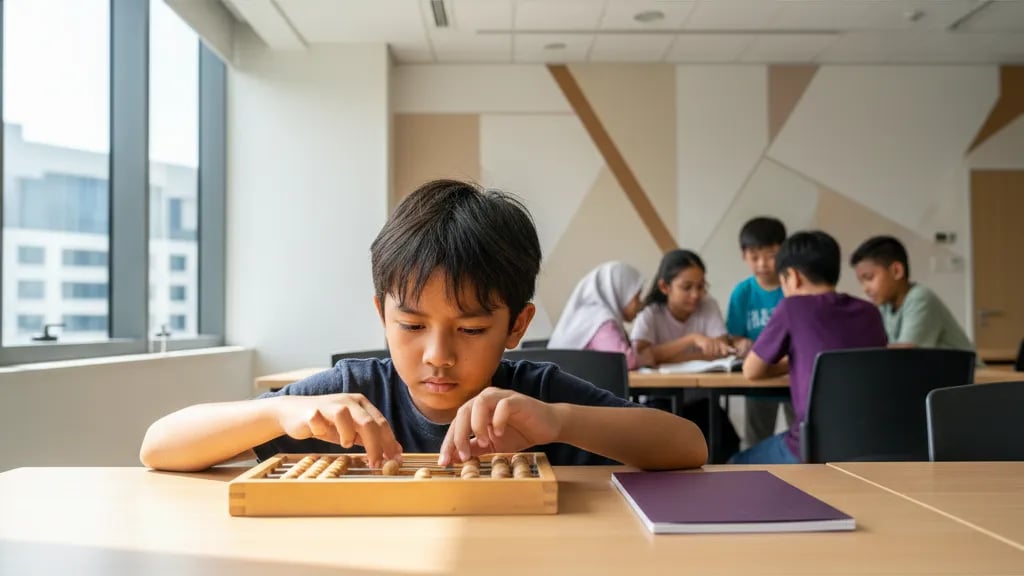
The abacus method teaches a child to manipulate beads, then to picture the abacus mentally and calculate without it.
The target skill is mental arithmetic speed on addition, subtraction, multiplication and division, together with the concentration that rapid drilling demands. Programmes are level-based, with gradings and often competitions, and children typically start between ages 5 and 7.
Kumon works differently. According to Kumon Malaysia, the maths programme runs from counting and basic arithmetic all the way through fractions, order of operations, negative numbers, equations, algebra, trigonometry and calculus, via short daily worksheets with two centre visits a week.
So the scope differs sharply. Abacus goes deep on speed within arithmetic. Kumon goes wide across the syllabus but stays inside the worksheet format.
Facts about both approaches checked against public provider materials in September 2026. Verify current programme details with the centre before enrolling.
Read the last row first, because that is where most parents are actually stuck.
| Aspect | Abacus (UCMAS, SIP Abacus) | Kumon | Live online class |
|---|---|---|---|
| Target skill | Mental arithmetic speed | Procedural fluency across the syllabus | Understanding and unblocking |
| Tool | Physical abacus, then mental image | Printed worksheets | Live lesson with a teacher |
| Syllabus width | Arithmetic only | Arithmetic through algebra and beyond | Follows school topics plus coding and AI |
| Typical start age | 5 to 7 | From 4 | From 5 |
| Word problems | Rarely the focus | Present, but worked alone | Discussed and unpacked live |
| Helps with school exams | Indirectly, via speed | Partly, if levels align | Directly, topic by topic |
| Fixes "I don't understand" | No | No | Yes |

The speed abacus produces is real and often impressive. A child two years into a programme can add long columns faster than most adults. What that speed does not automatically deliver is the ability to read a word problem, work out which operation the situation calls for, and justify the answer.
That gap matters because Malaysian school assessment increasingly asks children to explain reasoning, not only to produce a number. If your child's marks fall on word problems rather than on arithmetic, faster calculation will not move them.
Abacus works best for a younger child, roughly 5 to 8, who enjoys repetition and visible progress through levels.
The format rewards a child who likes drilling and gets satisfaction from beating their own time. The gradings and competitions give that child a reason to keep going, and the concentration training is a genuine side benefit for children who struggle to sit still.
It fits poorly for a child who already finds arithmetic easy and is bored by repetition, because there is little conceptual novelty to hold them. It also fits poorly for an older child, since starting an abacus programme at 11 or 12 rarely pays back the time.
Kumon suits a child whose gap is consistency rather than comprehension, and a family who can hold a daily routine.
Because it runs from early arithmetic up to advanced secondary topics, it can serve a child for years rather than a phase. The self-paced structure lets a strong child move beyond their school year, which the abacus route does not offer in the same way.
The honest weakness is the same as any worksheet method: on the day your child does not understand something, the page cannot rephrase itself. That is why families often report the first few months going well and then a stall on a genuinely new topic.
If you are weighing Kumon against the other workbook chain, we compare them directly in Kumon vs Eye Level Malaysia.
To see what a Kumon month actually costs and what it adds up to over a year, read our breakdown of Kumon fees per month in Malaysia. Families in the Klang Valley who want a live teacher instead usually start with our guide to math tuition in KL and PJ.
Answer from your child's last report card and last month at home, not from what you hope.

A useful rule of thumb: abacus for speed in the early years, worksheets for consistency, live classes for comprehension. Most children need the third one at some point, because school keeps introducing topics nobody has explained to them yet. You can see how that works on our online math classes for kids page.
It is also entirely reasonable to combine. Abacus at 6, live classes from 9 when the syllabus turns abstract, with short daily practice throughout. What rarely works is two full programmes at once, because most children tire of both within a couple of months.
Three questions separate providers faster than any brochure, whichever method you are looking at.
First, who explains a topic my child has not met before? Listen for a specific answer rather than a description of the materials. Second, how do you tell the difference between a child who is slow and a child who is lost? A good centre has a real answer to this. Third, what happens on the day my child cannot do the work at all?
Then watch the trial itself for three signals: does your child speak, does anyone correct them in the moment, and do they want to come back. A child silent for an hour is not learning, at a centre or on a screen.
For related reading, see Algonova vs SIP Abacus Malaysia, Algonova vs Kumon Malaysia, and why a child is weak in maths. On format, see online versus physical classes and online maths tuition in Malaysia.
It depends on which problem you are solving: abacus targets mental arithmetic speed, while Kumon targets procedural fluency across a much wider syllabus. If your child understands the methods but calculates slowly, abacus drilling addresses that directly. If your child needs to keep pace with school topics from fractions through algebra, Kumon's range covers far more ground. Neither explains a topic your child has not understood, because a bead frame and a worksheet cannot notice confusion and rephrase themselves. Details checked against public provider materials in September 2026.
It helps indirectly, through faster arithmetic and better concentration, but it does not cover the school syllabus. Abacus programmes work on addition, subtraction, multiplication and division. They generally do not teach fractions in context, geometry, measurement, word problems or algebra, which is where most Malaysian school marks are won and lost from Year 4 onwards. For example a child who can add long columns mentally may still be unable to decide whether a problem needs multiplication or division. So abacus is a speed tool rather than a syllabus tool, and it is best judged on that basis.
Most programmes start children between ages 5 and 7, and the method loses much of its value if started late. The reason is that bead manipulation and then mental visualisation take time to automate, typically a couple of years of regular practice. A child beginning at 11 or 12 often does not stay long enough to reach the payoff. For an older child whose arithmetic is slow, short daily practice on the specific operations is usually a faster route than a full abacus curriculum. If the older child's problem is understanding rather than speed, a live class addresses it more directly.
According to Kumon Malaysia, the maths programme runs from counting and number sequencing through addition, subtraction, multiplication, division, fractions, order of operations, positive and negative numbers, equations, graphs, algebra, trigonometry, logarithms, calculus, probability and statistics. That range is the main structural difference from abacus programmes, which stay within arithmetic. Delivery is by short daily worksheets, with two centre sessions a week and around five further assignments at home, each taking roughly 30 minutes. Placement is by assessment rather than school year, so a strong child can progress beyond their current level.
Neither drilling method addresses that directly, because the gap is reading and reasoning rather than calculation. A child who fails word problems typically grabs the numbers and calculates without first deciding what is being asked. More speed produces a faster wrong answer. A drill that helps: have your child cover the numbers and retell the problem in their own words before calculating. If they can describe the situation, choosing the operation becomes much easier. This is also the clearest case for a live class, because a teacher can hear the child's reasoning out loud and correct the thinking rather than the arithmetic.
It is possible but rarely advisable, because both demand daily practice and most children tire of the combination within a couple of months. Both methods rest on short repeated sessions at home. Stacking two such routines usually means one gets skipped, and the skipped one is the programme you keep paying for. A more workable sequence is one at a time: abacus in the early years for speed, then a syllabus-following option once school maths turns abstract around Year 4 or 5. If you want two things running together, pair one structured programme with short home practice rather than with a second programme.
Competition results show speed under pressure, which is a real skill, but they do not tell you whether school marks will improve. A child can place well in a mental arithmetic contest and still lose marks on a school paper full of word problems and reasoning questions. The two assess different things. A better progress check is whether your child now handles school arithmetic without hesitation and finishes papers within the time limit. If speed has improved but marks have not, the remaining gap is comprehension, and more drilling will not close it.
Abacus generally needs one to two years of regular practice to reach mental calculation, while worksheet fluency shows within weeks on topics already understood. That difference matters when choosing. If you need a change before the next school assessment, a two-year programme is the wrong instrument. For either method, two months of consistent attendance is enough to judge fit. Watch whether your child starts the work unprompted and can explain what they did. If the same error repeats in the same place after two months, the format is probably not addressing the actual gap.
Not directly. Both run their own level structures, and a child is placed by assessment rather than by school year. For a strong child that is an advantage, since self-paced progression allows work beyond the current year. For a child who needs help with next month's test it can be a mismatch, because the programme sequence may not follow what the class is covering. Ask any provider directly how they handle KSSR topics and school assessment timing before enrolling. Live classes that follow school topics are usually the closer fit when exam alignment is the priority.
Take that seriously, because a method a child resists daily rarely survives long enough to work. Both abacus and worksheet programmes depend on willing repetition. A child who has to be argued into it every afternoon usually stops progressing, and the family stops enjoying the evenings. For those children, project-based formats often hold attention better: coding, design, or maths taught through problems with a visible result rather than through volume. The practical test is a trial session in a different format, then comparing whether your child asks to go back.
Start your child's tech journey
Book your free 60-minute trial class with an Algonova certified tutor. No payment, no obligation, just discover what your child can build.

Algonova worldwide
Contact us
Email: int_legal@alg.team
Visit us
Suite 8634, 1021 E Lincolnway, Cheyenne, WY, Laramie, US, 82001
Algonova online LLC International tech school for kids and teens