AI and homework: where help ends and cheating starts

Course Guides7 min read
Math Education
Nurul Izzati
Math Education Specialist at Algonova Malaysia
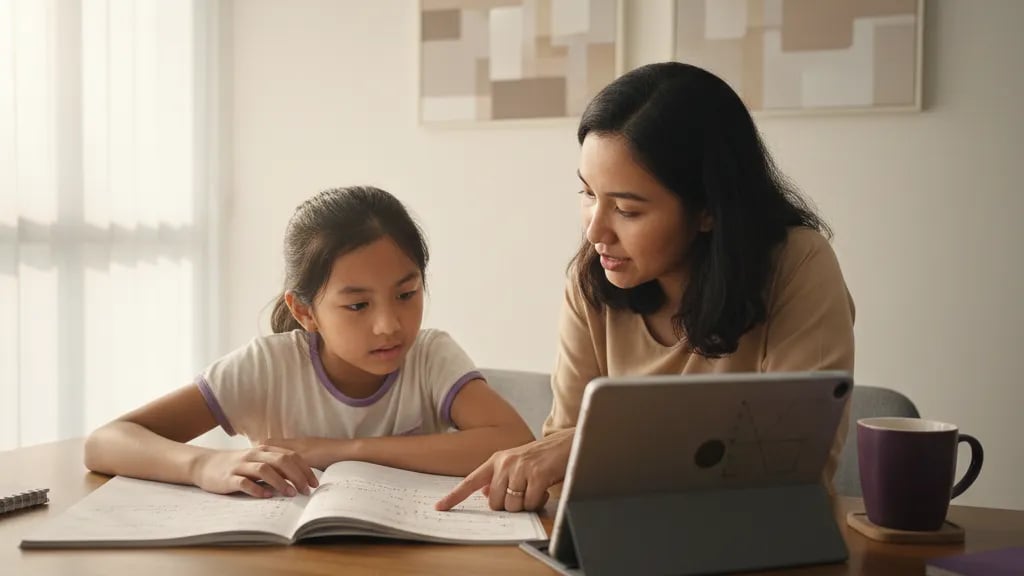
An AI math tutor for kids can help a Malaysian primary pupil practise more and get feedback faster, but it works best next to a human teacher, not instead of one. For children aged 7-12, short sessions of 15-20 minutes a few times a week, checked by a parent, are a sensible start. UNESCO also suggests 13 as the minimum age for using generative AI chat tools in class.
Algonova is an online school of coding, maths, AI and design for children aged 5-17, with more than 1,000,000 students in 97 countries. Lessons run live with a teacher in groups of up to 10, and parents rate the school 4.9 out of 5. In Malaysia, our maths classes for Darjah 1-2 follow KSSR topics and start with a free 60-minute diagnostic, while older children build the same reasoning in our coding and AI courses.
"AI math tutor" is a label for three quite different kinds of tools, and each one helps a child in a different way. Parents in Malaysia usually meet all three within a year of their child starting Darjah 3 or 4.
| Type of tool | What it does | Where it helps | The main risk |
|---|---|---|---|
| Photo solvers (Photomath and similar) | Reads a photo of a sum and shows the worked steps | Checking homework after the child has tried | The child copies the steps without thinking |
| Chat tutors built on large language models | Answers questions in conversation, explains in other words | "Explain it another way" moments | Confident answers that are sometimes wrong |
| Adaptive practice apps | Picks the next question based on earlier mistakes | Drilling sifir, number bonds, fractions | Practises what the child can already do |
None of them knows your child. They only see what the child types or photographs. That limit matters more than any feature list.
AI tools are good at the repetitive part of maths: instant marking, endless fresh questions and patient re-explaining. For a Darjah 4 pupil practising multiplication or equivalent fractions, that is useful.
A teacher in a class of 30 cannot mark every attempt the moment it happens. An app can. The child sees right away that 3/4 and 6/8 are equal, or that 7 x 8 is 56 and not 54, while the mistake is still fresh.
AI also never gets tired of the same question. A child who is embarrassed to ask a teacher "why" for the third time will often ask a chatbot. For some quiet children that is the first time they ask at all.
Adaptive apps are strongest for fluency: times tables, mental addition, simple conversions between ringgit and sen. If your child needs speed on facts they already understand, a 15-minute daily app session can work well. Our guide to why a child is weak in math explains how to tell a fluency gap from an understanding gap.
An AI tool can tell a child that 3/4 is not 3/8. It takes a teacher to notice that the child never really understood what the bottom number means.
Nurul Izzati · Math Education Specialist at Algonova Malaysia
The biggest problem is that an AI tutor sees the wrong answer but rarely sees why the child got it wrong. A child who keeps failing fractions in Darjah 4 often has a place value gap from Darjah 2. An app will keep serving fraction questions; a teacher will go back two years.
Other problems to watch for:
Child in Darjah 1-2 and not sure why they are stuck? A free 60-minute maths diagnostic maps the gaps and gives you a written plan.
The rule that works best is simple: the child tries on paper first, and the AI only checks or gives a hint. Here is a routine many families can run in 15-20 minutes:
Good prompts make a big difference. Teach your child to type "Give me a hint, not the answer" or "Explain this with an example from shopping". Our guide to prompt writing for kids has more examples, and which AI tools are safe for kids lists settings to check first.

The habit I want children to build is simple: try it yourself, then ask the machine. When that order flips, the learning stops.
Nurul Izzati · Math Education Specialist at Algonova Malaysia
For most primary pupils the answer is both: a teacher for understanding and AI for practice. The table shows where each one fits.
| Situation | Better choice |
|---|---|
| Needs speed on sifir 1-12 they already understand | Adaptive app, 15 minutes a day |
| Keeps failing one topic for weeks | Teacher who can trace the gap back |
| Revising for UASA | Teacher-set revision plus AI checking |
| Lost confidence and avoids maths | Live teacher first, apps later |
| Curious about how AI itself works (age 10+) | A structured AI course |
Malaysia is also moving AI into school. Under Kurikulum Persekolahan 2027, the Ministry of Education plans to teach AI basics in primary school through a new technology and digital subject, starting with Year 1 in 2027. Children who learn to question an AI answer now will be ahead of that change. For ages 10-14, our AI classes for kids teach how these tools work from the inside, and a free coding masterclass is an easy first step.
For a closer look at the trade-offs, read worksheets vs live classes for maths.
An AI math tutor can help primary pupils practise and get instant feedback, but it should support a teacher or parent rather than replace them. Apps are good at marking answers and giving fresh questions. They are weaker at finding why a child keeps making the same mistake. For example, a Darjah 4 pupil who keeps failing fractions may really have a place value gap from Darjah 2, and most apps will not trace it back. A typical case: a child scores 10 out of 10 in a fractions app every evening, then loses marks on the same topic at school because the word problems look different. Use AI for short practice sessions of 15-20 minutes and keep a human involved in checking progress every week.
Simple adaptive maths apps with fixed questions are fine from around age 7, while open chat tools such as ChatGPT are designed for users aged 13 and above. The difference is control. A practice app only shows maths questions. A general chatbot can answer anything, and its terms require users to be at least 13, with parental permission under 18. UNESCO's guidance on generative AI in education also proposes 13 as a minimum age for classroom use. For a 7- or 8-year-old, choose an app with a parent dashboard and no open chat box, so you can see exactly which questions were answered and how long each one took. If a younger child uses a chatbot for homework, sit next to them and type together.
Yes. Chat tools built on large language models usually solve primary maths correctly, but they can still make arithmetic slips and present a wrong answer with full confidence. These tools predict likely text rather than calculate like a calculator. A 9-year-old has no way to tell a confident wrong answer from a right one. That is why the order matters: the child solves on paper first, then uses the AI to check, and any disagreement goes to an adult or teacher. A simple test at home: ask the chatbot to add a long list of prices, then check the total with a calculator together. Children remember a caught mistake far longer than a warning. Treat a chatbot answer as a second opinion, not the final word.
It can, if the child photographs the question before trying it. Used after an honest attempt, a photo solver is a useful checking tool. The risk is a habit of skipping the thinking step. A common warning sign: homework becomes perfect while test scores stay flat. That usually means the app is doing the work. A simple fix is a house rule: no device until five questions are done on paper. Some families keep the photo solver on the parent's phone only, which turns it into a checking tool by default instead of a shortcut. Look at the exercise book, not only the answers. Crossed-out working is a good sign that your child is still thinking.
For children aged 7-12, about 15-20 minutes a day is enough for practice and fact fluency. Longer sessions tend to turn into tapping through questions. Short sessions keep attention high and leave time for paper practice and play. A good pattern is three or four sessions a week, each with a clear goal, such as sifir 7 or equivalent fractions. Our article on screen time limits by age gives broader guidance for the whole day. A child who practises sifir 7 for 15 minutes on four evenings usually remembers more than one who does an hour on Sunday. If your child needs more than 30 minutes daily to keep up, the problem is usually understanding, not practice.
Most global AI maths apps follow general primary topics that overlap with KSSR, but few are built around the Malaysian syllabus, its sequence or its Bahasa Melayu terms. Topics like fractions, decimals, money and measurement appear everywhere, so practice still helps. The gaps show up in wording. A child who learns "equivalent fractions" in English may freeze at "pecahan setara" in a UASA paper. Check that the app lets you choose topics by year or skill, and practise key Malay terms separately. One practical step is a short list of ten key KSSR terms on a card next to the desk, with the English and Malay versions side by side. A teacher who knows KSSR can bridge the two languages quickly.
Many AI apps cost less than weekly tuition, and some are free, but a lower price only helps if the child actually improves. Compare what each option gives. An app gives unlimited practice. A teacher gives a diagnosis, explanation and accountability. For a child who already understands the topic, an app may be enough. For a child who is behind or anxious, a teacher usually saves months of frustration. Think about cost per result. If an app keeps your child busy for a term but the school report does not change, it was not the cheaper option. Many families combine both: a small number of live lessons for understanding and an app for daily practice between them.
Your child probably needs a teacher if the same mistake repeats for more than two weeks, if they avoid maths entirely, or if school marks fall while app scores look fine. These signs point to a gap in understanding, which apps rarely detect. A short diagnostic can show which earlier topic is missing. At Algonova, children aged 6-8 can take a free 60-minute online diagnostic that ends with a written report listing the gaps and a plan to close them. Older children often strengthen the same reasoning through coding. Other signs include tears or arguments at homework time, and a child who can recite steps but cannot explain why they work. Starting with a diagnosis is faster than trying a third or fourth app.
AI can help with UASA revision by checking answers and generating extra practice, but the revision plan itself should come from a teacher or past papers. UASA questions test reasoning and word problems, not only calculation. A good routine is to work through past-year style questions on paper, then use AI to check the working and explain mistakes. Ask the AI for a hint first, so your child still does the thinking. Our guides to UASA Matematik for Tahun 4, 5 and 6 include sample questions. For example, after a timed practice paper, the child can photograph only the questions marked wrong and ask the AI to explain the first step. Two or three focused sessions a week usually beat cramming the week before.
Yes, from around age 10 learning how AI works is a strong next step, because it teaches children to question answers instead of trusting them. Malaysia's Kurikulum Persekolahan 2027 plans to introduce AI basics in primary school, starting with Year 1 in 2027. Children who already understand that AI predicts patterns, makes mistakes and needs good instructions will use it more wisely. At Algonova, the AI course for ages 10-14 has children build small AI projects with a live teacher. For example, a child can train a simple model to sort pictures of cats and dogs and then see why it fails on a cartoon cat. That one lesson teaches more caution than any warning. A free 60-minute masterclass is an easy way to see if your child enjoys it.
Start your child's tech journey
Book your free 60-minute trial class with an Algonova certified tutor. No payment, no obligation, just discover what your child can build.

Algonova worldwide
Contact us
Email: int_legal@alg.team
Visit us
Suite 8634, 1021 E Lincolnway, Cheyenne, WY, Laramie, US, 82001
Algonova online LLC International tech school for kids and teens