
Abacus vs Kumon vs Conceptual Math: Which Is Right for Your Child?
Which Is Better?6 min read
Checklists & Calendar

Nurul Izzati
Math Curriculum Team, Algonova Malaysia
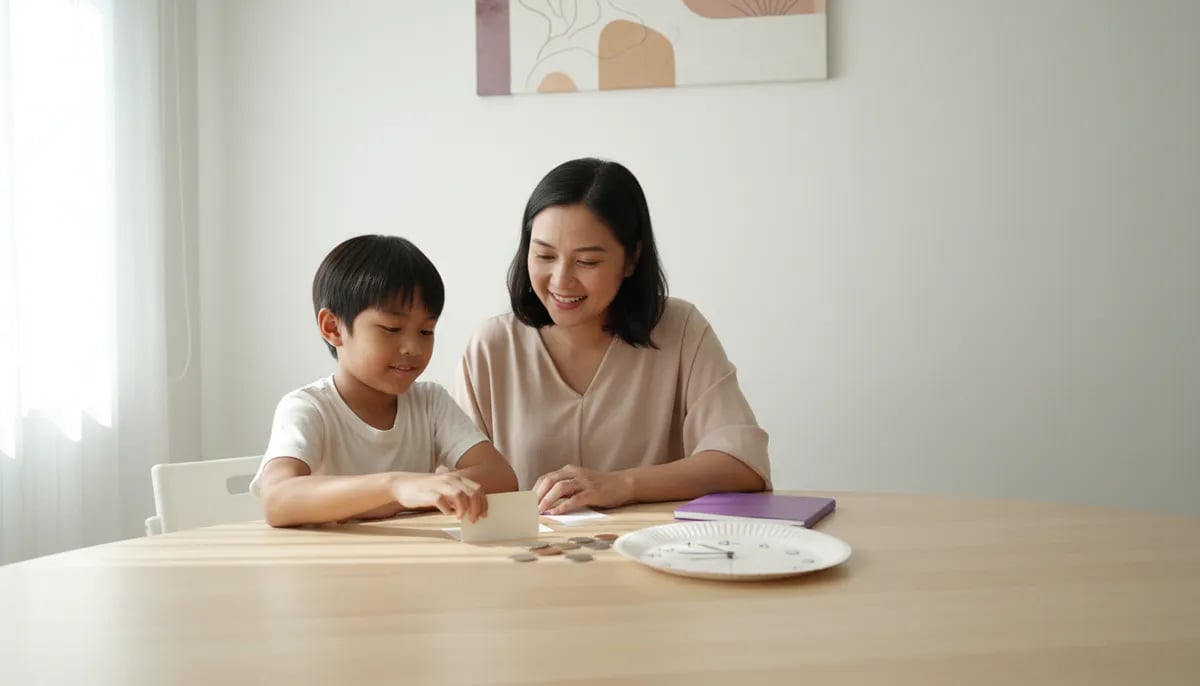
A December school holiday maths plan for Year 1 and 2 needs only 15 minutes a day on 16 days, Monday to Thursday from 7 to 31 December 2026, which adds up to 4 hours. Start with a 6-question check on 7 December, spend the middle weeks on the weak spot, and repeat the same check on 31 December. Families in Group A and Group B states follow the same dates.
Sixteen. The year-end holiday runs from 5 to 31 December 2026 for Group B states and from 4 to 31 December for Group A (Kedah, Kelantan and Terengganu), according to the Ministry of Education's Kalendar Akademik 2026 (Surat Siaran KPM Bil. 3 Tahun 2025). Count only Monday to Thursday from 7 December and you get 4 weeks of 4 days.
| Group A | Group B | |
|---|---|---|
| Last school day | 3 December | 4 December |
| Holiday | 4 to 31 December | 5 to 31 December |
| Maths days, Monday to Thursday, 7 to 31 December | 16 | 16 |
Fridays and weekends stay free, and so does Christmas Day on Friday 25 December. School reopens on 4 January 2027. All 2026 breaks are on our school holidays 2026 Malaysia page.
This article is the calendar and the check. For the games themselves, week by week, use our school holiday maths activities for Year 1 and 2.
A child finishing Year 1 should work with numbers to 100, and a child finishing Year 2 with numbers to 1,000 plus the first times tables. The table follows our Darjah 1 and 2 KSSR guide.
| Area | Finishing Year 1, ready for Year 2 | Finishing Year 2, ready for Year 3 |
|---|---|---|
| Numbers | Numbers to 100, tens and ones | Numbers to 1,000, hundreds, tens and ones |
| Add and subtract | Within 100, knowing that 6 + 4 = 10 means 10 - 4 = 6 | With regrouping, such as 38 + 47 |
| Times tables | Not needed yet | 2, 5 and 10 as equal groups |
| Money | Coins and notes, 100 sen = RM1 | Add and subtract RM and sen, give change |
| Time | Hour and half hour | 5-minute steps |
Year 3 goes up to 10,000 and adds the 6 to 9 times tables on top of the 2, 3, 4, 5 and 10, as our Year 3 and 4 guide explains. A shaky tens digit in December makes Year 3 slow in January.
KPM's new KP2027 curriculum starts in 2027 with the new Year 1 intake, so children moving up to Year 2 or Year 3 are not in that first group (KP2027 rollout).
The check has 6 questions. Sit beside your child, give no hints and write down where they pause.
Year 1 check
Year 2 check
Answers for Year 1: 62 to 55 counted backwards, 74 because 7 tens beat 4 tens, 14 and 8, 4 and 7, 40 sen, hour hand between 4 and 5, minute hand on 6. Answers for Year 2: 700 and 695, 85 and 47, 20, 70 and 4, 580 because 8 tens beat 0 tens, RM1.10, 3:35.
A check you repeat with the same questions shows progress. A new worksheet only shows effort.
Check on the first Monday, repeat the same check on the last Thursday, and give the 14 days in between one small skill a day. Dates follow the 2026 calendar.
| Date | Year 1 | Year 2 |
|---|---|---|
| Mon 7 Dec | Check 1, 6 questions | Check 1, 6 questions |
| Tue 8 Dec | Count to 100 in tens, then back from 63 | Read 3-digit numbers off receipts |
| Wed 9 Dec | Compare two numbers by the tens digit | Compare 508 and 580 with digit cards |
| Thu 10 Dec | Skip count by 2s and by 10s | Skip count by 2s, 5s and 10s |
| Mon 14 Dec | Make 10 in five ways | Add with regrouping: 38 + 47 |
| Tue 15 Dec | Add within 20 without fingers | Subtract with regrouping: 82 - 35 |
| Wed 16 Dec | Subtract within 20: 15 - 7 | Say the 2, 5 and 10 tables out loud |
| Thu 17 Dec | Story sums: 12 stickers, give away 5 | Share 12 into 3 equal groups |
| Mon 21 Dec | Name each coin, make RM1 from sen | Add two prices: RM2.30 + RM1.60 |
| Tue 22 Dec | Change from RM1 for a 60 sen sweet | Change from RM5 for two items |
| Wed 23 Dec | Hour and half hour on a paper clock | Paper clock in 5-minute steps |
| Thu 24 Dec | Draw 5 events of the day with times | Time between 2:10 and 2:50 |
| Mon 28 Dec | Weakest area from check 1, new numbers | Weakest area from check 1, new numbers |
| Tue 29 Dec | Same area, one harder question | Same area, one harder question |
| Wed 30 Dec | Same area, explain aloud to a parent | Same area, explain aloud to a parent |
| Thu 31 Dec | Check 2, the same 6 questions | Check 2, the same 6 questions |
Stop at 15 minutes by the clock, even if your child wants more.
Sofea, 8, is a made-up but typical Year 2 child, and her two checks show what 15 minutes a day can change. On Monday 7 December she scores 3 out of 6. She misses 38 + 47, 82 - 35 and the change from RM5.
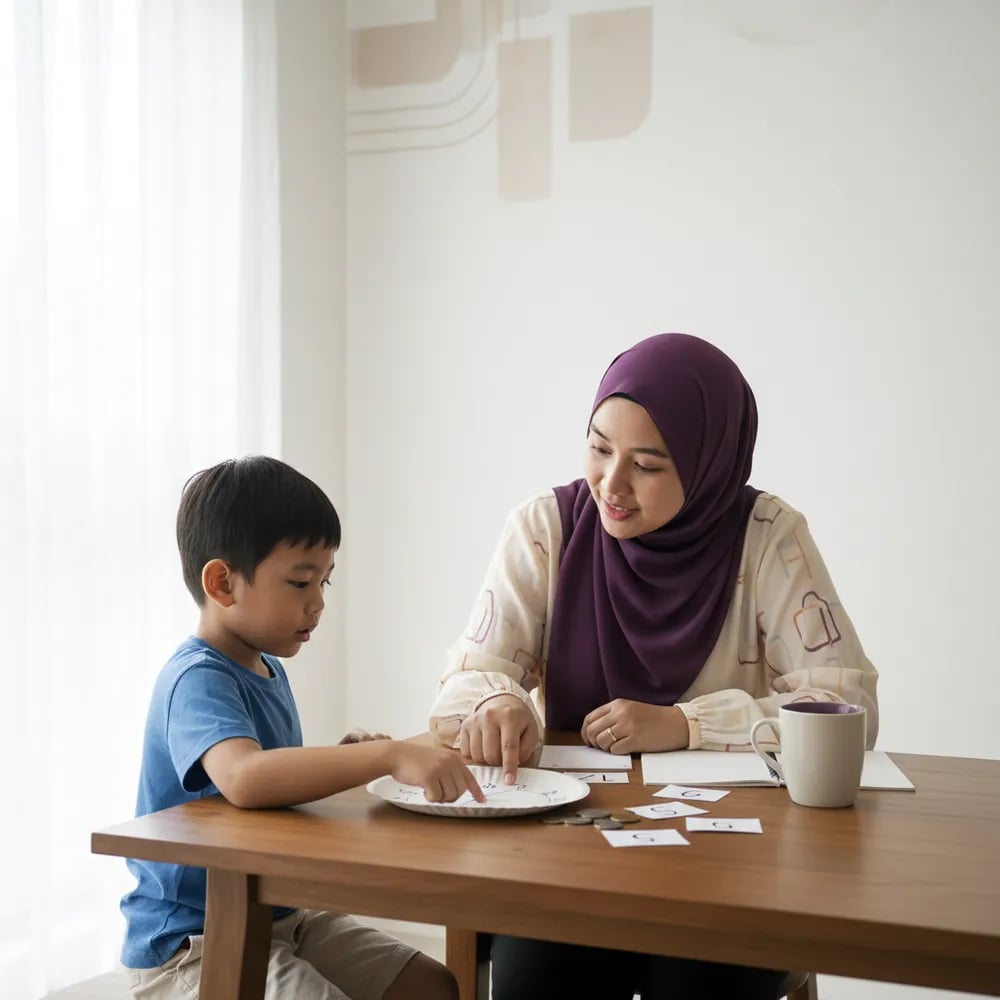
Her parent sees one pattern: regrouping. On 14 and 15 December Sofea practises exactly that. She splits 47 into 2 and 45, so 38 + 2 = 40 and 40 + 45 = 85. For 82 - 35 she takes away 30 first (82 - 30 = 52) and then 5 (52 - 5 = 47).
On 28 to 30 December she repeats regrouping with new numbers and explains each step aloud. On Thursday 31 December she scores 5 out of 6. The one miss is the clock question, saved for January.
Total effort: 16 days x 15 minutes = 240 minutes. The 3 and the 5 side by side show the holiday helped.
A score of 5 or 6 out of 6 means your child is ready, 3 or 4 means one area is shaky, and 2 or less means it is time for expert eyes.
| Score | What it usually means | Next step |
|---|---|---|
| 5 or 6 of 6 | The basics for the next year are in place | Rest. Revisit the one missed question in January |
| 3 or 4 of 6 | One area is shaky, often place value or regrouping | Repeat that area for 2 more weeks, 10 minutes a day |
| 0 to 2 of 6, or tears | A gap from earlier, or maths worry | Pause the worksheets and book a diagnostic |
Your child's school gives a mastery level from TP1 to TP6 for each topic. Our guide to what TP2 means in maths shows how to read it next to your own check. A child who freezes at every subtraction question needs a calm restart first, and our maths anxiety guide has the steps. For a younger child, see how to teach maths to a 6 year old.
Book the diagnostic when check 2 is below 4 out of 6, when the same mistake comes back after two weeks, or when your child avoids maths altogether. Home practice keeps skills warm, but it cannot tell you why a child keeps missing the same question.
Algonova's free maths diagnostic is for ages 6 to 8 (Darjah 1 and 2). It takes about 60 minutes online with a live teacher, and you get a written report on which topics to fix first. Lessons run in groups of up to 10 children. Our guide to helping a child catch up in maths shows how long a gap usually takes to close.
If your child enjoys building things more than sums, the free coding master class on our coding page is a separate option.
No. Both groups start the plan on Monday 7 December 2026 and finish on Thursday 31 December, so the table works unchanged. Group A schools close on 3 December and Group B schools on 4 December, per the KPM Kalendar Akademik 2026, which gives Group A one more rest day before the first maths day. Treat those days as rest and leave the first maths session for Monday, so the habit starts the same way in every state. Private and international schools often follow their own calendar, so check your school's dates before you print the table. If your holiday is shorter, drop the middle weeks and keep what matters most: check 1 at the start, check 2 at the end, and at least four days on the weak area in between. The check pair is the part that shows whether the holiday helped, and it takes about 15 minutes each time.
Yes. For a 6 or 7 year old, 15 minutes with real objects is a full session, and 4 days a week gives 240 minutes across the holiday. Young children lose focus fast, and a tired child starts guessing. Stop when the timer ends, even if your child asks for more, so the next day starts with interest and not dread. If a day goes wrong, skip it and carry on on Thursday without catching up. Most Year 1 gaps are small ones, such as place value or subtraction within 20. A few repeated minutes close those better than one long Sunday session. If 15 minutes feels too long, split it into two blocks of 7 or 8 minutes, one in the morning and one after dinner. The two checks can take a little longer, so give them a quiet half hour.
No. Spend the holiday on making Year 1 skills solid, such as tens and ones, adding within 100 and change from RM1. Year 2 will introduce numbers to 1,000, regrouping and the first times tables in class, with a teacher who knows the order of the lessons. A child who meets those topics early at home often learns a shortcut instead of the idea. The risk is confusion: a child can recite 38 + 15 = 53 without knowing why. The readiness table above shows what the school expects, so use it as a ceiling. Anything above it can wait for the school term, when the teacher can explain it in order. If your child finishes everything quickly, ask them to explain how they solved a problem, which is harder than solving it.
A Year 2 child should understand the 2, 5 and 10 times tables as equal groups, and recall of those facts should be getting quicker. According to our Year 3 and 4 guide, Year 3 adds the 6, 7, 8 and 9 tables on top of the 2, 3, 4, 5 and 10. So the real preparation is meaning first: 4 groups of 5 is 20, and 12 shared between 3 is 4 each. Use three or four minutes of the 15 on a spoken table, for example on Wednesday 16 December, then move to a story question. Avoid drilling the 6 to 9 tables in December. Children who arrive with the idea of equal groups learn those tables faster in school. If recall of 2, 5 and 10 is slow, give that area two extra days in the last week.
A score of 2 out of 6 on 7 December tells you where to start. Do not repeat the questions or start extra worksheets. Look at which questions were missed: if all four are about the same area, such as regrouping or money, that area becomes your plan for the whole holiday. Start from an easier version of the same skill, for example 18 + 5 before 38 + 47, and move up only when your child explains the step aloud. Keep the 15-minute limit. If a second check on 31 December still shows 2 or 3 correct, or your child cries or refuses, book a diagnostic. A teacher can then separate a small gap from a bigger one, and the written report names the topics in the order to fix them. A single low score on one morning, with a tired child, is not enough to decide anything.
No. You need paper, a pencil, a few coins, a paper clock made from a plate and the two checks printed or copied by hand. The plan uses real objects and spoken questions because a 6 to 8 year old understands them faster than a worksheet. A workbook is fine if your child enjoys one, but limit it to a single page after the daily 15 minutes. Skip apps in December: the plan asks your child to explain the answer in their own words, and a screen rewards the right tap. For game ideas without screens, see our article on maths activities at home, and use the plan only as the calendar around them. Keep the answers sheet away from your child during the check, and write down where your child paused.
KPM has said KP2027 starts in 2027 with the new Year 1 intake and Form 1, so a child moving up to Year 2 or Year 3 is not in the first KP2027 group. Our KP2027 article reports that KPM had not yet published a parent-facing list of Year 1 maths topics under the new curriculum when we checked on 25 October 2026. Until the ministry publishes more, the KSSR topics in the readiness table are the best guide for a child who is already in school. Ask your child's class teacher if the school plans any change for 2027, and check the TP levels on the next report. For a younger sibling who starts Year 1 in January 2027, the KP2027 Year 1 maths article covers what is known so far and how to prepare.
It is a free online session of about 60 minutes with a live teacher, built for children aged 6 to 8 (Darjah 1 and 2). The teacher checks your child's real level against KSSR topics such as numbers, adding and subtracting, money and time, and you get a written report afterwards that names the gaps and suggests where to start. There is no obligation to sign up for lessons. If you do, classes are live and run in groups of up to 10 children, with the same maths teacher through the year. Algonova teaches more than 1,000,000 students in 97 countries. The diagnostic does not replace the home check: the check shows where your child stands, and the diagnostic explains why. Bring the two check sheets from 7 and 31 December to the session if you have them, because the teacher can use your notes on where your child paused.
Blog
Start your child's tech journey
Book your free 60-minute trial class with an Algonova certified tutor. No payment, no obligation, just discover what your child can build.

Algonova worldwide
Contact us
Email: int_legal@alg.team
Visit us
Suite 8634, 1021 E Lincolnway, Cheyenne, WY, Laramie, US, 82001
Algonova online LLC International tech school for kids and teens

