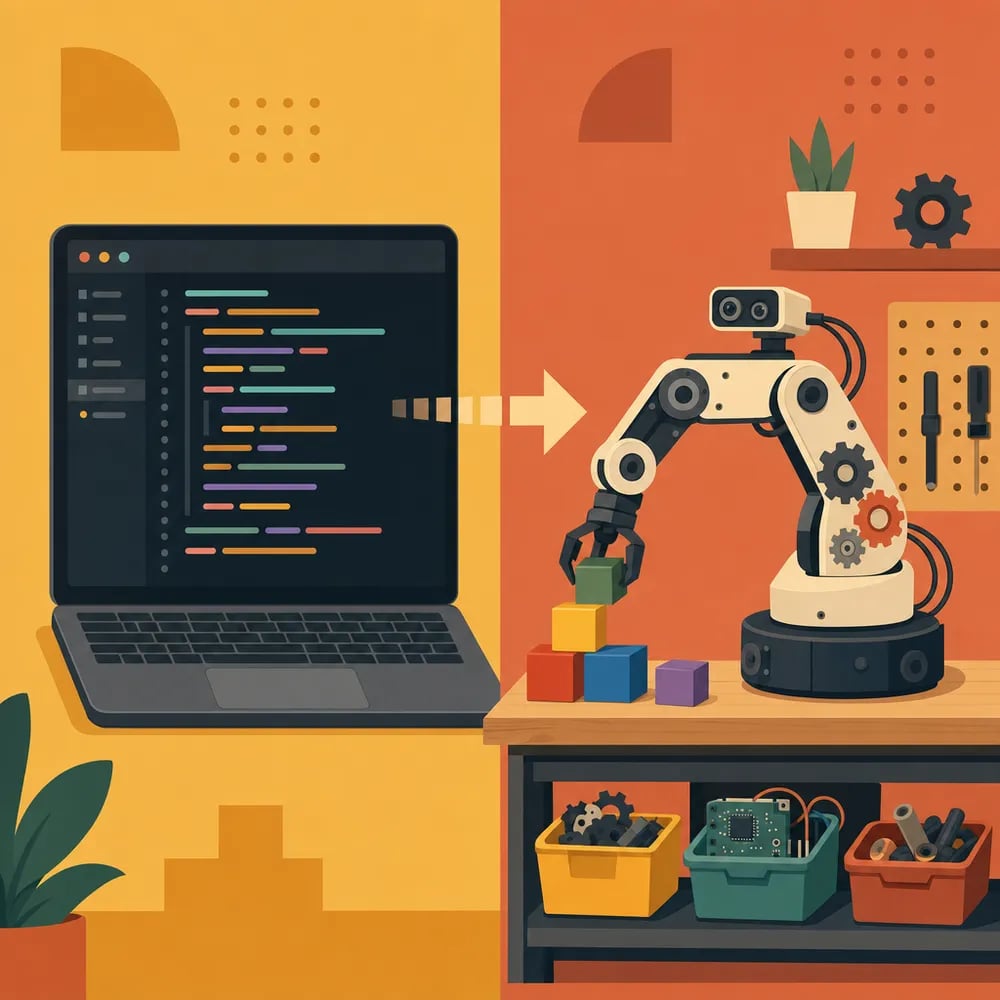
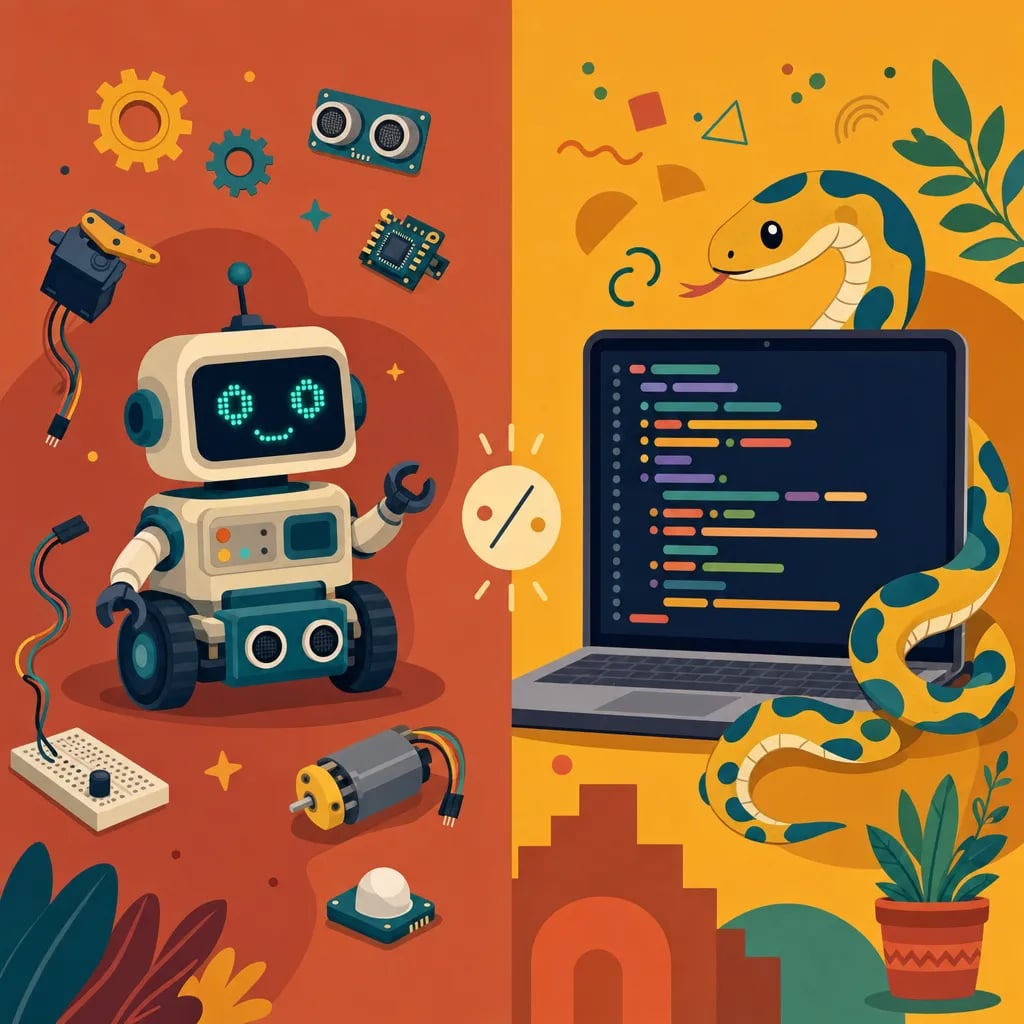
For most children in Latin America, coding is the best first step; robotics is a great specialization to add later. Coding teaches universal logic (loops, conditions, algorithms) at a low cost; robotics adds physical hardware that makes that logic visible, but it requires kits (USD 30–300) and usually in-person time. The decision isn't "one or the other" but "which first" and "when to add the second."
Algonova is an online school for coding, math, AI and design for kids aged 6 to 17, with more than 1,000,000 students in 97 countries and 10+ years of teaching experience. In Latin America, we teach families in Mexico, Argentina, Colombia, Chile, Peru and across the region — all online, in a private 1-on-1, mini group of 2 to 4, or group of up to 10 students format, with certified teachers.
The Short Answer: Coding First, Robotics Later
Start with coding between the ages of 7 and 10, and add robotics as a specialization at 10-12 if the child shows an interest in hardware. This order matters because coding builds the abstract logic (loops, conditions, variables) that robotics then applies to motors, sensors and real physics.
A child who goes straight into robotics without a coding foundation can assemble standard kits by following instructions — but stalls when a project calls for custom scripts. A coding foundation frees the child from "following a tutorial" to "creating something original."
In Latin America, the gap widens because of access: online coding is available in any city with internet; quality in-person robotics is concentrated in large cities (Mexico City, Buenos Aires, Bogotá, Santiago). Starting with online coding keeps every option open no matter where you live.
What Is Coding for Kids?
Coding means teaching a child to write instructions for the computer, using visual blocks first (Scratch, ages 8–11) and text-based code later (Python, 12+). The concepts learned — sequencing, loops, conditions, variables — are universal and apply to robotics, AI, web, data and game design later on.
Advantages: low cost (just a laptop and internet), global access (it works in any city with a connection), a mature curriculum (decades of research into how children learn to code), and transferable skills that serve multiple paths.
Drawback: less "tangible" at the start. A child who needs to see physical results may find coding abstract. This is exactly where adding robotics later works very well.
What Is Robotics for Kids?
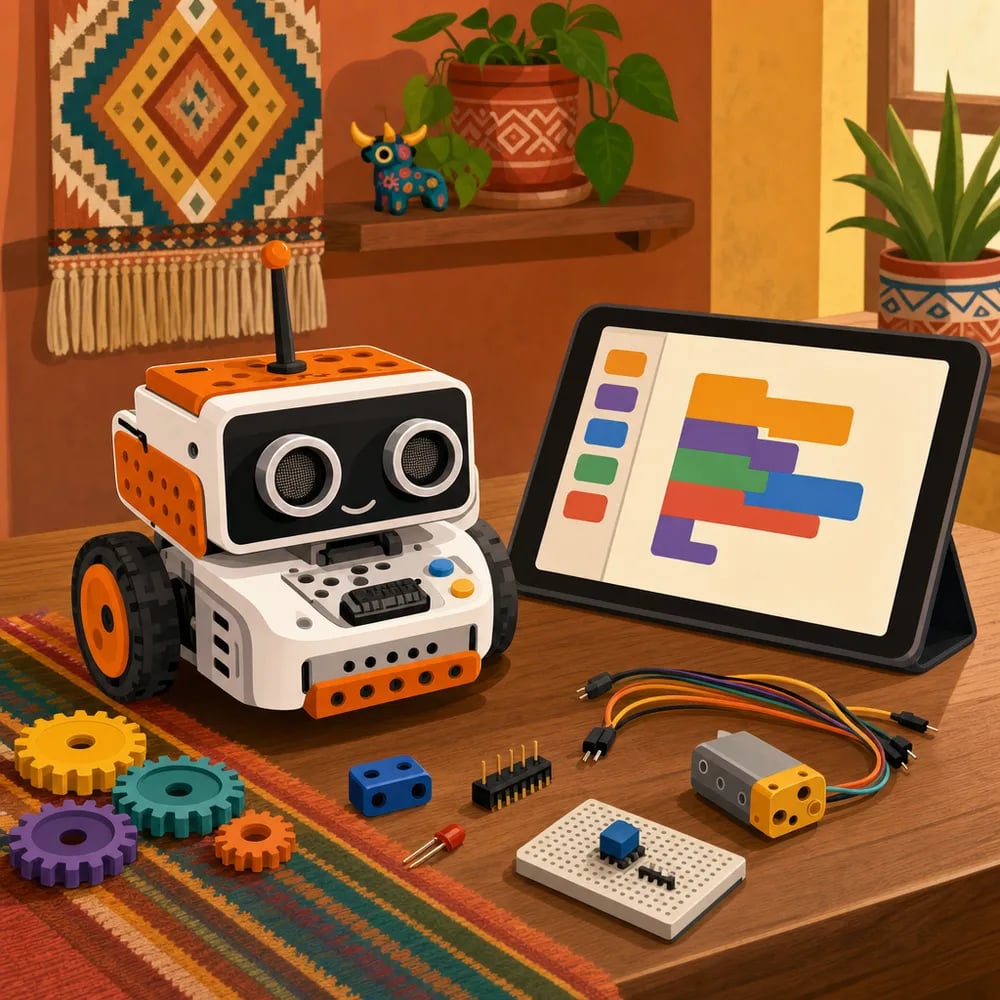
Robotics is about building and programming physical robots that move, sense their surroundings and carry out tasks. Children use kits such as LEGO WeDo (ages 7–10), mBot (8–12), VEX IQ (10+) or Arduino with sensors (12+), combining mechanical parts, motors, sensors and code.
Advantages: highly visual and tactile (the results are physical), it combines coding with physics/mechanics/engineering, there are motivating competitions (WRO Latin America, First Lego League), and it teaches fast iteration ("my robot won't move — why?").
Drawbacks: higher cost (kit + in-person class), availability concentrated in large cities, hardware that can break or become obsolete, and without a coding foundation the child gets stuck with prefabricated instructions.
For more detail on robotics specifically, see our guide Educational Robotics for Kids.