Direct and Inverse Proportion Explained for Kids + 12 Worked Examples with Answers
Math Education8 min
Math Education

Dewi Lestari
Mathematics Specialist
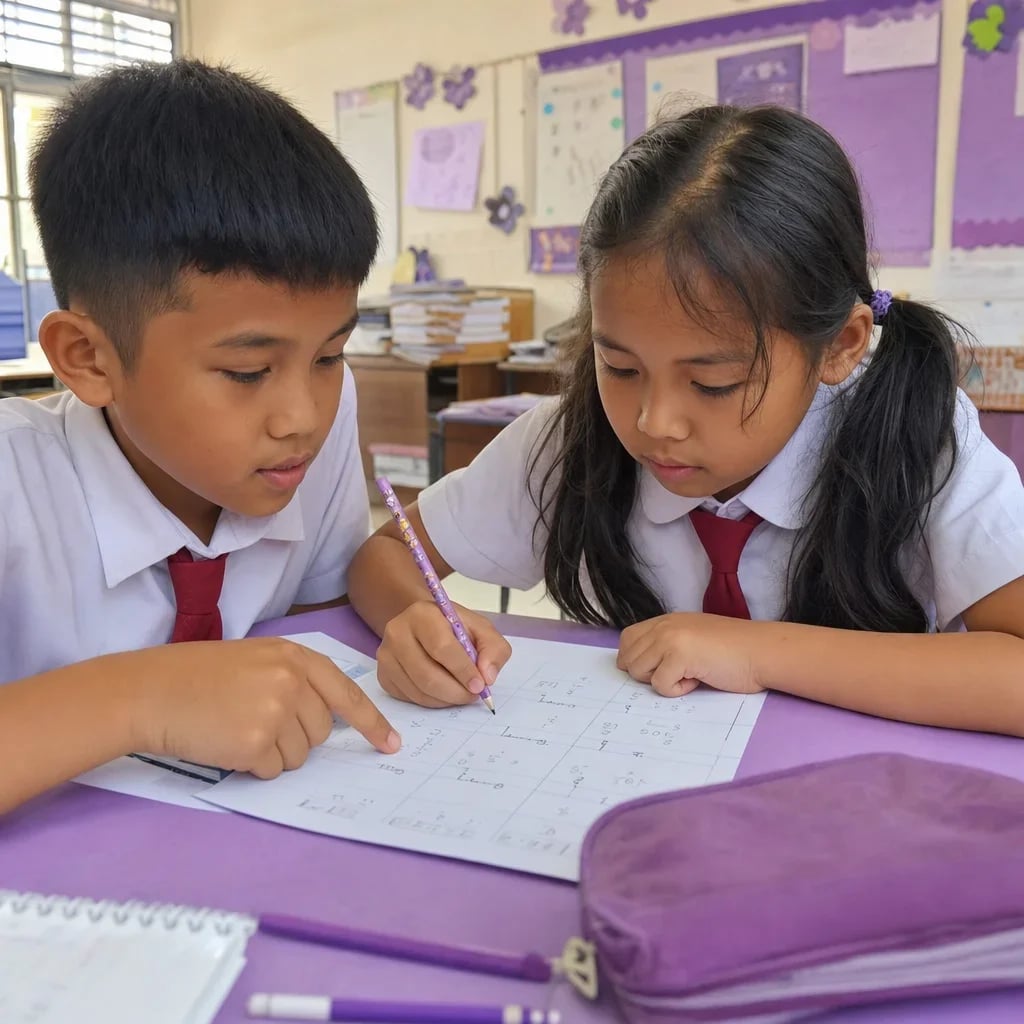
Rounding replaces a number with a simpler one that is closest in value. The purpose is to make calculation easier and to estimate results. It is taught in Year 4 and used for life, from estimating a shopping bill to reading a financial report.
The entire topic rests on a single rule:
Look at the one digit to the right of the place you are rounding to. If it is below 5, round down. If it is 5 or more, round up.
That is all. There is no separate rule for tens, hundreds or decimals — they all use the same rule, only the digit you look at changes.
To the nearest ten — look at the units digit:
To the nearest hundred — look at the tens digit:
To the nearest thousand — look at the hundreds digit:
The rule is identical, only you look to the right of the point. See also decimals.
To one decimal place:
To two decimal places:
To the nearest whole number:
This is what rounding is actually for, and it is what gets taught least.
Roughly what is 397 + 512?
Round to hundreds: 400 + 500 = about 900. The real answer is 909 — close enough.
Estimating is the most powerful self-checking tool a child can have. If they calculate 397 + 512 and get 1,909, they can see instantly that something is wrong without redoing the sum. That habit saves more marks than extra practice questions.
1. Looking at more than one digit. To round 3.449 to one decimal place, look only at the first 4 after the point — the answer is 3.4. Children often see the 49 behind it and wrongly round to 3.5. This is the number one cause.
2. Rounding in stages. 3.449 → 3.45 → 3.5 is wrong. Round once, directly to the required place.
3. Thinking 5 rounds down. In school rounding, 5 always rounds up.
4. Rounding to the wrong place. Rounding to tens when hundreds were asked for. Read the question twice.
5. Truncating instead of rounding. Turning 3.47 into 3.4 by simply cutting it off. Truncating and rounding are different operations, and only rounding is being asked for.
Yes, Algonova Indonesia offers a complete math program for kids aged 6 to 17, covering all school levels from primary, junior high, to senior high. Each level has a dedicated curriculum aligned with the child's cognitive stage and the Indonesian school curriculum (Kurikulum Merdeka). For primary school (6-12): basic operations, fractions, simple geometry, and introduction to algebra. For junior and senior high (13-17): algebra, quadratic equations, basic trigonometry, advanced geometry, basic calculus, statistics, UTBK SNBT preparation, and advanced topics. All classes are online live with certified teachers in small groups of up to 10 students per class. Our method is built on visual conceptual understanding, not formula memorisation. Try a free trial class for a child's level diagnostic and recommended learning path.
Yes. For mathematics Algonova Indonesia offers a free 45 minute diagnostic session with no commitment. The format is called Metode Diagnostik Algonova. No credit card is needed and there is no auto subscription afterwards. Note that these 45 minutes are a diagnostic session, not a regular class. A regular math class runs 90 minutes, while the coding and design tracks have their own introductory format, a free 60 minute master class. During the diagnostic a certified teacher maps the child's level: which topics are already solid and where the gaps sit. The child also tries the online learning platform and works through first problems matched to their school level. After the session parents receive a personal learning plan based on the diagnostic result, plus a transparent explanation of program, schedule, and pricing from Rp 102,000 per lesson. To book, fill in the form on the website.
Algonova Indonesia math classes come in three formats: 1-on-1 private, a mini-group of 2–4 kids, and a group of up to 10 students with similar ability and school grade levels. This small group format is deliberately chosen because it provides the optimal balance between social interaction with peers and personal teacher attention. In a mini-group, every child averages about 10 minutes of direct teacher interaction in a single session. Compare with traditional offline bimbel typically of 20-40 students per class — direct interaction there is only 1-2 minutes per child, or none at all. For families wanting full attention, one-on-one private class format is also available with one student per teacher. This format is more intensive and suits competition preparation, catching up from severe gaps, or specific topic depth.
Kids math tutoring at Algonova Indonesia starts from Rp 102,000 per lesson. The price includes a live session with a certified teacher, digital learning materials, online platform access, and an official certificate upon completing each program level. The transparent 'starting from' rate is the same across all school levels — the final quote depends only on class format (private, mini-group, or group) and how many sessions per week you choose. Groups are the most affordable option; private classes are more intensive and suit competition prep or closing larger gaps. Full pricing details are shared transparently after the free trial class. No surprise fees — every cost component is explained before formal enrolment. To receive the latest pricing details, fill in the booking form on the website.
Yes, all Algonova Indonesia math programs are fully available online with live sessions taught by certified teachers — not recorded videos. Kids learn in real time in small groups of up to 10 students, with two-way interaction, live Q&A, and problems worked on alongside the teacher throughout the class. To join online class, a child only needs a computer or laptop with a camera, a stable internet connection, and a headset. The Algonova platform runs directly in the browser so no special software installation is required. Kids can write problems in a regular notebook or on a tablet with stylus. Because every class is fully online, families can join from anywhere in Indonesia and easily fit lessons around school and other activities.
Three main factors make Algonova math tutoring effective for Indonesian kids. First, the curriculum aligns with Kurikulum Merdeka used in national schools, so what is learned at Algonova directly helps with school lessons and exams. Second, the methodology is built on visual conceptual understanding (not formula memorisation). Kids learn to break big problems into small systematic steps — a thinking pattern transferable to other subjects like science and IT. Third, small groups of up to 10 students per class let teachers adjust pace to each child's ability. Slower kids get personal help, while faster kids don't get bored waiting. The result: most Algonova students see math grade improvements at school within the first 2-3 months.
Algonova Indonesia is specifically designed to help kids behind catch up in a way that doesn't make them feel defeated or ashamed. Every new student starts with a free diagnostic during the trial class to identify exactly where the gap occurred. Based on the diagnostic, the teacher builds a personal learning path that closes the gap from the most basic foundation. For example, a junior high student weak in algebra might actually be behind in primary school fraction operations. We go back to the foundation, then progress gradually without comparison with other peers. Many Algonova students who initially started 1-2 grade levels behind successfully caught up and even surpassed classmates within 3-6 months with weekly classes and consistent homework. It's never too late to start. Try a free trial class for diagnosis without commitment.
Look at the one digit to the right of the place you are rounding to. If it is below 5, round down. If it is 5 or more, round up.
It rounds up to 50, because the units digit is 5 and 5 always rounds up.
It becomes 3.4. You look at only one digit past the target place, the 4, not the 49 behind it.
Round each number to the nearest hundred and add. For 397 plus 512, the estimate is 400 plus 500, about 900.
Rounding is taught in Year 4 for tens and hundreds, then extended to decimals in Years 5 and 6.
The most common errors are looking at more than one digit, and rounding in stages. Round once, directly to the required place.
Rounding is one of the maths skills adults use most and schools treat as least important. Estimating a shopping total in your head before reaching the till is rounding. Judging whether a figure in the news is plausible is rounding too.
See the Year 4 maths overview.
Want your child to learn maths with an experienced mentor? Try a free Master Class at Algonova — a 60-minute session to assess their level, at no cost.

Algonova worldwide
Contact
Whatsapp: +62 21 50996971
Email: info@algonova.id
Address
Coworking Area, Gedung IT 6 Lantai Dasar, Nongsa Digital Park, Jalan Hang Lekiu, Kelurahan Sambau, Kecamatan Nongsa, Batam, Indonesia Directorate General of Consumer Protection and Trade Compliance – Ministry of Trade of the Republic of Indonesia. WhatsApp Ditjen PKTN: 0853-1111-1010.
PT Algonova Indonesia Cerdas All rights reserved 2026