Online vs In-Person Coding Classes for Kids: Which Fits Better? (2026)
Which Is Better?9 min read
Q&A

Maya Putri
Early Childhood Education Specialist
What age should a child start coding? A child can start from age 5 with ScratchJr, and from age 7 with full Scratch. What decides it is not the birth certificate but three things: whether the child reads short words, holds focus for 15-20 minutes, and can follow a two-step instruction. The guide below splits readiness into age bands 5-7, 8-12, and 13-17.
Algonova is an online school for coding, maths, AI, and design for children aged 5-17, with more than 1,000,000 alumni across 97 countries since 2016. Classes run live with certified teachers in small groups of up to 10 students, not recorded video, lasting 45, 60, or 90 minutes, from Rp 102,000 per session.
The lower bound of 5 is not about thinking ability but about attention span and hand coordination.
Children aged 3-4 already grasp sequence, visible when they retell their day in order. What is not ready yet is sitting with a directed task for 30 minutes and dragging objects with precision.
By age 5 both are usually mature enough. ScratchJr, developed alongside the team behind Scratch at the MIT Media Lab, uses picture icons with no text, so a child who cannot read yet can still make a character move.
Under age 5, ordinary pattern play and puzzles give the same benefit without a screen. Fuller context is in Coding for Preschoolers.
In this band children learn through picture icons, with 45-minute classes because that is roughly the attention span.
What they learn is not syntax but sequence: what happens first, what happens next, and how to repeat something. The first result usually arrives in the first session, for instance a character that walks and then speaks.
The readiness signs at this age are simple: following a two-step instruction, and being willing to try again when the result is wrong. Reading is not required yet.
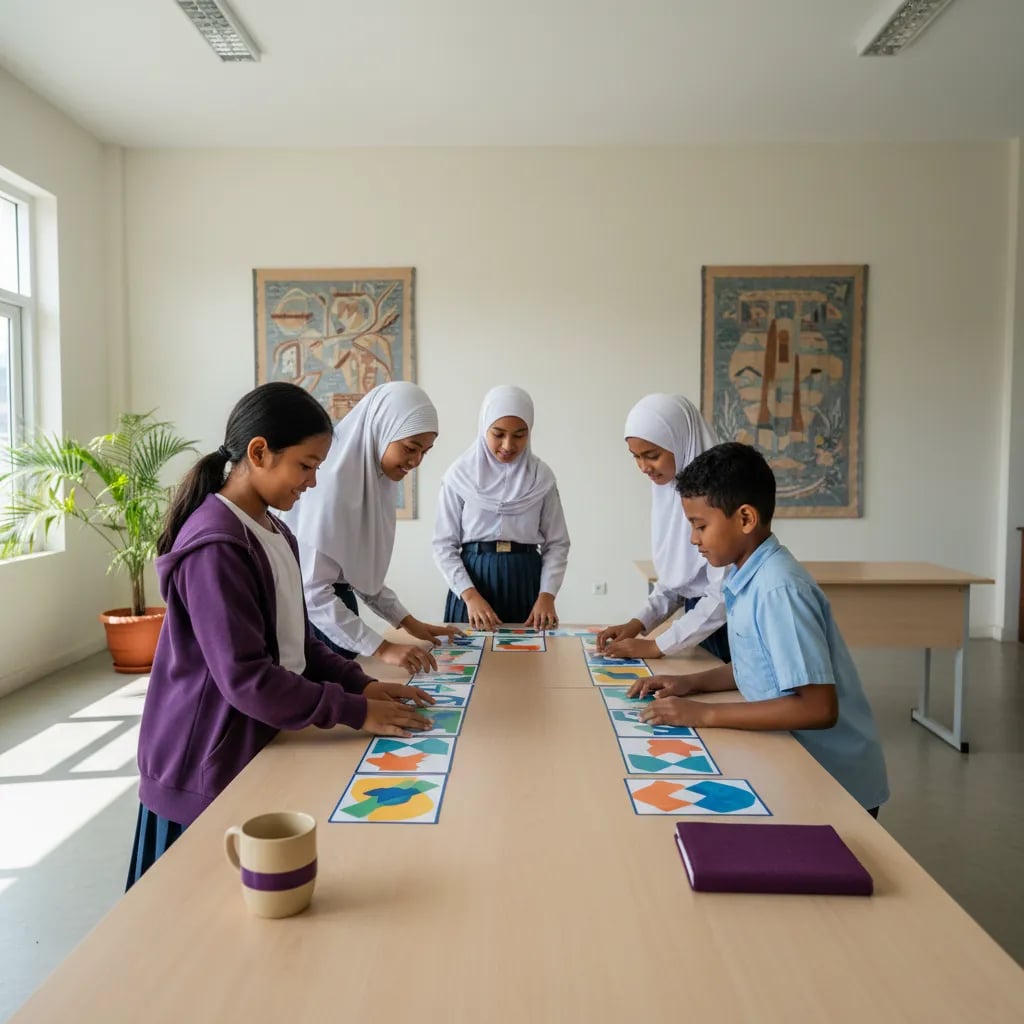
What to avoid at this age is outcome targets. A six-year-old asked to build a whole game will be overwhelmed; one asked to make a cat dance will ask for more next week.
The class path for this band is at Coding for Ages 5-7.
Age is only the first filter. These six questions show whether your child is ready now or better off waiting a few months.
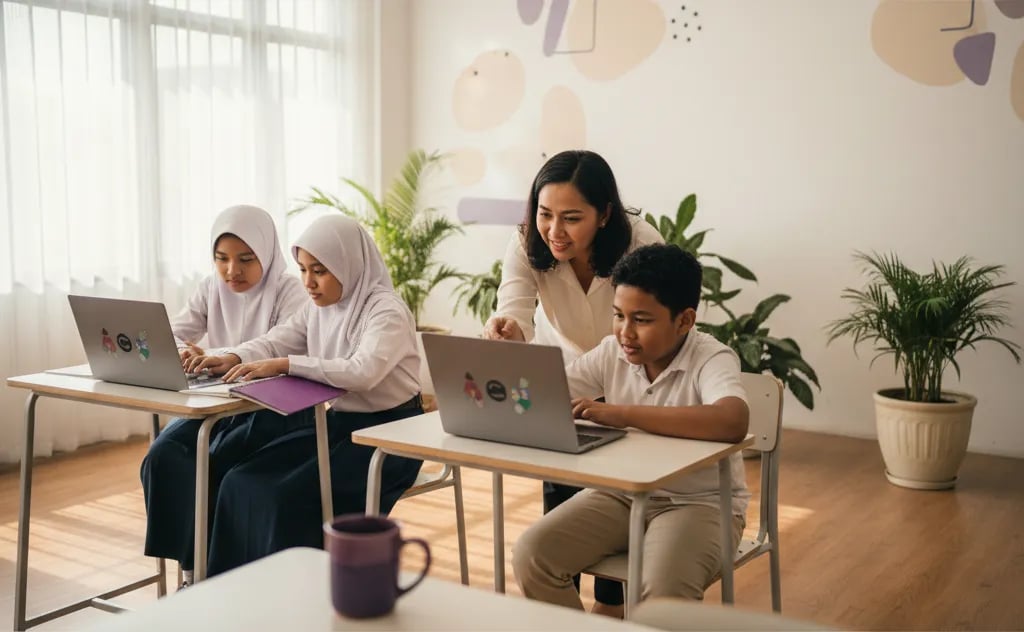
Five yeses or more means your child is ready to start now. Three or four means starting with the shortest session length and a small-group format. Below three, wait three to six months while playing puzzles and pattern games.
The fastest way to be sure is still watching your child try once. A free 60-minute masterclass does exactly that, and the teacher recommends the right level straight after.
It is not too late. A fourteen-year-old starting fresh often progresses faster than an eight-year-old, because reading and logic are already mature.
Only the entry point differs. Teenagers should skip visual blocks and go straight to Python, with projects that feel serious. Three years of primary-school material can be compressed into a few months for a teenager.
What needs managing is expectation. A teenager comparing their first result to a professional app is easily discouraged. A small finished project builds far more than a large abandoned one.
On healthy screen limits while your child studies, the benchmarks are in Screen Time for Kids. If you are still weighing whether your child is suited at all, the signs are in Signs Your Child Is Suited to Coding.
The 8-12 band is the most comfortable age to start coding, because a child reads fluently but is not yet loaded with exam schedules.
At this age a child can use full Scratch with word labels, build games with scores and levels, and start understanding variables. Many also play Roblox already, which makes Lua in Roblox Studio a natural bridge into text-based coding.
The right session length is 60 minutes once a week, plus 20-30 minutes of independent practice. More frequent is not automatically better.
The right language order for this band is covered in A Child's First Programming Language. The class path is at Coding for Primary School.
Teenagers can start straight with Python without passing through visual blocks, provided they are ready for the try-fail-fix cycle.
Visual blocks at this age often feel childish and sap motivation. What works is projects with tangible output: a simple bot, a calculator, an analysis of class marks, or a personal website.
Motivation shifts too. Younger children want friends to see their work; teenagers start thinking about portfolios, competitions, and university courses. The

Algonova worldwide
Contact
Whatsapp: +62 21 50996971
Email: info@algonova.id
Address
The path for this band is at Coding for Teens.
The 8 to 12 band is the ideal entry point, although children can start from age 5 with ScratchJr. Between 8 and 12 a child reads fluently, so full Scratch with word labels works, yet they are not yet loaded with exam schedules like a high-schooler. That combination makes learning flow most easily. Take a ten-year-old studying once a week. Within nine months they have typically built three or four games of their own, complete with scores and levels. Starting earlier still helps, only in a different shape: ages 5-7 focus on sequence and pattern rather than building complete programs.
No, provided the format matches. Five-year-olds learn through ScratchJr, which uses picture icons rather than text. What they learn is not syntax but sequence: what happens first and how to repeat something. The child drags arrow icons to make a character walk, and the result is immediately visible. The main requirement is not reading but sitting with a directed task for around 15 minutes and moving objects on screen with reasonable precision. Classes for the youngest group at Algonova run 45 minutes, because that is roughly the attention span at that age.
Not for ScratchJr, but yes for full Scratch and every text-based language. ScratchJr uses picture icons with no words at all, so a kindergarten child who cannot read can still build an animation. Full Scratch labels every block with words, so a child needs to recognise short words, generally around age 7. For Python and Lua, reading matters far more still, because a child must read error messages to locate the mistake. Reading ability turns out to predict readiness better than maths marks do.
It is not too late. A fourteen-year-old starting fresh often progresses faster than an eight-year-old. The reason is that a teenager's reading and logic are already mature, so material that takes three years with primary-school children can be compressed into a few months. Only the entry point differs. Teenagers should skip visual blocks and go straight to Python, with projects that feel serious such as a simple bot or a data analysis. What needs managing is expectation, since teenagers are easily discouraged comparing their first result to a professional app.
Ages 5-7 suit 45 minutes, ages 8-12 suit 60 minutes, and teenagers aged 13-17 can handle up to 90 minutes. These figures follow attention span rather than volume of material. A six-year-old forced to sit for 90 minutes loses interest long before the session ends. Take a family choosing a 60-minute Saturday morning class for a fourth-grader, plus 20 minutes of independent practice midweek. That pattern keeps the material fresh. Algonova offers 45, 60, and 90-minute options, chosen together with the team after the trial session.
Once a week is enough for most children, plus 20 to 30 minutes of short independent practice. Regularity matters more than frequency. A child studying 60 minutes every week for a year progresses far further than one doing three hours once a month. Twice a week makes sense for a child with clear interest chasing a specific project, or for a teenager preparing a competition or portfolio. The number of sessions is decided with the team after the trial, matched to the child's level and the family's schedule.
For children under 5, screen-free pattern play delivers the same benefit as early coding. Puzzles, building blocks, sequencing picture cards, and retelling the order of daily activities train exactly the same foundation, which is thinking in sequence and recognising patterns. Take asking a child to describe the steps of making breakfast in order. That is algorithmic practice in its simplest form. Assessing coding readiness under age 5 is generally not useful, and waiting a year leaves a child no further behind.
No. High-school students should go straight to Python or another text-based language without passing through Scratch. Visual blocks at this age often feel childish and actively reduce motivation. Teenagers are driven by projects that feel real, such as a personal website, a simple bot, or an analysis of class marks. The concepts Scratch would have taught, such as loops and conditions, are still covered, just directly in text form. For teenagers, career arguments also start to land, unlike younger children who are motivated more by peer recognition.
There is no gender-based difference in readiness across ages 5 to 17. What often differs is the kind of project that sparks initial interest. Some girls engage faster through story projects, animation, and character design than through action games. That is a fully valid route, because the concepts are identical: loops, conditions, and variables. A child building a story animation uses the same logic as one building a racing game. In Algonova classes the balance of girls and boys is relatively even.
A laptop or computer with a camera, a stable internet connection, and a headset so the child can talk to the teacher without background noise. High specifications are not needed. Scratch runs directly in the browser with nothing to install, and beginner Python uses only a lightweight text editor. Connection stability matters more than processor speed. A tablet works for ScratchJr with children aged 5-6, but becomes awkward once they move to text-based coding. Before the first session, the team sends a short list of what to have ready at home.
Coworking Area, Gedung IT 6 Lantai Dasar, Nongsa Digital Park, Jalan Hang Lekiu, Kelurahan Sambau, Kecamatan Nongsa, Batam, Indonesia Directorate General of Consumer Protection and Trade Compliance – Ministry of Trade of the Republic of Indonesia. WhatsApp Ditjen PKTN: 0853-1111-1010.
PT Algonova Indonesia Cerdas All rights reserved 2026