
Abacus vs Kumon vs Conceptual Math: Which Is Right for Your Child?
Which Is Better?6 min read
Which Is Better?

Arjun Menon
Education Analyst, Algonova Malaysia
Kumon suits a child of 6 to 8 (Year 1 and 2) whose main problem is slow, careless counting, because the child works through short worksheets for about 30 minutes a day at their own level. Regular math tuition suits a child who is confused by school topics such as place value, money and word problems, because a teacher explains the idea. Name the problem first, then pick the format.
The real difference is who does the explaining. At Kumon the child learns alone from worked examples on the sheet. In math tuition a teacher presents a topic to a group, and the children practise afterwards.
The table sticks to facts you can check. The Kumon details come from the official Kumon Malaysia site (my.kumonglobal.com, checked 19 October 2026). The tuition column is a general picture, since every centre and tutor runs things differently.
| What to compare | Kumon | Regular tuition (centre or tutor) |
|---|---|---|
| Method | Small-step worksheets, self-study | Teacher explains a topic, then practice |
| Follows the Year 1 and 2 KSSR syllabus? | No; the level follows ability, not school year | Yes, usually follows school topics |
| Time per week | About 30 minutes a day: 2 sessions at the centre and 5 tasks at home | Depends on the centre, often 1 to 2 classes |
| Who guides the child | An instructor observes and gives hints | A teacher teaches directly |
| Ages accepted | 4 to 17 | Varies by centre |
| Fee | RM175 a month per subject (ages 4 to 12) | Varies by centre and city |
Take a Year 1 child who gets 18 of 20 addition sums right within 20 but needs 15 minutes, because every answer is counted on fingers. That's a speed problem. If the same child can't say why 34 is smaller than 43, that's a concept problem. The first sits closer to Kumon, the second closer to tuition.
The full yearly cost is broken down in our Kumon Malaysia fees guide for 2026.
Kumon starts with a free placement test, then puts the child at a level slightly below what they can do and moves them up gradually. The math programme has 20 levels, from 6A to O, and the earliest levels begin with counting and number sequencing.
Kumon's own origin story involves a Year 2 child too. In 1954, Toru Kumon, a secondary school math teacher in Japan, saw that his son, then in Year 2, scored badly because he counted slowly and made mistakes. He wrote half-hour practice sheets for the boy, and in 1958 the method was launched. Kumon Malaysia now runs more than 200 centres.
At Kumon, a 7 year old who gets stuck reads the example and tries again. In tuition, the same child puts up a hand and asks.
Take Aisyah, 7, in Year 1. At school she already adds within 100, but at Kumon she begins by counting to 50. For the first few weeks her sheets feel far too easy. That's by design. Speed and habit come first, new topics later.
Sheets are done five days a week at home, so for a child this young a parent usually has to sit alongside. We compare the two methods in Kumon vs abacus.

Regular math tuition means a class with a teacher that follows school topics, whether at a tuition centre, at the tutor's home or online. The teacher explains each idea with objects and examples, then the children practise.
In Year 1 and 2, the KSSR primary curriculum from the Ministry of Education moves from whole numbers to 100 towards numbers to 1,000, from adding and subtracting towards the first 2, 5 and 10 times tables, plus Ringgit and time. A summary of the topics is in our KSSR Year 1 and 2 math guide. Tuition's strength is that a topic taught on Tuesday shows up again in school homework on Thursday.
Wei Jie, 8, in Year 2, is quick at 27 + 15. But he gets "An eraser costs RM2, a pencil RM3, you pay with RM10, what is the change?" wrong because he adds every number he sees. His tutor teaches him to read a problem in 3 steps: read, write the number sentence, calculate. Wei Jie doesn't need extra worksheets. He needs a way to read the question.
The weak side: quality depends heavily on the tutor, and in a big group a shy child rarely asks. We look at class size in group vs private tuition.
Start with the name of the child's problem. Kumon and tuition solve different things.
| Child's problem (ages 6 to 8) | Closer format | Why |
|---|---|---|
| Still counts on fingers, slow at adding and subtracting | Kumon | Daily practice builds fluency |
| Does not understand place value (tens and ones) | Tuition | Needs an explanation with objects |
| Mixes up Ringgit coins or reading a clock | Tuition | Needs everyday examples and explanation |
| Calculates well but fails word problems | Tuition | Needs a strategy for reading the question |
| Already strong and wants to move past school level | Kumon | Not tied to school year |
| Afraid of math, cries easily | Small class with a patient teacher | Needs adult support |
Time differs too. Kumon at about 30 minutes a day is roughly 210 minutes a week, with 2 sessions at the centre and the rest at home. Tuition with 2 classes of 60 minutes comes to 120 minutes, mostly with a teacher. For a 6 year old, a short attention span often decides it. The question comes up more now because, from the 2027 session, the Ministry of Education opens voluntary entry to Year 1 at age 6.

If you are not sure what lies behind your child's weak results, our list of 7 reasons a child struggles with math can help.
Test the problem at home for a week before you pay the first fee.
Encik Faizal, for example, found that 7 of his Year 2 son's 10 mistakes came from money and word problems. Only 1 was a counting slip. What helped him was a teacher who explained change with real coins.
We compare the two approaches in more detail in worksheets vs live class.
The third option is a small online group class that starts with a diagnostic, so the teacher knows your child's gaps before lesson one. It mixes a teacher's explanations, as in tuition, with a plan built around the child's level, as in Kumon.
At Algonova, Math Starters is the math programme for ages 6 to 8 (Year 1 and 2), taught live online by real teachers in groups of up to 10 children. The first step is a free diagnostic of about 60 minutes with a written report for parents. Lessons start from RM 48 each, and parents rate us 4.9 out of 5. Programme details are on the online math classes page for ages 6 to 8, and other families' experiences are in the Algonova parent reviews. More than 1M students in 97 countries have learned with Algonova.
Say a Year 2 child is stuck on the 2 and 5 times tables. Often the real gap is skip counting from Year 1, and extra times table sheets won't touch it if nobody finds it first.
Kumon for a Year 1 child costs RM175 a month per subject, because Kumon Malaysia charges the same rate for every child aged 4 to 12. The figure comes from the official Kumon Malaysia site, checked on 19 October 2026. There is also a one-off registration fee of RM50, and the child receives a Kumon bag on enrolment. Fees are per subject, so a 7 year old taking Math and English pays RM350 a month. One subject for 12 months adds up to RM2,100 before the registration fee, or roughly RM5.80 a day in a 30-day month. Families who drive to the centre twice a week should add fuel and travel time. Fees can change, so confirm the current figure with your nearest centre. A full cost breakdown, including the weekly time cost, is in our Kumon Malaysia fees guide on the Algonova blog.
Yes, because Kumon centres in Malaysia accept children from 4 to 17, so a 6 year old in preschool or Year 1 can enrol at any time. Enrolment starts with finding a nearby centre, then a parent orientation and a free placement test with an instructor. The test sets the child's starting point. For a 6 year old that is usually counting and number sequencing, even if the child can already add. That's normal, since Kumon deliberately starts with easy material to build habit and confidence. What matters more is whether your child will sit for about 30 minutes every day. From the 2027 session, the Ministry of Education also opens voluntary entry to Year 1 at age 6, so a lot of parents are thinking about preparing early. After the first 2 weeks, ask yourself: is my child still enjoying numbers?
No, Kumon does not arrange its worksheets by the KSSR syllabus, because each student's level is set by ability and not by school year. According to Kumon Malaysia, students advance at their own pace and are not tied to age or grade. Its math programme also concentrates on calculation skills and leaves out topics unrelated to computation. That means KSSR topics such as Ringgit money, reading the clock, 2D and 3D shapes and pictographs are not the focus of Kumon sheets. A Year 2 child learning to give change from RM10 at school may still be practising two-digit addition at Kumon. For a child with shaky foundations, this helps, since fluency comes first. For a parent who wants help with this week's school topic, it can be frustrating. Ask the instructor for your child's starting level after the placement test.
According to Kumon Malaysia, daily math sheets take about 30 minutes, with 2 sessions a week at the centre and 5 more tasks at home. So a Year 1 child does sheets 7 days a week, including weekends and school holidays. Kumon says daily practice is what builds mastery and self-discipline. For a 7 year old, 30 minutes is a long stretch to work alone. In practice, many parents sit beside the child, read the instructions and watch the clock. The arithmetic is simple: 30 minutes a day is about 210 minutes a week. Parents overlook this at sign-up, because sheets continue through school holidays and festive breaks. Before enrolling, decide who at home will keep your child company every afternoon. If the answer is nobody, a class with a teacher on a fixed weekly schedule is usually easier to keep up for families where both parents work.
Most 6 year olds don't need formal math tuition before Year 1, but they do need solid basics: counting to 20, recognising numbers and comparing groups of objects. These basics can be built at home with daily activities, such as counting stairs or sharing snacks equally with a sibling. Tuition or a structured class starts to pay off if the child is clearly behind preschool classmates, for example still mixing up 6 and 9 or unable to count backwards from 10. A 6 year old usually learns better with objects and games than with long worksheets. If you choose a class, check that the length suits your child's attention span and that the teacher uses hands-on materials. Start with 10 minutes a day and watch how your child reacts.
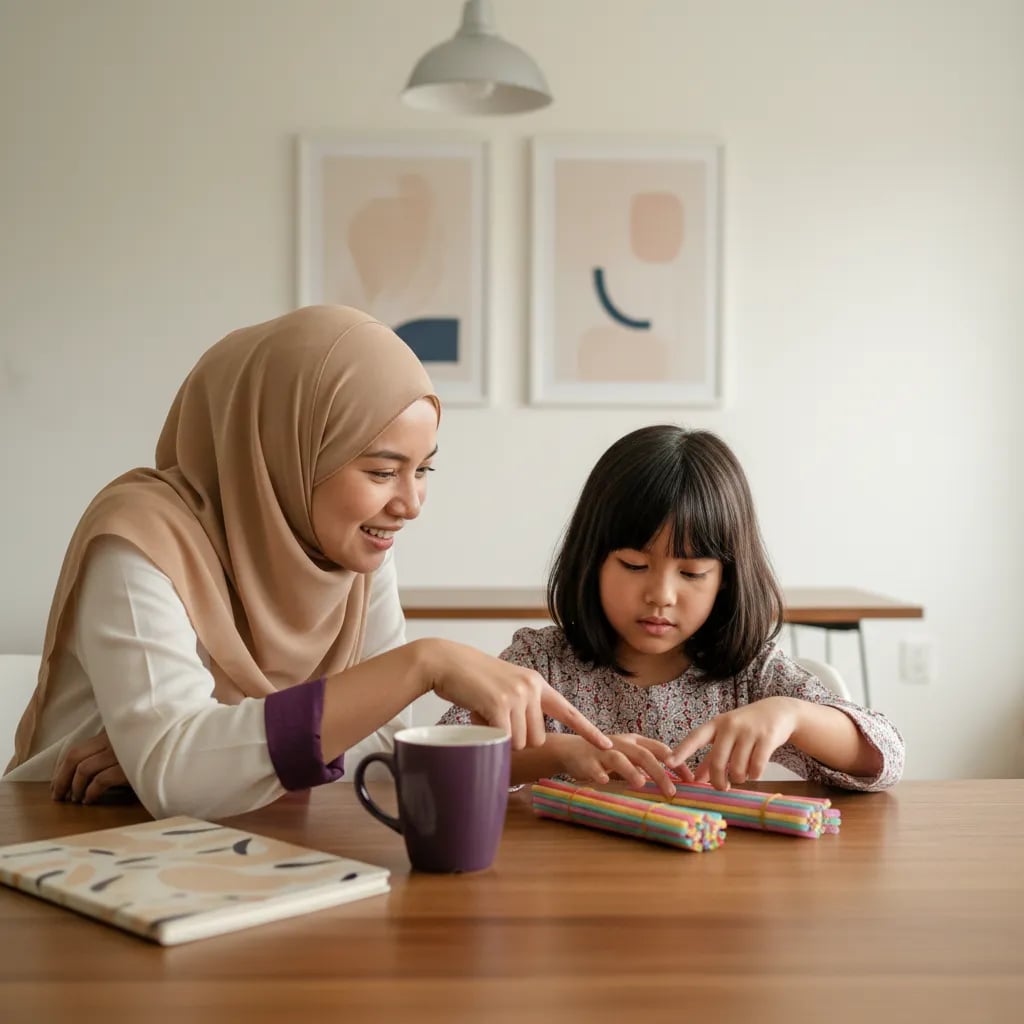
Kumon can help a Year 2 child who is weak because they count slowly and carelessly, but it suits less well a child who is weak because they do not grasp the concept or fear math. Kumon relies on self-study: the child reads an example on the sheet and tries alone, with an instructor giving light hints. A confident child gains independence from this. For an 8 year old who already fails often, working alone can add to the frustration. A Year 2 child who scores 40 because they don't understand place value needs someone to explain tens and ones with straws or blocks. Ten minutes with blocks is often worth more than 5 extra sheets. If at home your child stops at the first hard question and waits for help, self-study may not be right for them yet, at least for now. A diagnostic with a teacher can show the gaps from Year 1 behind the weakness today.
Yes, but for a 6 to 8 year old the combination easily becomes too heavy, so add up the extra study time before signing up for both. Kumon trains calculation fluency while regular tuition explains school topics, so in theory the two complement each other. The catch is tiredness. For example, 30 minutes of Kumon a day plus 2 tuition classes of 60 minutes comes to about 330 minutes of extra learning a week, on top of school and homework. For a 7 year old, that is close to an extra school day each week, and part of it lands on weekends. Watch for fatigue: delayed sheets, random answers, tears before class, or "I hate math". If that happens, keep the one format that deals with the main problem. A single consistent format is easier to judge after 8 weeks than two half-done ones.
For a 7 year old, an online math class with a teacher suits better if the child needs concepts explained, while Kumon suits better if the only problem is calculation speed. The main difference remains who explains. Kumon Malaysia offers KUMON CONNECT, a digital version of the worksheets on a tablet with a stylus, but it is still self-study and not a live class. An online class happens from home with a teacher who explains in real time. For example, a family living 20 minutes from the nearest centre saves about 80 minutes of travel a week for 2 sessions. For this age, pick a small group class so the child has a chance to speak and ask questions. The downside: your child needs a computer and stable internet, and a parent should stay nearby for the first few classes. Also ask whether the teacher sends written progress reports.
A Year 1 or 2 child may need math tuition if they still use fingers for 8 + 5, avoid math homework, or cannot explain how they got an answer. These signs matter more than one low mark, since a single bad worksheet can just be a bad day. Look at the pattern of mistakes too. A child who is correct in home practice but wrong at school may have trouble reading instructions, not numbers. Gaps in Year 1 and 2 grow quickly. A child who has not grasped tens and ones will struggle when Year 2 brings numbers to 1,000 and regrouping. Before choosing tuition, sit with your child for 15 minutes and ask them to explain 3 questions they got wrong. The explanation shows whether the problem is concept, speed or confidence, and from there you can choose the format that matches.
Blog

Start your child's tech journey
Book your free 60-minute trial class with an Algonova certified tutor. No payment, no obligation, just discover what your child can build.

Algonova worldwide
Contact us
Email: int_legal@alg.team
Visit us
Suite 8634, 1021 E Lincolnway, Cheyenne, WY, Laramie, US, 82001
Algonova online LLC International tech school for kids and teens

