December School Holiday 2026 Coding Plan for Kids 7-12: 4 Weeks From Scratch to Roblox

Learn Coding13 min read
Checklists & Calendar

Priya Nair
Education Calendar Editor, Algonova Malaysia

The best school holiday activities for kids in Malaysia work around the weather: outdoor play before 10am or after 5pm, indoor projects through the hot and rainy middle of the day. This list covers 8 ideas for children aged 5 to 14, each with a suggested age range, how long it takes, and what you need at home to start.
Algonova teaches coding, mathematics, AI, and design online to children aged 6 to 17. More than 1,000,000 students in 97 countries have gone through our programmes over the past 10 years, and parents rate the classes 4.9 out of 5. Lessons run live with a certified teacher — private 1-on-1, mini groups of 2–4, or groups of up to 10 students — never recorded video.
In Malaysia the time of day decides whether an activity works, so split each holiday day into three blocks instead of one big plan. Outdoors stays comfortable until roughly 10am and again after 5pm. The middle of the day belongs indoors, especially once the afternoon storm arrives.
A shape that holds up: one active block in the morning, one quiet project after lunch, one family block in the evening. Term breaks are not identical in every state, so check yours first in our guide to the Malaysian school holiday calendar before you book anything.
Free indoor options are easier to find than most parents expect. Public libraries are air conditioned and cost nothing to enter, and a mall playground buys younger children an hour of movement when the rain refuses to stop. Play is not filler either. UNICEF's summary of the science of play explains how unstructured play builds the same problem solving habits school tries to teach.
Two low cost activities cover most of the 11am to 4pm block: a kitchen experiment and a reading habit.
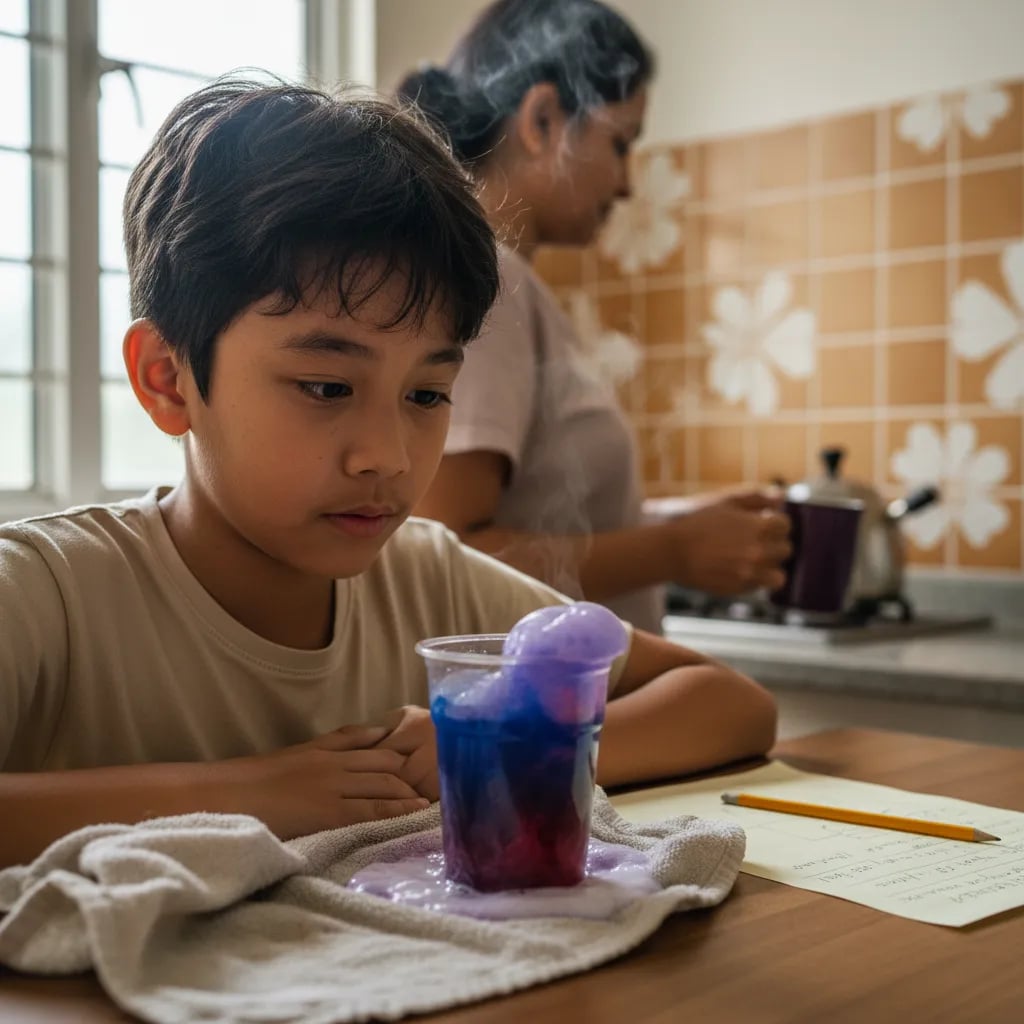
Age 5 to 10. About 45 minutes per session, twice a week. You need baking soda, vinegar, food colouring, a few clear cups, and an old towel for the mess. Ask the child to predict what happens before each attempt, then write the result down.
What the child keeps: the habit of guessing, testing, correcting. That loop is the same one used later in coding and in secondary school science.
Age 6 to 14. Two hours, once or twice a week. You need a library card and a small notebook. Let the child choose the target, for example four books this break, and ask for one drawing per book so the trip has a product.
Reading in both languages during the break keeps neither from slipping. It also feeds the vocabulary side of the digital skills children need for school once assignments move online.
Still fixing the dates? Our school holidays 2026 Malaysia guide lists every break for Group A and Group B, with a four-week plan for December. Children who enjoy the guess, test and correct loop can later aim at one of the coding competitions for kids in Malaysia.
The activity matters less than the time slot. Move outdoor play to before 10am and keep the afternoon for indoor projects, and you get a calmer child with fewer arguments about the heat.
Hafiz Rahman, Education Specialist, Algonova Malaysia
A holiday is the easiest window for one structured class, because no homework is competing for the child's attention.
Age 6 to 14. Two 60 minute sessions a week. You need a laptop or tablet, headphones, and stable internet. The point is a finished project the child can show someone: a small game, an animation, a poster, a working web page.
Many parents report that this is where a bored child changes attitude, because the result is visible. If coding is new territory, what coding for kids actually means covers the basics in plain language, and what age to start coding in Malaysia helps you match the format to your child. Groups are split by age: coding for ages 6 to 7 works through visual blocks, while coding for ages 8 to 12 moves into real projects and text based languages. Prices start from RM 48 per lesson, and a free trial class shows you the format before you commit to a term.
Age 5 to 12. 20 minutes, daily, ideally at the same hour. You need a deck of cards, dice, or a printed sudoku. Mental arithmetic races and card games where the target is a fixed number keep fluency alive without a worksheet.
Twenty minutes a day across a four week break adds up to roughly nine hours of practice. Children who keep it up tend to skip the usual first week fog when school restarts.
Two outdoor blocks a day, one before 10am and one after 5pm, cover the movement children lose during a long break.
Age 5 to 14. 45 to 60 minutes, before 10am. You need water, a cap, and proper shoes. Add a small mission so the walk has a point: count how many bird species you spot, or time each other on the monkey bars.
WHO recommends at least 60 minutes of moderate physical activity a day for children and teenagers aged 5 to 17. Holidays are when that number quietly collapses, and a fixed morning slot is the cheapest fix available.
Age 8 to 14. About 90 minutes, early morning. You need a budget you decide on, a written shopping list, and a calculator the child is not allowed to touch at first. Let them compare two stalls, do the arithmetic in their head, and hand over the money themselves.
This is applied mathematics with a consequence attached: get the sums wrong and there is nothing left for the last item on the list. Children also practise talking to adults outside the family.

Boredom in the second week is not a discipline problem. It usually means the child has nothing to finish. Give them one project with a visible ending and the complaining stops.
Hafiz Rahman, Education Specialist, Algonova Malaysia
Longer projects work best in the second half of the break, once the novelty of doing nothing has worn off.
Age 8 to 14. Two or three sessions over a week. You need a phone for photos and voice notes, plus one grandparent willing to talk. Ask the child to collect three stories, one recipe, and one old photograph, then turn them into a small book or a slideshow.
If your child already started a course, online classes for children carry on from the kampung as long as there is a phone hotspot, which removes the awkward two week gap in the middle of a term.
Age 5 to 14. One full day. You need a notebook, pencils, and a plastic bag for whatever gets collected. Ask for three drawings: something alive, something man made, something they cannot identify. The last one becomes the evening research task.
A day trip like this costs the petrol and the food. What the child keeps is the habit of noticing detail, which is far harder to teach at a desk.
Give a bored child one project with a clear ending rather than a longer list of activities, because boredom in the second week usually means nothing is waiting to be finished. A finished thing changes the mood of the whole break. One family in Seremban set their nine year old a single target for the holidays: build a game his cousins could actually play. He spent about four hours a week on it, complained for the first three days, then started asking for extra time on the laptop. The complaining stopped once there was something concrete to show at the end of each session, and his younger sister wanted a turn by the second week. Two active blocks a day plus one project usually fills a four week break without you inventing a fresh idea every morning. Let the child choose the project, and choose it before the holiday starts.
Children can start structured coding classes from age 6, using visual blocks instead of typed code, and move to text based languages around age 8 or 9. The format matters more than the age number. A six year old works in short sessions with big colourful blocks and a teacher who guides each step out loud. An eleven year old can hold a four week project in their head and debug their own mistakes without much help. Algonova teaches ages 6 to 17 and splits groups by age, so a six year old is never sitting in a class built for teenagers who already type their own code. Groups hold up to 10 students with a certified teacher, so a younger child still gets attention in every session. If you are unsure which level fits, a free trial class settles it in one hour.
Plan roughly two to four hours a week for a structured class, plus one hour of outdoor movement and 20 minutes of maths games daily. That leaves most of the day free, which is the point of a holiday. A schedule packed hour to hour usually collapses by the second week. One mother in Johor kept only three fixed items on the wall calendar: park before breakfast, class on Tuesday and Thursday evening, library on Saturday. Everything else stayed loose, and her two children stopped asking what happens next after the first few days of the break. Consistency beats volume here. Three fixed blocks a week hold better than an ambitious plan nobody follows past day four. Younger children do better with 30 minute sessions than with a full hour of the same activity.
A laptop or tablet with a working camera, headphones with a microphone, and a stable internet connection are enough. No paid software or extra hardware is needed. A phone works for watching but not for building, because most coding tools need a real screen and a keyboard. Headphones matter more than parents expect, especially in a house full of cousins during the holidays. A quiet corner with a table, a chair at the right height, and a plug nearby covers the rest. Tablet users should add a simple bluetooth keyboard once the child moves past visual blocks and starts typing. Set the equipment up once before the first session so the child spends the whole lesson learning instead of troubleshooting audio settings. Ten minutes of preparation saves the same ten minutes every week after that.
Yes, when classes are live with a named certified teacher in a small closed group rather than an open public room or a recorded video with a comment section. Ask three things before signing up: who is in the room, who can see my child, and can I sit in for a session. At Algonova a session holds up to 10 students with the same teacher across the whole course, so nobody unknown drops in halfway through. Parents can watch any session, and children never publish work to a public feed without a parent knowing about it first. A free trial class is the simplest way to see the room and the teacher yourself before deciding anything. Sit through one session, then ask your child what they thought of the teacher before you decide.
All 8 ideas work the same for girls and boys, including the coding project, the pasar budget task, and the park circuit. Nothing here depends on gender. The gap that shows up in coding is usually about who gets invited, not who is capable. In mixed groups where the teacher hands out the same roles to everyone, girls take the lead on projects as often as boys do. One family found their daughter preferred design and animation while her brother went straight for game logic, and both finished a project in the same month using the same tools. Ask what the child wants to build first, not which subject sounds more suitable. The interest picks the direction, not the gender, and interests shift more than once during the primary school years.
No, your child does not need to be good at maths first. Early coding uses counting, sequencing, and simple patterns, all of which a child already meets in primary school. The relationship often runs the other way. Children who spend a holiday breaking a project into steps tend to handle word problems more calmly afterwards, because the habit of splitting a big task into small ones transfers across subjects. A ten year old who struggled with fractions still built a working quiz game over one break, and his teacher noticed he stopped freezing whenever a question looked long on paper. If maths is the actual worry, 20 minutes of card and dice games a day does more for fluency than extra worksheets. Advanced maths only enters coding much later, if at all.
Algonova classes start from RM 48 per lesson. Compare the format, not only the price. A live session in a group of up to 10 students with a certified teacher is a different product from a recorded course or a class of 25 children. Ask how many children share the room, whether the teacher stays the same through the whole course, and what your child finishes with at the end. Most of the other 7 ideas in this list cost nothing beyond transport and food. A free trial class lets you judge the teaching before spending anything, and it takes just one hour of your time to see if it is the right fit for your child.
Look for something finished: a game that runs, a slideshow about the family, a notebook listing four books read, or a project the child can explain without help. Explaining is the real test. Ask your child to walk you through what they made and why they chose that particular step, and you learn more than any certificate shows. One father asked his daughter to teach him her animation on a Sunday evening. She talked for twenty minutes, caught a mistake herself halfway through, and fixed it while he sat there watching. Set that check at the end of week two so there is still time to change course if nothing is moving. Progress you can see and hear the child explain beats progress that somebody else reports to you on a printed certificate.
Go to the public library, run a kitchen experiment with baking soda and vinegar, or start the family history project by recording a grandparent on your phone. All three cost close to nothing. Rain is predictable enough in Malaysia to plan around. Keep a shortlist of three indoor activities on the fridge so nobody has to negotiate in the moment. A mall playground works when the children need to move and the corridor at home is not an option. A notebook, a pack of cards, and a library card cover most wet afternoons across a four week break. Children remember the projects they finished, not the money spent on the day out. Keep the rainy day list short and stuck somewhere visible so it actually gets used instead of quietly forgotten.
Blog

Algonova worldwide
Contact us
Email: int_legal@alg.team
Visit us
Suite 8634, 1021 E Lincolnway, Cheyenne, WY, Laramie, US, 82001
Algonova online LLC International tech school for kids and teens