
Abacus vs Kumon vs Conceptual Math: Which Is Right for Your Child?
Which Is Better?6 min read
Parent Guides

Aina Rashid
Parent Education Editor, Algonova Malaysia
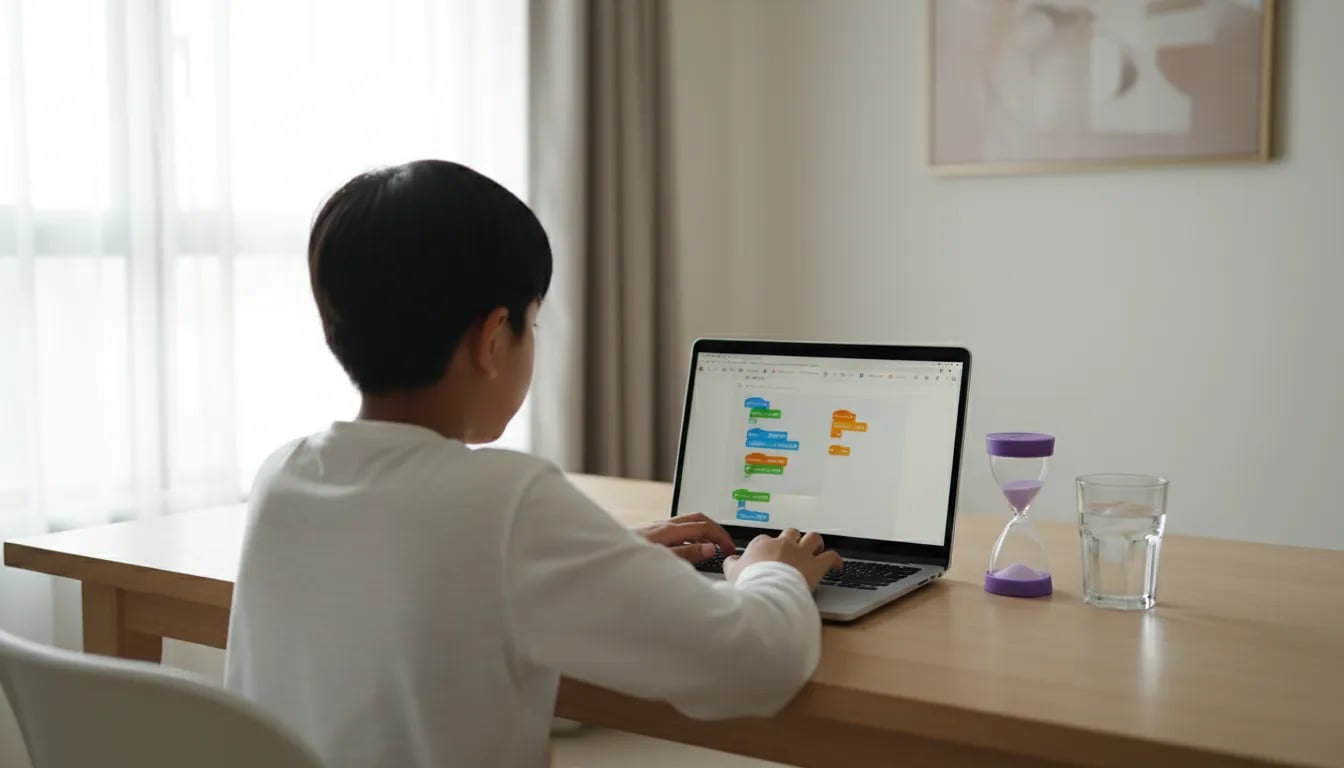
Is coding good for kids with ADHD? For some children it can be: results show quickly on screen, the steps are small and the child picks the project. But coding is not a treatment for ADHD, and no class can tell you whether your child has it. This guide for parents of children aged 8 to 12 covers what to expect, what to ask a class and when to see a doctor.
Coding can be a good fit for some children with ADHD, and a poor fit for others. It is an activity, not a therapy. We know of no solid study showing that learning to code reduces ADHD symptoms, so we do not claim that it does.
What we can say comes from watching children in classes and from how a coding lesson is built. A child sees a character move within seconds of snapping two blocks together. A mistake shows up as a character that walks the wrong way, not as a red mark on a page. For a child who loses interest when the reward is far away, that closeness can matter.
The National Institute of Mental Health (NIMH) in the United States says standard ADHD treatment is medication and psychosocial support, such as parent training and help at school, and that cognitive training is still being researched (NIMH, ADHD overview). Coding sits beside that care, not in place of it.
A coding class can be one good hour in your child's week, next to the real plan.
If you are still deciding whether coding is right for your child's age, see what age to start coding in Malaysia.
ADHD (attention deficit hyperactivity disorder) is a neurodevelopmental condition with three groups of signs: inattention, hyperactivity and impulsivity. NIMH says these behaviours are common in all children now and then, but in ADHD they happen often, in more than one setting such as home and school, and they get in the way of daily life.
A coding teacher cannot diagnose ADHD. Neither can a parent from a checklist, or an article like this one. A diagnosis comes from a doctor or a qualified mental health professional, such as a paediatrician, a child psychiatrist or a clinical psychologist, who looks at the child's history and behaviour in several places.
Malaysia's Ministry of Health publishes a clinical practice guideline on ADHD in children and adolescents (Management of ADHD, 2nd edition, 2021). It names school-based support as part of care. That is worth remembering when you plan the week: coding does not replace support in class.
The US Centers for Disease Control and Prevention (CDC) adds an age detail. For children under 6, behaviour therapy with parent training comes first. From age 6, the American Academy of Pediatrics recommends medicine together with behaviour therapy (CDC, ADHD treatment). Those choices belong to you and your child's doctor.
Coding can suit these children because a lesson is made of short, visible steps with quick feedback. These are our observations from running classes for children aged 8 to 12, not research findings.
Here is an example. A 9-year-old who cannot sit through 20 minutes of fractions homework may spend 40 minutes making a maze game, because every few minutes the game does something new. That does not mean the child has no attention problem. It shows that the amount of attention depends heavily on the task. Talk about that pattern with your child's doctor or teacher, because it is useful information for them.
For a gentle first step, Scratch online for kids explains how the block language works, and make your first Scratch game shows a project a child can finish in one sitting.
Coding is not easy for everyone, and some parts can be tough for a child who is easily frustrated or who finds it hard to stay on one task. Knowing these in advance lets you plan around them.
None of these is a reason to avoid coding. They are reasons to start small and watch.
The class format matters more than the language it teaches. Use the table below as a checklist when you talk to any school, including ours. It is our own guide, not a clinical standard.
| What to check | Why it helps | What to ask |
|---|---|---|
| Live teacher | Someone notices when a child is stuck or drifting | "Who is in the room, and do they watch each child?" |
| Small group | Less noise and more attention per child | "How many children per class?" (Algonova: up to 10) |
| Same teacher all year | The teacher learns what works for your child | "Will the teacher change during the course?" |
| Clear lesson structure | Short phases are easier to follow than one long block | "How is the lesson split?" |
| Block-based start | Fewer typing errors, quicker results | "Does it start with Scratch or similar?" |
| Breaks and pace | A tired child stops learning | "Can we pause or shorten a session?" |
| Free trial | You see your child's reaction before paying | "Is there a trial and how long is it?" |
At Algonova Malaysia, the Scratch course for ages 8 to 11 has 36 sessions of 60 to 90 minutes a week, with the same teacher all year and groups of up to 10. A typical session starts with about 15 minutes of explanation, then a live build, then a short show-and-tell. Lessons start from RM 48, and the first class is a free 60-minute master class. Our teachers are coding teachers, not clinicians. They do not diagnose or treat, and they follow what you and your child's doctor decide. See the ages 8 to 12 coding course for details, or what coding classes cost in Malaysia for how prices compare.
If you cannot decide between a group and a one-to-one class, group vs private tuition lays out the trade-offs.
A trial first, then a short test period, is the safest way to see whether coding helps or adds pressure.
See a doctor or a qualified mental health professional if you notice that your child's trouble with attention, restlessness or impulsive behaviour is frequent, appears at home and at school, and affects friendships, schoolwork or family life. That is how NIMH describes the difference between ordinary behaviour and ADHD.
A teacher mentioning it at a parent meeting, or a worry that keeps coming back, is also a good reason to ask. You do not need to be sure before you ask. Start with a paediatrician or a government health clinic and bring notes: what you see, where, how often and since when.
Do not wait for coding to "fix" things. If your child is also under pressure at school, exam stress before UASA may help you tell apart a stress reaction from a longer pattern, though only a professional can say for certain.
Yes, many children with ADHD can learn to code, and the skill is not limited by the diagnosis. What changes from child to child is how they learn best. Some work well in short bursts with a clear goal, and some need breaks or a quieter space. The language matters less than the format of the class: a live teacher, small steps and a project the child cares about. Start with a free trial and watch how your child handles being stuck, because that tells you more than any label. If you have concerns about attention, mention them to your child's doctor first and ask whether a weekly class fits the current plan. Coding should add something enjoyable to the week, not another source of pressure.
We do not know of a good study showing that coding improves attention in children with ADHD, so we do not promise it. Some parents say their child stays with a project for longer than with homework, and that is something we hear from families. But staying focused on something enjoyable is different from a change in ADHD symptoms. NIMH says research into cognitive training is still going on. Treat coding as an activity that may be motivating, not as a way to improve focus, and keep any treatment your doctor has set up. If you want to know whether the activity helps, watch your child over several weeks and share what you see with the doctor.
There is no separate age for children with ADHD. Block-based coding such as Scratch usually suits children from about 8, because they can read instructions and use a mouse and keyboard with some confidence. Younger children can try simple visual games with a parent beside them. Algonova's Scratch course is for ages 8 to 11, and the master class is for children who are 8 or older. Readiness matters more than the number: can your child follow a short instruction, stay with a task for about 10 minutes with support and cope with a small mistake? If not yet, wait a few months and try again. Our guide on what age to start coding has more.
Scratch is usually the easier first step, because it is block-based and built around finishing a small project. Roblox Studio uses a text language called Lua and sits close to a game world, which many children love but which can pull a child from building into playing. There is no proof that one is better for ADHD, so choose by your child's interests and watch how they handle each. Many children start with Scratch and move to Roblox around age 10. Whatever the tool, a teacher who sets a clear goal for each lesson is more important than the software. Compare them in detail in our article on Roblox Studio or Scratch.
A coding class is screen time, so it counts in your child's daily total, even though the child is creating rather than watching. Research on screen time and ADHD is still debated, so we will not give a firm rule. Ask your child's doctor how much screen time is sensible for your child. In practice, set a start and an end, add a break every 20 to 30 minutes, keep screens out of the hour before bed and make sure there is movement in the day. If your child becomes upset when the session ends, shorten the time and plan something active afterwards. Our screen time guide has a simple way to set the limits.
Either order is fine, and a coding class does not need to wait for an assessment. If you already have concerns, though, it is better to book the assessment than to wait and see. A free trial class is low risk, and what you notice there can be useful for the doctor. Write down how long your child stayed focused, what made them frustrated and what made them proud. If your child is diagnosed, tell the doctor about the class so it can be fitted into the wider plan. The CDC says treatment should include close monitoring of how well it works, and how your child responds to an activity like coding can be one more thing you observe and report.
You decide, and many parents find it helps. A short, practical message works best: "He focuses better with one instruction at a time and needs a short break after 30 minutes." That gives the teacher something to act on without a label. At Algonova a child stays with the same teacher through the course, so the teacher can learn what works over time. Teachers are not clinicians and cannot assess or treat ADHD, but they can adjust pace, give a clear first task and tell you what they see. If you prefer not to share a diagnosis, you can still describe what helps. Either way, tell the teacher before the first lesson, not after a hard one.
Not always. One-to-one gives full attention and a flexible pace, which suits some children and costs more. A small group gives a child peers, shared excitement and a short moment to show their work, which others enjoy. Our group size is up to 10, and one-to-one is available. The right choice depends on your child: if a group distracts them, try one-to-one, and if they are shy or bored alone, try a small group. Use the free trial to test it. The article on group vs private tuition lists what to weigh, and your child's reaction in the trial is the best evidence you will get.
No. Coding is an activity, and it is not a replacement for medication, behaviour therapy, parent training or school support. NIMH lists medication and psychosocial treatment as the standard care, and those choices are made with a doctor. Never stop or change a treatment because a child enjoys a class. If you think a class is helping, tell the doctor what you see, because that information can be useful. Our teachers are coding teachers, not clinicians, and we do not advise on treatment. A good coding class can make a week a little brighter, and the medical decisions stay with you and your child's doctor.
At Algonova Malaysia, lessons start from RM 48 each, and the first class is a free 60-minute master class. The price covers the live lesson with a certified teacher, learning materials, platform access and a certificate for each finished course. A laptop is needed. Costs elsewhere vary by format and city, so compare like with like: group size, lesson length and whether the same teacher stays all year. Read what coding classes cost in Malaysia before you decide, and use the free trial to check fit first. A cheaper class that your child dislikes costs more in the end than a class they attend happily.
Blog

Start your child's tech journey
Book your free 60-minute trial class with an Algonova certified tutor. No payment, no obligation, just discover what your child can build.

Algonova worldwide
Contact us
Email: int_legal@alg.team
Visit us
Suite 8634, 1021 E Lincolnway, Cheyenne, WY, Laramie, US, 82001
Algonova online LLC International tech school for kids and teens

