Direct and Inverse Proportion Explained for Kids + 12 Worked Examples with Answers
Math Education8 min
Coding Education

Bayu Nugraha
Children's Coding Specialist
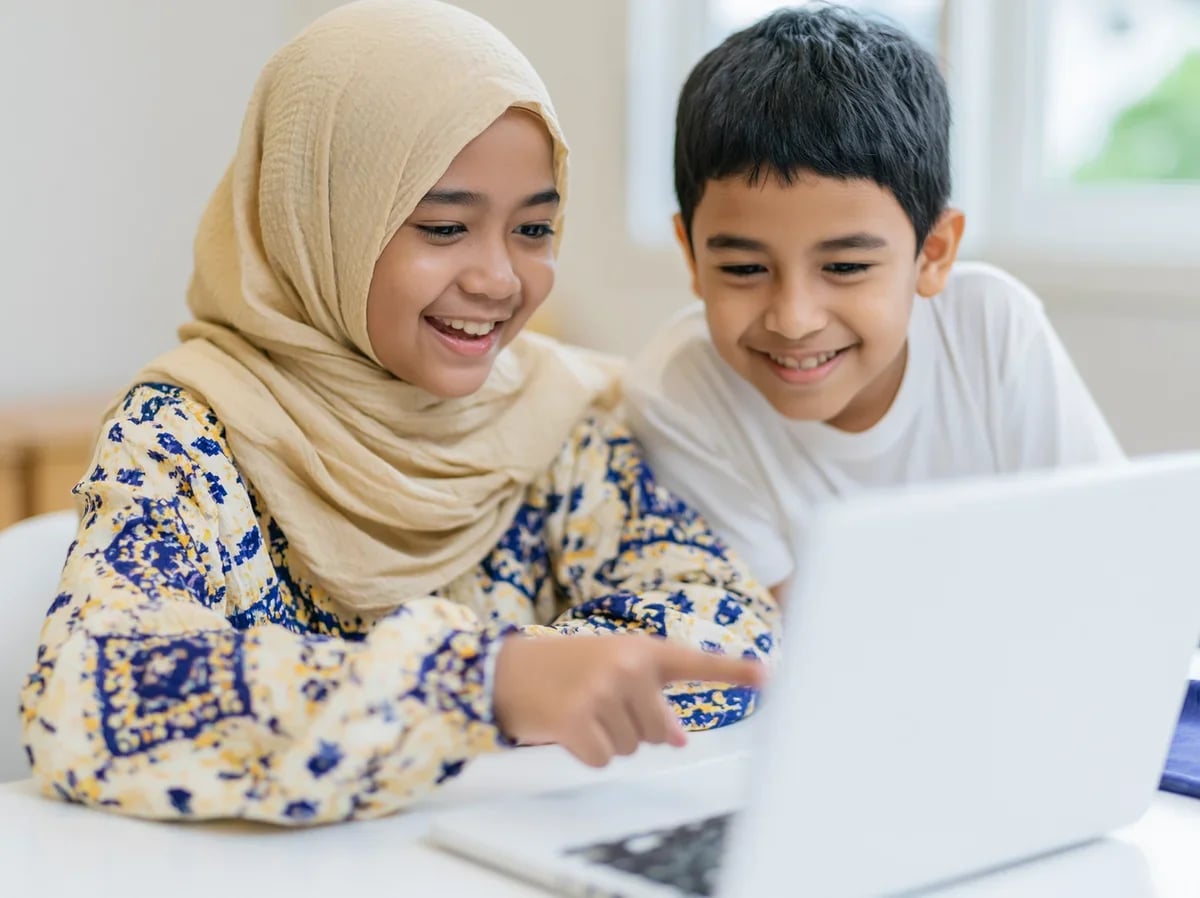
Artificial intelligence, or AI, is a computer's ability to find patterns across large amounts of data and then use those patterns to make decisions on its own, without being programmed rule by rule.
Table of Contents
The difference from ordinary software is about who writes the rules. In ordinary software a programmer writes every rule directly. In AI the programmer supplies a large number of examples, and the computer works out the rules itself.
Imagine you want a computer to recognise a picture of a cat. The old approach means writing rules one by one: if there are triangular ears, and whiskers, and a tail. Such rules fail immediately on a cat curled up asleep or photographed from behind.
AI reverses the approach. You give the computer tens of thousands of photos already labelled cat and not-cat. The computer finds for itself the features that separate the two and stores them as a set of numbers. This is called training. Once trained, it can make a guess about a new photo it has never seen.
This way of learning from examples is called machine learning, and it is the engine behind almost all modern AI.
| What the child sees | The AI working behind it |
|---|---|
| Video recommendations on YouTube or TikTok | A system that studies past viewing to guess the next video |
| Google Translate | A language model trained on millions of sentence pairs |
| Filters and portrait mode on a phone camera | Image recognition separating a face from the background |
| Voice assistants such as Siri or Google Assistant | Speech recognition plus command understanding |
| Computer opponents in games | Adaptive logic that adjusts to how the player plays |
In other words, children already interact with AI daily, long before they learn its name.
This is the part most often skipped, and the most important one for children.
From the 2025/2026 school year, coding and artificial intelligence entered Indonesian primary and junior secondary schools as elective subjects. AI is no longer an extracurricular topic but part of the curriculum a child will meet.
What separates a prepared child from an unprepared one is not the ability to use AI, which is easy. It is the ability to judge when an AI answer deserves trust and when it needs checking. That judgement grows from understanding how it works, not from memorising terms.
In Algonova's AI classes for children, kids build a simple model themselves and see first-hand why it sometimes gets things wrong. Want to try? Join a free class.
Artificial intelligence is a computer's ability to learn patterns from many examples and then use those patterns to decide something on its own. The difference from ordinary software: in ordinary software a person writes every rule, while in AI the computer works out the rules itself from data.
Video recommendations on YouTube and TikTok, Google Translate, portrait mode on a phone camera, voice assistants such as Google Assistant, and computer opponents inside games. Children already use AI every day, usually without noticing.
AI is the broad term, while machine learning is one way of achieving it, by training a computer from examples. Almost all modern AI is built with machine learning, but the two terms are not exact synonyms.
No. AI calculates probabilities from patterns in its training data, so it can give a wrong answer in very convincing language. Every fact taken from AI should be checked against another source before it is used for schoolwork.
Children aged 8 and up can grasp the basic idea through concrete examples, such as training a computer to recognise pictures. Deeper concepts like how a model is trained usually suit ages 11 to 12 and above. Since the 2025/2026 school year, coding and AI are also elective subjects in Indonesian primary and junior secondary schools.

Algonova worldwide
Contact
Whatsapp: +62 21 50996971
Email: info@algonova.id
Address
Coworking Area, Gedung IT 6 Lantai Dasar, Nongsa Digital Park, Jalan Hang Lekiu, Kelurahan Sambau, Kecamatan Nongsa, Batam, Indonesia Directorate General of Consumer Protection and Trade Compliance – Ministry of Trade of the Republic of Indonesia. WhatsApp Ditjen PKTN: 0853-1111-1010.
PT Algonova Indonesia Cerdas All rights reserved 2026