Roblox Studio for Kids: How to Start Making Their Own Games (Age, Phone or Laptop)
Learn Coding14 min read
Which Is Better?

Dimas Prasetyo
Education Analyst, Algonova
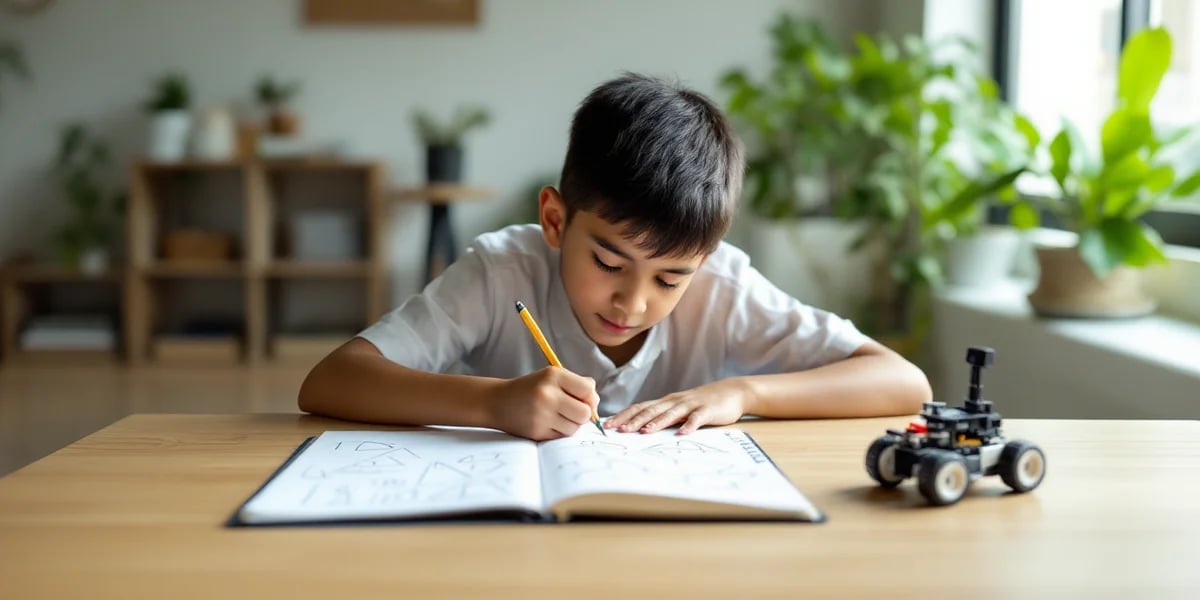
Parents often ask: should my child take a robotics course or maths tutoring? The short answer: maths is more fundamental — because robotics runs on maths, not the other way round.
To be fair, robotics has real strengths. A child works with their hands, assembles something, and watches it move on the table — that builds fine motor skills and gives immediate satisfaction a screen struggles to match.
Robotics also teaches engineering thinking: if the wheel does not turn, find the cause, fix it, try again. For a child who gets bored sitting still, it is a very good fit.
We do not teach robotics, so we have no reason to talk it down.
Look at what a child actually does when programming a robot:
Every one of those is maths. If a child has it, robotics opens up. If not, what remains is assembling a kit by the manual and pressing a button.
That is the core point: maths is the layer underneath robotics. A child strong in maths can move into robotics at any time. A child good at assembling but weak with numbers will stall at the same point, over and over.
Maths marks decide report cards, graduation, and UTBK/SNBT for state university entry. No national exam assesses the ability to build a robot.
Medicine, economics, architecture, data, engineering, even design — all stand on numbers. Robotics is one field of application. Investing in the base layer opens more doors.
A child who does not grasp fractions in year 4 will struggle with algebra in SMP, then trigonometry in SMA. The gap widens every year. Robotics has no such chain effect — it can be started any time without accumulated debt.
If a child is already comfortable with numbers and looking for ways to apply them, robotics is an excellent next step. Or if a child has no interest in screens at all and only wants to work with their hands, robotics can be the first door into logical thinking.
But if you have to choose one, and the child is still in primary or lower secondary school: put maths first. It is the layer that carries everything else, robotics included.
At Algonova, maths tutoring for kids is taught through projects and visuals rather than rote drilling — children see what the numbers are actually for.
There are primary school maths classes for years 1–6 and SMP & SMA maths including UTBK preparation. Classes run live with a teacher in Private (1 student), Mini (2-4 students), and Group (up to 10 students) formats.
Try one free class and see how your child responds.
For most children, maths is the more fundamental base, because it underpins robotics, coding, and science alike. Robotics is engaging and fun, but without strong logic and numbers a child soon hits a ceiling. Ideally the two run together, starting from a foundation of logic. To find the right path, see the programs on the Algonova classes page, or try a free maths diagnostic first.
If you have to pick one, maths is more fundamental. Robotics uses maths — angles, ratios, logic — so a child strong in maths can move into robotics at any time, while the reverse does not hold.
Yes. Turning a robot 90 degrees uses angles, calculating wheel rotations uses circumference and proportion, and sequencing commands uses logic. Without that base, a child is only assembling a kit by the manual.
When a child is already comfortable with numbers and wants to apply them, or when a child has no interest in screens and only wants to work with their hands. Robotics works as a next step, not as a replacement for the base.
No. Algonova teaches maths, coding, AI and digital design for ages 5–17. We do not run robotics classes.
Because gaps in maths compound. A child who misses fractions in year 4 will struggle with algebra in SMP and trigonometry in SMA. Robotics has no such chain effect and can be started at any time.
Blog

Algonova worldwide
Contact
Whatsapp: +62 21 50996971
Email: info@algonova.id
Address
Coworking Area, Gedung IT 6 Lantai Dasar, Nongsa Digital Park, Jalan Hang Lekiu, Kelurahan Sambau, Kecamatan Nongsa, Batam, Indonesia Directorate General of Consumer Protection and Trade Compliance – Ministry of Trade of the Republic of Indonesia. WhatsApp Ditjen PKTN: 0853-1111-1010.
PT Algonova Indonesia Cerdas All rights reserved 2026