
Online Math Tutoring for SMP Students: How to Choose and What to Check in the Trial Class

Learn Math10 min read
Parent Guides

Maya Putri
Early Childhood Education Specialist
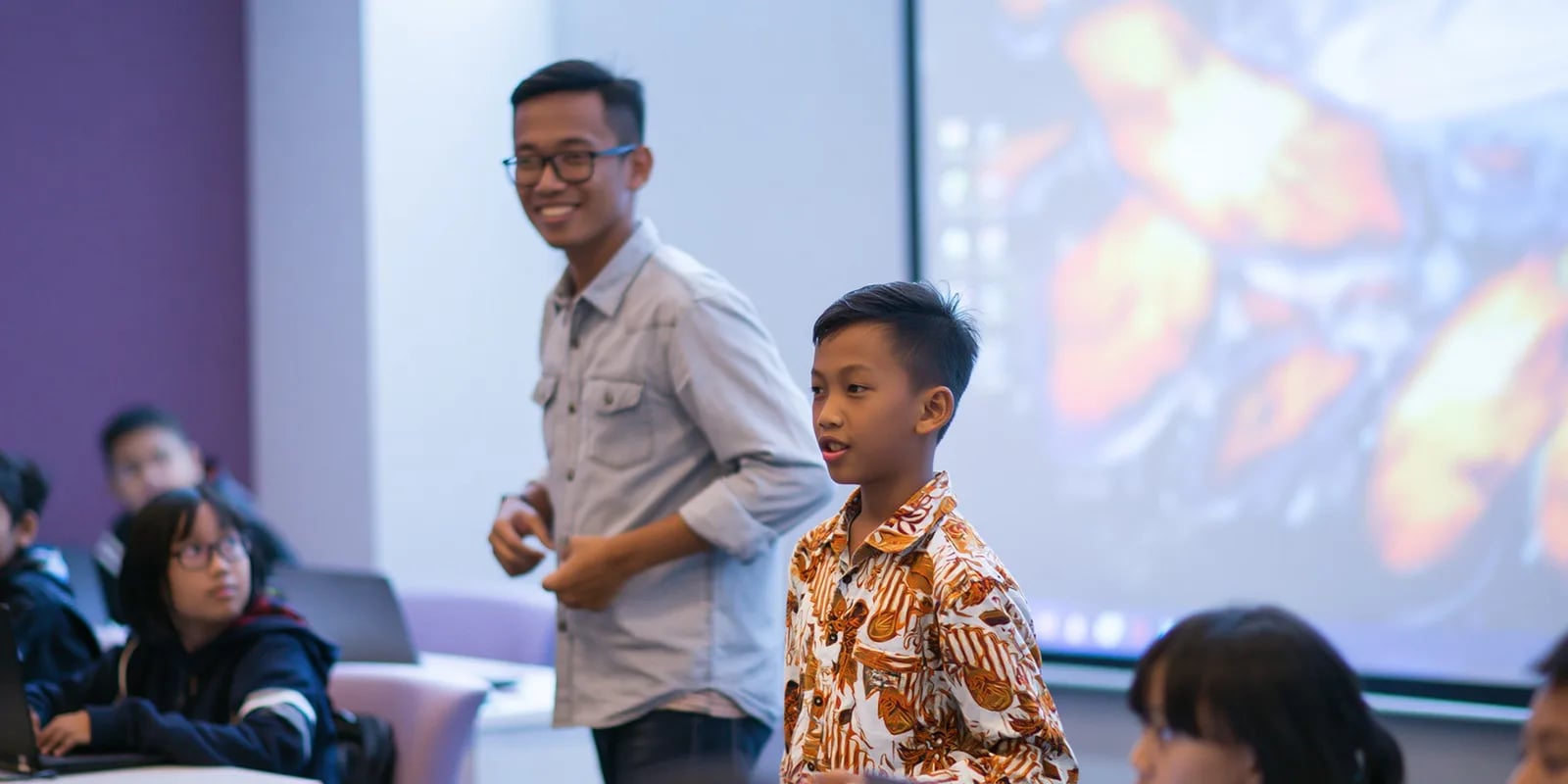
Families in Surabaya, East Java have several kids coding class options: some providers teach fully online, others have in-person classes in this city. This page summarises six options and how to compare them. Algonova pricing starts from Rp 102,000 per lesson.
Algonova is an online school for coding, math, AI, and design for children aged 5-17: 1,000,000+ alumni across 97 countries since 2016. Classes are live with certified teachers in Private (1 student), Mini (2-4 students), and Group (up to 10 students) formats.
This is a set of options for parents to compare for themselves — not a quality ranking, and not a complete directory of every provider in Surabaya.
A few notes before you read on:
Online classes remove one hidden cost parents rarely count: round-trip travel time.
In a city the size of Surabaya, driving a child to a class twice a week can mean hours on the road at peak times — time and energy spent before the lesson even starts. Learning from home removes that commute entirely: the child sits at their own desk, parents can sit in on the first session, and evening or weekend slots are far easier to arrange.
That said, some children genuinely focus better in a classroom alongside peers, and that is a valid reason to choose an in-person format. No single format is better for every child. What matters more is whether the class is genuinely live with a teacher rather than pre-recorded video.
Algonova is a fully online school for coding, math, AI, and design, available to families in Surabaya and across Indonesia.
Every class is taught live by a certified teacher — not pre-recorded video — in three formats: Private (1 student), Mini (2-4 students), and Group (up to 10 students). The learning path is progressive: Scratch for beginners, then Roblox, then Python and AI as the child's ability grows.
The coding programme is split into three age tiers: Little Coders (5-7), Junior Coders (8-12), and Teen Coders (13-17). Primary school kids join the coding classes for kids 8-12, and teenagers the coding classes for teens. Regular classes run 90 minutes, and the trial class is a free 60-minute masterclass. Since 2016, more than 1,000,000 alumni across 97 countries have studied with Algonova.
See all programmes and age tiers on the coding classes page, or try a free coding class to judge the teaching quality for yourself. For a detailed explanation of how our online classes work for children in this city, read online coding classes for kids in Surabaya. For an overview of every Algonova subject, see kids courses in Surabaya.
Timedoor Academy is an Indonesian-founded kids IT school that started in Bali and runs a network of in-person branches in several major cities, including Surabaya.
Its programmes generally cover coding (Scratch, Python), game programming (Roblox), and web development. Children attend a branch and learn in a classroom with a local Indonesian-speaking instructor; online options are also available for families outside branch cities.
Its strength is clear and something an online format cannot replicate: a physical presence in the city, a local STEM community, and face-to-face interaction with peers. For Surabaya families who specifically want offline classes with a well-known Indonesian brand, it is a reasonable option to consider.
If you are weighing up online against in-person, read the full comparison of Algonova and Timedoor Academy — it sets the two side by side, including which kind of family each one suits.
KodeKiddo focuses on introducing coding early through a child-friendly approach.
It provides learning levels from basic to advanced, with material tailored to school-age children. KodeKiddo offers both online and in-person options and, according to its own website, runs a network of 34 learning centres across Indonesia.
Its strength lies in that national footprint and the physical classroom experience: headquarters in Silicon Valley, robotics classes using kit such as Sphero, micro:bit, and Arduino, students taking part in international competitions such as Codeavour and CTC Battle, and the Klaskoo app that makes it easy for parents to follow their child's progress.
To see how the curricula and class formats differ side by side, read the full comparison of Algonova and KodeKiddo.
Koding Next offers structured technology programmes for children and teens that reach beyond basic coding.
Alongside programming, its curriculum covers robotics, AI, and cybersecurity, with age-appropriate levels.
Its strength is that breadth and its network: a child who has the coding basics can move on to robotics, AI, or cybersecurity without switching providers, and according to its own website it works with 70+ partner schools.
In a city the size of Surabaya, the first question for parents usually isn't which school is best, but which format this family can realistically sustain every week for the next year.
Bayu Nugraha · Children's Coding Specialist, Algonova Indonesia
Coding Bee Academy is a kids coding provider with a structured curriculum and accreditation from external bodies.
According to its own website, it runs 18 learning centres and holds accreditation from STEM.org and Code.org. Its positioning does not stop at technical skill either: the stated aim is to raise well-rounded digital citizens, not just children who can write code.
Its strength is that accreditation: of every provider in this list, Coding Bee Academy is the only one we found that states external accreditation — and it is something you can verify for yourself.
Kodland is an international online coding platform that also serves students in Indonesia.
Its programmes cover game creation, web development, and programming basics. Classes are generally held online in a group format, suiting families who prioritise schedule flexibility without attending in person.
Its strength is international scale and flexibility: as a platform operating online across many countries, Kodland can be joined from any part of Surabaya with no travel at all, across a fairly wide choice of topics from game creation to web development.
The table below summarises what we know and what we have not confirmed. Where a column carries no figure, we genuinely lack verified data — it does not mean the provider is any weaker. The branch counts below come from each provider's own website and can change; confirm them directly.
| Provider | Format | Price | In-person in Surabaya |
|---|---|---|---|
| Algonova | Fully online · Private 1 · Mini 2-4 · Group up to 10 | From Rp 102,000 per lesson | No — we are an online school |
| Timedoor Academy | In-person in branch cities + online option | Not published · contact a branch | Has branches in Surabaya · 3 locations · confirm directly |
| KodeKiddo | Online + in-person at its learning centres | Check with provider | Has branches in Surabaya · 2 locations · confirm directly |
| Koding Next | In-person at its learning centres | Check with provider | Has branches in Surabaya · 4 locations · confirm directly |
| Coding Bee Academy | Online and in-person, depending on programme | Check with provider | Has branches in Surabaya · 2 locations · confirm directly |
| Kodland | Online · group format | Check with provider | No — online only |
Compare providers on class format, group size, teacher qualifications, and the learning path — not on the lowest price or the name that appears most often in ads.
Use this checklist when you contact each provider:
Algonova pricing starts from Rp 102,000 per lesson. For the other providers in this list we state no figures, because we have no rate information we can confirm.
In general, three things shape the cost of a kids coding class: whether it is live or pre-recorded, how many students share a class, and whether the format is online or in-person. In-person classes usually carry venue and equipment costs, so their structure differs from online classes.
When comparing quotes, make sure you are comparing like with like: session length, students per class, and whether a teacher is present live. Two monthly figures can look similar while containing very different things.
The fastest way to decide is to try one session, not to read more reviews.
To see all Algonova programmes and age tiers, visit the coding classes page, or try a free coding class and judge for yourself in a free 60-minute masterclass.
A child can start exploring coding from age 5 through visual block-based games, long before writing actual text code. At an early age, coding is taught through fun drag-and-drop activities, like assembling a puzzle. Children learn sequencing logic and cause-and-effect without typing. In early classes, a child starts by moving a character on screen using colourful command blocks; within weeks they can make simple animations themselves and proudly show their parents. As they grow, the material advances to text languages like Python. Algonova accepts students aged 5 to 17 with learning paths tailored to each age group. Book a trial class to find the level that best fits your child.
Choose a school with live classes, small groups, certified teachers, and a curriculum that levels up with the child's ability. Many platforms look similar in ads, but the difference lies in details: whether classes are truly live or just recorded video, and how many children are in one class. A cheap, large class often makes a child lose interest because they rarely get a turn to ask; in a small group, every child has room to ask questions and stay engaged. Always use a trial class before committing — the child's reaction is the best indicator. Algonova offers three formats — 1-on-1 private, a mini-group of 2–4, and a group of up to 10 — all far more personal than classes of dozens.
For most children, one to two structured sessions per week, each 90 minutes, is enough for steady progress. Consistency matters far more than long duration. Learning regularly helps children absorb concepts without burnout. A rhythm of twice a week after school, for example, keeps a child enthusiastic and unburdened amid other schoolwork, while still leaving time to play. What matters most is a schedule the family can sustain long-term. Structured classes with a live teacher, like the private and small-group formats at Algonova, help children stay focused throughout the session.
Structured coding differs from passive screen time because the child is actively creating something, not just watching or scrolling. When coding, a child solves problems, designs logic, and builds projects — the brain works actively, not consumptively. This quality of screen time is what sets it apart from endless video watching. Parents who were initially worried about screens often see the opposite: the child draws more on paper to design a game before building it on the computer. You can still balance it by keeping the number of sessions measured, one to two per week, and encouraging offline activities. Screen time spent creating something has a different value from passive entertainment.
A child doesn't need to master advanced math to start coding — basic arithmetic skills are more than enough for beginners. Quite the opposite, coding often helps children understand math more concretely and enjoyably, as they see numbers and logic working in real time on screen. For example, coordinate concepts become far easier to grasp when a child moves their own game character — even for a child who previously disliked math. At Algonova, coding and math are taught in an integrated way so they reinforce each other. This approach helps children see math not as memorization, but as a tool to create something they love.
Both are effective — the best choice depends on the child's learning style and the family's needs, not the format itself. Online classes offer schedule flexibility and save travel time, ideal for busy families. Offline classes provide direct face-to-face interaction that some children prefer. Families living far from the city centre usually choose online, while others prefer dropping their child at weekend in-person classes for socializing. What determines quality is not online versus offline, but whether the class is live with a real teacher. Algonova classes are held fully online, so families anywhere in Indonesia can join.
The cost of a kids coding course in Indonesia varies widely depending on format, class size, and program duration. At Algonova it starts from Rp 102,000 per lesson. Factors affecting price include whether classes are live or recorded, the number of students per class, and online versus in-person. Small-group classes with a live teacher generally cost more because of their personal attention. When comparing several options, the cheapest often turns out to be recorded video — so a slightly pricier live class delivers more tangible results. The best way to judge a course's value is to try a trial class first. Book an Algonova Master Class to directly experience the quality of live small-group classes before deciding.
There are several options, and all of them can be accessed online from anywhere in Surabaya. This page summarises six of them: Algonova, Timedoor Academy, KodeKiddo, Koding Next, Coding Bee Academy, and Kodland. This list is not a quality ranking and not a complete directory of every provider in the city. The order means nothing, and we do not rate other schools. Of the six, four run in-person classes in Surabaya: Koding Next, Timedoor Academy, KodeKiddo, and Coding Bee Academy. Algonova and Kodland are fully online. Branch counts and addresses can change, so confirm them directly with each provider before enrolling.
Algonova pricing starts from Rp 102,000 per lesson. For the other providers in this list we state no figures, because we have no rate information we can confirm. Timedoor Academy does not publish rates on its main website; parents need to contact a branch for a quote. The other providers are best asked directly. When comparing, make sure you compare like with like: session length, students per class, and whether a teacher is present live. Two monthly figures can look similar while containing very different things.
Algonova is a fully online school and has no in-person classes in Surabaya or any other Indonesian city. Every class is taught live by a certified teacher over video. For many Surabaya families that is an advantage: no round-trip commute at peak times, the child learns at their own desk, and parents can sit in on the first session. If your child focuses better in a classroom, several other providers in this list have branches in Surabaya. Three formats are available to suit the child: Private with 1 student, Mini with 2-4 students, and Group with up to 10 students. Regular classes run 90 minutes.
Compare on class format, group size, teacher qualifications, and the learning path, rather than on the lowest price. The four questions that separate providers most: whether classes are genuinely live or pre-recorded video, how many children share a class, whether there is a level diagnostic at the start, and whether a trial class is available. Many providers offer a free trial session, so use them to compare. For in-person classes in Surabaya, add one more question: how long is the round trip at peak times. Time on the road is a hidden cost that often only becomes obvious a few months in.
Blog


Algonova worldwide
Contact
Whatsapp: +62 21 50996971
Email: info@algonova.id
Address
Coworking Area, Gedung IT 6 Lantai Dasar, Nongsa Digital Park, Jalan Hang Lekiu, Kelurahan Sambau, Kecamatan Nongsa, Batam, Indonesia Directorate General of Consumer Protection and Trade Compliance – Ministry of Trade of the Republic of Indonesia. WhatsApp Ditjen PKTN: 0853-1111-1010.
