

Online Math Tutoring for Primary & Middle Schoolers: Options & Pricing 2026
Math Education8 min
Course Guides

Bayu Nugraha
Children's Coding Specialist
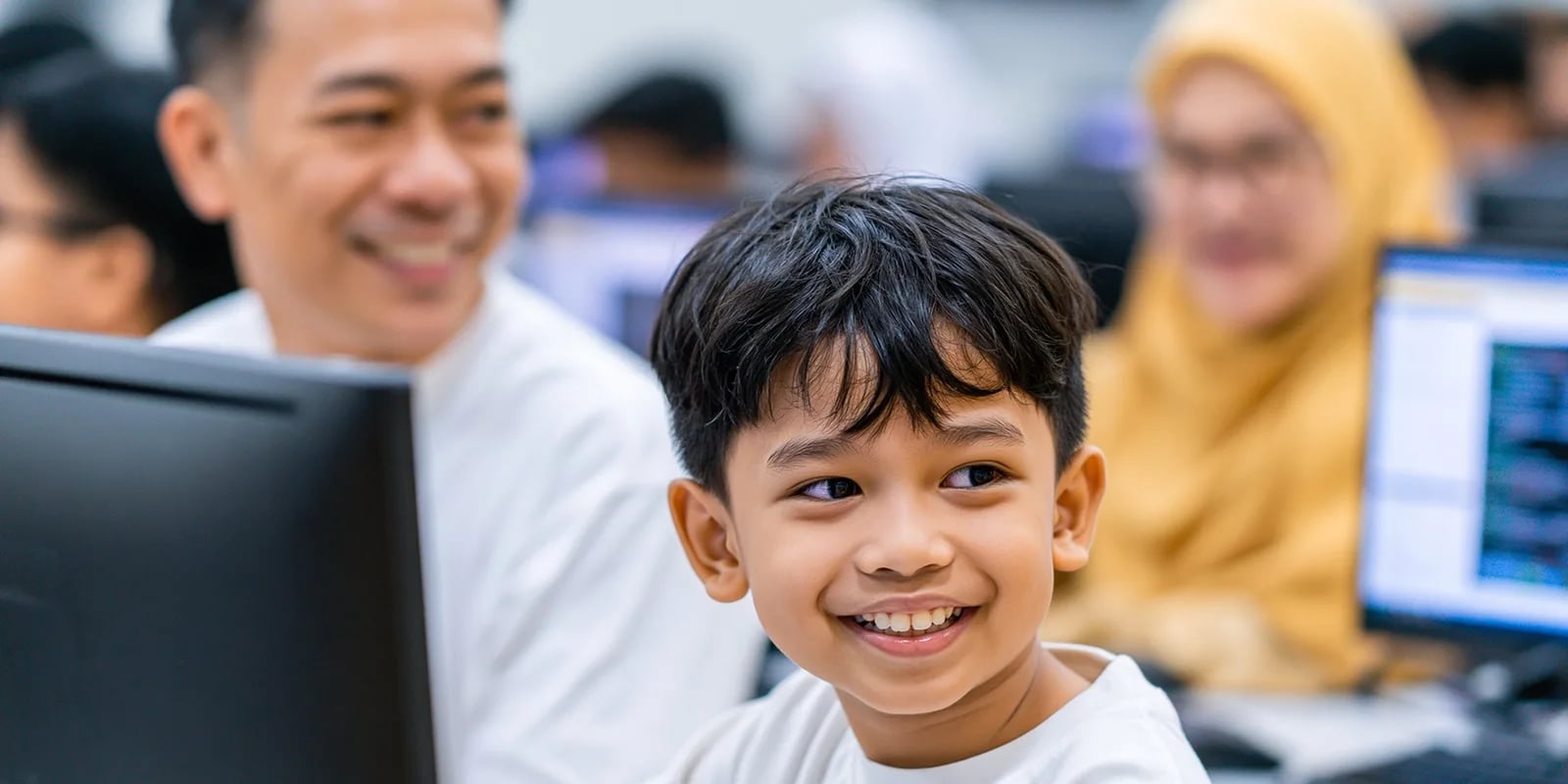
Is your child already comfortable with Scratch and starting to get curious about "real code"? Python is a sensible next step, and a first program can run within minutes.
This guide covers five steps from zero to a working first Python program, written so a child can follow it alone.
Download Python from python.org, then Thonny from thonny.org. Installation works like any regular app. Or open replit.com directly to try it with no installation.
print("Hello, world!")
Press Run (or F5 in Thonny). If "Hello, world!" appears, the first program is already running.
name = input("What is your name? ")
print("Hello, " + name + "!")
Now the program asks a question first, then answers with the typed name.
age = int(input("How old are you? "))

if age >= 10:
    print("You're old enough for the advanced level!")
else:
    print("Let's start with the basics first!")
This line already uses three concepts at once: variables, input, and conditions (if/else).
Combine everything learned so far into a simple calculator:
num1 = float(input("First number: "))
num2 = float(input("Second number: "))
print("Sum:", num1 + num2)
This small but genuinely useful program is a real achievement for day one.
A beginner starts by installing Python and a simple editor like Thonny (or using an online interpreter with no install), writing a single print statement, then gradually adding input and a simple condition before combining it all into a small useful program like a calculator. Understand one concept before moving to the next, and treat errors as a normal part of the process, not a sign of failure. For guided, step-by-step learning with a teacher, see the Python course for ages 9-17, or try a free coding class so your child builds a first working program in a diagnostic session.
1. Wrong indentation. Python uses spaces at the start of a line to mark which code belongs where (for example, the body of an if). One wrong space makes the program error out.
2. Forgetting the quotation marks. Text in Python has to be wrapped in quotation marks ("like this"). Unclosed quotation marks are the most common source of errors for beginners.
3. Jumping to a big project before understanding the basics. Wanting to build a game or a bot right after learning print() usually ends in confusion. Master variables, conditions, and loops first, before moving on to bigger projects.
Around 9-12 years old, ideally after building a logic foundation in Scratch or another visual block platform. Teens who only start coding later can begin straight from Python without any problem.
Errors in Python can be confusing for beginners, and they often make a child stop trying. In the Algonova Python classes, certified teachers debug together with the child live, in Private (1 student), Mini (2-4 students), and Group (up to 10 students) formats. The first trial class is free, with no obligation to continue.
Python is free, light enough for an ordinary laptop, and a first program can run within minutes. The key: understand one concept before moving on to the next, and treat errors as a normal part of the process, not a sign of failure.
Yes, Python is completely free to download and use from python.org. Beginner editors like Thonny are also free. It can also be tried directly online with no installation via sites like replit.com.
No. Python runs lightly even on an old laptop. All that's needed is enough RAM to run a browser or a basic code editor.
Not required, but it helps a lot. A child with a logic foundation from Scratch usually grasps the same concepts faster when they appear as text in Python.
A simple program like a calculator can be finished in 30-60 minutes. What usually slows things down isn't concept difficulty, but small mistakes like indentation or a missing quotation mark.
The most common causes are wrong indentation, an unclosed quotation mark, or unmatched parentheses. Reading the error message to find which line has the problem is a basic debugging skill to practice, not a sign of failure.
Around ages 9-12 for a basic introduction, especially with a logic foundation from Scratch already in place. Teens starting coding later can also jump straight into Python.

Algonova worldwide
Contact
Whatsapp: +62 21 50996971
Email: info@algonova.id
Address
Coworking Area, Gedung IT 6 Lantai Dasar, Nongsa Digital Park, Jalan Hang Lekiu, Kelurahan Sambau, Kecamatan Nongsa, Batam, Indonesia Directorate General of Consumer Protection and Trade Compliance – Ministry of Trade of the Republic of Indonesia. WhatsApp Ditjen PKTN: 0853-1111-1010.
PT Algonova Indonesia Cerdas All rights reserved 2026
