Roblox Studio or Scratch: Which First for an 8 to 10 Year Old?
Learn Coding8 min read
Parent Guides

Aina Rashid
Parent Education Editor, Algonova Malaysia
What is an enrichment class? It is a paid class outside school that builds a skill the school timetable only touches, such as coding, art, music, public speaking or mental arithmetic. Tuition follows the KSSR syllabus and aims at better marks. A coding class is one kind of enrichment. Our rule of thumb for a primary school child aged 7 to 12: one tuition subject and one enrichment class a week is plenty.
An enrichment class teaches a child something beyond the school syllabus, at a pace set by interest rather than by exams. In Malaysia the label covers a lot: coding and robotics, drawing and digital design, piano, speech and drama, chess, abacus, language clubs.
Malaysian teachers already use the idea inside school. In many primary classrooms, pupils who are behind get pemulihan (remedial work) and pupils who finish early get pengayaan, extra tasks that stretch them. A private enrichment class does that second job after school hours, usually once a week for 60 to 90 minutes.
The easiest way to tell the two apart is the goal. A class that exists to raise a UASA score in Mathematics or Bahasa Melayu is tuition, even if the brochure says enrichment. A class that builds something your child will still use in five years, like making a game or speaking in front of 30 people, is enrichment.
Tuition fixes gaps in school subjects, enrichment builds new skills, and a coding class is a skill class with a clear technical path. Here is how the three compare for a child in Year 1 to Year 6.
| Tuition | Enrichment class | Coding class | |
|---|---|---|---|
| Main goal | Better marks in school subjects | A new skill or a stronger interest | Building games, apps and logic step by step |
| Follows KSSR? | Yes, chapter by chapter | No, its own programme | No, but it uses maths and logical thinking |
| How progress shows | Tests and UASA results | A performance, a drawing, a grade or badge | Finished projects your child can open and show |
| Typical rhythm | 1 to 3 sessions a week, more before exams | 1 session a week all year | 1 session a week in a course of about 36 lessons |
| Best when | Marks are slipping in one subject | The child copes well and has a clear interest | The child likes games, puzzles or building things |
| Main risk | Repeating school work the child already dislikes | Paying for a hobby the child drops in a month | Screen time with no real building, if the class only plays |
If your child is behind in a school subject, fix that first. Enrichment pays off on a child who is not already struggling.
Yes, when it matches a real interest and still leaves time for rest and play. Children who picked the activity themselves usually stick with it longer, and a skill practised for a year or two gives them something to be proud of that has nothing to do with marks.
It goes wrong in three common ways. The first is a full timetable. The World Health Organization recommends that children aged 5 to 17 get an average of 60 minutes of moderate to vigorous physical activity a day, in its 2020 guidelines on physical activity. A child with school, homework, tuition and three enrichment classes rarely gets that hour.
The second is tuition in disguise: worksheets from the school textbook under a new name. The third is a choice made only by the parent. If your child cried before every piano lesson for a whole term, the class isn't giving them much.
Start from your child, not from the list of classes nearby. These 5 steps take one evening and one trial week.
For a longer list of questions to ask a centre, see our guide to choosing a tuition centre near you.
The right class depends on what each child needs this year. These three cases come up again and again with Malaysian families.
Aisyah, 7, is in Year 1. She reads well but counts on her fingers and freezes at simple word problems. Maths comes first for her, because gaps in Year 1 get bigger by Year 3. Our maths classes for ages 6 to 8 start with a diagnostic, so the teacher knows which topics to rebuild.
Daniel, 9, is in Year 3. His marks are fine and he spends weekends designing levels in a game, which makes him the classic case for a coding class. In Scratch, a free tool from MIT made for ages 8 to 16 (Scratch for Parents), he can build his own game instead of only playing other people's.
Mei, 11, is in Year 5. She does well in Science but goes quiet during class presentations. A speech and drama or debate class would help her most. Coding can wait, or she can try both for a term and keep the one she likes.
None of the three needs three classes at once. With one clear goal per term, you can actually tell whether the class worked.
For most families the choice comes down to travel time and group size. A centre 30 minutes away in Klang Valley traffic adds an hour of driving to every session, and that hour usually comes out of homework or play.
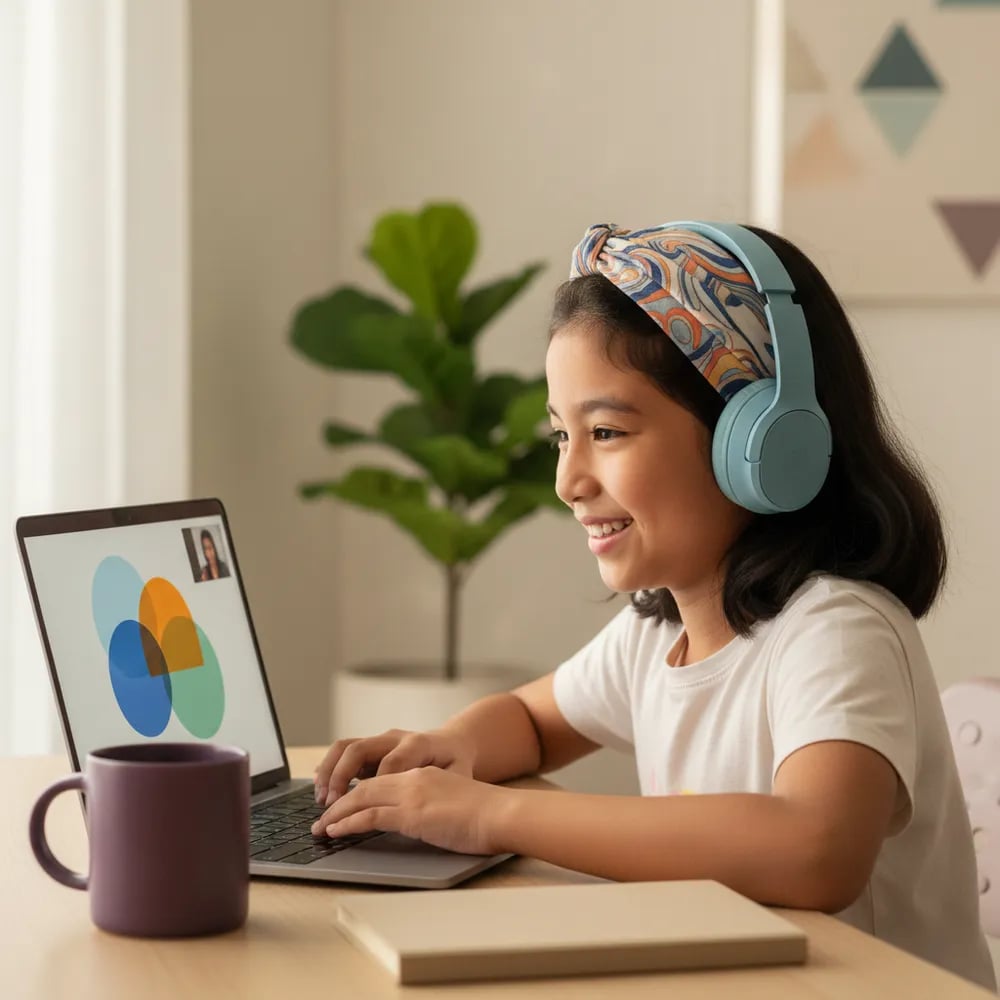
Online classes work well for coding, design and maths, where the work happens on a screen or on paper anyway. Check two things: a live teacher rather than recorded video, and a small group. At Algonova, coding and maths classes run live online in groups of up to 10 children with a certified teacher.
A centre still makes more sense for music, sport, drama and art with real paint and clay. Our comparison of online vs physical coding classes goes into the trade-offs, and the guide on how to choose a coding school lists the questions to ask before you pay.
An enrichment class for kids is a regular class outside school that builds a skill or interest beyond the school syllabus. Common examples in Malaysia are coding, robotics, art, music, chess, abacus and public speaking. "Enrichment" means adding to what the child already learns, rather than repairing gaps. A Year 3 child who already copes with maths might join a weekly coding class to build games and practise thinking in logical steps. Most enrichment classes meet once a week for 60 to 90 minutes and follow their own programme instead of KSSR textbooks. Parents usually choose them for confidence, creativity or a skill that will matter later. If a class mostly repeats school worksheets, it is closer to tuition, whatever its name. A useful first question for any centre: what will my child be able to do after 3 months?
Tuition follows the school syllabus and aims at better marks, while an enrichment class builds a separate skill and does not follow KSSR chapters. Tuition is judged by test results such as UASA, and its content moves with the school calendar. Enrichment is judged by what the child can make or perform: a game, a drawing, a short speech. Take two Year 4 children. One has weak fractions and will gain more from tuition, because that gap affects every later maths topic. The other has good marks and loves building things, so a coding or design class suits her better. Many families combine one of each. The simple rule is to close the gap in a weak core subject first, then use enrichment to stretch a strength. For most primary school children, one tuition subject and one enrichment class a week is enough.
Yes, an enrichment class is good for a primary school child when it matches a real interest and does not crowd out rest and play. Children who chose the activity usually practise it longer, and a year of steady practice builds confidence that has nothing to do with marks. Problems start when the timetable is too full. The World Health Organization recommends an average of 60 minutes of moderate to vigorous physical activity a day for ages 5 to 17, and a child with three or four classes after school rarely gets it. Another warning sign is a child who dreads the class every week for a whole term. In that case, change the class rather than push harder. Our advice is one enrichment class a week, kept for at least one school term before you decide whether it works.
Yes, a coding class is a type of enrichment class, because it teaches a skill outside the core school syllabus. Progress is easier to see than in many other enrichment classes, since each lesson ends with something the child built: a game, an animation, a small program. Children aged 8 to 11 usually start with block coding in Scratch, which is free and designed for ages 8 to 16. Older children move on to Roblox Studio or Python. Coding also gives school maths a practical use, because it relies on sequences, patterns, coordinates and simple logic. Making a character jump, for instance, means working with positive and negative numbers on a grid. At Algonova, coding runs in 5 courses for ages 5 to 17, and a free 60-minute master class shows whether your child enjoys it before you sign up.
Most children are ready for a structured enrichment class at around 5 to 7 years old, once they can sit with a teacher and focus for most of an hour. Before that, free play, reading together and time outdoors usually do more than a timetable. The right age also depends on the activity. Music and swimming often start early. Block coding in Scratch suits children from about 8, when they can read short instructions on their own, while simpler computer-skills classes can start younger. A 7 year old who loves drawing may enjoy an art class long before a coding class. So watch for interest rather than a target age. If your child asks to do the same thing again and again at home, that is a good reason to try a class in it for one term and see how it goes.
One or two enrichment classes a week is enough for most primary school children, and one is often better. Each class needs time for practice at home, travel and rest. Try a quick check: list a normal week of school, homework, religious class, tuition, sport and family time. If fewer than 3 free hours remain, add only one class. Too many activities tend to show up as tiredness, slipping homework or a child who no longer plays on their own. Picture a Year 2 child with school until 1 pm, religious class in the afternoon and one tuition subject. That week is already full, and one weekend coding or art class is the most that fits. Look at the timetable again each school term, and drop the class your child talks about least.
Online enrichment classes can be as good as classes near you for subjects done on a screen or on paper, such as coding, digital design and maths. They are weaker for music, sport, drama and crafts that need physical materials or a stage. Quality depends less on location than on three things: a live teacher rather than a video, a small group, and a clear project in each lesson. Online classes also cut travel time. A 60-minute class at a centre 30 minutes away takes 2 hours out of the afternoon once you count the drive both ways, and longer in Klang Valley traffic. At Algonova, coding and maths classes run live online in groups of up to 10 children with a certified teacher, so you can judge one free class at home before you commit to a course.
If your child is behind in maths, start with maths support, then add coding once the gap is closed. Weak number sense in Year 1 and Year 2 turns into bigger problems with fractions and word problems later, and coding won't repair it on its own. If maths marks are fine and your child enjoys games, puzzles or building, a coding class is a good next step and gives maths a practical use. Some children do both, with one maths session and one coding session a week. A Year 2 child who still counts on fingers might do maths for one term and add coding in the next. Algonova maths classes are for ages 6 to 8 and begin with a free diagnostic of about 60 minutes, which shows which topics need work and comes with a written report for parents.
An enrichment class is working when your child can do something new after 8 to 10 weeks and still wants to go. Ask the teacher for evidence you can see: a finished project, a video of a performance, a piece of art, or a skill your child can show you at home. In a coding class, your child should be able to open a game they built and explain how one part of it works. Good signs include talking about the class at dinner, practising without being told and asking for harder tasks. Warning signs include nothing to show, the same worksheet level for weeks, or a child who looks relieved when a lesson is cancelled. If you can't name one new skill after a full term, talk to the teacher or switch to a different class.
Start your child's tech journey
Book your free 60-minute trial class with an Algonova certified tutor. No payment, no obligation, just discover what your child can build.

Algonova worldwide
Contact us
Email: int_legal@alg.team
Visit us
Suite 8634, 1021 E Lincolnway, Cheyenne, WY, Laramie, US, 82001
Algonova online LLC International tech school for kids and teens