Coding Competitions for Kids in Malaysia 2026/2027: List, Ages and How to Prepare
Checklists & Calendar7 min read
Which Is Better?

Arjun Menon
Education Analyst, Algonova Malaysia
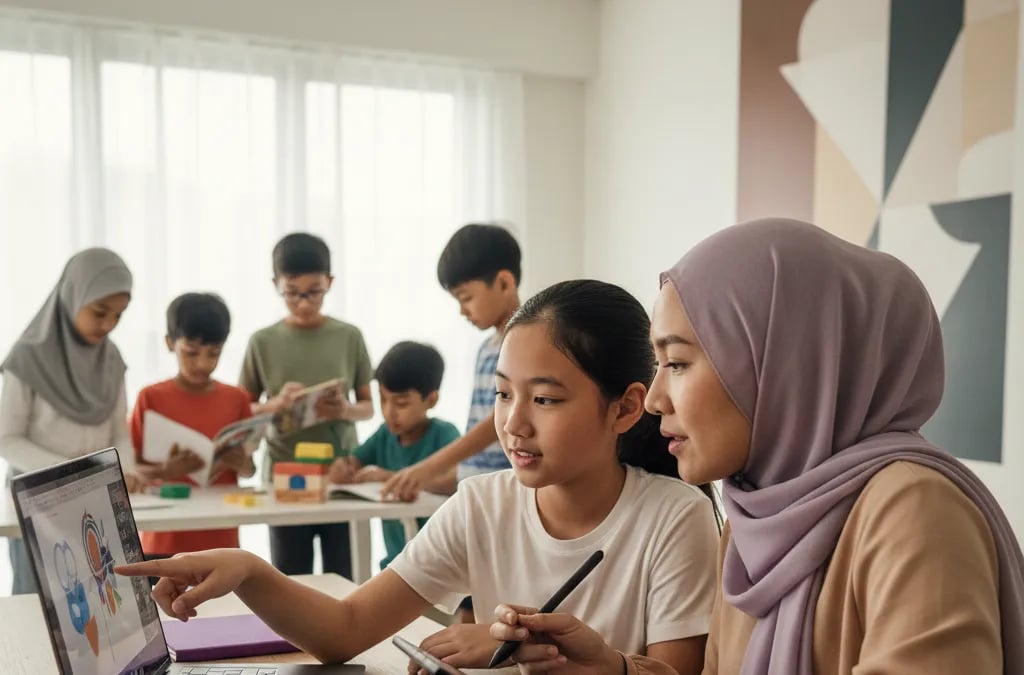
Choosing between coding vs graphic design for kids in Malaysia comes down to one question: does your child want to make things work, or make things look right? Coding builds logic, sequencing and debugging. Graphic design builds composition, colour and visual storytelling. Both suit ages 7 and up, both run about an hour a week, and both can be tested free before you commit to a term.
Coding teaches a child to break a problem into steps. Graphic design teaches a child to hold one idea inside one image. The two overlap more than most parents expect, because both are project work that ends with something the child can show you.
| Coding | Graphic design | |
|---|---|---|
| Core skill | Logic, sequencing, debugging | Composition, colour, typography |
| First tools | Scratch, then Python | Canva, Figma, Photoshop basics |
| Comfortable start age | 6-7 | 8-9 |
| What one lesson produces | A game or script that runs | A poster, logo or character |
| Feedback loop | Instant: it works or it doesn't | Slower: it is judged, not tested |
| School subjects it touches | Mathematics, Science, ICT | Visual Arts, RBT, folio work |
| Fits a child who | Asks why something happened | Redraws things until they look right |
A coding lesson is about an hour spent building one small thing that runs. There is almost no theory block at the start. A typical session goes like this:
That last part carries more weight than it looks. A visible result every single week is the main reason live classes hold attention better than worksheets.
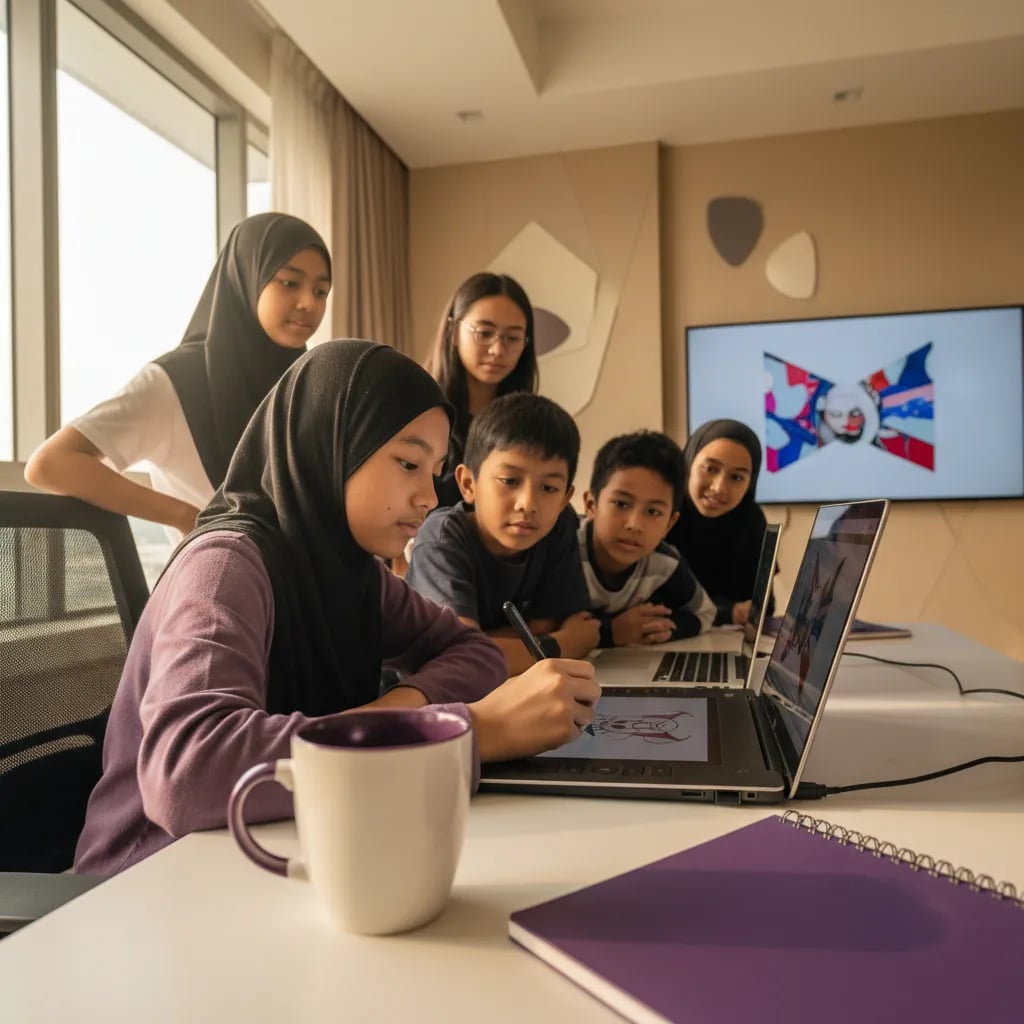
A design lesson is an hour of making one visual that has to communicate something. The brief is always concrete: a poster for a school event, a logo for an imaginary kedai, a character for a game.
The skill that grows fastest here is not drawing. It is judgement: deciding what to take out. You can see the progression we use in our graphic design course for kids.
Coding transfers to Mathematics and Science. Design transfers to folio work and presentations. Both have a landing spot in the Malaysian syllabus, but they land in different places.
| School need | Coding helps | Design helps |
|---|---|---|
| Mathematics: patterns, variables, logic | Strongly | Weakly |
| Science: modelling and testing a guess | Strongly | Weakly |
| RBT and Design and Technology | Moderately | Strongly |
| Visual Arts | Weakly | Strongly |
| Folio work and presentations | Weakly | Strongly |
| Structured problem solving in exams | Strongly | Weakly |
One honest caveat. Coding builds the habit of thinking in ordered steps, but it does not move exam marks on its own. If maths results are the actual worry, a maths class aimed at the syllabus is the faster route, and the same logic applies when parents compare Kumon and Eye Level.
Before age 8 the choice barely matters. After 12 it starts to matter a lot. Young children are sampling; teenagers are building something they can show.
| Age | Coding | Graphic design |
|---|---|---|
| 5-7 | Block coding fits well, Scratch style | Usually too abstract, free drawing is enough |
| 8-10 | Scratch projects, first game logic | Canva posters, basic composition |
| 11-13 | Python basics, real syntax | Figma, layout, simple branding briefs |
| 14-17 | Python, web projects, portfolio | Photoshop and Illustrator, client-style briefs |
For a 6-year-old, pick whichever class has the better teacher and the better time slot. The subject matters less than the habit of turning up and finishing something.
Watch what your child does when nobody has assigned anything. That is the honest signal, not what they say when you ask directly.
Leaning towards coding:
Leaning towards design:
If both lists describe your child, that is common and not a problem. Game design sits in the middle of the two, and it lives inside our coding programme. The same either-or question comes up with coding versus robotics, and the answer there is similar: let the child try before you theorise.
Both are real career routes here. Coding has the wider job base, design has the lower barrier to a first paid piece of work. Malaysia's digital economy push, run through MDEC, pulls on both sides at once.
A teenager with a design portfolio can pick up small freelance jobs earlier, sometimes at 16. A teenager with coding skills tends to have more openings when they finish studying. Neither choice at age nine locks anything shut, and the crossover roles above are growing faster than either pure track.
Yes, but one after the other rather than both at once. Two hour-long classes a week on top of school and tuition is too much for most primary-school children. The order that works:
Switching is not failure. It costs far less to find out at lesson four than at month six. Class format matters here too, and the trade-offs are laid out in our piece on group versus private classes.
Your child's answer on day 5 is the strongest signal you will get. Parents tend to over-weight career logic and under-weight whether the child will still want to log in eight weeks from now. Enthusiasm at week eight beats a good argument at week one.
Worth reading next: what parents say after their first term and Kumon versus abacus classes.
Start with the one your child asks about on their own. If there is no clear pull either way, coding is the safer first step for children aged 6 to 9, because block-based tools give instant feedback and the child can see whether something worked within seconds. Graphic design asks a child to judge their own work, which is harder before about age 8. That said, the order matters less than the teacher and the time slot. A child who enjoys the first term will keep going; a child placed in the theoretically correct subject at an awkward hour will quietly stop. Book a free trial of each on different days and let your child pick. Their answer after the second trial is a better predictor than any age chart.
Most children are ready at 8 or 9. Before that, the tools are usable but the underlying skill is not really teachable yet: a 6-year-old can drag shapes in Canva, but cannot yet judge whether a poster reads clearly from three metres away. That judgement is what a design class actually builds. Children aged 5 to 7 get more out of free drawing, building with blocks and block-based coding. From 9 upwards the progression is quick: composition and colour first, then typography, then Figma and layout by about 11, then Photoshop and Illustrator style work in the teenage years. If your child is 7 and set on design, a short taster is fine. Just expect the real jump in ability a year or two later.
Neither is harder overall, but they are difficult in different places. Coding is harder at the start, because syntax and logic are unforgiving and a missing bracket stops everything. After that first wall, progress feels steady and measurable. Graphic design is easier to begin and harder to get good at, because there is no error message telling a child that the spacing is wrong. Feedback comes from a teacher, not from the computer, so progress depends more on the quality of critique the child receives. Children who like clear right-and-wrong answers usually find coding more comfortable. Children who are comfortable with ambiguity and revision often prefer design. Frustration in the first month is normal in both and is not a sign that you chose wrong.
Coding, in most cases, but not for the reason parents expect. A child who loves games is usually drawn to how the systems behave, and coding lets them build those systems: rules, scoring, levels, enemy behaviour. Game art is a real path too, and children who spend their time on character skins, thumbnails or in-game building lean towards design. The clean test is what your child talks about after playing. Complaints about balance, glitches or unfair rules point to coding. Comments about how a character or a map looks point to design. Game design itself needs both and sits inside our coding programme, so a child who cannot choose is not stuck. They can start with coding and add visual work later.
It helps with the habit of thinking in ordered steps, but it does not raise exam marks on its own. Coding forces a child to define a variable, follow a sequence and test whether a result is correct, which overlaps with how word problems are solved. Teachers often notice that coding students are less likely to give up halfway through a multi-step question. What coding does not do is cover the syllabus: it will not teach fractions, geometry or the specific question formats used in school assessments. If your main worry is maths results, a maths class aimed at the syllabus is the faster route, and coding works better as a complement than as a substitute.
Yes, and most students in a design class are not strong illustrators. Graphic design is about arranging elements so a message is clear, not about drawing them by hand. Children work with existing shapes, photos, icons and type, and the skills being taught are hierarchy, contrast, spacing and colour. Plenty of professional designers sketch badly. What matters more is whether your child notices when something looks off and is willing to redo it. If your child has never drawn but rearranges their room, cares about slide backgrounds or comments on logos, they will do fine. Illustration is a separate skill that can be added later if the interest appears.
Expect something showable after the first lesson and a genuine jump after about twelve. In coding, the first lesson usually ends with a small game your child can send to relatives, which is motivating but not yet proof of skill. Real progress shows around lesson ten to twelve, when a child starts changing a project without being told how. In design, the first poster arrives quickly too, and the shift to look for is when your child begins removing elements rather than adding them. A full term is the fair unit of judgement. Assessing after three lessons tells you about the teacher and the time slot, not about your child's aptitude.
Coding has the wider job base, design has the earlier route to first paid work. Software, data and IT roles are more numerous across Malaysian employers, and the digital economy push run through MDEC keeps demand steady. Design roles are fewer but reachable sooner: a teenager with a solid portfolio can take small freelance jobs from around 16, which is rare on the coding side. The fastest growing area is the overlap, in roles like front-end developer, game developer and product designer, where employers want someone who can both build and judge how it looks. None of this is settled by a decision made at age nine. Treat both as skill building rather than career selection.
Yes, and switching part way through is normal rather than a failure. The habits carry over: breaking a task into steps, working to a brief, finishing something and showing it. A child who spends two terms in coding and then moves to design does not start from zero, and often works faster because they are used to iterating. The practical advice is to give the first choice one full term, roughly twelve lessons, before deciding. Switching after three lessons usually reflects a hard first month rather than a genuine mismatch. If interest drops for three weeks in a row and the child cannot say what they are working on, that is the moment to move.
Use the free trials and run them a few days apart. Book one coding trial and one design trial on separate days so your child can compare without being tired from the first. Sit in for the last ten minutes of each rather than the whole hour, because the ending shows whether the child finished something and wanted to keep going. Then ask one question: which one do you want to do again? Avoid asking which was better, since children tend to answer with whichever came second. Check the timetable against school and tuition before committing, then pay for one subject for one term. Running both at once is where families usually overload the week and drop everything.
Blog
Start your child's tech journey
Book your free 60-minute trial class with an Algonova certified tutor. No payment, no obligation, just discover what your child can build.

Algonova worldwide
Contact us
Email: int_legal@alg.team
Visit us
Suite 8634, 1021 E Lincolnway, Cheyenne, WY, Laramie, US, 82001
Algonova online LLC International tech school for kids and teens