
Exam Stress Before UASA: Signs in Your Child and How to Help

Parent Guides12 min read
Which Is Better?

Arjun Menon
Education Analyst, Algonova Malaysia
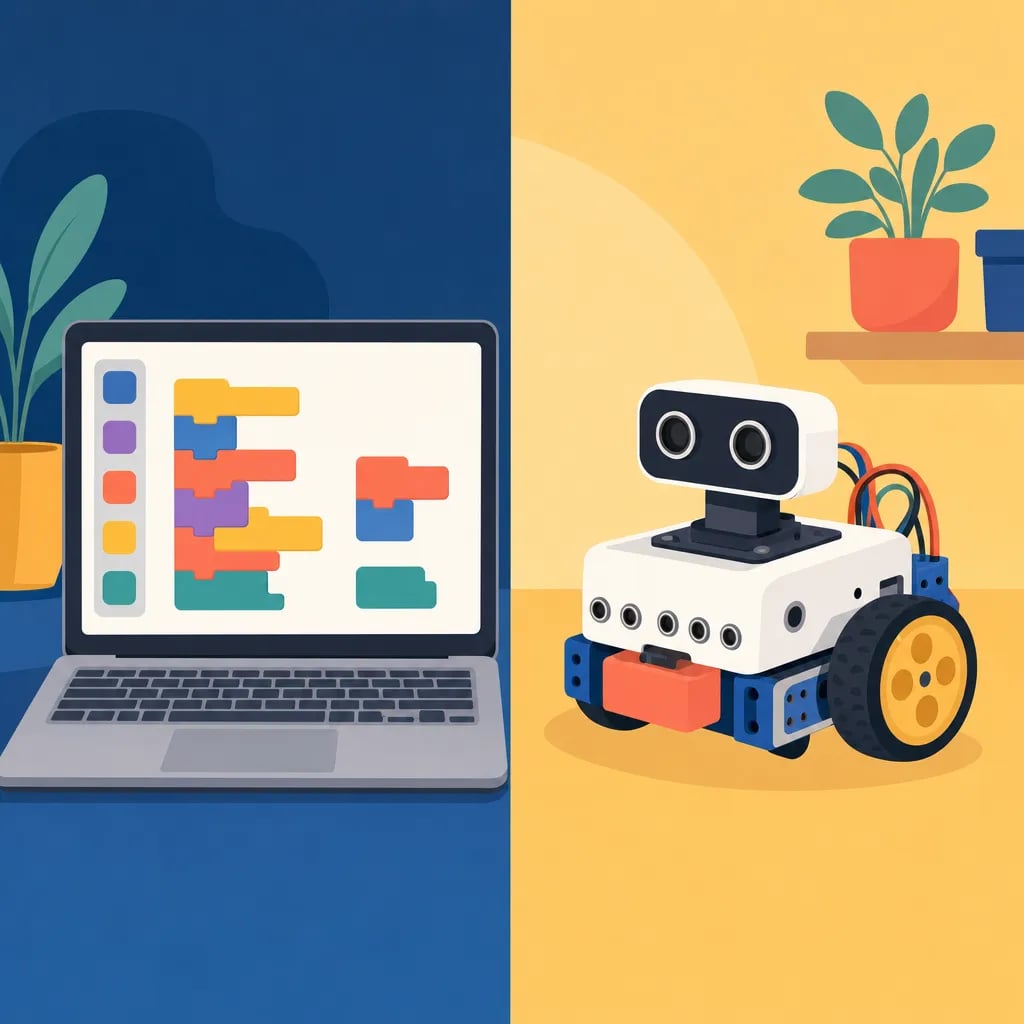
Coding and robotics are both excellent STEM activities for Malaysian children, so the right pick depends on your child: coding for logic-first learners, robotics for hands-on builders — a free trial confirms the fit. Algonova is an international tech school with 10+ years experience, 1,000,000+ students in 97 countries, and a 4.9-star rating. This guide compares coding versus robotics fairly across skills, cost and future paths.
Coding is writing instructions a computer follows; robotics is building and programming a physical machine that senses and moves. For children, these translate into two different daily experiences.
In coding, a child works on screen. Younger kids use block-based Scratch to drag commands and animate stories or games, the approach we use in Coding for Kids age 6-7; older kids move to text languages like Python. The feedback is instant, and no equipment is needed beyond a computer.
In robotics, a child assembles motors, sensors, and parts, then writes simple programs to make the robot move, avoid walls, or follow a line. The learning is tactile and visible in the real world, which many children love.
Both develop computational thinking, the skill of breaking problems into logical steps that Malaysia's KSSR curriculum introduces early. The key difference is medium: coding lives in software and scales endlessly, while robotics adds hardware, cost, and physical craft. Understanding this distinction is the first step to a good choice.
The three differences that matter most are the skills built, the tools required, and the ongoing cost. Weighing these honestly beats picking on reputation alone.
Skills: coding builds logic, debugging, and programming fluency that transfer to apps, games, websites, data, and AI — the kind of path a teen can follow through Coding for Teens age 12-17. Robotics builds those same logic skills plus electronics, mechanical assembly, and physical troubleshooting, a narrower but deeply engaging set.
Tools: coding needs only a computer and internet, so a child can practise anywhere. Robotics needs kits, sensors, and batteries, which must be bought, stored, maintained, and sometimes replaced.
Cost: because of that hardware, robotics generally costs more than coding. At Algonova, coding starts from RM 48 per lesson, with private 1-on-1, mini groups of 2–4, or groups of up to 10 students. We confirm the exact fee after a free trial.
Neither is better in absolute terms. Robotics is superb for tactile, engineering-minded children; coding suits the widest range of interests and future paths.
Coding lives in software and scales endlessly; robotics adds hardware, cost, and physical craft. The right pick depends on your child, not on which sounds more advanced.
Hafiz Rahman · Lead Coding Instructor at Algonova Malaysia
Use this comparison to match each option to your child's temperament, budget, and goals. The table below summarises how coding and robotics differ across the factors Malaysian parents raise most often, from starting age to career breadth.
Read it as a quick scan rather than a scoreboard. Coding tends to win on flexibility and low setup, while robotics wins on tactile, hands-on engagement. Both still develop the computational thinking that KSSR and Malaysia's wider STEM push already value.
| Factor | Coding | Robotics |
|---|---|---|
| Best starting age | 5-6 (block-based) | 7+ (building readiness) |
| Core skills | Logic, debugging, Python, web/game/app building | Logic plus electronics and mechanical assembly |
| Equipment | Computer and internet only | Robot kits, sensors, batteries |
| Typical cost | Lower; no hardware | Higher; kit-dependent |
| Career breadth | Very wide across the digital economy | Specialised: engineering, IoT, manufacturing |
| Learns best if child | Enjoys screens, stories, puzzles | Enjoys building with hands |
The table is a starting point, not a verdict. Many children thrive in either path, and some do both over time. What matters is honest observation of what keeps your child engaged for an hour without prompting.
Choose based on what your child already gravitates toward, then verify with a trial rather than committing blind. Use this quick checklist to narrow it down.
Lean coding if your child: loves games and stories on screen, enjoys puzzles, is aged 6 to 7, or you want the widest future options with no equipment to manage — our take on why Malaysian kids should learn coding in 2026 unpacks this further.
Lean robotics if your child: constantly builds with blocks or Lego, is aged 7 or older, prefers hands-on tasks, and you are comfortable with kit costs.
Consider both if your child shows steady interest in one and curiosity about the other; coding first as a foundation, robotics layered on, works well.
Whichever way you lean, a free Master Class at Algonova is the honest tiebreaker. Our AI-assisted talent diagnostic watches how your child engages, then recommends the best-fit track, often not the one you arrived expecting. Ready to see which clicks? Book a free trial session, and we will match the path to your child and give a clear quote afterward.
Neither is better in absolute terms. Robotics is superb for tactile, engineering-minded kids; coding suits the widest range of interests and future paths.
Hafiz Rahman · Lead Coding Instructor at Algonova Malaysia
For most 7-year-olds, coding is the easier entry point, though robotics works well too if the child loves building with their hands. At age 7, kids are developing logical sequencing but still have limited fine-motor precision, so block-based coding in Scratch feels natural and rewarding. Robotics adds physical assembly, which some children find motivating and others find frustrating. At Algonova Malaysia, we start young learners on visual coding through our Coding for Kids age 6-7 track, then introduce robotics-style logic once they are comfortable. For example, a Kuala Lumpur parent might see their child animate a story in Scratch within the first month, building confidence fast. The best choice depends on your child's temperament, which a free trial session helps us assess directly rather than guessing.
No, you do not need robotics before coding, and neither one is a prerequisite for the other. Robotics and coding are separate skills that overlap: robotics teaches hardware, sensors, and mechanical thinking, while coding teaches logic, sequencing, and problem-solving that apply everywhere from apps to games. Many children start with coding first because block-based tools like Scratch require no equipment and give instant on-screen results. Others begin with robotics kits because physical building holds their attention. There is no fixed order backed by education research. In Malaysia, KSSR introduces basic computational thinking early, so coding pairs naturally with school learning. At Algonova, our free Master Class diagnostic looks at your child's interests first, then recommends whichever path fits, rather than forcing a sequence.
Coding builds more directly transferable future job skills, because software runs through nearly every modern industry, while robotics is a strong but more specialised field. Coding develops logic, debugging, and programming languages like Python that apply to web development, data, AI, and automation. Robotics combines coding with electronics and mechanical engineering, which suits careers in manufacturing, IoT, and hardware design. Malaysia's MyDIGITAL blueprint targets the digital economy contributing 25.5% of GDP by 2030, and most of that demand is software-driven. That makes coding fluency valuable across the widest range of roles. For example, a teen who learns Python through our Coding for Teens age 12-17 track can move toward data science, game development, or app building. Robotics remains excellent for hands-on engineering interest.
Robotics classes in Malaysia typically cost more than coding classes, mainly because robotics requires physical kits, sensors, and hardware that coding does not. Coding classes need only a computer and internet, so there is no equipment bill on top of the lesson. Robotics fees often include or add kit costs, which raises the total. At Algonova, coding starts from RM 48 per lesson, with private 1-on-1, mini groups of 2–4, or groups of up to 10 students. We confirm the exact fee after a free trial session where we assess your child's level and goals. This keeps pricing honest and matched to real needs.
Yes, your child can do both coding and robotics, and combining them often produces the strongest results. Coding teaches the logic and problem-solving that robotics then applies to physical machines, so the two reinforce each other naturally. Many families start with one, usually coding because it needs no equipment, and add the other once the child shows steady interest. There is no rule that forces a choice. At Algonova Malaysia, learning paths are individual, so a child can build a coding foundation through Scratch or Python and layer robotics-style projects on top as they grow. For example, a student in Petaling Jaya might code a game one term, then explore robotics logic the next. A free Master Class helps map the right balance for your child.
KSSR, Malaysia's national primary curriculum, introduces computational thinking and basic coding through subjects like Reka Bentuk dan Teknologi and Sains, but it does not deliver dedicated robotics training in depth. Schools may run robotics as co-curricular clubs or STEM activities rather than as a core timetabled subject, so coverage varies widely between schools. This means most Malaysian children get some exposure to coding logic at school but need extra classes for hands-on robotics or advanced coding. At Algonova, our programmes complement KSSR by going deeper into real tools like Scratch and Python and by adding structured project work that classroom time rarely allows. For example, a KL parent can use our coding tracks to extend what their child touches briefly in school into genuine, portfolio-ready skills.
Children can start coding from around age 5 to 6 using block-based tools, while robotics usually suits ages 7 and up once fine-motor skills and patience for building have developed. Early coding relies on drag-and-drop visuals like Scratch, which young children grasp quickly, so it works as the earliest STEM entry point. Robotics involves assembling parts and troubleshooting hardware, which tends to click a little later. At Algonova Malaysia, we teach ages 6 to 17 across staged tracks, from Coding for Kids age 8-12 to teen programmes, matching content to developmental readiness. For example, a 6-year-old in Johor Bahru might begin with simple Scratch animations, then move toward robotics-style logic at 8 or 9. A free trial helps confirm the right starting point for your child.
Blog

Start your child's tech journey
Book your free 60-minute trial class with an Algonova certified tutor. No payment, no obligation, just discover what your child can build.

Algonova worldwide
Contact us
Email: int_legal@alg.team
Visit us
Suite 8634, 1021 E Lincolnway, Cheyenne, WY, Laramie, US, 82001
Algonova online LLC International tech school for kids and teens

