
AI tools safe for kids: what to allow and what to skip
Course Guides7 min read
Course Guides

Aina Rashid
Coding Education Specialist at Algonova Malaysia
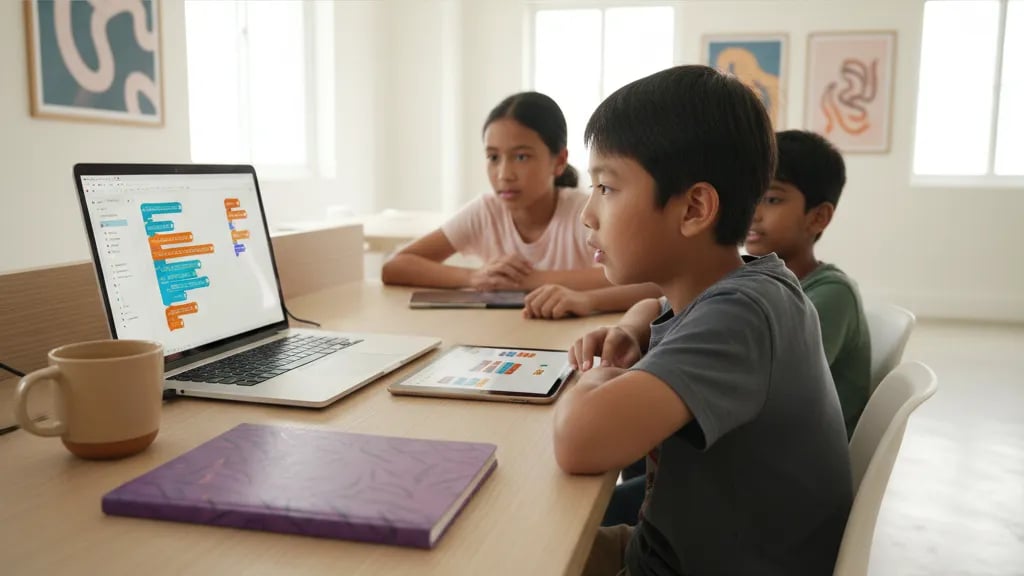
AI or coding first is the wrong framing for most Malaysian families, because the two are not competing subjects. Below age 11, coding comes first in almost every case, since it builds the model of how software behaves that makes AI make sense. From 11 upwards they work best together. Here is what each one actually teaches, and 3 questions that settle the order for your child.
Coding teaches how a machine follows instructions. AI teaches how a machine learns from examples. Those are different ideas, and the second is much harder to grasp without the first.
| Coding | AI | |
|---|---|---|
| Core idea | Give exact instructions in order | Give examples and let the system generalise |
| What the child makes | A game, a script, a website | A trained model, a directed output |
| Feedback | Instant and unambiguous | Fuzzy, needs judgement |
| Comfortable start age | 6 to 7 | 9 to 10 with tools, 13 for chatbots |
| Failure mode | It does not run | It runs and is quietly wrong |
| Transfers to | Maths, Science, ICT | Research, writing, design briefs |
The fifth row is the whole argument for the order. A coding error announces itself. An AI error sounds confident, and a child with no debugging habit has no reason to doubt it.
A child who has never debugged anything has no reason to distrust a confident answer. That habit is built by coding, not by chatting.
None of that means waiting to touch AI. It means the child should meet AI through bounded tools while the coding foundation is being built.
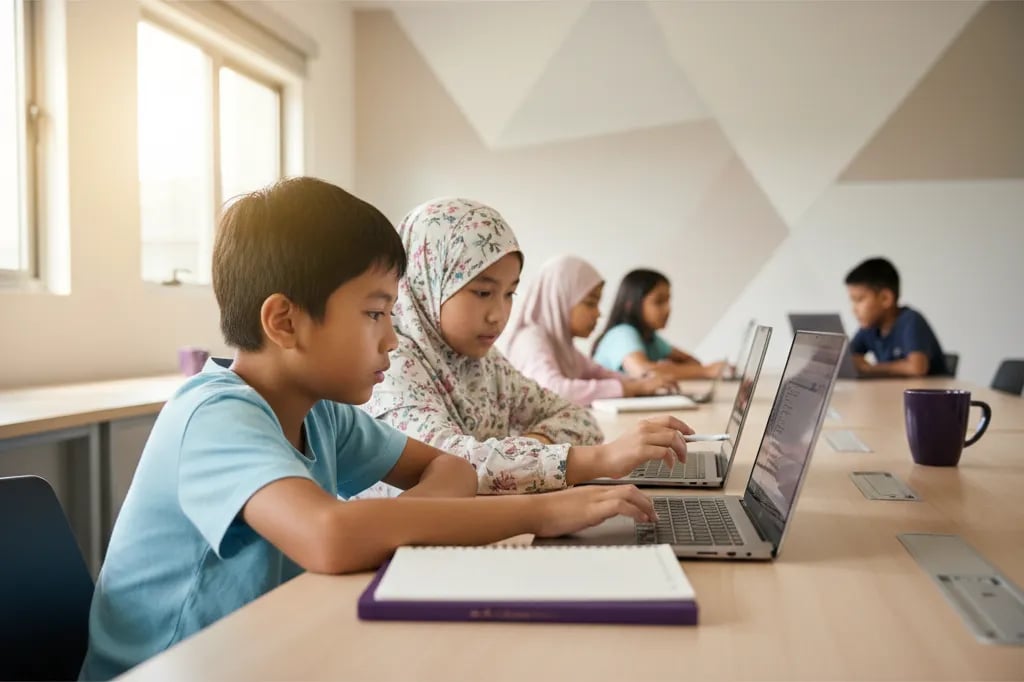
Age decides the mix, not whether AI is allowed at all.
| Age | Coding | AI |
|---|---|---|
| 6 to 8 | Block coding, the main activity | Teachable Machine with a parent, occasionally |
| 9 to 10 | Scratch projects, first game logic | Bounded tools, AI lessons on Code.org |
| 11 to 13 | Python basics, real syntax | Prompting with supervision, checking habits |
| 14 to 17 | Python, web, portfolio projects | Prompting, model concepts, AI inside projects |
The row that changes most is 11 to 13. That is when a child can hold both ideas at once: instructions that must be exact, and a system that produces plausible text without knowing anything.
Answer these about your child rather than about the subjects.
Most children under 11 get two noes, which is why coding first is the usual answer. Teenagers who are already using these tools daily are the exception: with them, waiting is not neutral, because habits are forming either way.
The useful version is not two subjects side by side, it is one project that needs both. Three examples that work in a class:
In every case the AI shortens one step and the child still has to build the thing. That balance is the point. A project where AI does everything teaches nothing, and a project where it is forbidden ignores how work actually happens now.
The common worry is that AI makes coding pointless. The real risk is different.
| Worry | How real it is |
|---|---|
| AI will write all the code, so why learn | Overstated, someone still has to judge and fix the output |
| My child will never learn to think | Real, if AI replaces the working rather than the explaining |
| Coding is obsolete for kids | No, the concepts are what make AI usable |
| Starting AI too early confuses them | Somewhat, under 9 the idea of learning from examples is abstract |
Row two is the one worth acting on, and the signal is measurable: homework marks holding up while test marks fall. We covered how to read that in AI and homework.
Both sit under the same digital skills push, and employers here increasingly want the overlap rather than either alone. The MDEC programmes point the same way: software roles remain the larger base, while AI literacy is becoming assumed rather than special.
For a child in primary school, none of this is a career decision. It is about which mental model gets built first, and instructions before examples is the order that holds up.
The answer on week three beats any argument about future jobs. A child who asks to return will still be there in eight weeks, and a child placed in the theoretically correct subject at an awkward hour quietly stops.
Under 11, start with coding and meet AI through bounded tools. From 11 to 13, do both, with coding as the spine and prompting as the habit. From 14, treat them as one subject, because that is how they behave in real work. Our coding programme and AI classes are built to be taken in that order, with the first class free either way.
Worth reading next: prompt writing for kids, safe AI tools and coding versus robotics.
Below age 11, coding first in almost every case. Coding builds the model of how software behaves, which is what makes AI comprehensible rather than magical. There is a second reason that matters more than parents expect: coding makes errors visible, because the program simply stops. AI errors sound confident and read as correct, so a child with no debugging habit has no reason to doubt them. From 11 upwards the two work best together, and from 14 they are effectively one subject, since that is how they behave in real work.
No, though the job changes shape. AI can produce code quickly and it produces plenty of code that is subtly wrong, so someone still has to read it, judge it and fix it. That someone needs to understand variables, sequences, conditions and how to debug. What is genuinely shifting is the balance: less time typing boilerplate, more time deciding what to build and checking whether the output is right. Both halves of that require exactly the concepts coding teaches, which is why the subject has become more useful rather than less.
Bounded AI tools work from about 9, and open chatbots from 13, which is the minimum age the main services set themselves. Below 9, the idea of learning from examples is fairly abstract, though a child can still enjoy training a model in Teachable Machine with a parent sitting there. Between 9 and 12, the useful version is tools with a defined task rather than an open conversation. From 13, an own chatbot account with permission and visible history is reasonable, with the checking habits taught from day one.
That a machine can learn from examples rather than instructions, and that its output is plausible rather than guaranteed. Those are genuinely different ideas from anything coding covers. A child who trains a model with ten photos and watches it fail on the eleventh learns something about data quality that no amount of Scratch will teach. The second idea, judging an answer that arrives with full confidence and no working, is the skill most adults are currently bad at, and children pick it up faster when they meet it early.
From about 11, yes, and the best version is not two subjects side by side but one project needing both. A game where the child trains a small model to recognise a gesture and then writes the code that responds to it teaches more than either topic alone. Below 11, splitting attention usually means neither lands properly, so coding as the main track with occasional AI tools works better. Two hour-long classes a week on top of school is also too much for most primary-school children.
Teach prompting and checking immediately, and add coding alongside rather than instead. With teenagers already using these tools daily, waiting is not a neutral choice, because habits are forming either way and the passive ones are hard to undo later. Start with the checking side: verify numbers by hand, treat references as unverified, notice when a confident answer is empty. Then add coding, since a teenager who can read and modify code stops being at the mercy of whatever the tool produces, which is the difference between using AI and being used by it.
Coding, fairly clearly, at least in Malaysian schools as they work today. It reinforces the step-by-step reasoning used in Maths and Science and builds tolerance for getting something wrong and fixing it. AI helps with research and understanding a topic faster, but exams here are handwritten with nothing on the desk, so anything that removes the working eventually shows up in the paper. The measurable warning sign is homework marks holding steady while test marks drift down over a term.
Software and data roles remain the widest job base in Malaysia, and they now assume AI familiarity rather than treating it as a specialism. The fastest growing area is the overlap: product roles, game development, automation and analytics all want someone who can build and judge. For a child in primary school none of this is a career decision anyway. It is about which mental model gets built first, and instructions before examples is the order that holds up regardless of which tools exist in ten years.
Start there and add coding when the first wall appears, which usually comes fairly quickly. Prompting without any understanding of how software works tends to stall at the first unexpected result, because the child has no way to reason about what went wrong. Our AI classes include coding for exactly this reason rather than teaching prompting in isolation. Interest is worth following, since a child who chose the subject turns up; the curriculum then fills the gap without an argument about it at home.
Three questions about your child rather than about the subjects. Has your child ever built something that ran and then broke. Can they explain why an answer might be wrong. Are they 13 or older and already using AI daily. Two noes point to coding first, which is where most children under 11 land. Then book a free trial of that track and sit in for the last ten minutes, because the ending shows whether they finished something and wanted to continue. Ask one question afterwards: do you want to go back.
Start your child's tech journey
Book your free 60-minute trial class with an Algonova certified tutor. No payment, no obligation, just discover what your child can build.

Algonova worldwide
Contact us
Email: int_legal@alg.team
Visit us
Suite 8634, 1021 E Lincolnway, Cheyenne, WY, Laramie, US, 82001
Algonova online LLC International tech school for kids and teens