AI or coding first: which should your child learn?
Course Guides7 min read
AI Education

Aina Rashid
Coding Education Specialist at Algonova Malaysia
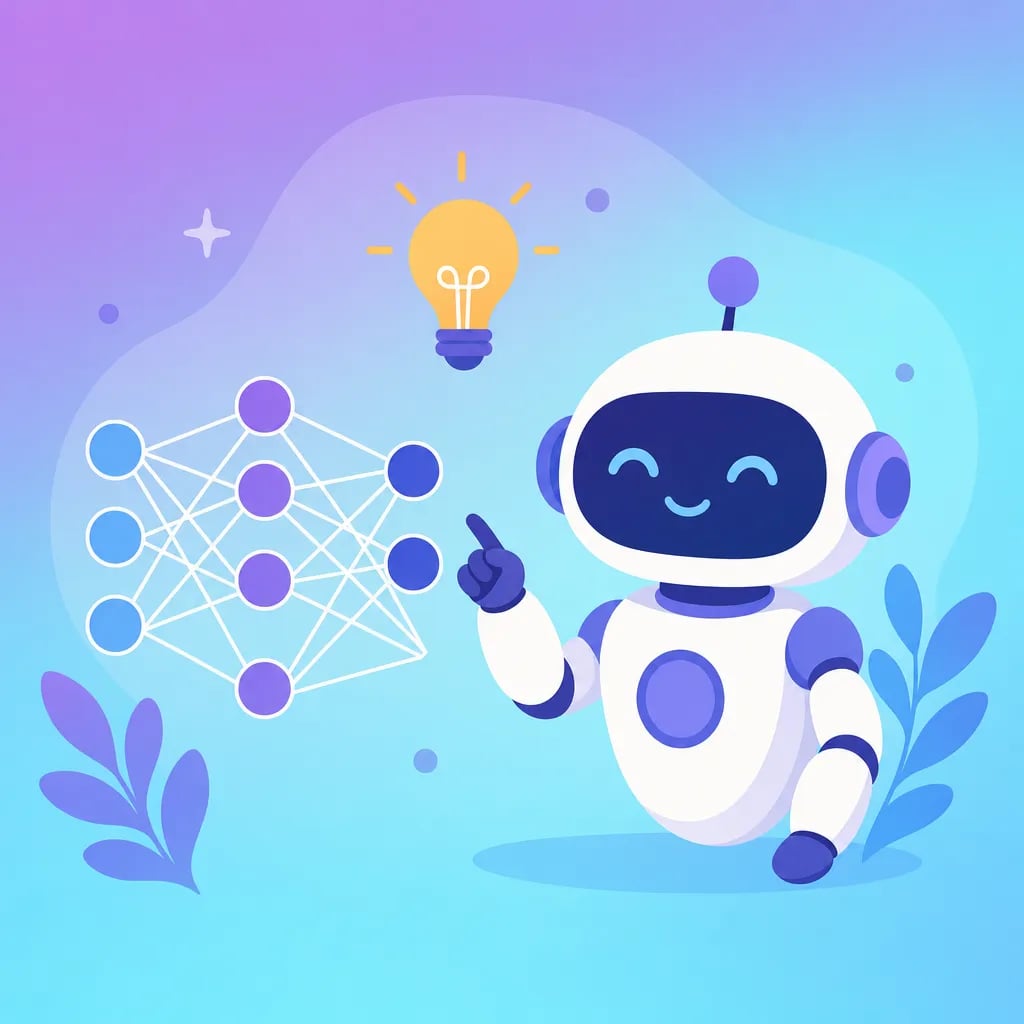
AI for kids is learning how the systems that recognise patterns, make decisions and generate responses actually work — starting as early as age 6–7 with screen-free pattern games, adapted to a child's age through visual examples and simple projects. It does not require coding from day one — it begins with curiosity and adult-guided conversation.
More Malaysian families, from KL to Penang to Johor Bahru, are asking when and how to introduce AI into their children's lives. The honest answer: earlier than you'd expect, and more simply than it sounds. The goal isn't for your child to build a robot at seven. It's for them to understand that behind every voice assistant, game recommendation or photo filter there are rules, data and human decisions. This guide maps that path by age, tools and concrete first steps.
Children can start exploring AI concepts from age 6 or 7 through screen-free activities that show how machines sort and recognise patterns. Formal learning with digital tools usually fits best from age 8–9, once a child handles basic logic and reading comfortably. The key is adjusting the depth, not waiting until secondary school.
A 7-year-old can grasp what a "pattern" is by sorting animals by their features. A 12-year-old can train a simple model that recognises images. Each stage builds on the one before. That's why it helps to pair AI with a foundation in computational thinking — the ability to break problems down and build logical sequences.
| Age | What they can understand | How they learn it |
|---|---|---|
| 6–7 years | What a pattern and a rule are | Sorting games, screen-free activities |
| 8–10 years | How machines decide using data | Visual block tools, guided voice assistants |
| 11–13 years | Training simple models, basic bias | Teachable Machine, Scratch with AI |
| 14–16 years | Algorithm and data logic | Python, image or text projects |
| 17 years | Building AI applications | Full projects, APIs, applied ethics |
Yes — it's safe when there is adult supervision, age-appropriate tools and clear usage limits. The main risks aren't technical; they're privacy, exposure to unsuitable content, and over-reliance. Safety depends far less on the technology than on guidance.
Three practical rules cut almost all of the risk. First, use educational platforms built for minors, not open chatbots without filters. Second, keep usage in shared family spaces, not behind closed doors. Third, talk about what the AI produces — teach that it can be wrong and that not everything it says is true. In Malaysia, reputable kids' platforms follow data-protection standards such as the PDPA 2010 and the international COPPA, which limit how children's data is collected.
Learning AI in childhood builds critical thinking, creativity and a real understanding of the digital world children already live in. According to the World Economic Forum, analytical and creative-thinking skills are among the most in-demand toward 2030, and AI literacy feeds directly into both.
The benefits go well beyond the technical. A child who understands how a recommendation algorithm works makes better decisions about screen time. One who knows AI learns from data understands why it can carry bias. These habits build more informed citizens — not just future programmers. Combined with logic and problem-solving, they prepare your child for jobs that don't exist yet, in a digital economy Malaysia is actively growing.
There are free, visual tools designed so children can learn AI without coding at first. The most widely used in education include Google's Teachable Machine, Scratch with AI extensions, Machine Learning for Kids and Cognimates. Each lets a child experiment with image, voice or text recognition in an intuitive way.
As the child grows, it's worth moving toward deeper tools. Scratch and block-based environments are ideal between ages 8 and 12. After that, languages like Python open the door to real AI projects. The advice is simple: don't skip stages. The visual foundation is what makes the later code meaningful instead of abstract.
Coding usually comes first — it's the foundation AI is built on. Through coding, a child learns logic, sequences and how to give a computer instructions; AI then becomes the next layer, where the machine learns from data rather than following fixed rules. Trying to teach AI with no coding base often leaves children memorising buzzwords instead of understanding them.
In practice the two overlap early. A child can explore AI ideas visually (sorting, patterns, Teachable Machine) while building coding fundamentals in Scratch. By the early teens, those skills merge naturally into Python and real model-building. Think of coding as the grammar and AI as one of the things you write with it. If you're weighing programmes, our Algonova vs Kidocode comparison and our guide on why Malaysian kids should learn coding help put it in context.
Starting with AI at home is possible with no technical background, by following a gradual path. The goal isn't to master the technology in a month — it's to spark lasting curiosity and build understanding in layers.
If you'd like a clearer structure, our guided coding programmes and maths programmes for kids offer a step-by-step progression with mentor support.
At Algonova we support more than 1,000,000 students across 97 countries, with over 10 years of experience teaching technology to children aged 6 to 17 and an average rating of 4.9★. Classes are 100% online — private 1-on-1, in mini groups of 2–4, or in groups of up to 10 students — taught in English and Malay so every child can learn in the language they're most comfortable with.
Our approach is built on guidance, not hype: small groups, mentor support and a progression that takes children from patterns and logic into coding and, in time, AI. You can read more about Algonova, or book a free trial class and watch your child's first session with no commitment.
From age 6–7 with screen-free pattern games, and from 8–9 with simple digital tools. Adjust the depth to the child rather than waiting for secondary school.
Yes, with adult supervision, age-appropriate platforms and clear limits. Use tools built for minors, keep devices in shared spaces, and discuss that AI can be wrong.
Coding usually comes first because it teaches logic and instructions. Children can explore AI ideas visually in parallel, then merge both into Python as teenagers.
Teachable Machine, Scratch with AI extensions, Machine Learning for Kids and Cognimates are free, visual and designed for children to experiment without coding.
Reputable kids' platforms follow data-protection standards such as Malaysia's PDPA 2010 and the international COPPA, which limit how children's data is collected and used.
Spot everyday AI together, play sorting games, try Teachable Machine, connect it to Scratch logic, and talk about AI's mistakes and privacy.
It builds critical thinking, creativity and digital awareness — skills among the most in-demand toward 2030 — and prepares children for future careers, not only programming.
Yes. Algonova teaches technology 100% online — private 1-on-1, in mini groups of 2–4, or in groups of up to 10 students — in English and Malay, for children aged 6 to 17 across 97 countries.
Start your child's tech journey
Book your free 60-minute trial class with an Algonova certified tutor. No payment, no obligation, just discover what your child can build.

Algonova worldwide
Contact us
Email: int_legal@alg.team
Visit us
Suite 8634, 1021 E Lincolnway, Cheyenne, WY, Laramie, US, 82001
Algonova online LLC International tech school for kids and teens