Computational thinking is the ability to solve complex problems by breaking them into logical steps, and children can start developing it from age 4 or 5, without ever touching a computer. It is not coding; it is the way of thinking behind coding, and it applies equally to a math problem, planning a trip or packing a backpack. According to the World Economic Forum it is one of the most valuable skills for the jobs of the future.
When a parent hears «computational thinking», they usually picture a child in front of a screen writing complicated code. The reality is broader and more reassuring: it's a way of thinking that can be learned and trained like any other, combining four pillars we'll see next.
Algonova is a platform of live courses in coding, design and AI for children aged 6 to 17, with over 1,000,000 graduates in 97 countries and more than 10 years teaching technology to kids. Classes are live with certified teachers in a 1-on-1 private format, a mini-group of 2 to 4 or a group of up to 10 students —not pre-recorded videos— and a 4.9★ rating from families confirms it.
What computational thinking is
Computational thinking is a structured method for tackling problems that combines four mental skills and works with or without a computer. Programmers use it, but so do doctors when diagnosing, chefs when designing a menu and anyone who organizes a big task into manageable steps. For a child, learning it means gaining a mental toolbox that lasts a lifetime.
It rests on four pillars worth every parent knowing:
- Decomposition — breaking a big problem into small, manageable pieces. Instead of «tidy your room», the child learns to see it as «pick up the toys, then the clothes, then the books».
- Pattern recognition — identifying what repeats or what is similar across problems. If they already solved an addition with carrying, they recognize the same pattern in another and don't start from scratch.
- Abstraction — keeping the essential and ignoring the noise. When drawing a map home, the child leaves out the colors of the houses and keeps only the streets and turns that matter.
- Algorithms — designing a clear, repeatable sequence of steps to solve the problem. A cooking recipe is an algorithm: do it in this order and you get the same result every time.
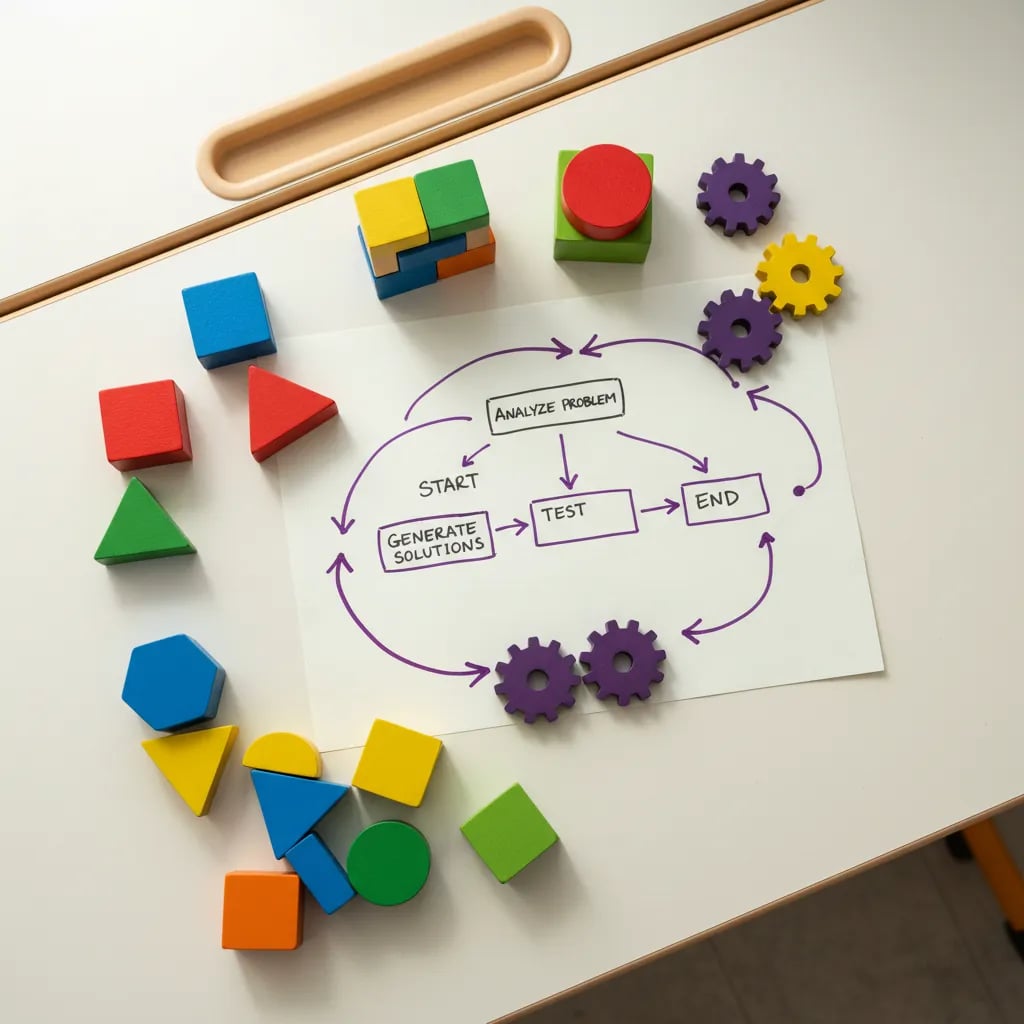
The four pillars work together. The child decomposes, looks for patterns, abstracts what matters and builds an algorithm. That combination is what turns a confusing problem into a series of steps they actually can solve.