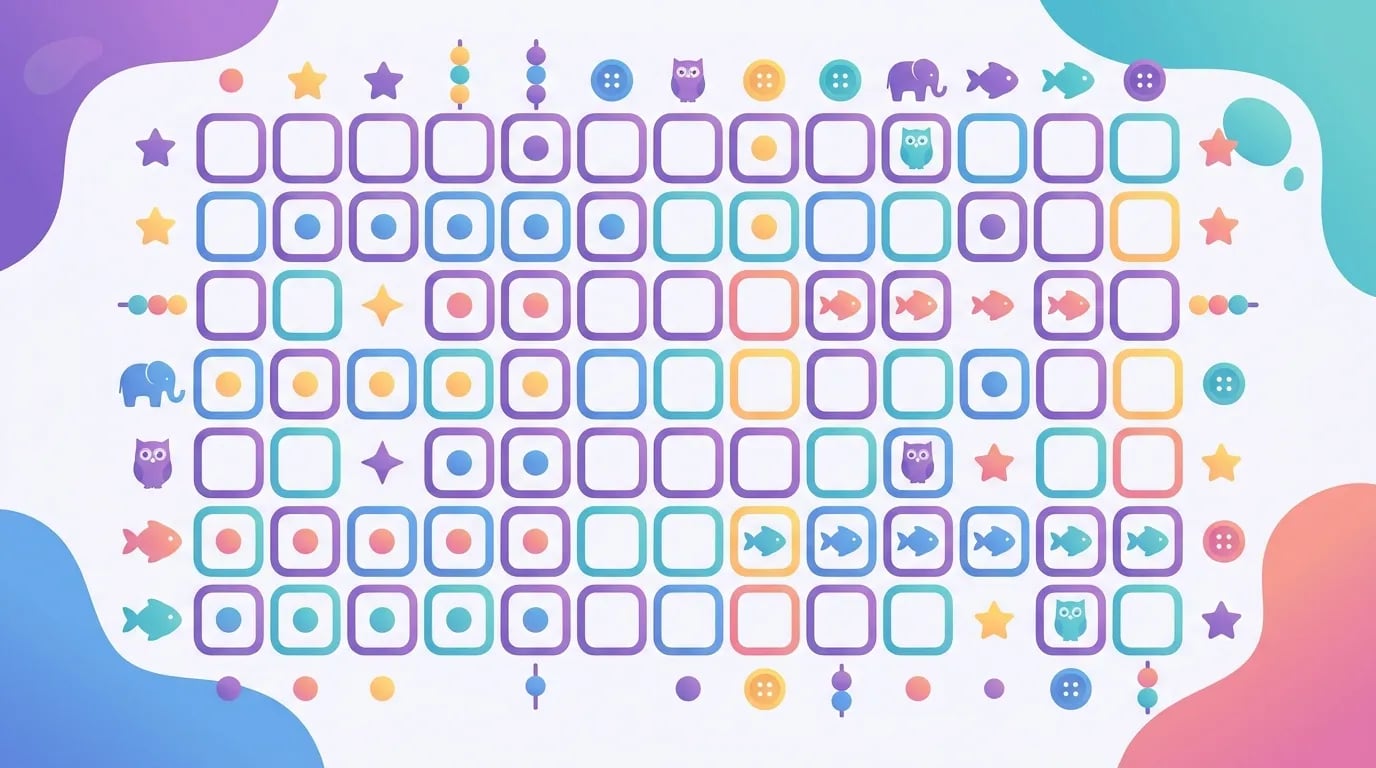
Multiplication tables are an ordered list showing the result of multiplying a number by the numbers from 1 to 10 (or up to 12). They let you know by heart what, for example, 7 × 8 is without adding over and over. Multiplying is nothing more than adding the same number several times: 3 × 4 means adding 3 four times (3 + 3 + 3 + 3 = 12).
Example: the 2 times table
| Multiplication | Repeated addition | Result |
|---|---|---|
| 2 × 1 | 2 | 2 |
| 2 × 2 | 2 + 2 | 4 |
| 2 × 3 | 2 + 2 + 2 | 6 |
| 2 × 4 | 2 + 2 + 2 + 2 | 8 |
| 2 × 5 | 2 + 2 + 2 + 2 + 2 | 10 |
As you can see, each result goes up by 2. An important trick is that the order does not change the result: 2 × 5 is the same as 5 × 2 (both equal 10). This is called the commutative property and it cuts in half what you have to memorize.
Why do multiplication tables matter for kids?
Multiplication tables are learned between 2nd and 4th grade (ages 7-9) and are the foundation of almost all later math: division, fractions, percentages, areas and algebra. In daily life they are used to work out the price of several identical items, share things into groups or measure how much fits in a box. Mastering them by heart frees the mind to solve harder problems.
To keep learning, see also what fractions are and the area of a rectangle formula, which uses multiplication. Want your child to learn math without boring rote memorization? Book a free masterclass with an Algonova teacher.