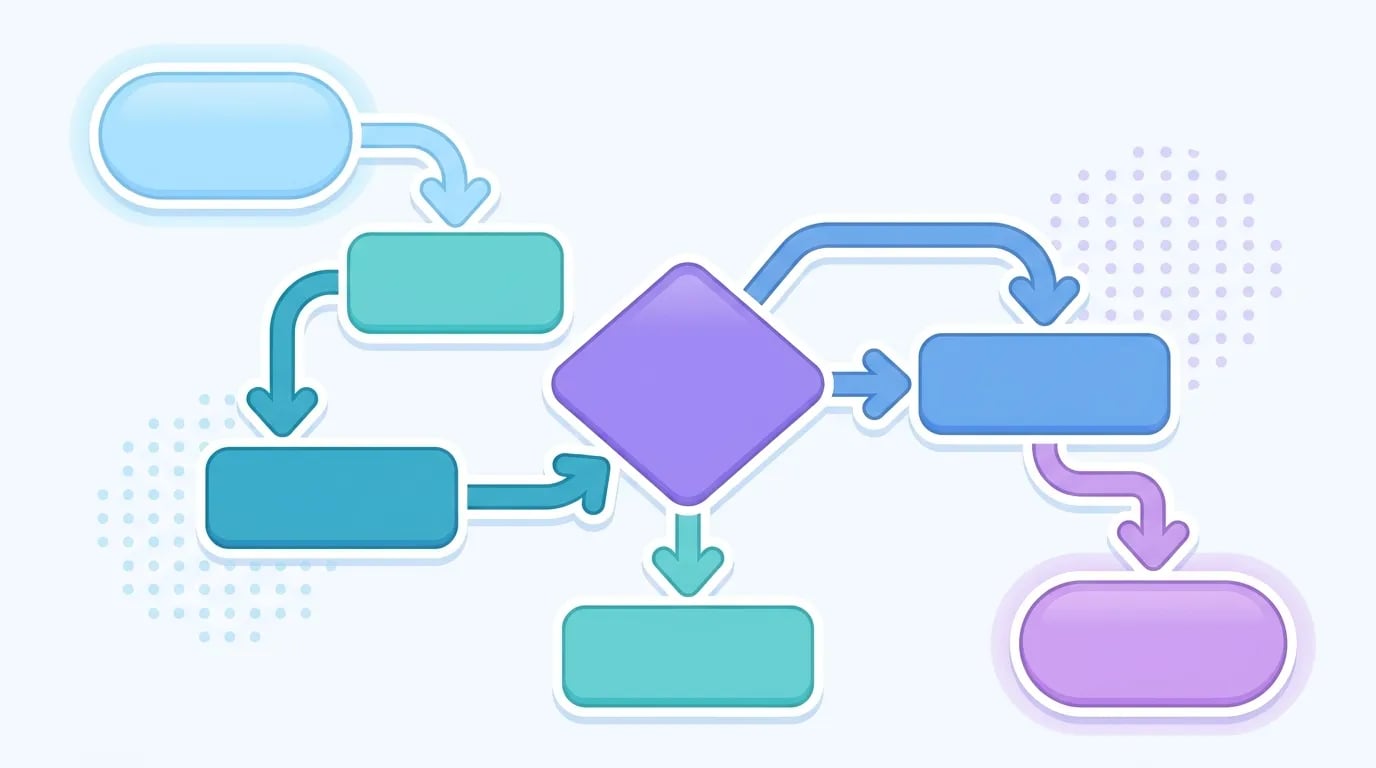
A flowchart is a drawing that represents the steps of a process or algorithm using symbols connected by arrows. Each symbol has a meaning: an oval marks the start or end, a rectangle indicates an action, and a diamond represents a decision (yes or no). The arrows show the order in which the steps are followed.
How to Read a Flowchart: Example for Kids
Imagine the flowchart for "leaving the house in the morning." It starts at an oval ("Start") and moves to a diamond that asks "Is it raining?". If the answer is yes, an arrow leads to "Take an umbrella"; if no, it goes straight to "Leave." That diamond is a conditional: the same kind of decision a program makes. Drawing the process before coding it helps you see every possible path.
Why It Matters for Kids
A flowchart turns an abstract idea into something visual, so kids plan their logic before writing code. Ordering the steps and anticipating decisions builds computational thinking and prevents mistakes. It is a tool that engineers and scientists also use to explain complex processes.
In Algonova's coding courses for kids, students draw flowcharts before building their games, so they think like programmers from day one. You can see it in a free trial class, at no cost.