
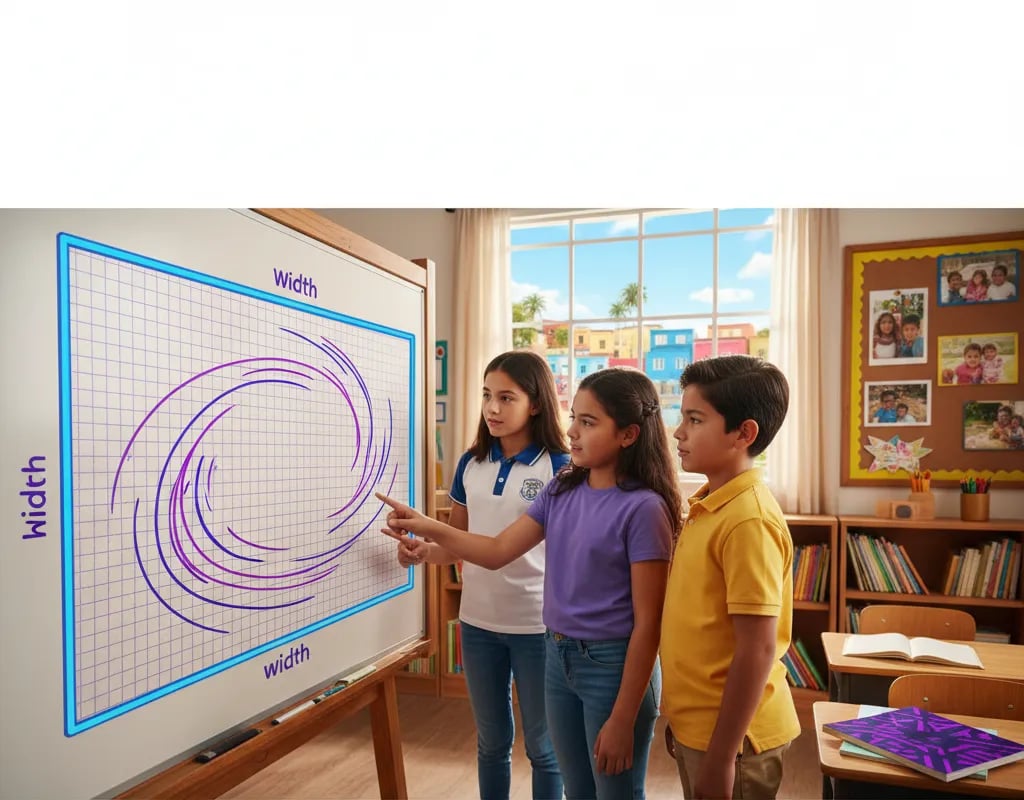
The area of a rectangle formula is base times height, or A = b × h. For example, if the base is 8 cm and the height is 5 cm, then the area is 8 × 5 = 40 cm². This formula is used from 3rd grade through middle school to calculate the area of floors, gardens, notebooks, and even the TV screen at home. The units of area are always square units (cm², m², km²).
💡 Quick note: if you get confused between area and perimeter — area is what's inside the rectangle (square units), while perimeter is the line around the edge (regular units, such as cm or m). See also our guide on why kids in Mexico should learn coding in 2026.
What Is the Area of a Rectangle
The area of a rectangle is the measure of the flat region bounded by the four sides of the rectangle. A rectangle has two pairs of parallel and equal sides — the longer side is called the base (b) and the shorter one is called the height (h). All four of its angles are right angles (90°).
Picture the floor of your bedroom at home. It's usually shaped like a rectangle. If you want to know how many ceramic tiles you need to cover the floor, you calculate its area. That's why this concept is widely used by builders, by parents in the kitchen (cutting a rectangular cake pan), and by garden designers in cities like Mexico City, Guadalajara, or Bogotá.
Unlike a square (all sides equal), a rectangle has base ≠ height. If b happens to equal h, the figure becomes a square — and the area formula becomes side × side. If you like visualizing geometric shapes with the computer, in our coding courses for young children kids aged 6 to 9 draw rectangles in Scratch while discovering these properties.
Area of a Rectangle Formula
The main formula you need to remember:
Read in words: the area equals the base times the height. Each symbol means:
- A = Area of the rectangle (square units: cm², m², km²)
- b = base, the longer side (units: cm, m, km)
- h = height, the shorter side (units: cm, m, km)
- × = standard multiplication operation
If you already know the area and one of the sides, you can find the other side:
This means: the base equals the area divided by the height, and the height equals the area divided by the base. It's the inverse operation of multiplication.
How to Calculate the Area of a Rectangle
Follow these 4 steps every time you face a rectangle area problem. This method works at every grade level, from elementary school to middle school.
Step 1 — Identify the base and the height. Read the problem carefully. Find two numbers: the larger one is usually the base, the smaller one is usually the height. Label them with the symbols b and h.
Step 2 — Match the units. If the base is in meters and the height is in centimeters, first convert them to the same unit. Example: 2 m = 200 cm. Without this step, the result is guaranteed to be wrong.
Step 3 — Compute the multiplication b × h. Write the formula, substitute the numbers, and multiply. You can use long multiplication if the numbers are large.
Step 4 — Write the square units. Don't forget: if the base and height are in cm, the area is cm² (square centimeters). If they are in meters — m². Without the units, the answer is counted as incorrect at school.
Worked Examples
Below are 5 worked examples from easiest to most challenging.
Example 1 ⭐ — María's bedroom
The floor of María's bedroom in Mexico City has a rectangular shape. Its base is 6 m and its height is 4 m. What is the area of the floor of her bedroom?
Step 1. Write the data: b = 6 m, h = 4 m. Step 2. Write the formula: A = b × h. Step 3. Substitute: A = 6 × 4 = 24.
✅ Answer: The area of María's bedroom floor = 24 m².
Example 2 ⭐ — Sofía's notebook
Sofía has a rectangular notebook with a base of 25 cm and a height of 18 cm. What is the area of the notebook's cover?
Step 1. Data: b = 25 cm, h = 18 cm. Step 2. A = b × h = 25 × 18. Step 3. 25 × 18 = 25 × 20 − 25 × 2 = 500 − 50 = 450.
✅ Answer: The cover's area = 450 cm².
Example 3 ⭐⭐ — School garden with mixed units
The garden of a school in Guadalajara has a rectangular shape with a base of 12 m and a height of 250 cm. What is the area of the garden?
Step 1. Data: b = 12 m, h = 250 cm. Different units — they must be matched first. Step 2. Convert the height to meters: 250 cm = 2.5 m. Step 3. A = 12 × 2.5 = 30.
✅ Answer: The garden's area = 30 m².
Example 4 ⭐⭐ — Finding the height from the area
A school cafeteria table is rectangular. Its area is 120 cm² and its base measures 15 cm. What is the height of the table?
Step 1. Data: A = 120 cm², b = 15 cm. Looking for: h. Step 2. Use the inverse formula: h = A ÷ b. Step 3. h = 120 ÷ 15 = 8.
✅ Answer: The table's height = 8 cm.
Example 5 ⭐⭐⭐ — Soccer court in Monterrey
Mr. Diego has a rectangular indoor soccer court with a base of 25 m and a height of 15 m. The floor will be covered with 50 cm × 50 cm tiles. How many tiles are needed?
Step 1. Data: court b = 25 m, h = 15 m. Tile = 50 cm × 50 cm. Step 2. Compute the court's area: A = 25 × 15 = 375 m². Step 3. Compute one tile's area: 50 cm × 50 cm = 2,500 cm² = 0.25 m². Step 4. Number of tiles = 375 ÷ 0.25 = 1,500.
✅ Answer: 1,500 tiles are needed.
Common Mistakes When Calculating the Area of a Rectangle
These are the five most frequent mistakes teachers see in class:
- Adding instead of multiplying. Many students write A = b + h. That is incorrect — that is half of the perimeter. The correct operation: multiplication (×).
- Forgetting the square units (cm², m²). Writing "24 m" when it should be "24 m²". Half a point lost just for forgetting the exponent.
- Not matching the units. Multiplying 6 m × 80 cm directly — the result is broken. Always convert to the same unit first.
- Mislabeling base and height in a drawing. It actually doesn't matter, because b × h = h × b. But the serious mistake is using the same side twice (for example, base × base).
- Confusing it with the perimeter. The perimeter uses the formula P = 2 × (b + h), not b × h. Read the problem: the word "perimeter" → fence/edge, the word "area" → surface/floor.
Area vs Perimeter — What's the Difference
Many elementary and middle school students mix up these two concepts.
Easy trick to remember: if you want to paint the floor → area. If you want to put up a fence → perimeter.
💡 Did you know? In Algonova coding classes, kids use formulas like this to build games and projects, without rote memorization. Classes run in groups of up to 10 students, and more than 1,000,000 students in 97 countries have studied with Algonova. Book your free coding masterclass now →
Practice Exercises
- ⭐ A postcard is rectangular with a base of 15 cm and a height of 10 cm. What is its area?
- ⭐⭐ The garage floor: base 5 m, height 350 cm. Area in m²?
- ⭐⭐ A field: A = 240 m², base 20 m. What is the height?
- ⭐⭐⭐ A classroom wall: 8 m × 3 m. If 1 can covers 6 m², how many cans needed?
Answer Key
- A = 15 × 10 = 150 cm²
- A = 5 × 3.5 = 17.5 m²
- h = 240 ÷ 20 = 12 m
- 24 ÷ 6 = 4 cans
Summary
- The formula is A = b × h.
- Units are always squared: cm², m², km².
- To find an unknown side: b = A ÷ h or h = A ÷ b.
- Match units before multiplying.
- Area = inside surface; perimeter = outer edge.
Use math through coding at Algonova
At Algonova, kids and teens learn math through coding and real projects. More than 1,000,000+ students in 97 countries study with us — private 1-on-1, mini-groups of 2 to 4, or groups of up to 10 students — more than 10 years of experience.
Explore: Coding 6-9 · Coding 10-13 · Coding 14-17 · Graphic Design