How to Explain Fractions to a Child: A Guide by Age and 12 Exercises
Published: 08.10.2026·Updated: 08.10.2026
Neftalí Cázares
Senior Coding Instructor
How to explain fractions to a child aged 7 to 12: start with something they can touch and split into equal parts, like a pizza or a chocolate bar, and leave the numbers for later. At 7-8, halves and quarters with real objects are enough; by 11-12 they can compare and add fractions with different denominators. Below you will find a guide by age, the 4 most common mistakes and 12 solved exercises.
We wrote this guide at Algonova, where we teach coding to kids in groups of up to 10 students. Fractions show up all the time in Scratch projects.
Start with a pizza and a chocolate bar, not with numbers
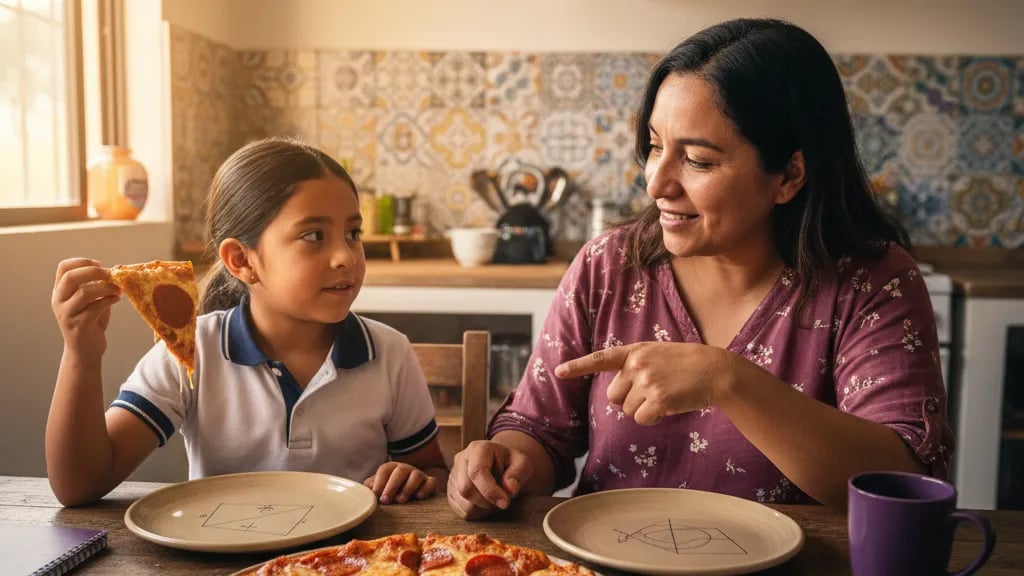
Take a pizza and cut it into 8 slices of the same size. If your child eats 3, they ate 3 of the 8 parts. That is written 3/8 and read "three eighths". What matters is that all 8 slices are equal. If one slice is twice the size of the others, you no longer have fractions, you have pieces.
The second example works better with kids who already know their times tables. A chocolate bar with 12 squares: if your child eats 6, they ate 6/12 of the bar. Ask them how much that is, said another way. They almost always answer "half" before knowing they just simplified a fraction. That is the moment to tell them that 6/12 and 1/2 are the same piece of chocolate written two different ways.
If your child needs the theory for a school assignment, we cover it separately in what a fraction is, definition and types. This guide is for teaching it at home and practicing.
If a child still cannot split a pizza into equal parts with their hands, they are not ready to write 3/8. First the sharing, then the number.
Neftalí Cázares, Senior Coding Instructor
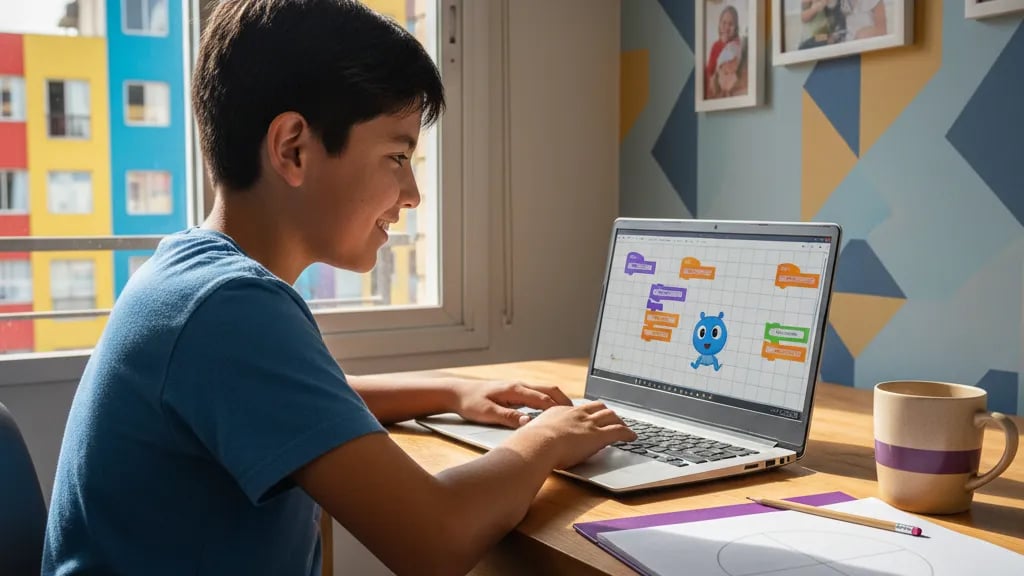
In Scratch you can see the mistake: if the sprite turns 270 degrees instead of 360, it ends up facing the wrong way. The child fixes it alone and suddenly understands what 3/4 of a turn is.
The most common doubt is which number goes on top and which goes on the bottom. Here is a trick that works at home: the bottom one says how many pieces you cut, the top one says how many you took.
Part
Where it goes
What it answers
In 3/8
Numerator
Top
How many parts do I take?
3 slices
Denominator
Bottom
How many parts did I cut?
8 slices in total
Fraction bar
Middle
Means "divided by"
3 divided by 8
A rule that saves arguments: the bigger the denominator, the smaller each piece. With food they accept it instantly; on paper, they argue.
If your child understands the sharing but gets lost when writing it down, the problem is the order of writing, not the understanding. You train it by saying the steps out loud and by building things: in the
12 fraction exercises with step-by-step answers
Three levels: identify, compare and operate. Every fourth exercise has a Scratch version, the visual language from MIT that kids use to code, because fractions show up there naturally in loops, turns and paths. New to it? Start with what is Scratch.
Level 1: identifying fractions
Exercise 1. A pizza is cut into 8 equal slices and Lucía eats 3. What fraction did she eat? What fraction is left?
Answer: she ate 3/8 and 5/8 are left. The parts taken and the parts left always add up to the whole: 3/8 + 5/8 = 8/8 = 1.
Exercise 2. A chocolate bar has 12 squares and Mateo eats 6. Write the fraction and simplify it.
Answer: 6/12. Dividing top and bottom by 6 gives 1/2. He ate half.
Exercise 3. A pencil case holds 10 pencils and 4 are red. What fraction of the pencils is red?
Answer: 4/10. Dividing top and bottom by 2 gives 2/5.
Exercise 4 (Scratch version). In Scratch, a sprite draws a square with the instruction "repeat 4 times: move and turn 90 degrees". If it has completed 3 repetitions, what fraction of the square has it drawn?
Level 3: adding and subtracting fractions
Exercise 9. 1/5 + 2/5 = ?
Answer: 3/5. With the same denominator you add only the numerators and leave the denominator alone.
Exercise 10. 1/2 + 1/4 = ?
Answer: 3/4. First make them match: 1/2 is the same as 2/4. Then 2/4 + 1/4 = 3/4.
Exercise 11. 3/4 - 1/3 = ?
Answer: 5/12. The common denominator of 4 and 3 is 12: 3/4 = 9/12 and 1/3 = 4/12. Then 9/12 - 4/12 = 5/12.
Exercise 12 (Scratch version). A sprite moves 1/4 of the stage and then another 1/3. What part of the stage did it cover and how much is left?
Answer: it covered 7/12 and 5/12 are left. With denominator 12: 1/4 = 3/12 and 1/3 = 4/12, which add up to 7/12. To reach 12/12, 5/12 are missing.
To practice without peeking, ask your child to cover the answers with a sheet of paper while solving. If they want more tasks at the same level, there is another set in third grade math exercises with solutions.
When your child needs more than homework at home
There are clear signs that what is missing is no longer practice but a different way into the problem: they solve it well when you sit next to them but freeze on their own; they copy the procedure without being able to explain why; they understand today's exercise and forget last week's; or they avoid math homework before even trying. If you are thinking about a private teacher, math tutor vs online classes compares both options.
What does change things is letting the child practice the same logic in a setting where mistakes are not embarrassing. Coding does exactly that. When your child builds a game in Scratch, they split the screen into parts, repeat an action a set number of times, work out how much health the character has left and fix the program when it breaks. That is fractions and logic in action, and here getting it wrong is part of the process.
At Algonova we teach coding to kids and teens in groups of up to 10 students, with more than 1,000,000 students in 97 countries. The first class is a free coding class: a 60-minute masterclass where your child builds their first project and you see how they reason through a new problem. For kids aged 10 to 13 there is the Roblox and Python coding course, and every level by age is on coding classes for kids.
you can see in 60 minutes how your child puts the steps of a problem in order.
How to explain them by age: 7-8, 9-10 and 11-12
This table sums up what to work with at each stage.
Age
What to explain with
What they should achieve
What not to demand yet
7-8
Real objects cut in halves and quarters
Recognize 1/2, 1/3 and 1/4 and share into equal parts
Written operations with fractions
9-10
Drawings, number lines, cooking recipes
Compare fractions and add with the same denominator
Different denominators without visual support
11-12
Percentages, money, measurements, split screens
Simplify, compare with different denominators, add and subtract
Long operations without understanding why
If your 11-year-old still needs to draw the pizza, that is not a delay: they need more time in the visual stage. With younger kids it helps to turn practice into a game, and math games for kids has several that work for sharing and comparing.
Answer: 3/4. Each repetition draws one of the 4 sides, and 3 turns of 90 degrees are 270 of the 360 degrees in a full turn: 270/360 = 3/4.
Level 2: comparing fractions
Exercise 5. Which is greater, 1/3 or 1/5?
Answer: 1/3. With the same numerator, the smaller denominator wins: cutting into 3 leaves bigger pieces than cutting into 5.
Exercise 6. Which is greater, 3/4 or 2/4?
Answer: 3/4. Same-size pieces, so just count how many are taken.
Exercise 7. Which is greater, 2/3 or 3/5?
Answer: 2/3. You need a common denominator: 2/3 = 10/15 and 3/5 = 9/15. Ten fifteenths is more than nine fifteenths.
Exercise 8 (Scratch version). Ana finished 15 of the 20 blocks in her project. Diego finished 5 of 8. Who got further?
Answer: Ana. 15/20 simplifies to 3/4, which is the same as 6/8, and 6/8 is more than 5/8.
The 4 most common mistakes and how to fix them at home
Adding the denominators. The child writes 1/2 + 1/4 = 2/6. Fix: ask them to draw both portions. They will see the result has to be more than half, and 2/6 is less. The denominator tells you the size of the piece; it does not get added.
Thinking the bigger denominator wins. Between 1/8 and 1/3, many kids pick 1/8 because 8 is more than 3. Fix: cut one sheet into 3 and an identical one into 8, and let them compare the pieces by hand.
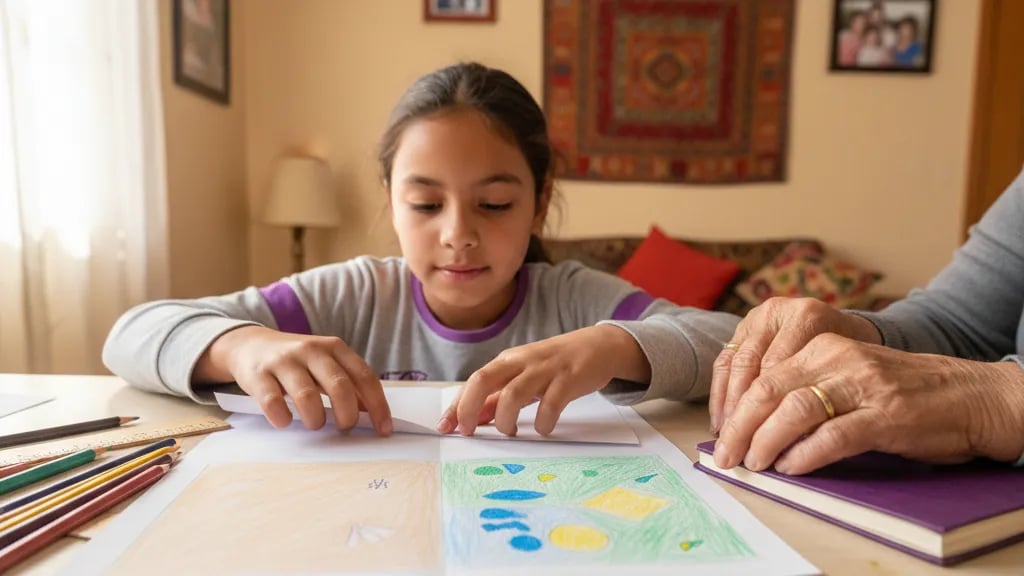
Cutting unequal pieces. If the parts are not equal, there is no fraction. Fix: use folded paper, not freehand drawings.
Swapping numerator and denominator. They write 8/3 when they meant 3/8. Fix: have them say the full sentence out loud before writing: "I took 3 of 8 parts".
Summary
Always start with objects that can be split into equal parts and leave the numbers for later.
The denominator says how many parts you cut; the numerator, how many you took.
At 7-8, 1/2, 1/3 and 1/4 are enough; sums with different denominators come around 11-12.
The most common mistakes are adding denominators and thinking the bigger denominator wins.
When homework at home is no longer enough, coding offers the same logic in a format where mistakes do not weigh on the child.
At what age can you explain fractions to a child?
Most children can start with simple fractions around age 7, always with real objects and beginning with halves and quarters.
At that age the goal is not writing 3/8 but sharing into equal parts and naming the result. Between 9 and 10 they can compare fractions and add those with the same denominator, using drawings for support. Around 11 and 12 come equivalent fractions, simplifying and adding with different denominators.
For example, a 7-year-old who splits a quesadilla between herself and her brother is already working with 1/2, even if she does not write it. If your child moves slower than this guide, that is fine: it is better to stay longer in the visual stage before moving on to numbers.
What household objects can I use to explain fractions?
The best objects are the ones that can be split into equal parts and that your child cares about: pizza, tortillas, chocolate bars, fruit or a folded sheet of paper.
Food works because the child wants the sharing to be fair and pays attention to the size of each portion. Folded paper is good for precision, since folding in half and in half again gives exact quarters with no argument. A measuring cup or a recipe helps once the child handles 1/2 and 1/4 and wants to go further.
A simple example: ask them to cut an apple into 4 equal parts, eat one and tell you what fraction is left. If they answer three quarters, they got the idea. Avoid freehand drawings at the start, because the parts almost never come out equal.
How do I explain the difference between numerator and denominator?
The denominator says how many equal parts you cut the whole into, and the numerator says how many of those parts you took.
One way to remember it is that the bottom number is the knife and the top number is the hand. In 3/8 you cut into 8 and took 3. It helps if the child says it out loud before writing: I took 3 of 8 parts. That way they avoid swapping the numbers.
For example, if your child cuts a pizza into 6 and eats 2, ask them to say first how many pieces there are in total and then how many they ate. That order, total on the bottom and taken on top, is exactly how it is written. After two or three rounds like this the confusion usually goes away.
Why does my child think 1/8 is bigger than 1/3?
Because they compare the numbers as if they were whole numbers: they see that 8 is bigger than 3 and assume 1/8 is too.
It is one of the most common mistakes and it makes sense from their point of view, because until then a bigger number always meant more. You need to show them that the denominator tells you the size of the piece: the more parts, the smaller each one.
The quickest fix is physical. Take two identical sheets, cut one into 3 parts and the other into 8, and ask them to compare one piece of each by hand. They see it in seconds. Then you can ask whether they would rather have a third or an eighth of their favorite cake, and they almost always choose well. With that concrete memory, the written rule stops feeling arbitrary.
How do I explain adding fractions with different denominators?
Explain that you can only add pieces of the same size, so first both fractions need to be turned into a common denominator.
With 1/2 + 1/4, the child can see with a pizza that half a pizza is the same as 2 quarters. So the sum becomes 2/4 + 1/4 = 3/4. What matters is that they understand why the denominator has to match, not just the procedure. If they jump straight to the rule, it is easy to end up adding top and bottom.
A good test is to ask them to estimate before calculating. If they know 1/2 + 1/4 has to be more than half, they will notice on their own that 2/6 cannot be the answer. This kind of sum is usually covered around 11 and 12, once they handle equivalent fractions well.
How much time a day should we practice fractions at home?
For most primary school children, 10 to 15 minutes a day a few times a week is enough, and it works better than one long session at the weekend.
Fractions settle in with short, varied repetitions: sharing something at dinner, two written exercises, a quick question in the car. Long sessions tend to end in tiredness and in mistakes the child already knows how to avoid when fresh.
An example of a routine that works: Monday and Wednesday, two exercises at their level; Friday, a real sharing task with food. If they get stuck one day, go back to the previous level without making them feel bad. What helps most is consistency over several weeks, not the number of worksheets done in a single day.
What should I do if my child gets frustrated with fractions?
Go one step back to concrete materials and shrink the exercise until they solve it successfully before raising the difficulty again.
Frustration almost always appears when numbers come in too early. If your child freezes on 3/4 - 1/3, they probably need to review equivalent fractions with drawings. Avoid phrases like this is easy, because if they cannot do it, they feel worse.
For example, if they get upset with a written exercise, switch to a real sharing task: two sheets of paper, scissors and the question of which piece is bigger. Once they solve it, go back to the written exercise with the same idea. It also helps to practice logic in settings where a mistake does not feel like failing, such as a game or a coding project.
How do I explain that 1/2 and 2/4 are the same fraction?
Show them with a single object that half a pizza takes up exactly the same space as two quarters of a pizza: the way you cut changes, the amount does not.
Equivalent fractions are where many children get lost, because they see different numbers and assume different amounts. That is why they need to see it before calculating it. Cut a sheet in half, color one half and then fold the sheet again: the colored part is now 2 of 4.
A chocolate bar with 12 squares works just as well. If the child eats 6, ask what part of the bar they ate. They usually say half before knowing they just simplified 6/12. Then you can show them the rule: multiplying or dividing top and bottom by the same number does not change the fraction.
Does coding help children understand fractions?
Yes, because when coding a child uses fractions with a concrete purpose, such as moving a character, splitting the screen or working out how much health a player has left.
In Scratch, for example, a square is drawn by repeating move and turn 90 degrees 4 times. If the program stops after 3 repetitions, the child sees on screen that 3/4 of the shape is done. The mistake is visible too: if the sprite turns too far, it ends up facing the wrong way, and the child fixes it without anyone pointing it out.
That does not replace written practice, but it gives it meaning. At Algonova fractions, angles and logic show up inside the coding courses, and the first 60-minute class is free.
Does Algonova offer math classes in Latin America?
No. In Latin America Algonova teaches coding and design for kids, and math is practiced inside those projects rather than in a separate course.
In coding classes your child uses fractions, coordinates, percentages and patterns to make their game or animation work. That is why this guide ends by recommending coding and not a math course: it is what we offer in the region, and it is a practical way to see logic in action.
Classes are live, in groups of up to 10 students, and Algonova already counts more than 1,000,000 students in 97 countries. The first class is a free 60-minute masterclass where your child builds their first project and you can see how they reason through a new problem.
Make Your First Scratch Game — A Kids' Step-by-Step Guide