How to Calculate LCM and GCF: Prime Factorisation & Worked Examples

Learn Math9 min read
Learn Math

Nadia Rahmawati
Math Curriculum Team, Algonova

A prime number is a natural number greater than 1 that has exactly two factors, 1 and itself, for example 2, 3, 5, 7, and 11. There are 25 prime numbers between 1 and 100, and 2 is the only even prime number. The topic is first taught in grades 4-5 of primary school and forms the basis for LCM, GCF, and factorization. This guide is for parents and primary-school children who want to understand the meaning, features, and how to check prime numbers through step-by-step examples.
Many children memorize the list of prime numbers without really understanding why 7 counts as prime while 8 does not. Once the concept clicks, though, prime numbers become one of the most logical math topics, not random memorization.
A prime number is a number that can only be evenly divided by two numbers: 1 and itself. If any other number divides it evenly, it is not prime, it is a composite number instead.
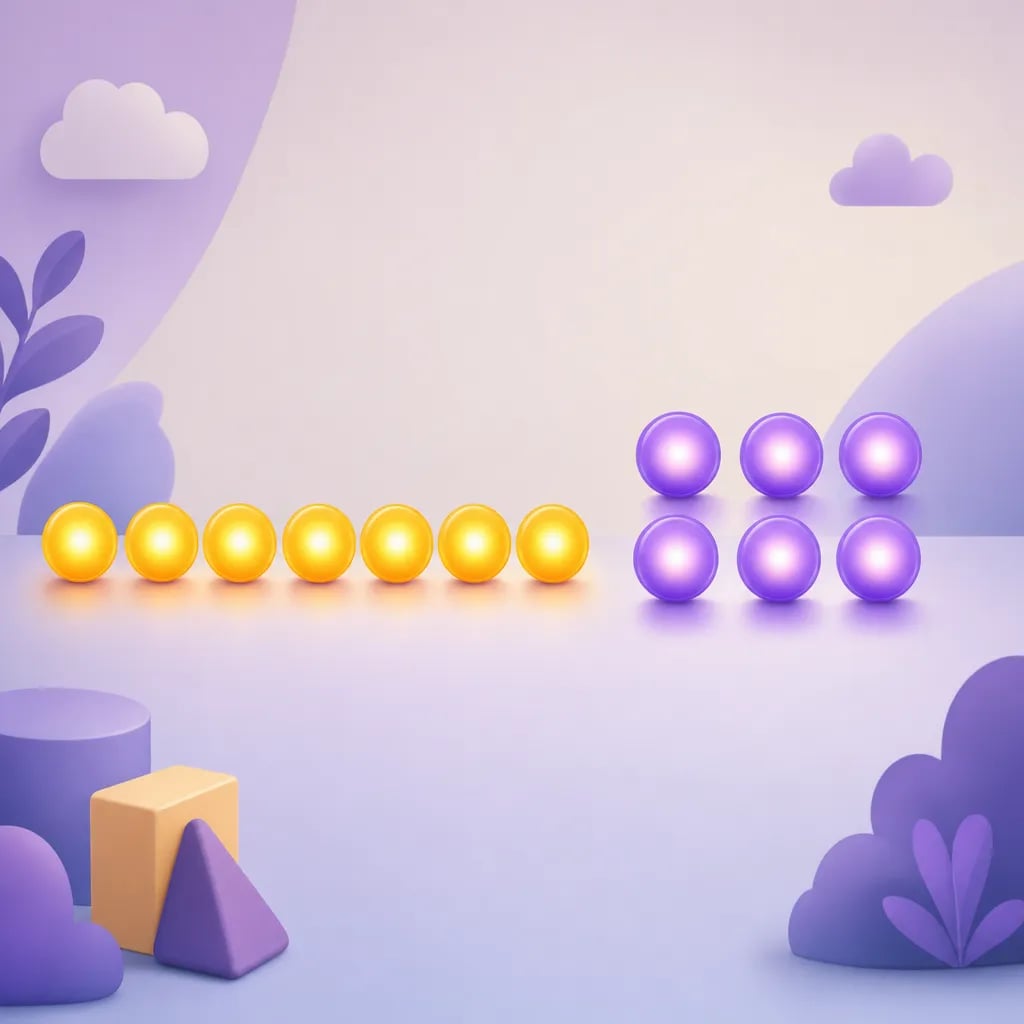
The easiest way to picture it is with real objects. Imagine 7 candies to be shared equally among some children. Those candies can only be arranged into 1 row of 7, or split among 7 children with 1 candy each, there is no other way to divide them evenly. Compare that to 6 candies, which can be arranged into 2 rows of 3, or 3 rows of 2, that is the sign that 6 is a composite number, not a prime one.
One thing that often confuses children: the number 1 is not a prime number. The rule for a prime number is having exactly two distinct factors, while 1 has only one factor, itself. So 1 stands in a category of its own, neither prime nor composite.
So a child can recognize a prime number right away without memorizing a long list, here are a few features to use as a quick reference:
These features work as a quick check. If a number is even and greater than 2, it is automatically not prime because it can be divided by 2. If a number ends in 0 or 5 and is greater than 5, it is automatically not prime because it can be divided by 5.
Once a child knows a number can only be divided by 1 and itself, there is nothing left to memorize, only to check.
Putri Anggraini, Head of Math Program, Algonova
To check whether a number is prime, the steps are simple: try dividing it by small prime numbers in order (2, 3, 5, 7...) up to the square root of that number. If none of them divide it evenly, the number is prime.
Example: is 91 prime?
| Step | Check | Result |
|---|---|---|
| Square root of 91 | about 9.5 | only need to check primes ≤ 9 |
| Divide by 2 | 91 is odd | not evenly divisible |
| Divide by 3 | 9+1=10, not divisible by 3 | not evenly divisible |
| Divide by 5 | does not end in 0/5 | not evenly divisible |
| Divide by 7 | 91 : 7 = 13 | evenly divisible |
Since 91 is evenly divisible by 7, 91 is not a prime number (91 = 7 x 13). Compare that with 97: tried against 2, 3, 5, 7, none of them divide it evenly, so 97 is a prime number.
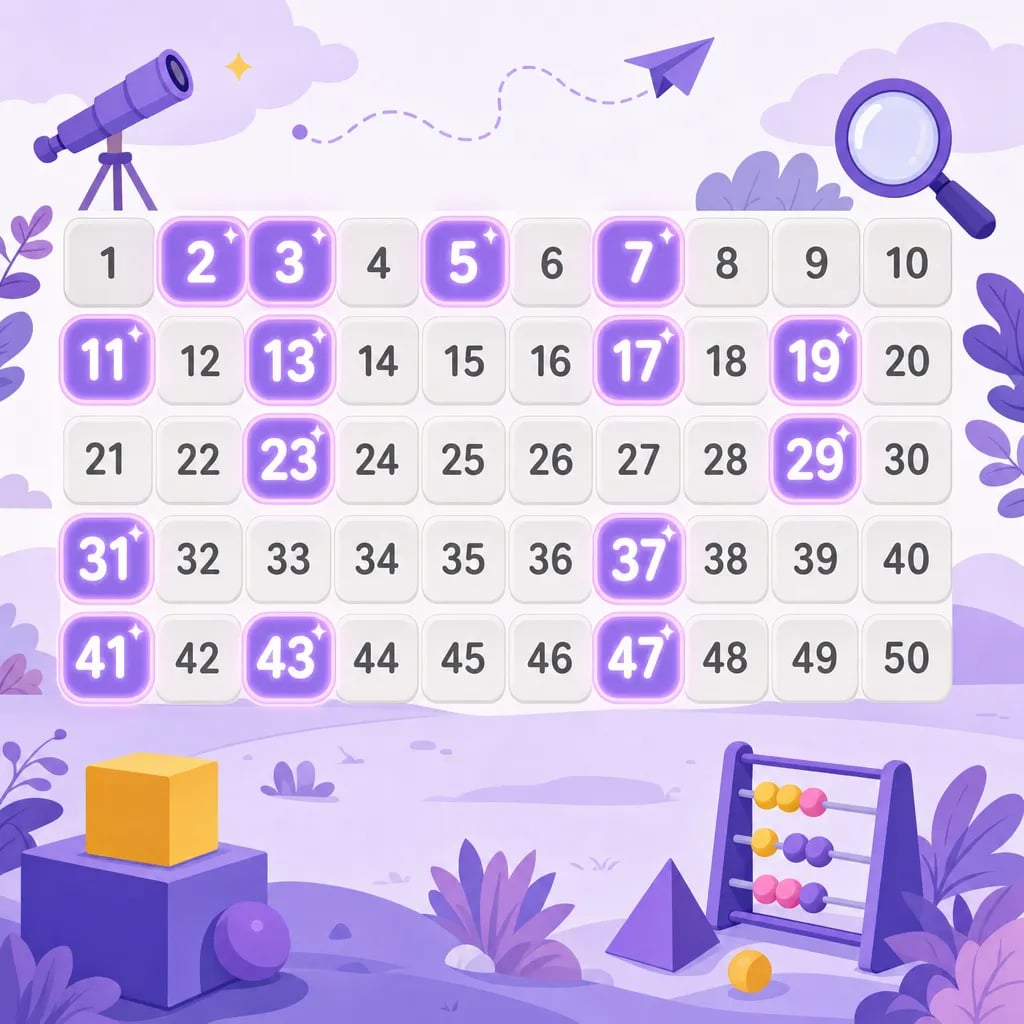
This approach is called the Sieve of Eratosthenes method when it is used to find all prime numbers in a range at once: cross out every multiple of 2 (except 2), then every multiple of 3 (except 3), then multiples of 5, and so on. The numbers left uncrossed are the prime numbers.
There are 25 prime numbers between 1 and 100. Here is the full list, from smallest to largest:
2, 3, 5, 7, 11, 13, 17, 19, 23, 29, 31, 37, 41, 43, 47, 53, 59, 61, 67, 71, 73, 79, 83, 89, 97.
A few interesting things about this list: the smallest prime number is 2, the largest prime number below 100 is 97, and the bigger the numbers get, the rarer new primes become. That is why prime numbers are still a subject of mathematical research today, mathematicians are still searching for a definite pattern.
Knowing prime numbers is also directly useful for other math topics. Prime factorization, for example, is used to find the LCM (Least Common Multiple) and GCF (Greatest Common Factor) of two or more numbers. Once a child can recognize prime numbers quickly, finding the LCM and GCF becomes much faster, since it just means breaking a number down into its prime factors. Read the full guide at How to Calculate LCM and GCF.
Children stop fearing prime numbers when they see them as sharing candies equally, not just a list of numbers to memorize.
Dewi Lestari, Mathematics Specialist, Algonova
Prime numbers are not just a math textbook topic. The idea shows up in plenty of places a child might not notice:
Introducing these examples helps a child see that prime numbers are not an abstract topic that only shows up on tests, but a pattern that is genuinely used in the real world.
A few simple things you can try at home:
Want your child to feel more confident with numbers? Try a free math class at Algonova and see the teaching approach for yourself.
At Algonova, we teach math through understanding, not memorization. More than 1,000,000 children across 97 countries have learned with us, with a 4.9 out of 5 rating. If you want your child to understand prime numbers and other math concepts in a fun way, the first class is free to try.
A prime number is a natural number greater than 1 that has exactly two factors: 1 and itself. Examples include 2, 3, 5, 7, and 11. A prime number cannot be evenly divided by any number other than 1 and itself. This topic is first taught in grades 4-5 of primary school and forms the basis for LCM, GCF, and factorization.
A prime number has exactly two factors, 1 and itself, for example 7, which can only be divided by 1 and 7. A composite number has more than two factors, for example 6, which can be divided by 1, 2, 3, and 6. The number 1 itself is neither prime nor composite because it has only one factor.
There are 25 prime numbers between 1 and 100: 2, 3, 5, 7, 11, 13, 17, 19, 23, 29, 31, 37, 41, 43, 47, 53, 59, 61, 67, 71, 73, 79, 83, 89, and 97. The number 2 is the only even prime number; all the rest are odd.
Try dividing the number by small prime numbers in order, 2, 3, 5, 7, and so on, up to the square root of the number. If none of them divide it evenly, the number is prime. Example: to check 91, you only need to try up to 9 (since the square root of 91 is about 9.5), and it turns out 91 is divisible by 7, so 91 is not prime.
A prime number must have exactly two distinct factors: 1 and itself. The number 1 has only one factor, itself, so it does not meet that condition. That is why 1 is considered neither a prime number nor a composite number, but its own separate category.

Algonova worldwide
Contact
Whatsapp: +62 21 50996971
Email: info@algonova.id
Address
Coworking Area, Gedung IT 6 Lantai Dasar, Nongsa Digital Park, Jalan Hang Lekiu, Kelurahan Sambau, Kecamatan Nongsa, Batam, Indonesia Directorate General of Consumer Protection and Trade Compliance – Ministry of Trade of the Republic of Indonesia. WhatsApp Ditjen PKTN: 0853-1111-1010.
PT Algonova Indonesia Cerdas All rights reserved 2026