Future careers in the AI era: what to prepare now
AI Education8 min
Math Education

Dewi Lestari
Mathematics Specialist
Preschool math is not about counting to 100 before first grade — it is about building number sense through play, concrete objects, and daily interaction with parents. Kids ages 4-6 learn math best through 5 areas: counting, sorting, patterns, shapes, and measurement.
Many parents panic when their preschooler can't count to 20 yet. They buy worksheets, sit the child at a desk for 20 minutes, and hope for fast results. What usually happens is the opposite — the child starts associating math with pressure, and the door to learning closes before primary school even starts.
The opposite approach works better. Kids ages 4-6 learn math best through a play-based approach: games, concrete objects, movement, and everyday conversation. What's being built is not memorization of digits, but number sense — an intuition for big vs. small, more vs. less, patterns, and space. This is the foundation that supports arithmetic and logical thinking later.
At Algonova (since 2016, 1,000,000+ alumni across 97 countries, 4.9★ rating) we teach with certified teachers in Private (1 student), Mini (2-4 students), and Group (up to 10 students) formats, and we see the same pattern: preschoolers who are ready for structured class are the ones who played with numbers at home first — not the ones who memorized 1-100 fastest. This guide covers the 5 key areas, 12 no-worksheet home activities, 5 common parent mistakes, and signs of readiness for structured tutoring.
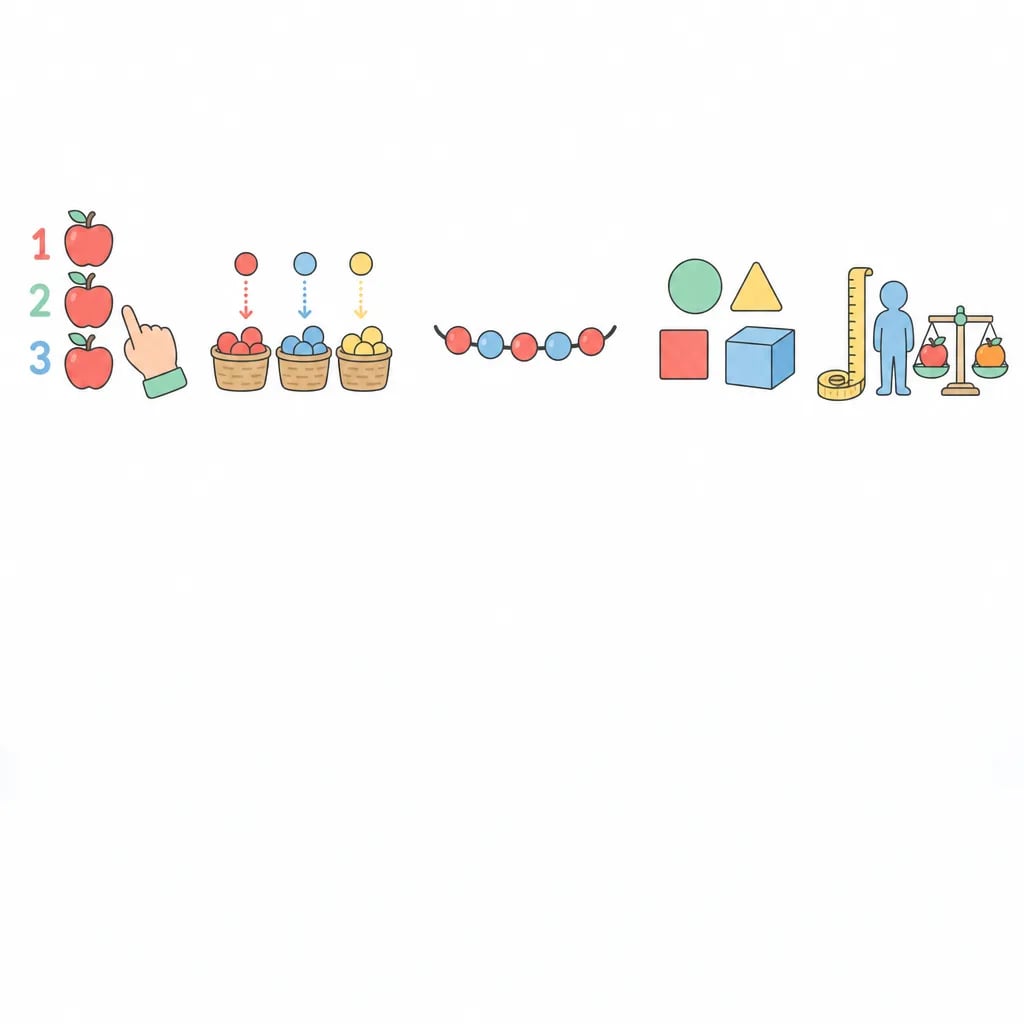
Math for ages 4-6 doesn't start with digits. It starts with 5 interconnected areas. Know all five so you can pick balanced activities at home.
Counting isn't just reciting "one, two, three". Preschoolers need to build one-to-one correspondence — each number represents one object. Activities: count stairs as you climb, count spoons when setting the table, count toys before putting them away. Target for age 4: up to 10. Ages 5-6: up to 20 with understanding.
Grouping objects by color, shape, size, or function. This is the foundation of logical thinking. Activities: separate socks by color while folding laundry, group LEGO Duplo by size, arrange fruit in a basket by type.
Recognizing and extending patterns is the beginning of algebra. Start with simple AB-AB (red-blue-red-blue), then ABC-ABC. Activities: make a bead necklace with a repeating pattern, arrange stones alternating big-small, clap a rhythm and have the child copy.
Recognizing circle, triangle, square, then 3D shapes like cube and sphere. This is the foundation of geometry. Activities: hunt for shapes at home ("find 3 round things!"), do puzzles, build with blocks, draw with shape stencils.
Concepts of length, weight, volume, and time — before formal units. Activities: measure your child's height with a ribbon each month, ask "which is heavier, apple or orange?", pour water between differently-sized cups, count how long tooth-brushing takes.
These five areas work together. A child strong in sorting and patterns usually picks up arithmetic in primary school quickly, because their brain is already used to seeing structure. For a broader view of when to start formal math tutoring, read when a child should start math tutoring.
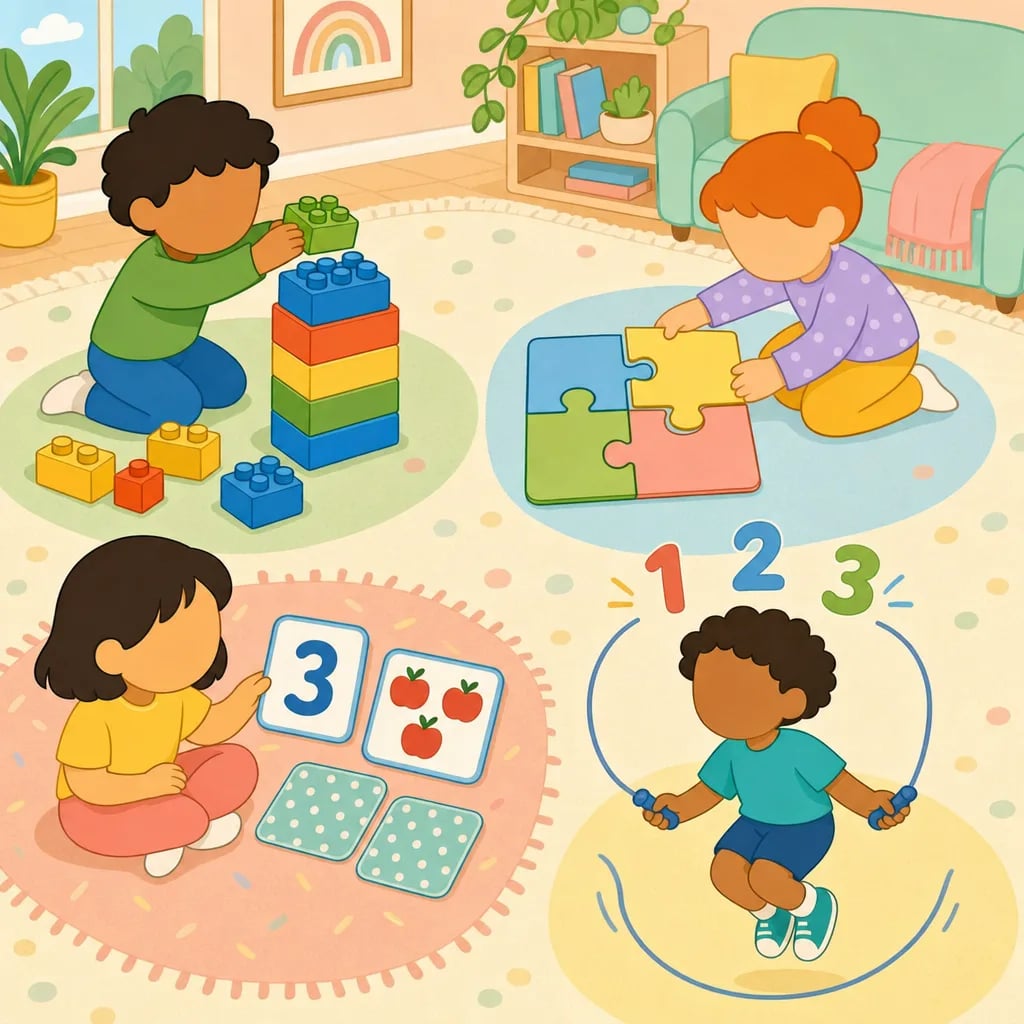
Here are 12 play-based activities that cover all five key areas. All can be done with household items in short 5-15 minute sessions.
Key: rotate activities, don't force. A child who laughs while playing is a child who is learning. For safe digital game ideas, read math games for kids.
Play-based approach only works if you avoid these five traps. All of them are well-intentioned, but the outcome closes the door to math for the child.
For a positive approach to building a child's love of numbers, read how to make a child love math.
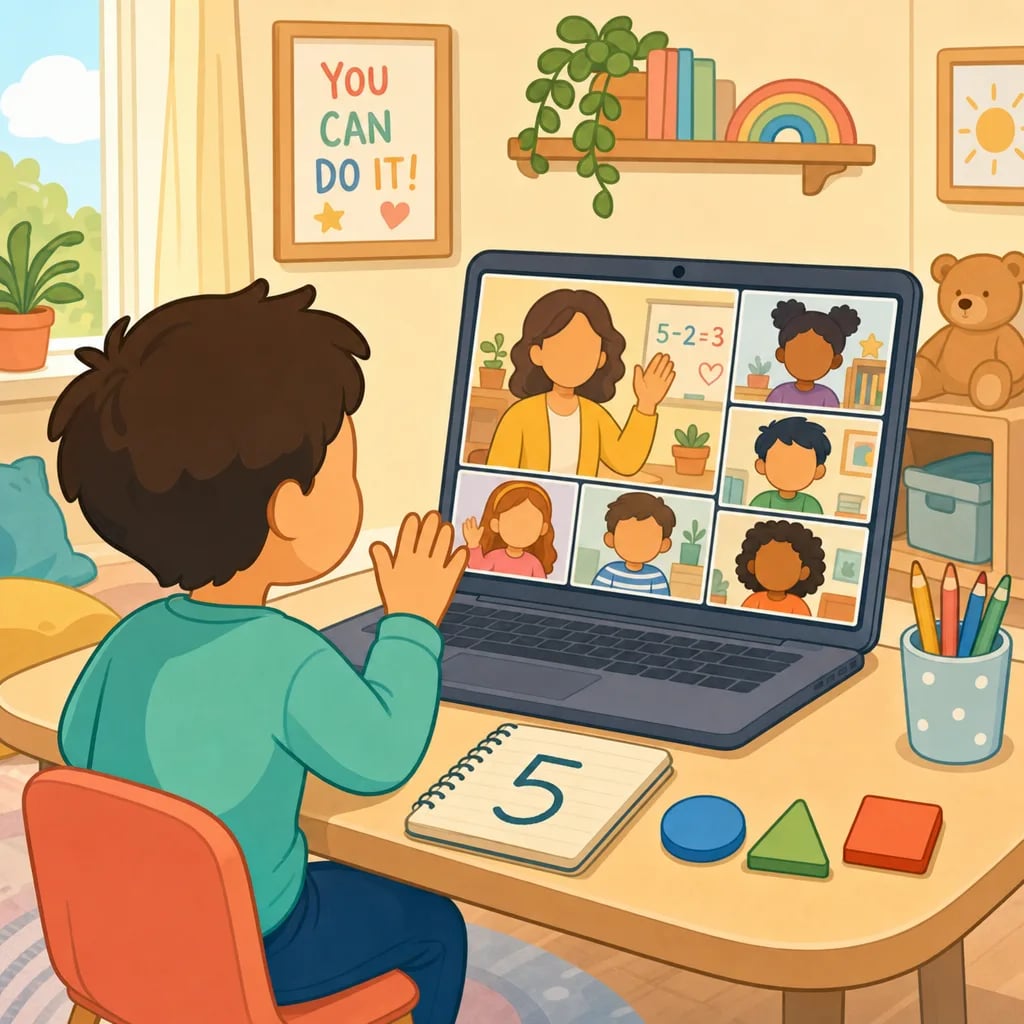
Play-based approach is powerful, up to a point. After that, a child needs a teacher who can challenge and guide. Signs of readiness:
For genuinely effective learning methods beyond play-based, read 5 effective ways to learn math.
Preschool math is not a race to count fastest — it is building number sense through 5 key areas, daily play-based activities, and pressure-free interaction. A child who plays with numbers at home enters first grade with a much stronger foundation than one who was drilled 1-100. When your child is ready to level up — asking their own questions, able to focus, approaching primary-school age — a class with a certified teacher will accelerate their growth.
Try a free Master Class to experience what an Algonova math class for young learners looks like.
Maths for preschool and kindergarten children is best introduced through play and real objects: counting toys, recognising shapes, and comparing sizes, rather than formal worksheets. At this age the focus is growing a sense of enjoyment around numbers and simple logic. This play-based approach lines up with how visual coding teaches logic early. To start in a structured way, see the programs on the Algonova classes page, or try a free class so a teacher can gauge your child's readiness in a diagnostic session.
Kids already start learning math from age 3-4 — by counting toys, recognizing colors, and stacking blocks. What matters isn't the formal "start age" but the approach: play-based, concrete objects, and casual interaction with parents. Structured class usually fits from age 5-6 when a child can focus for 20 minutes and starts asking questions themselves. Before that, home is the best classroom.
No. What's really needed before first grade is *understanding* of numbers 1-20, not memorization to 100. A child who understands the meaning of "5" (five real objects, more than 4, one less than 6) is far more ready than one who can parrot 1-100 without understanding. Indonesian PAUD curriculum and global early learning standards agree: quality of understanding beats quantity of recitation.
For age 4, focus on 3 things: counting with real objects (stairs, spoons, toys), sorting (grouping by color or size), and simple patterns (arrange beads red-blue-red-blue). 5-10 minute sessions are enough. Avoid worksheets and symbolic numerals at this stage — a 4-year-old's brain still builds concepts through touch and movement, not abstract symbols.
For preschoolers (4-6), worksheets shouldn't be your main tool from the start. Kids this age learn best through play-based approach and concrete objects. Worksheets can be introduced lightly at 5.5-6 as prep for writing numbers in first grade, max 5-10 minutes and only if the child enjoys it. If you see signs of stress, frustration, or refusal, stop immediately.
Not every preschooler needs tutoring. Home play-based approach is enough to build the foundation. Structured class fits if a child shows 3 signs: (1) asking their own questions about numbers, (2) able to focus 20-25 minutes, (3) enjoying peer interaction. At this point, a class with a certified teacher in Private (1 student), Mini (2-4 students), or Group (6-10 students) format, like an Algonova Master Class, gives the right challenge without pressure.
A child who's "not interested" usually hasn't found the right form yet. Try three things: first, change approach (from worksheets to games/movement), second, tie it to their interests (if they love cars, count cars on the road; if they love cooking, measure ingredients together), third, never say "you're bad at math". If strong resistance continues after 2-3 months, consult a PAUD teacher or professional — there may be a specific learning style to accommodate.
The ideal session for preschoolers is 5-15 minutes per activity, 2-3 times a day, scattered across natural moments (while cooking, before bed, in the car). Not one long session at a desk. Kids 4-6 aren't neurologically ready for extended static concentration. Structured classes at Algonova run 90 minutes for all levels, including the youngest.
Yes, but not as a replacement for concrete objects at preschool age. Apps like Khan Academy Kids, Endless Numbers, and Moose Math are safe and educational. Cap at 15-20 minutes per day, always sit with your child, and mix in physical activity. Screens at 4-6 work best as a supplement after your child has already played math with real objects, not as the main foundation. The only official hourly figure comes from the World Health Organization, which recommends no more than 1 hour of sedentary screen time per day for ages 2-4. There is no official hourly limit for children over 5, so judge screens by content quality and by whether they crowd out sleep, play, and movement.

Algonova worldwide
Contact
Whatsapp: +62 21 50996971
Email: info@algonova.id
Address
Coworking Area, Gedung IT 6 Lantai Dasar, Nongsa Digital Park, Jalan Hang Lekiu, Kelurahan Sambau, Kecamatan Nongsa, Batam, Indonesia Directorate General of Consumer Protection and Trade Compliance – Ministry of Trade of the Republic of Indonesia. WhatsApp Ditjen PKTN: 0853-1111-1010.
PT Algonova Indonesia Cerdas All rights reserved 2026