

Online Math Tutoring for Primary & Middle Schoolers: Options & Pricing 2026
Math Education8 min
Coding Education

Bayu Nugraha
Children's Coding Specialist
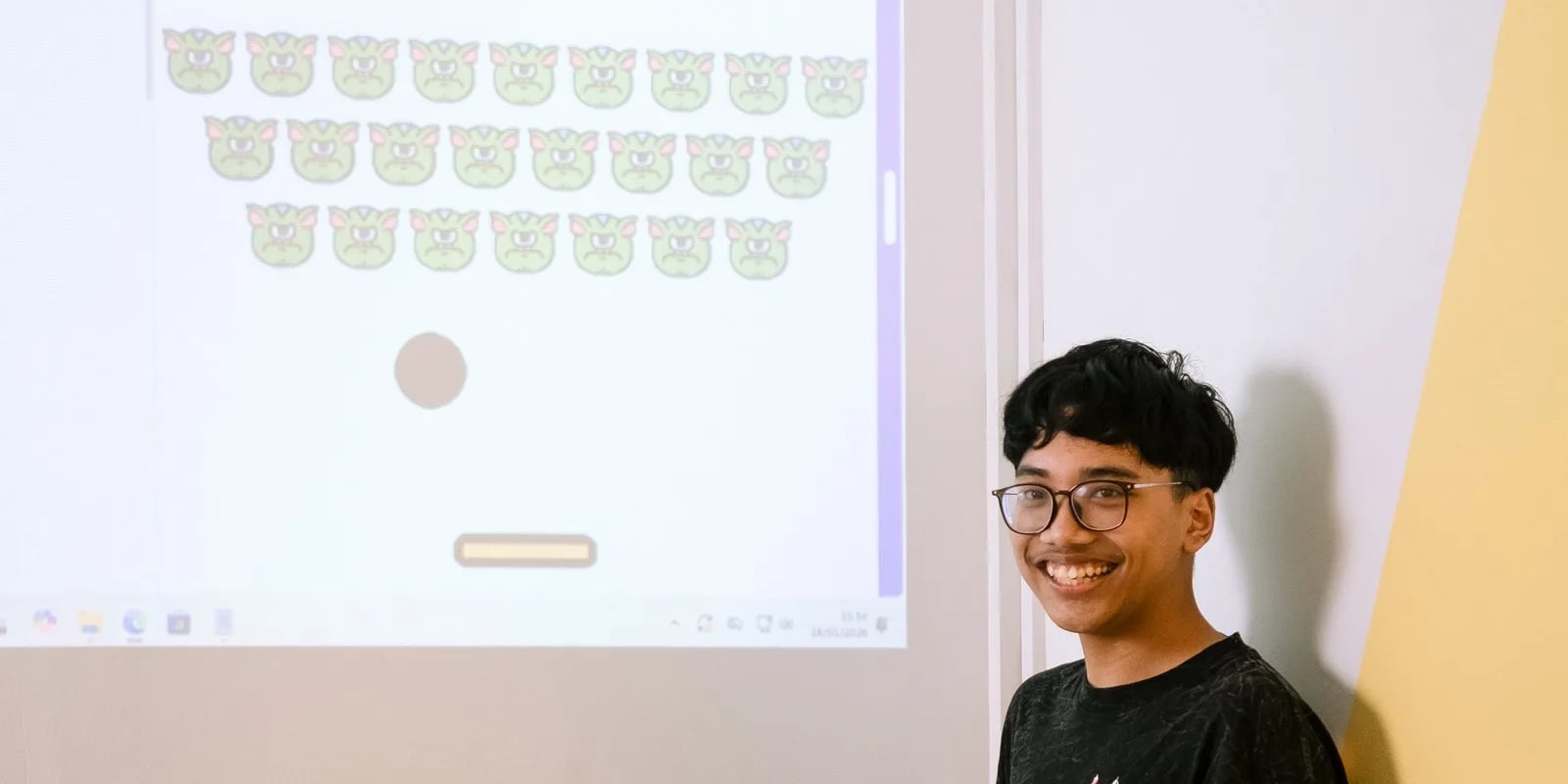
Coding is the process of writing instructions (code) in a programming language so a computer can perform tasks — how humans "talk" to computers to build apps, websites, and games.
Algonova is an online platform for coding, math, AI, and design courses for kids aged 5-17: 1,000,000+ alumni in 97 countries since 2016. Live classes with certified teachers, available in Private (1 student), Mini (2-4 students), and Group (up to 10 students) formats.
Table of Contents
Coding is the part of programming focused on writing code, while programming covers the broader process, including designing, testing, and maintaining a program.
Many people use the two terms interchangeably, and in everyday conversation that is fine. The difference lies only in scope: coding is narrower (typing commands), while programming spans the whole journey of building software. For beginners, this distinction is not worth worrying about — learning to code is the natural first step. Read more in what coding is for kids. Algonova teaches this path in its coding course, and the simplest way to begin is a free class with a teacher.
Coding works by turning human-written commands into instructions a computer can run through a translation process.
Computers only understand machine language made of 0s and 1s. Since that is hard for humans, we write code in a readable programming language, and the computer translates it. The flow is simple:
Think of coding like writing a recipe: the computer follows the steps exactly as written. If one step is wrong, the result is wrong too. This idea of ordered steps is called an algorithm.
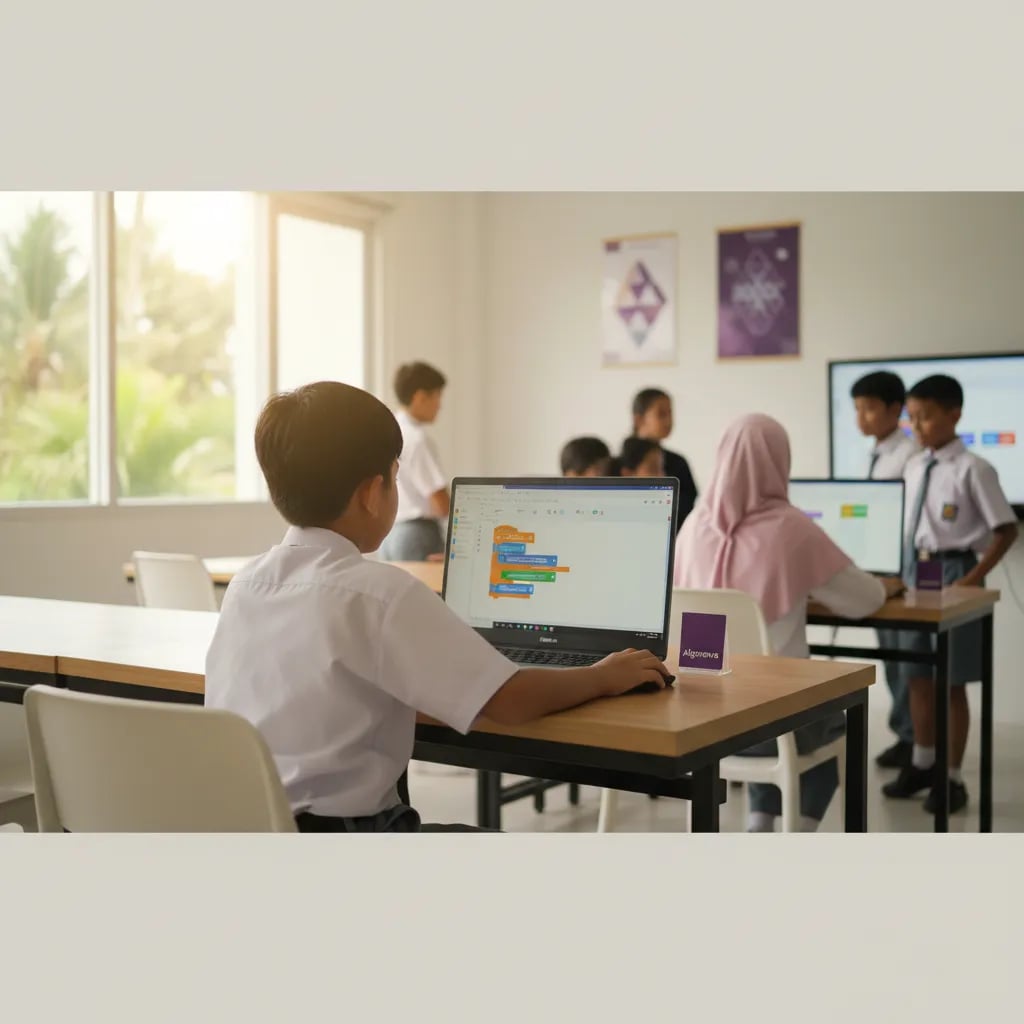
A programming language is the tool used to write code, and each one has different strengths and uses.
For children, Scratch is usually the best starting point because it is visual and fun. Many then move on to Python for kids when ready for text-based code.
Coding is not just a technical skill. When children learn to break problems into small steps, they are really training a way of thinking that will serve them for life.
Maya Putri, Child Education Specialist
Learning to code helps children build logic, creativity, and problem-solving skills useful in nearly every field, not just technology.
Coding trains children to think in a structured way: breaking big problems into small steps. This skill applies to math, science, and daily life.
According to the World Economic Forum Future of Jobs 2025 report, technology skills and analytical thinking are among the most in-demand competencies for the future. Children exposed to coding early are better prepared for an increasingly digital world.
Coding also builds persistence: when code fails, kids learn to debug and try again — a valuable lesson in patience and precision. See the full benefits in coding for elementary school kids.
The best way to start coding is to choose one beginner-friendly language and consistently practice with small projects.
The key is practice, not memorization. The more you try, the faster understanding grows. For a step-by-step guide, read coding for beginners.
For children who want structured guidance, live classes with a teacher can speed up progress and keep motivation high. Children can start with the Algonova coding course or go straight to a free coding class with a certified teacher.
The most important thing when starting to code is consistency, not speed. A child who practices a little each day will progress far more than one who studies a lot at once then stops.
Maya Putri, Child Education Specialist
Coding is a way of giving commands to a computer using a special language so it does what we want, like showing an image or running a game. Imagine a computer as a very obedient robot that can't think for itself — it does exactly what it's told. Coding is that list of commands, written step by step. For example, a single line of code is enough to make a character on screen move right each time the arrow key is pressed. The computer follows the instructions without adding or removing anything. The essence of coding is clear, orderly communication with a machine. Today, most digital-sector jobs require at least a basic understanding of how technology works, so getting to know coding early is a valuable head start.
Coding and programming are closely related but not exactly the same. Coding is the act of writing code, while programming covers the whole process of building a program from start to finish. Coding is part of programming. When you type commands in Python, that's coding. But when you design an app idea, structure its logic, test it, then fix errors, that whole sequence is programming. For example, building a to-do app is not only about writing code (coding) but also about deciding which features are needed and how the app looks (programming). For beginners, this difference isn't important to master right away. What matters most is starting to practice. Over a million children worldwide have begun their coding journey without understanding every technical term first.
Everyday examples of coding are in almost every device we use: messaging apps, mobile games, websites, even ATMs and automatic traffic lights. Every time you open an app like WhatsApp, watch a video on YouTube, or order a ride online, you're using the result of coding. All those functions were built with lines of code that control what happens when you press a button. For example, building a simple number-guessing game in Scratch is also a real example of coding on a small scale. Coding is behind technology we take for granted. Understanding this helps children see they too can become creators of technology, not just users. Learning from something simple is a good start.
Coding isn't as hard as imagined. With the right language and method, anyone, including children, can learn it gradually and enjoyably. The difficulty often comes from starting with a language that's too complex. If you begin with a beginner-friendly tool like Scratch, the process feels like play. For example, a first project is usually as simple as making a cat dance in Scratch — the result shows up on screen straight away, which encourages a child to move on to the next project. The key is starting easy and leveling up slowly. What's needed isn't special talent but regular practice and patience. Many children show real progress in just a few weeks when learning with a fun approach and the right teacher's guidance.
The best way to start coding is with Scratch for children and beginners, then move to a text language like Python after understanding basic logic. Start with the simplest. Scratch lets you build programs using colorful blocks without typing code, so the focus is on logic, not syntax. After that, Python is a popular choice because its syntax resembles everyday English. For example, a common learning path starts with a maze game in Scratch, then moves on to building a simple calculator in Python. Don't rush to learn many languages at once. Focusing on one thing until comfortable is far more effective. Live classes with a teacher in small groups can help keep your learning on track and speed up understanding.
The time to learn coding differs for everyone, but the basics can usually be mastered in a few weeks to a few months with regular practice. To grasp basic concepts like command sequences and loops, a child generally needs a few weeks of regular practice. Building a simple project like a small game can be achieved in one to two months. For example, a rhythm of 30 minutes twice a week kept up without breaks usually matters more than one long session. The time needed depends heavily on consistency, not the length of a single session. What matters is gradual progress, not speed. Learning bit by bit each week gives longer-lasting results than occasional intensive study followed by quitting. Patience is the main key.
Young children absolutely can learn to code. Even kids aged 5-7 can grasp basic concepts through visual tools like Scratch Jr, designed specifically for them. At an early age, children learn coding through games and visuals, not complex text. They arrange command blocks to make characters move or speak. This trains logic and creativity without feeling like a lesson. For example, one of the first projects for this age group is a simple interactive story where the character says hello each time it is touched — a visible result that makes a child proud and eager to keep trying. Learning early builds a strong foundation of logical thinking. At Algonova, children start at age 5 learning with certified teachers in 1-on-1 private, a mini-group of 2–4, or a group of up to 10 students, so each child gets attention and guidance suited to their age.

Algonova worldwide
Contact
Whatsapp: +62 21 50996971
Email: info@algonova.id
Address
Coworking Area, Gedung IT 6 Lantai Dasar, Nongsa Digital Park, Jalan Hang Lekiu, Kelurahan Sambau, Kecamatan Nongsa, Batam, Indonesia Directorate General of Consumer Protection and Trade Compliance – Ministry of Trade of the Republic of Indonesia. WhatsApp Ditjen PKTN: 0853-1111-1010.
PT Algonova Indonesia Cerdas All rights reserved 2026
