AI or coding first: which should your child learn?
Course Guides7 min read
Coding Education

Aina Rashid
Coding Education Specialist at Algonova Malaysia
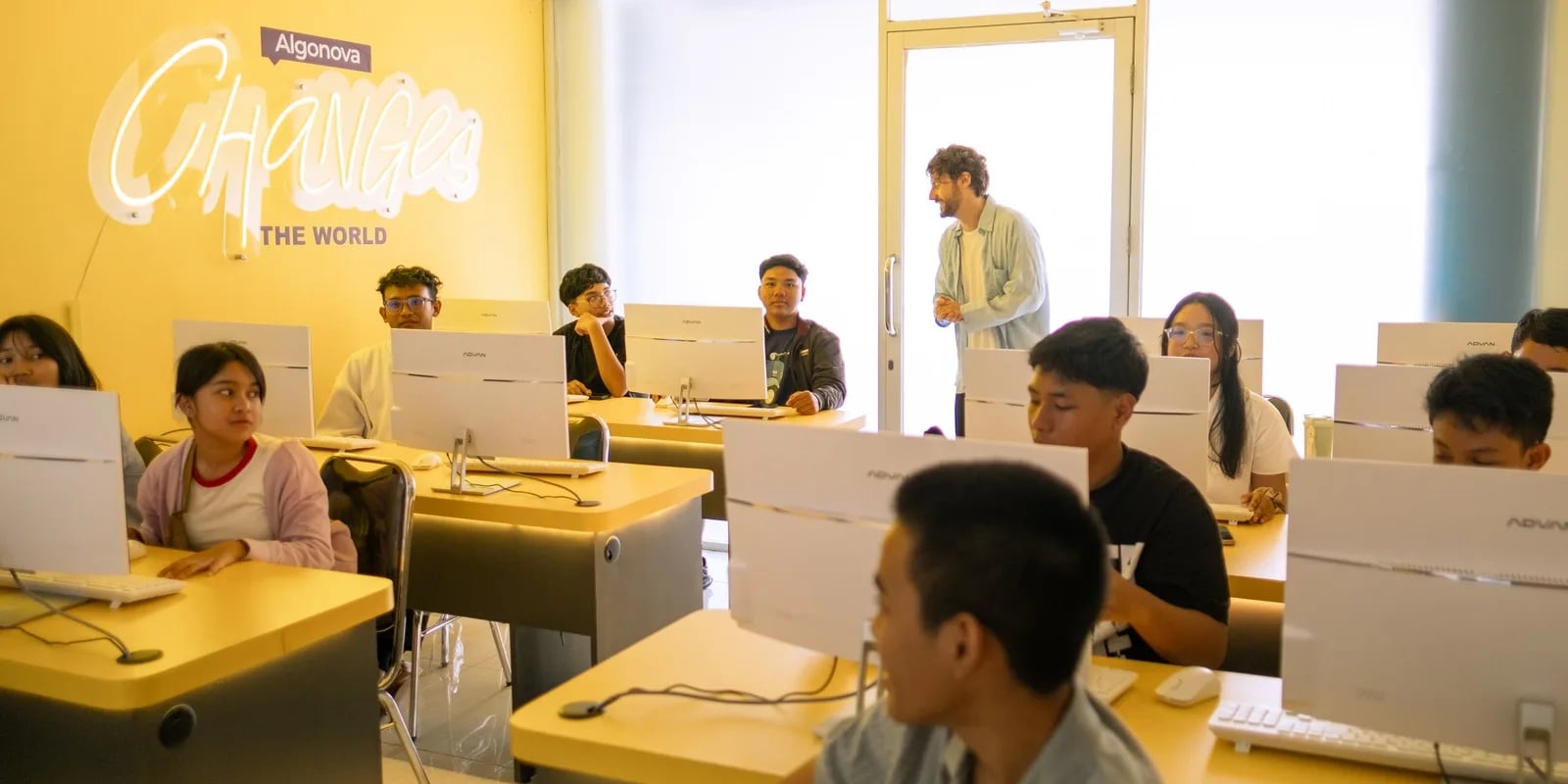
Malaysian kids should learn coding starting at ages 6–8 because Malaysia's MyDIGITAL blueprint targets a fully digital economy by 2030, and the World Economic Forum's Future of Jobs 2025 report ranks analytical and creative thinking among the top skills employers will need. Algonova already teaches over 1,000,000 students across 97 countries. This guide is for parents of children ages 6–17 in Malaysia who want to know where to start.
Algonova Malaysia is part of a global coding, math, AI and design school for ages 6–17, with 1,000,000+ students across 97 countries and a 4.9★ parent rating over 10+ years. Classes are live with certified tutors in small groups or 1-on-1 — never recorded video. This guide walks through five things every Malaysian parent should know before their child starts: why coding matters for the 2030 economy, what skills it actually trains, how it fits alongside KSSR, when to start by age, and what a good coding class looks like.
By 2030, Malaysia's MyDIGITAL blueprint targets a fully digital economy where the digital sector contributes 25.5% of GDP and 500,000 new digital-skill jobs are created — roles most of today's children will apply for. Coding is no longer a niche specialisation; it is a baseline literacy for the economy your child will graduate into.
The direction is clear from three converging sources. Malaysia's own MyDIGITAL plan pushes cloud, AI, data-analytics and cybersecurity across banking, manufacturing, healthcare and government. The World Economic Forum's Future of Jobs 2025 report names analytical thinking, creative thinking and technology literacy as the top three skills employers will need through 2030 — while forecasting that AI, big data and cybersecurity roles are among the fastest-growing occupations globally. UNESCO's education outlook adds that even non-technical jobs will increasingly require digital fluency to remain employable.
What does that mean for a Malaysian 8-year-old today? By the time they finish SPM in 2035, entry-level roles in banking (KL), electronics manufacturing (Penang), palm-oil analytics (Sabah), digital marketing and government administration will assume the ability to read data, automate simple tasks, and reason about how software behaves. That's not "become a programmer" — that's "work in Malaysia in 2035."
Learning to code teaches four transferable habits — computational thinking, decomposition, debugging and iteration — that transfer directly into mathematics, science, language and everyday problem-solving. These are the skills MIT Media Lab (creators of Scratch) call the "lifelong kindergarten" mindset.
Computational thinking is the ability to break a hard problem into small, ordered steps. When a 9-year-old builds a Roblox game, they cannot just wish the character to jump — they must specify, in exact sequence, what happens when a key is pressed. That habit carries into KSSR Mathematics word problems and PT3 Science experiments.
Decomposition and abstraction teach children to zoom in on the important part and ignore noise — a habit their English essays and Sejarah revision reward. Debugging trains resilience: code either runs or it doesn't, so a child learns that a first attempt failing is normal, not a verdict on their intelligence. And iteration — the loop of build, test, refine — is exactly how they will later write a good essay, revise for exams, or run a small business.
A 2021 MIT study on Scratch-based coding classrooms found measurable gains in mathematical problem-solving and reading comprehension in children as young as 8, even in students who did not go on to study computer science. The point is not to raise programmers — it is to raise better thinkers.
Malaysia's KSSR curriculum introduced Reka Bentuk dan Teknologi (RBT) and elements of computational thinking from Tahun 4 onwards, so most Malaysian children meet the ideas of algorithms and Scratch at school — but limited computer-lab time and a class of 35 mean they rarely get enough practice to internalise the skill. That gap is where private classes matter most.
What schools do well is coverage of the vocabulary: what an algorithm is, what a loop is, what a variable is. In many national schools, KSSR RBT covers block-based coding with Scratch for about one period a week during upper primary, and Sains Komputer becomes an elective in Tingkatan 4. Some Sekolah Berprestasi Tinggi and international schools go further, but the average national-school pupil finishes Tahun 6 having heard of coding without ever having built a working program.
The missing piece is practice time. Coding, like a musical instrument or bahasa, is learned by doing it — hours of trial, error and iteration on a keyboard. A once-a-week 40-minute school period shared with 35 classmates rarely delivers that. This is why families across Klang Valley, Johor Bahru and Penang increasingly enrol their children in small-group or 1-on-1 coding classes outside school hours: not to replace KSSR, but to complete it.
Malaysian children can meaningfully start coding from around age 6, with the right format shifting every 3–4 years as their thinking matures. Starting earlier is a gift, as long as the pace is playful and pressure-free.
Ages 6–7 — Digital literacy and pre-coding. Children learn to use a mouse and keyboard, follow visual sequences, and play with block-based logic (ScratchJr, simple Blockly). The goal is confidence with computers and the discovery that they can make things, not consume them.
Ages 8–10 — Scratch and first game projects. Kids build small games, animations and stories in Scratch, learning loops, variables and event handlers. This is the age where computational thinking clicks and school Matematik marks often improve alongside.
Ages 11–13 — Roblox, Lua and web basics. Children move from pure block coding to text-based scripting inside real platforms they already enjoy (Roblox, Minecraft). Many also build their first HTML/CSS pages. Portfolios begin to look like real work.
Ages 14–17 — Python, AI and portfolio-building. Teenagers work in Python (the language used in Malaysian universities and industry), get comfortable with VSCode and GitHub, and start small AI, data-analytics or app projects that strengthen university and scholarship applications.
At Algonova Malaysia, the curriculum path follows exactly this progression across 1,000,000+ students in 97 countries — and every stage is optional entry, so a 12-year-old with no prior coding can start comfortably at Scratch and catch up quickly.
In every industry Malaysia is investing in — semiconductors, finance, palm-oil analytics, halal manufacturing — the workers who will matter are the ones who can talk to software. Coding is how you teach a child to have that conversation.
Aina Rashid · Coding Education Lead at Algonova Malaysia
Compared with the usual after-school options in Malaysia — additional math tuition, robotics, art or music — coding is unique in producing a portable digital artefact your child can show, remix and keep improving for years. Every activity has value; coding just plays a different role.
| Activity | What it builds | What it produces | Career transfer |
|---|---|---|---|
| Math tuition | Exam technique, speed | Better UPSR/PT3/SPM marks | Foundation, not a portfolio |
| Robotics | Hardware intuition, teamwork | A robot that stays at school | Overlaps with coding |
| Art / music | Creativity, discipline | Physical or audio artwork | Indirect |
| Coding | Computational thinking, digital fluency | Real portfolio on GitHub / Roblox | Direct to 2030+ jobs |
Coding is not a replacement for other activities — the strongest students often combine one physical activity, mathematics tuition and coding. But if a family has to pick one after-school investment with the longest payoff for the digital economy Malaysia is building, coding is the one that keeps compounding after the class ends. A child can log in tonight and keep improving a Roblox game they built last month; that's rarely true for a robotics kit locked in a school cupboard.
A high-quality coding class in Malaysia will show four signals: certified live teachers, small groups (or 1-on-1), a structured age-by-age curriculum, and children who produce real projects they can name. These are the signals of learning — not of a good sales page.
Certified live teachers, not recorded video. A tutor who can watch a child code, spot a misconception in real time, and adjust the explanation is the difference between a child "attending" and a child learning. Ask specifically: who teaches, what's their qualification, is the class live?
Small groups or 1-on-1. In a group of 25 sharing five laptops, most children spend the lesson waiting. Groups of 4–6 or 1-on-1 keep every child actively coding for most of the session.
Structured curriculum with a visible next step. A serious programme has a path from Scratch → Roblox/Lua → Python → AI, with clear age brackets. Ask what the next four courses look like — a good school will show you.
Real projects your child can name. After three months, your child should be able to say "I made a maze game where the character jumps" or "I built a Python script that draws a Ramadan calendar." If the honest answer is "we did some exercises," the class is not working.
At Algonova Malaysia these four signals are the design of the school — live certified tutors, small groups or 1-on-1, an age-based curriculum from 5 to 17, and every student finishing with a real project portfolio.
The three questions we hear most from parents in KL, Selangor, Penang and Johor are: is my child too young or too old, is this just for boys, and will this actually help academic marks? The short answer to all three is: coding is more inclusive and more academic than most parents assume.
"Is my child too young or too old?" Six-year-olds can meaningfully begin with ScratchJr and visual sequences — no reading of code required. Fifteen-year-olds who have never coded before can comfortably start at Scratch or Python and catch up within a few months, because the thinking skills transfer from mathematics and Bahasa. There is no "missed the window" — there is only "start now."
"Is coding a boys' subject?" No. Girls make up roughly half of Algonova's 1,000,000+ students globally, and in Malaysia the share is growing every year. The Ministry of Education's own STEM push actively encourages girls into computing. In small-group and 1-on-1 formats — unlike large lab classes — girls don't get crowded out; the tutor makes sure every child codes.
"Will this help school marks?" Yes, indirectly but reliably. The MIT and OECD research on children who learn to code consistently reports gains in mathematical problem-solving, logical reasoning and reading comprehension — the exact skills UPSR, PT3 and SPM reward. Many Algonova parents in Malaysia report their child's Matematik and Sains marks improving within a semester of starting weekly coding classes.
The best way to check any of this for your own child is to try one lesson and watch. Explore the full Algonova coding programme, or book a free 60-minute masterclass with a certified Algonova tutor — your child builds a small real project, you see how the teaching works, and you decide whether to continue with no pressure.
Malaysian children can meaningfully start coding at age 6, with age 8–10 being the sweet spot for most families. Six- and seven-year-olds work in ScratchJr and visual block-based tools that need no reading. By age 8–10 they can handle full Scratch and build small games, animations and stories. Teenagers who have never coded can still comfortably begin at Scratch or Python at 13, 14 or 15 and catch up quickly, because the thinking skills transfer from Matematik and Bahasa. There is no "missed the window" — there is only "start now." At Algonova Malaysia the curriculum runs from 6 to 17 with entry-friendly starting points at every stage, so families can begin whenever the child is ready.
Coding is not a stand-alone mandatory subject, but computational thinking and elements of programming are part of KSSR through Reka Bentuk dan Teknologi from Tahun 4 onwards, and Sains Komputer becomes an elective in Tingkatan 4. In practice, most national-school pupils meet Scratch and the vocabulary of algorithms during upper primary. What is usually missing is practice time — one 40-minute period a week shared with 35 classmates rarely gives a child enough hours on the keyboard to internalise the skill. That gap between "has heard of coding" and "can actually build something" is why families in KL, Penang and Johor increasingly enrol their children in small-group or 1-on-1 coding classes outside school hours, to complement rather than replace KSSR.
Yes. Malaysia's MyDIGITAL blueprint targets a fully digital economy by 2030, projecting 500,000 new digital-skill jobs across banking, semiconductors, healthcare and government. The World Economic Forum's Future of Jobs 2025 report names analytical thinking, creative thinking and technology literacy as the top three skills employers will need through 2030. Even non-technical roles increasingly assume the ability to read data and reason about software. Coding is now baseline literacy for the economy your child will graduate into, not a niche specialisation. A child who starts at 8 has ten years of building portfolio before entering the workforce — that lead is very hard to beat with catch-up learning at 22. Starting now is one of the highest-leverage investments a Malaysian parent can make.
No — a basic laptop that most Malaysian families already own is enough, and every tool a child needs is free. Scratch and ScratchJr run in a browser, Roblox Studio is free to download, Python and VSCode are free, and GitHub gives children a free account to store their code. What matters is a stable internet connection for live lessons and a screen big enough to code on comfortably (a 13-inch laptop or larger). Tablets alone are limiting once children move past ScratchJr, because coding is a keyboard skill. Families do not need to buy special robotics kits, high-end computers or gaming rigs to give their child a serious start. A good coding class supplies the curriculum, the tutor and the structure; the family only needs a working laptop.
Coding is fully open to girls, and Algonova's global student base of 1,000,000+ children is roughly half female. In Malaysia the share of girls in coding classes is growing every year, and the Ministry of Education actively promotes STEM participation for perempuan through Program STEM di Sekolah and MDEC's DigitalNinja initiative. The stereotype of coding as "male" comes from an older generation of computer-lab culture, not from the skill itself — logic, storytelling, design and problem-solving are neutral. In small-group and 1-on-1 formats girls are not crowded out by louder boys, which is a real risk in a 25-child school lab. Parents of daughters can enrol with full confidence; some of Algonova's fastest-progressing students in Malaysia are girls building serious Roblox and Python projects.
That is completely fine, and it is not the goal of coding class anyway. The skills a child builds — computational thinking, decomposition, debugging, iteration — transfer directly into medicine, law, business, engineering, design and even the arts. A future doctor who can read a data dashboard, a marketer who can automate a report, or a filmmaker who can script an animation is more capable than one who cannot. MIT and OECD research consistently shows measurable gains in mathematical problem-solving and reading comprehension in children who learn to code, even those who never study computer science formally. Coding is best thought of as a modern literacy, like reading or basic maths — the child does not have to become a novelist to benefit from learning to write well.
For a beginner in Malaysia, one live 60-minute session per week plus about 30 minutes of independent play is usually enough to see clear progress. That rhythm gives the child regular contact with a tutor to keep bad habits from forming, while leaving space for the messy, self-directed exploration where real learning happens. Two sessions a week accelerate progress meaningfully and suit families who want the child to build a serious portfolio for scholarship or university applications by age 14–16. What matters more than raw hours is consistency — six months of steady weekly practice beats a school-holiday bootcamp followed by nothing. The Algonova free 60-minute trial lets a certified tutor recommend the right rhythm after seeing your child code for the first time.
Start your child's tech journey
Book your free 60-minute trial class with an Algonova certified tutor. No payment, no obligation, just discover what your child can build.

Algonova worldwide
Contact us
Email: int_legal@alg.team
Visit us
Suite 8634, 1021 E Lincolnway, Cheyenne, WY, Laramie, US, 82001
Algonova online LLC International tech school for kids and teens