AI or coding first: which should your child learn?
Course Guides7 min read
Coding Education

Hafiz Rahman
Lead Coding Instructor at Algonova Malaysia
Coding is simply the act of writing instructions that tell a computer what to do — and for kids, it means learning to create apps, games and animations instead of only using them; at Algonova Malaysia, children aged 5-17 learn coding in live online classes with certified teachers.
If your child keeps asking how their favourite game was made, or you keep hearing the word "coding" at school and in the news, this guide is for you. We will explain, in plain language, what coding actually is, why it matters for children in Malaysia today, and exactly how a child starts — step by step, from the very first block to real Python code. No technical background needed on your part.
Computers are not clever on their own. They only do what they are told, in a language they understand. Coding (also called programming) is the process of writing those instructions — a set of step-by-step commands a computer follows to do something useful: show a picture, move a character, add up numbers, or send a message.
Think of it like a recipe. A recipe lists steps in order: first do this, then do that, and if the water is boiling, add the pasta. Code works the same way. The child decides what should happen, and in what order, and the computer carries it out exactly. That word "exactly" is the whole game — computers follow instructions precisely, so a big part of learning to code is learning to think clearly and in order.
In Malay, parents often ask maksud coding — the meaning of coding. The simplest answer: coding is giving a computer clear instructions, in a language it understands, to make something happen.
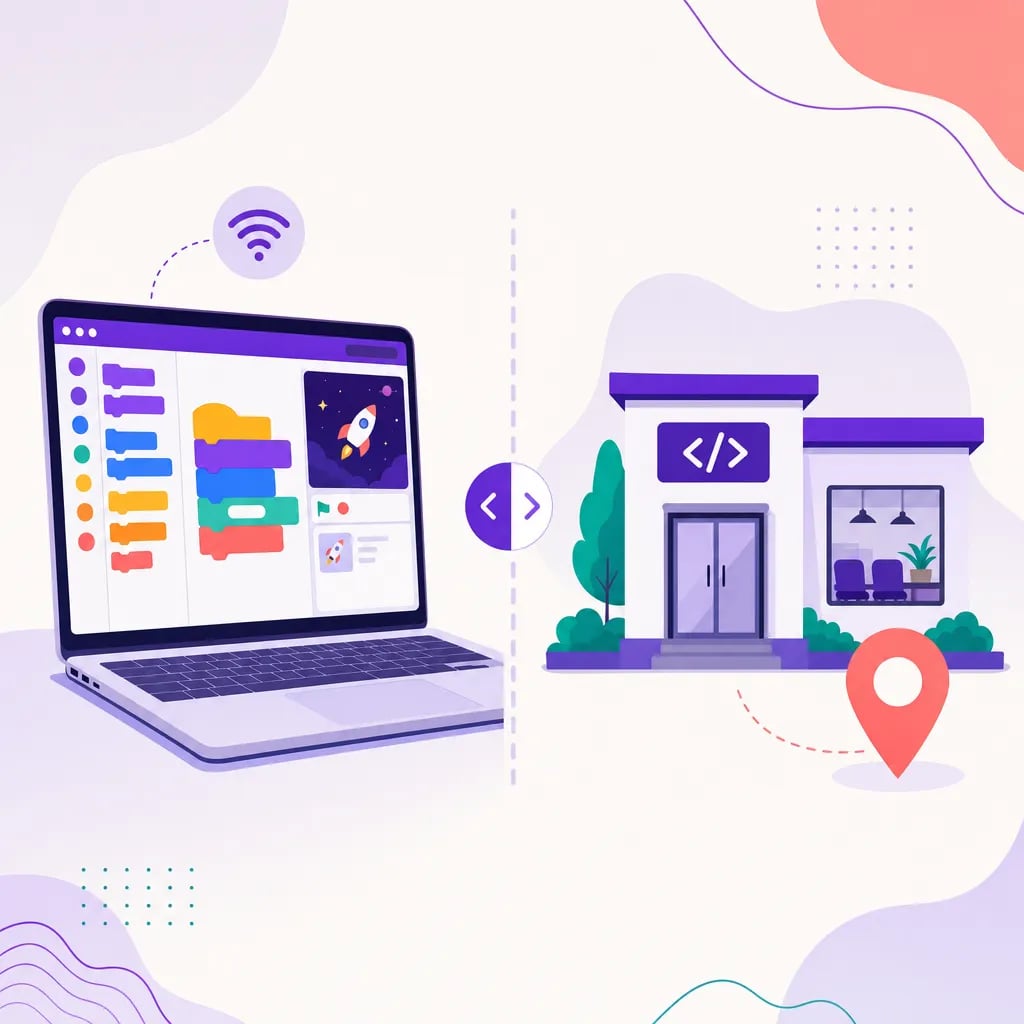
Coding for kids is the same idea, taught at a child's level. Instead of typing complicated text from day one, young children usually start by dragging colourful blocks that snap together like Lego. Each block is a command — "move forward", "turn", "wait", "repeat" — and by stacking them, a child builds a working game or animation.
This matters because it removes the scary part. A seven-year-old does not need to memorise syntax or spelling; they focus on the logic — what should happen and when. As they grow, the blocks are gradually replaced by real typed code. The thinking stays the same; only the tools get more grown-up.
So when someone asks what is coding for kids, the honest answer is: it is problem-solving made visible. Your child builds something real, sees it work (or break), fixes it, and tries again. That loop — build, test, fix — is the heart of coding, and children love it because they are making, not just watching.
Coding is no longer a niche hobby. In Malaysia, computational thinking and digital skills are woven into the KSSR curriculum and the national push for STEM education. Children who understand the basics of code are better prepared for school subjects and, later, for a job market that increasingly rewards digital fluency across almost every field — not just software.
But the benefits go beyond exams and careers. Learning to code builds skills that help in daily life:
For families in Kuala Lumpur, Selangor, Penang and Johor Bahru, live online classes make this practical: a child learns from home, in a small group, guided by a certified teacher — no long commute after a full school day.
You can see how a structured path looks on our coding for kids hub, which lays out the courses by age and stage.
The good news for parents: belajar coding follows a clear, proven path. A child does not jump straight into hard text-based programming. They climb a ladder, and each rung is designed to feel like play.
Stage 1 — Scratch (ages ~7-10). Scratch is a free, block-based tool made by MIT. Children drag blocks to make cartoon characters move, talk and react. There is nothing to spell wrong, so kids build confidence fast while quietly learning the real ideas behind code: sequences, loops and events.
Stage 2 — Roblox / Lua (ages ~10-13). Most Malaysian kids already know Roblox. Here they cross from playing games to building them, using a simplified text language called Lua. It is the bridge between blocks and full typed code — familiar and fun, but real programming underneath.
Stage 3 — Python (ages ~13-17). Python is one of the most widely used real-world languages, and it reads almost like English. Teenagers use it to build genuine projects: small games, simple websites, data tools, and first steps into artificial intelligence. By this stage your child is writing real code that professionals use every day.
Want a closer comparison of the first and last rungs of this ladder? Our guide on Scratch vs Python for Malaysian kids explains which fits which age.
Parents often ask how to learn coding when they themselves have never written a line. You do not need to teach it yourself. What helps most is a structured start:
"My child needs to be great at maths first." Not true. Early coding is about logic and patience, not heavy maths. Many children who dislike maths worksheets happily debug a game for an hour — and coding often improves their maths confidence.
"It is only for boys." Also false. Girls do equally well, and mixed small groups help every child feel it is normal to build and create.
"They will just be gaming." The opposite. Learning to code turns a child from a consumer of games into a maker of them — an active, creative role.
"You must start very young or it is too late." There is no expiry date. A motivated 15-year-old can start with Python and progress quickly. The best time to start is now.
The simplest first step is to let your child try one real, guided lesson and see how they respond — with no pressure. Start with a free trial class at Algonova Malaysia: your child joins a live online session with a certified teacher, in a small group, and builds something real in their very first lesson. You will quickly see whether coding clicks for them, and exactly which stage of the ladder fits their age. From Scratch to Python, we guide every step for children aged 5-17 across Kuala Lumpur, Selangor, Penang, Johor Bahru and all of Malaysia.
Coding for kids means learning to write step-by-step instructions that tell a computer what to do, so a child can build their own games, apps and animations instead of only using ones made by others. Young children usually start with colourful drag-and-drop blocks before moving to typed code.
Most children can start around age 7 using block-based tools like Scratch. From about 10 they can move to Roblox and Lua, and from around 13 to Python. There is no upper limit — a motivated teenager can begin at 15 and progress quickly. At Algonova Malaysia we teach children aged 5-17.
No. Early coding is about logical thinking, patience and creativity, not heavy maths. Many children who dislike maths worksheets enjoy building and fixing games — and coding often improves their maths confidence over time.
For beginners, Scratch is the best first step because it uses blocks instead of typing. As children grow, Lua (through Roblox) and then Python are the natural next languages. Python is ideal for teens because it reads almost like English and is widely used in the real world.
At Algonova Malaysia, children join live online classes in small groups, guided by a certified teacher. Lessons are project-based, so your child builds something real each session. Families in Kuala Lumpur, Selangor, Penang and Johor Bahru learn from home with no commute.
The easiest way is a free trial class. Your child joins one live online lesson with a certified teacher and builds a small project, so you can see whether coding clicks for them and which stage — Scratch, Roblox or Python — fits their age, with no pressure to continue.
Start your child's tech journey
Book your free 60-minute trial class with an Algonova certified tutor. No payment, no obligation, just discover what your child can build.

Algonova worldwide
Contact us
Email: int_legal@alg.team
Visit us
Suite 8634, 1021 E Lincolnway, Cheyenne, WY, Laramie, US, 82001
Algonova online LLC International tech school for kids and teens