How to Choose an Online Coding School for Kids in Malaysia: A Parent's Guide
Course Guides8 min read
Coding Education

Hafiz Rahman
Lead Coding Instructor at Algonova Malaysia
Updated: October 2026
Of all the coding competitions for kids in Malaysia, the easiest first step is the Beaver Computational Thinking Competition, the local edition of Bebras. It runs online at school, usually in May, takes 45 minutes and has categories from Standard 1. After that, children aged 7-12 can try a robotics contest such as NRC or a project contest like Codeavour. Below are 7 competitions with ages, format, months and fees, plus a 6-week plan.
Algonova is an online school of coding, maths, AI and design with more than 1,000,000 students in 97 countries. We teach Malaysian children live with a teacher, in groups of up to 10. Every competition in this guide was checked on the organiser's official website in October 2026.
A competition gives a child a fixed deadline, written rules and judges who do not know them, and home practice never does that.
At home a child can stop a Scratch project the moment it gets hard. In a contest the clock keeps running, so they learn to read every rule, plan their time and decide when to skip a question. Project contests add one more skill: explaining your work to a stranger in two minutes.
Winning is not the goal of a first contest. For a Standard 3 or 4 pupil who has coded for a year, finishing every question in time is already a good result. Our guide to coding and STEM under KSSR shows where these skills sit in the school syllabus.
The children who do well in their first contest are rarely the fastest coders. They are the ones who read the whole task before they touch the keyboard.
Hafiz Rahman · Lead Coding Instructor at Algonova Malaysia
When a robot or a game fails in practice, I ask the child to tell me, step by step, what it should do. Most of the time they find the bug while they are still talking.
Hafiz Rahman · Lead Coding Instructor at Algonova Malaysia
Start your child's tech journey
Book your free 60-minute trial class with an Algonova certified tutor. No payment, no obligation, just discover what your child can build.
Seven competitions with official organisers are open to Malaysian children aged 7-12, from a 45-minute online logic test to national robotics finals.
Where 2027 dates are not out yet, the table shows the usual pattern.
| Competition | Age or category | Format | Usual timing | Fee |
|---|---|---|---|---|
| Beaver Computational Thinking Competition (Bebras) | Pre-Ecolier Std 1-2, Ecolier Std 3-4, Benjamin Std 5-6 | Online at school, 15 questions in 45 minutes, no coding needed | Registration from late November, contest in May (12 May 2026) | RM40 early bird, RM45 normal (2026) |
| National Robotics Competition (NRC), KPM and Sasbadi | RoboMission Junior 7-9, RoboMission Rookie/Pro primary 10-12, Future Innovators primary | School teams with a mentor, in person: state round, then national | State rounds June to August, national final in September |
Beaver is the Malaysian edition of the international Bebras challenge, run by Ardent Educational Consultants since 2015. The questions are short picture puzzles about order, patterns and logic, so they test computational thinking rather than coding, and beginners can take part.
In 2026 there was no individual registration. Pupils entered through their school, a learning centre or a tuition centre, the test ran on 12 May and results came out on 29 July. Dates for 2027 are not out yet. If the pattern holds, registration opens around late November, so ask your child's teacher early. The rules are on the official Beaver Malaysia FAQ.
The National Robotics Competition is organised by the Ministry of Education and Sasbadi, Malaysia's World Robot Olympiad partner. Teams build and program LEGO Education or MATRIX robots around a yearly theme. State rounds ran from 23 June to 13 August 2026, and the national final took place on 7-10 September at INTI International University, Nilai.
NROC is the open edition of the same programme for private, international, MRSM and public schools. Its 2026 national level is on 14-15 November at SEGi University, Petaling Jaya. Both need robot kits and team practice, so they suit children already in a school robotics club. Still choosing between the two paths? See our comparison of coding vs robotics classes.
Six weeks is enough for one contest: two or three practice sessions a week, 30-45 minutes each, counted back from contest day.
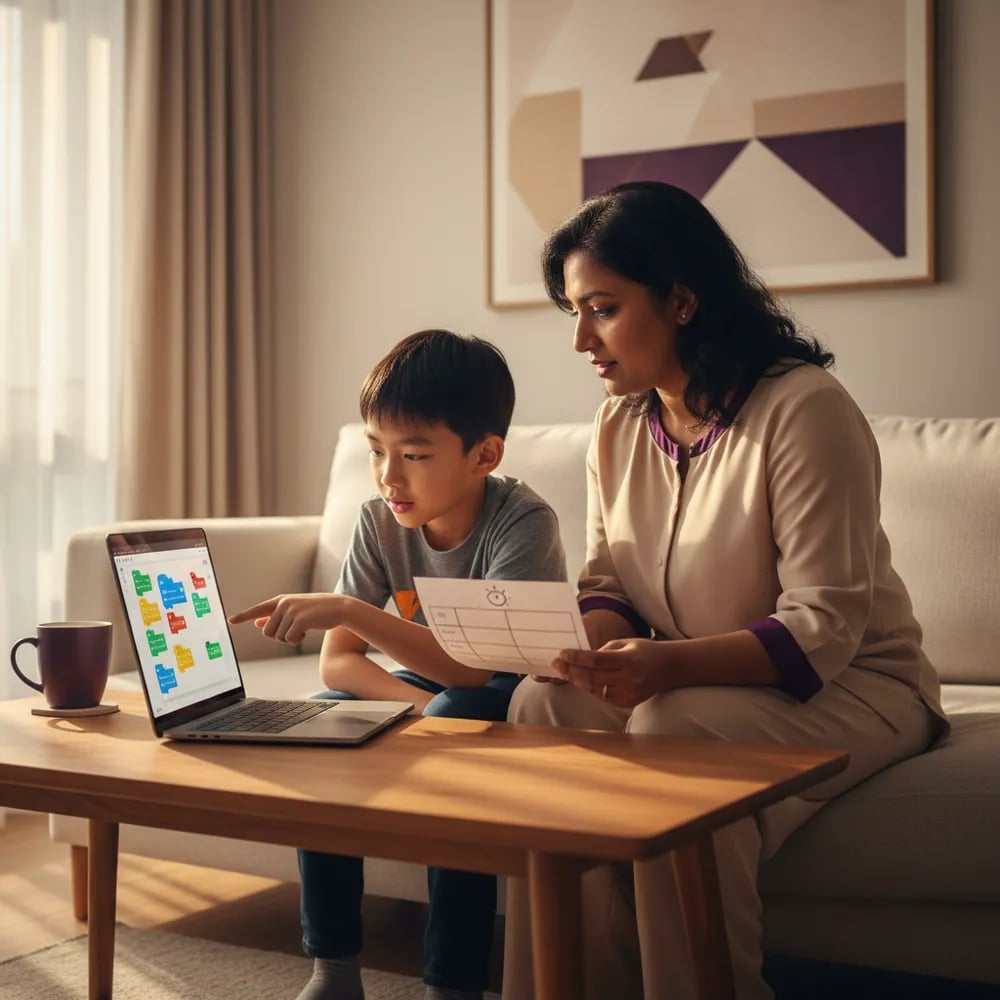
A teacher helps most when a child moves from logic quizzes to project contests, because there they must find bugs and explain their own work.
A child who learns Scratch from videos can usually sit Beaver alone. In a project contest, the same child can get stuck for days on a program that will not run.
At Algonova, Malaysian children learn live online with a teacher in groups of up to 10, from RM 48 per lesson. Courses go from Visual Programming for ages 8-11 to Game Design, AI and Python, and parents rate the school 4.9. You can see every track on our coding courses page. To check your child's level before you pick a contest, book a free 60-minute coding trial class.

Algonova worldwide
Contact us
Email: int_legal@alg.team
| Not published, ask the school |
| National Robotics Open Competition (NROC) | RoboMission Junior 7-9, RoboMission Rookie primary 10-12 | Teams of 2-3 plus a mentor, for private, international, MRSM and public schools | National level in November (14-15 Nov 2026) | Not published |
| FIRST LEGO League Malaysia | Explore 6-10, Challenge 9-16 | LEGO robotics plus a research project, team with an adult coach | 2025-26 season shown, check the official site for the next event | Not published |
| Codeavour 8.0 | Elementary 7-10, Junior 11-14 | AI or robotics project in PictoBlox, alone or in a team of up to 3 with a mentor | Registration open since 14 July 2026, Malaysia Nationals date to be announced | USD 45 for regionals and nationals |
| Malaysian Computing Challenge (MCC) | Junior, 15 and under, primary pupils allowed | Online, 4-6 problems in a 48-hour window | Check the official site, top scorers join a December training camp | Not stated |
| BugCrusher Junior Coding Hackathon (SDEC) | Junior 10-12, Scratch | Online challenges plus in-person hackathons | 2025 edition ran March to July, 2026/2027 not announced | Not stated |
Sasbadi is also the national partner for FIRST LEGO League. Explore takes ages 6-10 and Challenge ages 9-16, both in teams with an adult coach. The Malaysian pages still show the 2025-26 season, so check the site for the next date.
In Codeavour, children build an app, game or robot in PictoBlox, which has block and Python modes, and pitch it to judges. Registration for Codeavour 8.0 has been open since 14 July 2026, but the Malaysia Nationals date and venue are not announced yet.
The Malaysian Computing Challenge, run by the Malaysian Informatics and Programming Society, is the first step towards the International Olympiad in Informatics. Primary pupils may enter the Junior category. Some problems can be done by hand, others need Python or C++, so it suits a child who already writes text code.
The Scratch team at MIT does not run official contests, so every "Scratch competition" is organised by a school, company or agency. The clearest recent example is BugCrusher by the Sarawak Digital Economy Corporation, which drew 954 students from across Malaysia in 2025. Before paying for any Scratch contest, check who runs it, whether it goes beyond school level and the full cost. To practise at home, try our guide to making a first Scratch game.
Match the contest to how long your child has coded: Beaver for beginners, then one project or robotics contest after a year of practice.
One logic contest and one project contest a year is plenty. Beyond that, practice starts to feel like homework.
Preparing for a project contest? Book a free 60-minute coding masterclass and a teacher will see where your child gets stuck.
Primary pupils in Malaysia can join Beaver (Bebras), the KPM robotics contests NRC and NROC, FIRST LEGO League, Codeavour, the Junior category of MCC and Scratch hackathons such as BugCrusher. They test different things. Beaver is a 45-minute online quiz of picture puzzles with categories for Standard 1-2, 3-4 and 5-6, and needs no coding. NRC and NROC are team robotics contests with LEGO Education or MATRIX kits and a mentor. Codeavour asks children aged 7-14 to build an AI or robotics project in PictoBlox. MCC has harder problems, some of which need real code. For example, a Standard 3 pupil who has done a year of Scratch fits Beaver Ecolier well, and can try a project contest the following year. Check the official site of each contest before you register, because dates change every season.
Published fees start at RM40. Beaver cost RM40 early bird or RM45 normal in 2026, and Codeavour charges USD 45 for regionals and nationals. The robotics contests have a hidden cost: the kit. NRC and NROC use LEGO Education or MATRIX sets, which schools with a robotics club usually already own, and the organisers do not publish an entry fee on their main pages. Codeavour adds a USD 100 event fee for national winners who go on to the international showdown. MCC and BugCrusher do not state a fee on their official pages. For example, a family that only wants to try the feel of a competition can start with Beaver through the school for RM40 to RM45. For private contests, ask for the full cost in writing, including certificates and the final round.
A child can join from about age 6 or 7. FLL Explore starts at 6, while Beaver Pre-Ecolier (Standard 1-2), RoboMission Junior (7-9) and Codeavour Elementary (7-10) start at 7. The minimum age is not the same as the best age. A 7-year-old may enter Codeavour, but a project contest asks a child to finish a working project and explain it to judges. At that age, Beaver is gentler: picture puzzles, 15 questions, one sitting. Robotics contests group children by birth year. In NRC 2026, primary RoboMission Rookie was for children born 2014-2016. For example, a Standard 2 pupil can try Beaver Pre-Ecolier first and move to a project contest in Standard 4 or 5. Always check the birth-year limits in the official rules, because they shift every season.
For the 2026 edition, parents could not register alone. Pupils entered through their school, a learning centre or a tuition centre that had signed up for Beaver. The school's teacher-in-charge registers on the ContestHub platform and gives parents a form to fill in. The fee is not refunded if your child cannot attend. In 2026 the early bird fee of RM40 ran from 24 November 2025 to 28 January 2026, and the normal fee of RM45 ran until 27 April 2026. The test itself was on 12 May 2026, mostly at school under a teacher's supervision. For example, if your child's school has never entered, you can show the class teacher the official Beaver site in November and ask whether the school will join. Dates for 2027 have not been announced yet, so check beaver.my from late November.
Yes, Beaver is the Malaysian edition of the international Bebras challenge. It is run in Malaysia by Ardent Educational Consultants together with Bebras International, and it has been held here since 2015. Bebras started in Lithuania, and "bebras" means beaver in Lithuanian, which explains the local name. The format follows the international model: 15 short interactive questions, three levels of difficulty and 45 minutes. The questions are about order, patterns and logic, and children do not write any code. Each correct answer earns points, a wrong one loses points and a blank one scores zero. For example, a child who loves puzzles but has never coded can still score well, because the tasks need careful reading more than programming. The top 10% of participants receive a medal and certificate, according to the official FAQ.
Not for every contest. Beaver needs no coding at all, while project contests for primary pupils mostly use block coding like Scratch or PictoBlox, and Python appears in harder events. Block coding lets a child focus on logic, such as order, loops and conditions, without typing errors getting in the way. Codeavour uses PictoBlox, which has both a block mode and a Python mode, so a child can move up on the same platform. BugCrusher Junior used Scratch for ages 10-12. MCC is different: some problems can be done by hand, but others need real code. For example, a 9-year-old will do better in a Scratch game contest than in a Python category they have not mastered. Many children move to Python around age 11-13, once they can build their own Scratch projects comfortably.
NRC is the National Robotics Competition, run by the Ministry of Education and Sasbadi through school teams. NROC is the open edition of the same programme for private, international, MRSM and public schools. Both use the World Robot Olympiad theme, which in 2026 was "Robots Meet Culture", and both use LEGO Education or MATRIX kits. NRC runs through state rounds before a national final. In 2026 the state rounds ran from June to August and the final was on 7-10 September in Nilai. The NROC 2026 national level is on 14-15 November at SEGi University, Petaling Jaya, with teams of 2-3 students and a mentor. For example, a pupil at an international school who cannot join through NRC can look at NROC instead. Both list RoboMission Junior for ages 7-9 and a primary RoboMission Rookie category.
Plan about 6 weeks, with 2-3 practice sessions a week of 30-45 minutes each, and start by reading the contest rules together with your child. Use week 1 for the rules and a device check. Weeks 2 and 3 are for practice tasks, such as the official Beaver sample questions. In week 4, run a timed mock test. In Beaver a wrong answer costs points and a blank one does not, so practise when to skip. Weeks 5 and 6 matter most for project contests: lock one idea, build a simple version that works, then rehearse a 2-minute explanation. For example, a child sitting Beaver Ecolier can practise finishing 15 questions in 45 minutes twice before contest day. If your child often gets stuck midway through a project, a teacher can help find the problem faster, and a free 60-minute class is an easy first step.
Most fall between May and November. Beaver usually runs in May, NRC state rounds in June to August with the final in September, and the NROC national level in November. In 2026, the Beaver test was on 12 May and results came out on 29 July. NRC state rounds ran from 23 June to 13 August, followed by the national final on 7-10 September at INTI International University, Nilai. The NROC 2026 national level is on 14-15 November. Codeavour 8.0 opened registration on 14 July 2026, with the Malaysia Nationals date still to be announced. MCC top scorers are invited to a training camp around December. For example, a child who starts practising in late March still has about 6 weeks before Beaver in May. Most 2027 dates are not announced yet, so check each official site at the start of the school year.
Yes, but the choice is smaller. Codeavour and MCC accept individual entries, while Beaver 2026 required entry through a school, learning centre or tuition centre. Codeavour lets a child enter alone or in a team of up to 3 with one mentor, and the project is built in PictoBlox. MCC runs online over a 48-hour window, so a child can take it from home. Robotics contests like NRC, NROC and FIRST LEGO League are built around teams with an adult coach, so they are hard to join without a school or club. For example, a homeschooled 11-year-old who already codes can try MCC Junior from home, or build a Codeavour project with a parent as mentor. Read the eligibility section on each official site, since team rules can change from one season to the next.
Visit us
Suite 8634, 1021 E Lincolnway, Cheyenne, WY, Laramie, US, 82001
Algonova online LLC International tech school for kids and teens