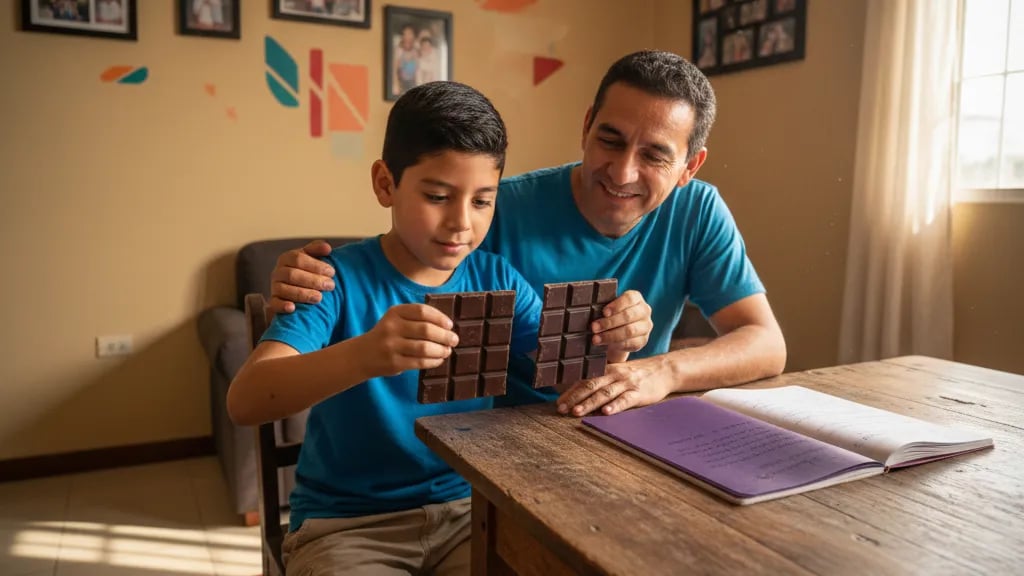

Geometric shapes are forms defined by lines, points and surfaces that take up space. They fall into two big groups: flat shapes (2D), which only have length and width, like the circle, the square or the triangle; and solid shapes (3D), which also have volume, like the cube, the sphere or the pyramid.
Types of flat geometric shapes
| Shape | Sides | Real-life example |
|---|---|---|
| Circle | 0 (curved) | A coin, a clock |
| Triangle | 3 | A slice of pizza |
| Square | 4 equal | A napkin |
| Rectangle | 4 (2 long, 2 short) | A door |
| Pentagon | 5 | A soccer ball |
Flat shapes are classified by their number of sides: those with straight sides are called polygons (triangle, square, pentagon), while the circle is not a polygon because its edge is a curved line.
Why do geometric shapes matter for kids?
Geometric shapes are learned from preschool and elementary school (starting at age 5) and are the foundation of geometry: to measure perimeter, area and volume you first have to recognize the shape. In daily life they are everywhere: windows, traffic signs, buildings and toys. Identifying them develops children's spatial perception, observation and creativity.
To keep learning, see also the area of a rectangle formula and what an angle is. Want your child to learn geometry by creating their own projects? Book a free masterclass with an Algonova teacher.