Future careers in the AI era: what to prepare now

AI Education8 min
Math Education

Reza Maulana
School Partnerships, Algonova
A percentage is a way to express a part of 100 — the mathematical concept that quietly underpins your child's future in personal finance, academics, and data literacy from primary school onward. Indonesia's Kurikulum Merdeka introduces percentages in phase C (grade 5–6) precisely because children who truly understand what "%" means — not just the "×100" formula — read discounts, exam scores, statistics, and interest rates with ease. This is a parent's practical guide to teaching percentages to kids in a way that actually sticks.
Algonova is an online math, coding, AI, and design school for children aged 5–17, with 1,000,000+ alumni across 97 countries since 2016. Classes are live with certified teachers in Private (1 student), Mini (2-4 students), and Group (up to 10 students) formats — never pre-recorded video.
Percentages aren't just an exam topic — they're the language of adult life. Every time a parent reads the news ("inflation of 4.2%"), shops ("30% off"), or checks a report card ("78 out of 100"), percentage literacy is at work. A child weak in this concept will stumble at many points in life.
OECD PISA 2022 data places Indonesia's mathematical literacy at score 366, well below the OECD average (472). One of the concepts that most often "fails to transfer" is percentages — kids memorize the formula but never grasp the meaning.
The missing insight: a percentage is a fraction with its denominator pinned to 100. The word itself comes from Latin per centum — "per hundred". When a child grasps this idea visually, they'll never again get confused converting 25% to 1/4 or 0.25 — those are the same quantity in different languages.
Kurikulum Merdeka introduces percentages in phase C (grades 5–6) after children have mastered basic fractions and decimals. This ordering isn't accidental — percentages build on those two concepts, and teaching them too early without a fraction foundation often ends in formula memorization that never sticks.
Three traps snare most children. If you recognize any of these in your child, it's not a sign of weakness — it's a sign that a foundational concept needs a small correction.
This is the fallacy of successive percentages. If a Rp 200,000 pair of shoes gets 50% off, the price becomes Rp 100,000. Another 50% off Rp 100,000 is Rp 50,000 — not free. Percentages are always calculated from a changing base, not from the original price.
Teach through a real example: ask your child to work out layered discounts at a shoe store. After a few tries, the "base changes" idea sticks far better than any rule.
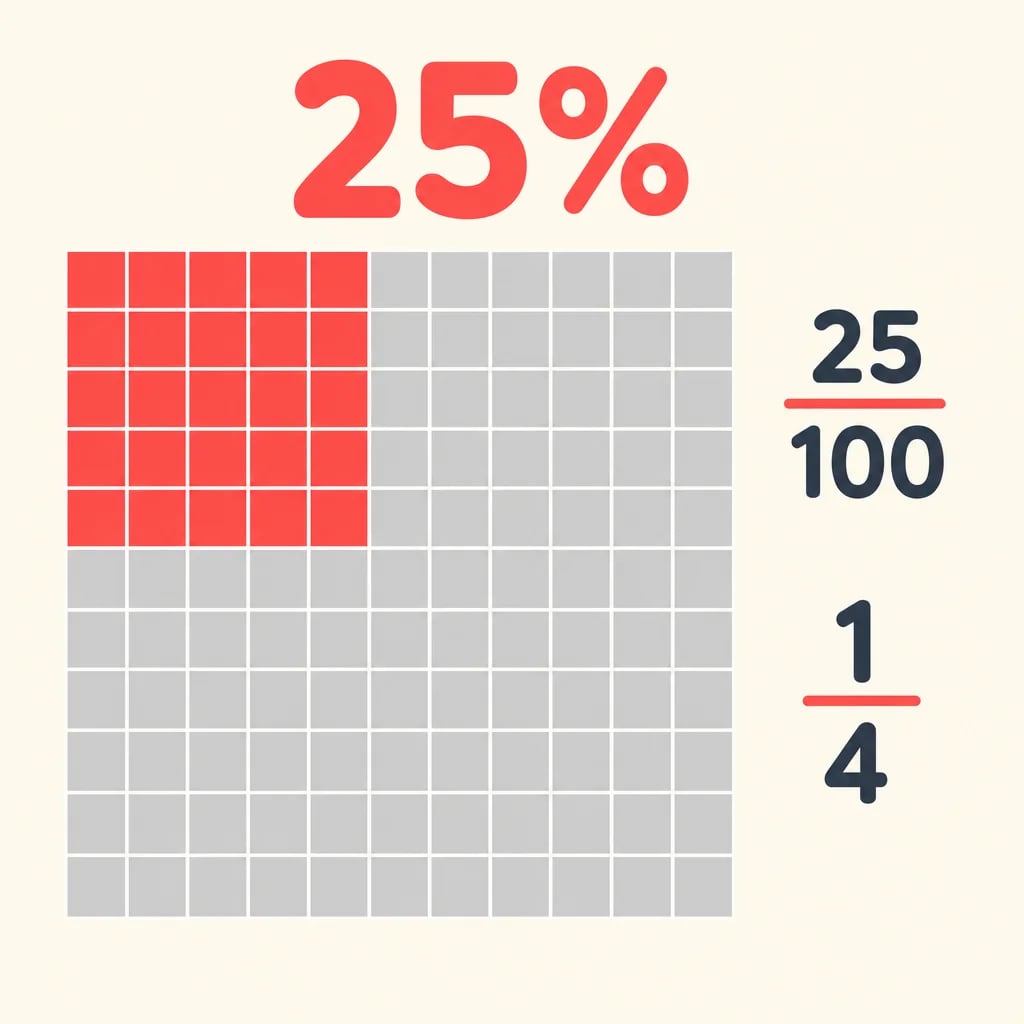
Many kids treat "25%" as a number different from "25/100" or "0.25". In reality, all three are the same amount in different languages.
The fix: show a 10×10 grid (100 squares). Colour in 25 — that's 25%, that's 25/100, that's 1/4. This grid visualization is a Singapore-teacher classic for grounding percentages.
Kids who haven't grasped the base concept assume percentages are "the same size everywhere". In reality: 10% × 200 = 20, but 10% × 20 = 2. A percentage is a ratio — the result always depends on the whole number.
Simple practice: have your child compute 10% of household amounts (a bowl of noodles, kilometres of a journey, marbles in a jar). After 5–10 rounds, they'll internalize that "10% is big" or "10% is small" depending on the base.
The most effective way to teach percentages is CRA — Concrete, Representational, Abstract. Introduced by cognitive psychologist Jerome Bruner in 1966, the method builds understanding in three stages that mirror how a child's brain naturally grasps new ideas.
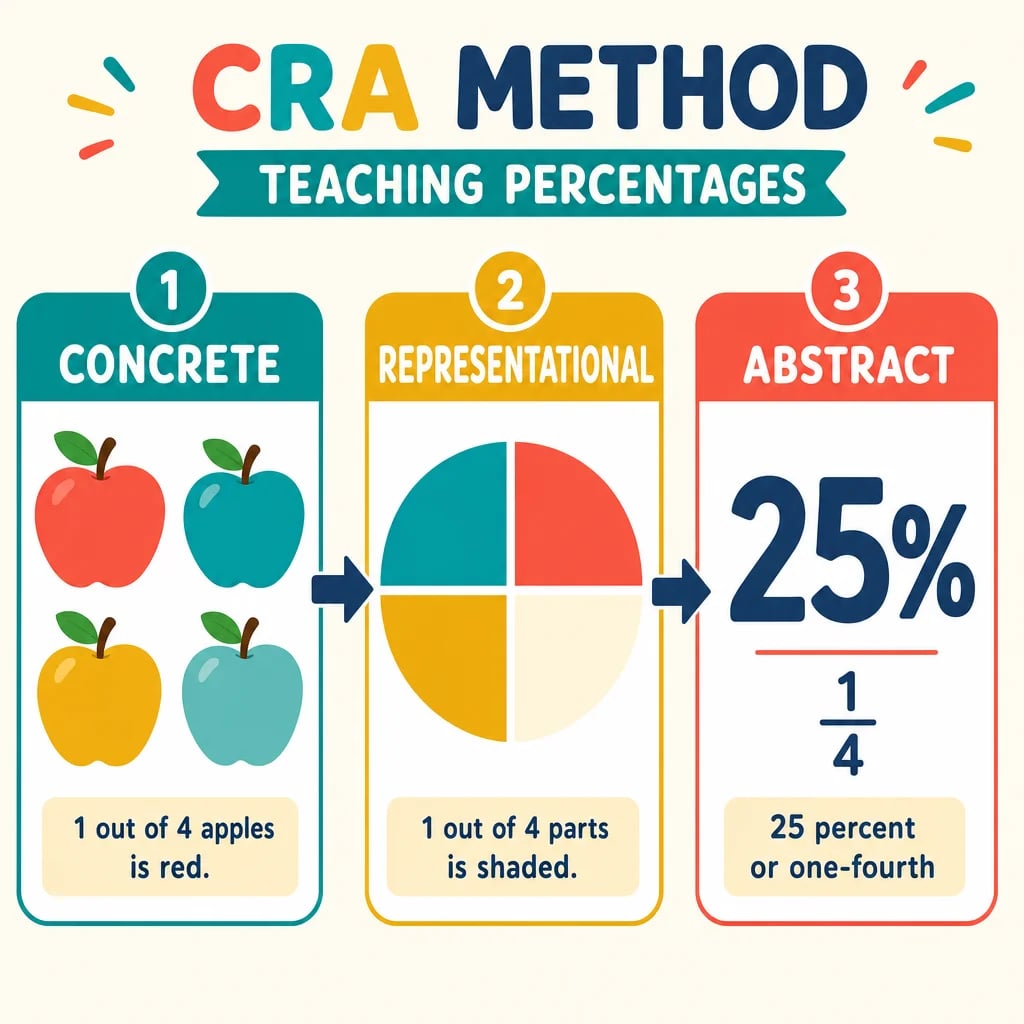
Start with things your child can hold. Take 4 apples on the table. Say: "If 1 out of 4 apples is red, that's 1/4 of the apples — or 25% of the apples." Your child touches, counts, moves. Hands teach the brain — that's why the concrete stage can't be skipped.
Alternatives: coins (25 out of 100 cents = 25%), candies (2 out of 10 = 20%), coloured LEGO blocks. Anything the child can physically manipulate.
Once your child is comfortable with real objects, move to drawings. The most powerful tools at this stage are the Singapore Math bar model and the 10×10 grid.
Bar model: draw a rectangle, split it into 4, colour one — that's 1/4 = 25%. 100-grid: colour 25 of 100 squares — the most direct visual of percentage ever invented. According to the National Council of Teachers of Mathematics (NCTM), the key to rational number understanding (percentages included) is building many visual representations before touching symbols.
Only now does your child start using the % symbol and formulas like "25% × 200 = 50". Because the previous two stages are solid, the symbol isn't memorized — it stands in for meaning already anchored in the child's head.
The most common school mistake: skipping C and R, jumping straight to A. Kids memorize the formula but don't understand it — and the concept collapses the moment a problem is worded differently.
A child who truly understands percentages will never forget the formula, because they've physically 'touched' the concept. That's the difference between learning to understand and learning for the test.
Reza Maulana, School Partnerships, Algonova
Percentages sink in fastest when kids practice on situations they meet themselves. Here are five exercises you can rotate through a week — no textbook, no calculator, just conversation.
While shopping, point at a discount tag. "This shirt is Rp 150,000, 20% off — what do we pay?" Have your child work it out: 20% × 150,000 = 30,000. Final price = 120,000. Repeat a few times a month and the discount mental math becomes automatic.
"If the test has 40 questions and you got 32 right, what percentage is that?" 32/40 = 0.8 = 80%. This exercise builds the bridge between fractions, decimals, and percentages — three languages your child should speak fluently.
"BMKG says there's a 70% chance of rain tomorrow. Should we bring an umbrella?" This teaches probability expressed as percentage — data literacy that only grows more important in the AI era.
"Your pocket money is Rp 20,000. If you save 25%, how much goes into the piggy bank?" Answer: 5,000 goes in, 15,000 for snacks. This is also foundational financial literacy — a child who learns to "set aside a percentage" from an early age saves more easily as an adult.
"Normal body temperature is 36.5°C. If a fever hits 38°C, by what percentage is that up?" This links percentages to science and health — showing that percentages aren't always about money.
The common thread: use retrieval practice — ask your child to answer from memory, not by re-reading. Research by Roediger and Karpicke at Purdue University shows active recall (not re-reading) is the most effective way to lock a concept into long-term memory.
Kids are most ready to learn percentages at age 10–12 (grades 4–6 primary), after mastering basic fractions and decimals. Kurikulum Merdeka schedules it in phase C for that reason. But if your third-grader is already asking "why do discounted prices vary?" — start from the concrete stage. The concept will fuse with their real experience.
They're three languages for one meaning. A child fluent in translating between them won't stumble on any problem type:
| Fraction | Decimal | Percentage |
|---|---|---|
| 1/2 | 0.5 | 50% |
| 1/4 | 0.25 | 25% |
| 3/4 | 0.75 | 75% |
| 1/5 | 0.2 | 20% |
| 1/10 | 0.1 | 10% |
Once your child grasps the concept, it's time to practice with our percentage calculator and full formula guide — that page has an interactive calculator and all the main formulas (percentage of, increase, decrease, and more).
Teaching percentages to your child gets much easier if you keep these five things in mind:
A concept built this way will still be sturdy a decade later.
Percentages aren't hard — what's hard is teaching them like a foreign language, when really they're how we talk about the world every day.
Putri Anggraini, Head of Math Program, Algonova
You teach a child percentages by starting from the idea of "per hundred" with real examples like discounts and test scores, before moving to formulas. Connect percentages to the fractions and decimals the child already knows, and practice with everyday shopping situations. Coding helps a child see the same logic in action. See Algonova's coding classes for ages 5 to 17, or try a free class to check your child's level through a diagnostic session.
The best age is grade 4–6 primary (10–12 years old), after your child has mastered basic fractions and decimals. Kurikulum Merdeka places percentages in phase C for a pedagogical reason — percentages build directly on fractions. That said, you don't have to wait strictly. A grade 2–3 child already asking "why do discounted prices differ?" is ready for the CRA concrete stage — using real objects (coins, candy, apples). What you can't skip is the fraction foundation. A child who doesn't yet understand 1/2 vs 1/4 won't understand 50% vs 25%. If you're unsure, book your child into Algonova's free Master Class — the teacher will run a short diagnostic to see whether the foundation is ready.
The easiest way is to use a 10×10 grid (100 squares). Colour 25 squares — that's 25%. Colour 50 — that's 50%. This visual sinks in far more firmly than any formula. Then connect it to fractions: 25 out of 100 = 25/100 = 1/4. And to decimals: 25 out of 100 = 0.25. Your child finally sees that all three are the same amount written in different languages. In Algonova classes, the grid comes first and the formula only afterwards. Once a child has coloured in those 25 squares themselves, they rarely mix percentages, fractions, and decimals up again when an exam rephrases the question.
The CRA (Concrete-Representational-Abstract) method is a three-stage approach from Jerome Bruner (1966). For percentages, the Concrete stage uses real objects (4 apples, 1 red = 25%). The Representational stage uses drawings (bar models, 10×10 grids). Only the Abstract stage introduces the % symbol and formulas. The most common school mistake is skipping C and R, jumping straight to A. Kids memorize "×100" but don't grasp the meaning. When a test rephrases the problem, the concept collapses. At Algonova, all teachers are trained to use CRA for abstract topics like percentages, fractions, and basic algebra. Kids move through all three stages before touching formulas — the concept then holds much longer.
Percentages, fractions, and decimals are three languages for the same quantity. 1/4 = 0.25 = 25%. All three describe a part of a whole; only the notation differs. A child fluent in translating between them won't stumble on any problem. Example: "Ali ate 3/8 of a pizza. What percentage is left?" The child converts 3/8 to 0.375 = 37.5%, then 100% – 37.5% = 62.5% left. Algonova teaches these three languages in a connected way from day one. Once your child masters this, you can move on to our percentage calculator and full formula guide at cara-menghitung-persen for further practice.
Three misconceptions come up most often. First: "50% off twice = free" — but each percentage is calculated from a changing base (50% off Rp 200,000 = Rp 100,000; 50% off Rp 100,000 = Rp 50,000, not zero). Second: treating percentage as separate from fractions/decimals — even though 25% and 1/4 are identical. Third: assuming "10% is always the same size" — but 10% of 200 (=20) differs from 10% of 20 (=2). In Algonova classes, teachers often find new students holding at least one of these three misconceptions. The good news: once corrected with CRA, they rarely resurface. A free Algonova Master Class is a great way to detect what your child still needs.
A child with a strong fraction foundation usually needs 4–6 weeks to master basic percentages with 2–3 practice sessions per week. "Master" here means: can convert fraction-decimal-percentage, compute percentage of, and solve simple word problems. A child without a strong fraction foundation needs longer — sometimes 2–3 months — because the teacher must step back to fractions first. That's why the initial diagnostic matters so much. In Algonova classes, percentages are consolidated across 90-minute lessons, with the number of lessons set by the initial diagnostic rather than a fixed package. Kids arriving with a strong foundation often finish faster and progress to topics like simple interest and basic statistics.
Not always — but tutoring helps if your child holds misconceptions the school hasn't caught. Basic percentages you can teach at home with a 10×10 grid, real objects, and everyday practice (discounts, report cards, weather). Tutoring becomes valuable when: (1) your child shows signs of repeated misconceptions, (2) the school moves too fast from fractions straight to the percentage formula, or (3) you're unsure how to apply CRA yourself. Algonova teaches percentages as part of a full math curriculum — not as a standalone topic. Online classes with certified teachers, Private (1 student), Mini (2-4 students), and Group (up to 10 students) formats, and the CRA approach build concepts that stick. Try a free Master Class to see the method in action.
Test with three types of question. First, quick conversion: ask your child to change 3/5 to a percentage (answer: 60%). Second, changing-base arithmetic: "An item costs Rp 100,000. 20% off, then another 10% off. Final price?" (Rp 72,000, not Rp 70,000). Third, word problem: "Mum spent Rp 500,000, paid with Rp 600,000. What percentage is change of the total paid?" (Rp 100,000 / Rp 600,000 = 16.67%). A child who grasps the concept handles all three fluently. If your child stumbles on types 2 or 3, a hidden misconception is at play. The fix: return to the Representational stage (bar model, 10×10 grid) before touching symbolic problems again. Algonova can help diagnose it in a free Master Class.

Algonova worldwide
Contact
Whatsapp: +62 21 50996971
Email: info@algonova.id
Address
Coworking Area, Gedung IT 6 Lantai Dasar, Nongsa Digital Park, Jalan Hang Lekiu, Kelurahan Sambau, Kecamatan Nongsa, Batam, Indonesia Directorate General of Consumer Protection and Trade Compliance – Ministry of Trade of the Republic of Indonesia. WhatsApp Ditjen PKTN: 0853-1111-1010.
PT Algonova Indonesia Cerdas All rights reserved 2026