AI or coding first: which should your child learn?
Course Guides7 min read
Coding Education

Hafiz Rahman
Lead Coding Instructor at Algonova Malaysia
For most children, the best path is not one "best" language but a progression by age: start with Scratch or ScratchJr at ages 7-9, move to Roblox Studio with Lua at 10-12, and learn Python from 12-17 — the exact route Algonova Malaysia uses in its live online coding classes for kids aged 7-17.
Every parent in Kuala Lumpur, Selangor, Penang or Johor Bahru who starts looking into coding for their child hits the same wall: Scratch? Python? Roblox? Java? The internet is full of strong opinions and almost none of them ask the one question that matters — how old is your child?
Coding is a skill that stacks. A 7-year-old and a 15-year-old should not be learning the same thing, in the same way, at the same pace. The right answer is a map, not a single destination. Below is that map: which language fits which age, why, and how each step prepares your child for the next. If you want a closer look at just two of these options, we also compare them head-to-head in Scratch vs Python for Malaysian kids.
Young children think in pictures and actions before they think in abstract symbols. That is why we don't hand a 7-year-old a blank screen and ask them to type for i in range(10). We give them coloured blocks they can drag, snap and see move. As they grow, their working memory, reading, and abstract reasoning develop — and the tools grow with them.
This matches how schools in Malaysia already introduce computing under KSSR and the national STEM push: start visual and playful, then move toward real, text-based logic. A good progression keeps the child in the sweet spot — challenged, but never lost.
The stages below map neatly onto that idea.
This is where almost every child should begin. Scratch (and ScratchJr for the youngest readers) is a free, block-based language from MIT. Instead of typing code, children snap together colourful blocks — "move 10 steps", "when green flag clicked", "repeat 4 times" — and instantly see a cat, rocket or dinosaur react on screen.
What your child actually learns here is not "Scratch". It's the thinking underneath all coding: sequences, loops, events, and simple conditionals. They build real projects — an animated story, a maths quiz, a small game — and feel the click of "I made this". That feeling is the whole point at this age; it's what makes a child want to come back next week.
Because there's no typing barrier and no confusing syntax errors, a 7-year-old can succeed in their very first lesson. For most Malaysian families, Scratch is the correct first coding language — full stop.
Around ages 10-12, two things change. Children can read and type comfortably, and they desperately want to build things their friends recognise. This is the perfect moment for Roblox Studio with the Lua language.
Most Malaysian kids already play Roblox. Roblox Studio flips them from player to maker: they design a 3D world, then use Lua, a real text-based scripting language, to make doors open, scores count, and characters respond. It's the ideal bridge between drag-and-drop blocks and "grown-up" code — the logic is familiar from Scratch, but now they're typing actual commands and seeing them run in a game they care about.
By secondary school, most teens are ready for a professional, text-based language — and Python is the best first "real" coding language for kids in this age group. It reads almost like English, which keeps the focus on problem-solving instead of fighting punctuation. Yet it is genuinely powerful: Python runs behind data science, automation, and much of today's artificial intelligence.
With Python a teenager can build a working calculator, automate a boring task, analyse data, or take their first steps into AI and machine learning. It's the language that opens doors to real projects, competitions, and — eventually — university and careers. If your child enjoyed the logic in Scratch and the scripting in Roblox, Python is where it all becomes serious, usable code. This is the single most valuable coding language for kids to end up with.
A quick note on the questions parents often ask next.
HTML and CSS are not really "coding" in the logic sense — they describe how a web page looks. They're wonderful as a side project (building a personal website is motivating for many 11-14 year olds), but they aren't a substitute for learning true programming logic through Scratch, Lua or Python.
AI is not a beginner language you "start with" — it's a destination you reach through Python. Once a teen is comfortable with Python, tools for AI, chatbots and data become the exciting next chapter rather than a confusing first step.
JavaScript and Java are excellent, but they usually come later, once a strong Python foundation is in place.
Put together, the by-age map for kids coding languages looks like this:
Your child does not need to master all of these at once. The goal is a steady climb where each stage makes the next one feel natural. A child who starts Scratch at 8 can be writing confident Python by 13 — not because they're a prodigy, but because the path was built in the right order.
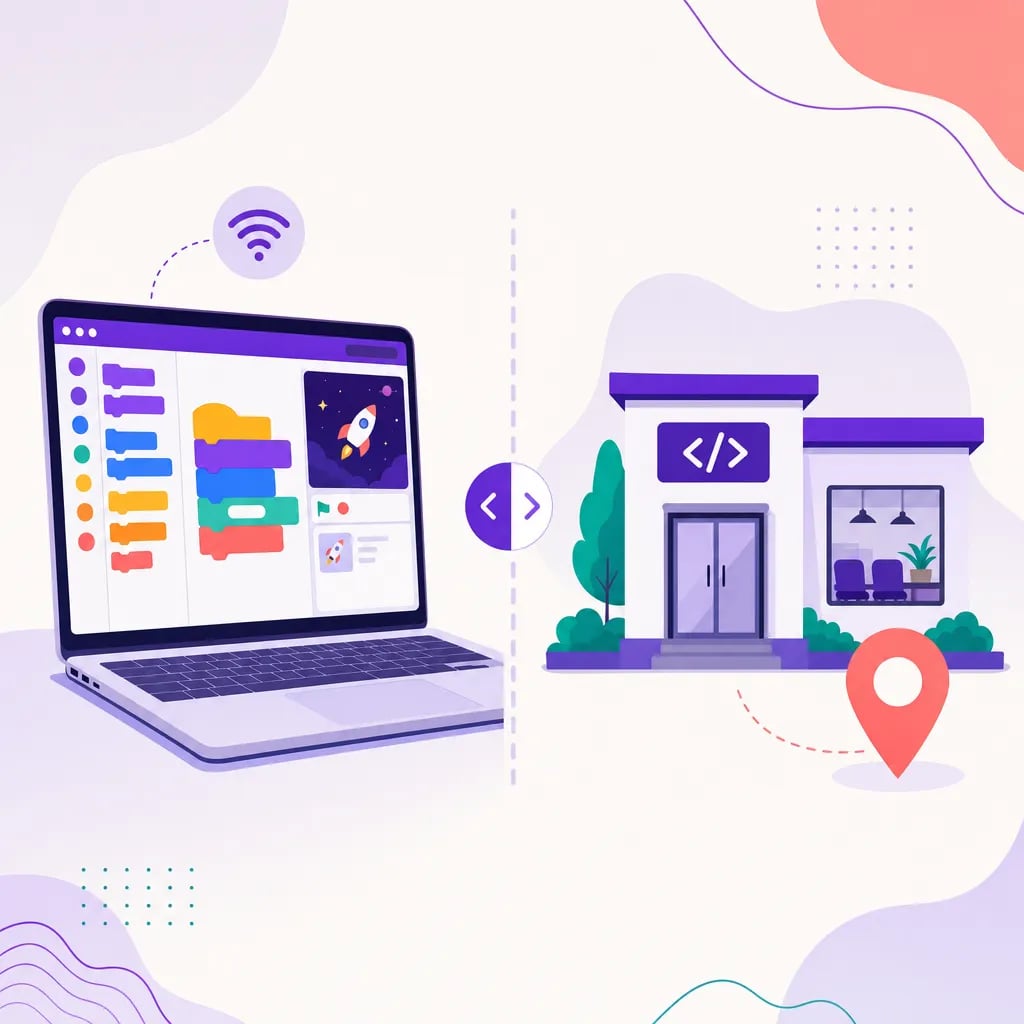
Algonova runs this exact progression as live online coding classes for kids aged 7-17 across Malaysia — Kuala Lumpur, Selangor, Penang, Johor Bahru and beyond. Classes are small groups led by certified teachers, so your child is placed at the right stage for their age and ability, not dropped into a one-size-fits-all course. Lessons are live and interactive, aligned with the KSSR/STEM direction, and your child moves from Scratch to Lua to Python at their own healthy pace.
You can explore the full learning path on our kids coding hub, or read our deeper comparison of Scratch vs Python for Malaysian kids to see how two of these stages differ.
The easiest way to find your child's right starting point is to see a lesson in action — start with a free trial class at Algonova Malaysia, and we'll match your child to the language and level that fits their age.
There is no single best coding language for kids — the best choice depends on age. Scratch is best for ages 7-9, Roblox Studio with Lua suits 10-12, and Python is the best first "real" language for ages 12-17. A progression through all three gives most children the strongest foundation.
Children can start coding as early as age 7 with Scratch, or around age 6 with ScratchJr. At that age it's playful and visual, using drag-and-drop blocks rather than typing, so there's no reading or syntax barrier. Algonova Malaysia teaches children from age 7 upward.
It depends on age. Scratch is better for younger children (7-9) because it uses visual blocks and builds core logic without typing. Python is better for teens (12-17) who are ready for real text-based code. Most kids benefit from doing Scratch first, then progressing to Python. See our full Scratch vs Python comparison for details.
Yes, for the right age. Roblox Studio with the Lua language is an excellent step for ages 10-12. It turns kids from players into makers and bridges block-based coding and real typed code, using a platform they already love — which keeps motivation high.
Algonova's live online classes are aligned with the KSSR and national STEM direction, teaching computational thinking and real programming logic. Small groups led by certified teachers mean lessons are matched to your child's age and level rather than a one-size-fits-all syllabus.
All Algonova Malaysia coding classes are live online, so children in Kuala Lumpur, Selangor, Penang, Johor Bahru and anywhere in Malaysia can join. Classes are taught live by certified teachers in small groups — not pre-recorded videos.
Start your child's tech journey
Book your free 60-minute trial class with an Algonova certified tutor. No payment, no obligation, just discover what your child can build.

Algonova worldwide
Contact us
Email: int_legal@alg.team
Visit us
Suite 8634, 1021 E Lincolnway, Cheyenne, WY, Laramie, US, 82001
Algonova online LLC International tech school for kids and teens