KSSR Mathematics Year 3 & 4: A Parent's Guide to Topics, Skills and How to Help
Math Education8 min read
Math Education

Aina Rashid
Coding Education Specialist at Algonova Malaysia
Under Malaysia's KSSR, Mathematics in Year 5 and Year 6 (Tahun 5 dan Tahun 6) is where primary maths turns abstract: whole numbers stretch into the millions, and fractions, decimals and percentages must finally click together, alongside ratio, area, volume and coordinates. This guide for parents of 11-12 year-olds maps every topic, shows where children get stuck, and gives simple ways to help at home, plus a free 60-minute diagnostic.
If your child has come up through the earlier years, you already know the pattern from our KSSR math Year 3-4 guide: bigger numbers, times tables, and the first fractions. Year 5 and Year 6 raise the stakes again. This is the stage where maths stops being mostly about calculating and starts being about reasoning, connecting ideas, and solving multi-step problems that mix several topics at once. Year 6 carries extra weight too, because it is the bridge into secondary school. A child who is shaky on fractions or times tables tends to feel it most here. Below is a clear, topic-by-topic map of what is taught and how to support it at home.
In Year 5, children read, write and work with whole numbers up to 1,000,000, and Year 6 pushes further into larger seven-digit numbers. They round, estimate, and, in the real Year 5-6 skill, combine all four operations in a single problem, following the correct order (brackets and multiplication or division before addition or subtraction).
Mastery looks like a child who can plan a calculation before diving in, deciding which step comes first in "RM250,000 minus 3 times RM45,000" rather than working left to right and getting it wrong. Estimation matters just as much, so they can sense-check whether an answer is reasonable.
At home: read big numbers off news headlines, property prices or population figures. Pose quick two-step questions ("we drove 320 km on Saturday and twice that on Sunday, how far altogether?") and ask your child to explain the order they solved it in.
This is the heart of Year 5 and Year 6 maths. Children learn to add, subtract, multiply and divide fractions, work with mixed numbers, and handle decimals to three places. The big new idea is percentages, and, most importantly, that fractions, decimals and percentages are three ways of writing the same thing. One half is 0.5 is 50%. Converting fluently between them is the single skill that unlocks most of Year 6.
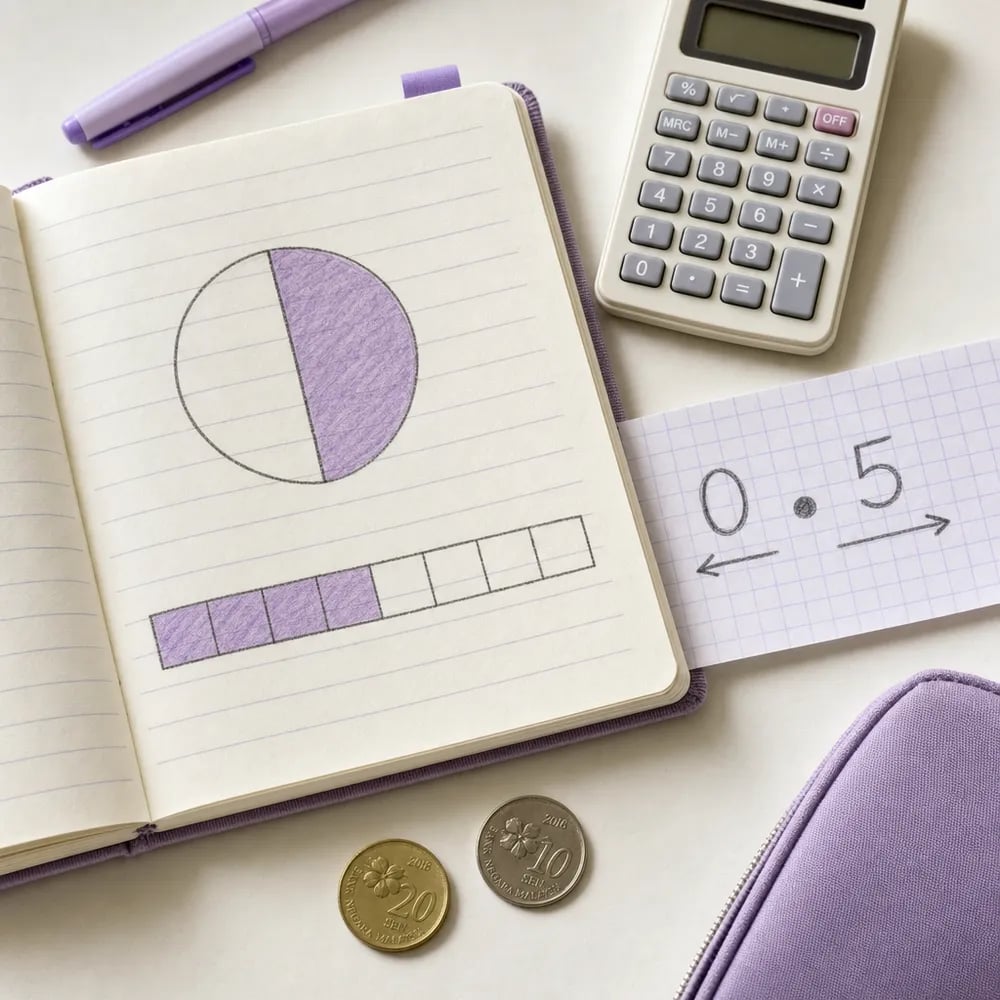
Mastery is a child who sees "20% off RM60" and knows to find one-fifth without panicking, because they understand that 20% is one-fifth. If this connection is missing, percentages feel like a brand-new subject rather than fractions in a different outfit.
At home: shopping is the perfect classroom. Sale signs, price changes and "how much do we save?" turn percentages into something real. Ask your child to convert a discount into a fraction, or to work out a tip. Use ringgit to bridge decimals, since RM3.75 is already three and three-quarter ringgit.
Percentages not clicking yet? A free diagnostic shows whether the real gap is in the fractions underneath. Book a free Master Class.
Year 6 introduces ratio and proportion (nisbah dan kadaran), one of the first genuinely secondary-school ideas children meet. They compare quantities as ratios, simplify them, and solve proportion problems: if 3 pens cost RM6, what do 5 cost? They also find percentages of amounts and work backwards from a percentage to the whole.
This topic rewards children who truly understand fractions, and quietly exposes those who only memorised them. Ratio is really proportional reasoning, the same thinking behind scaling a recipe up for more guests or reading a map.
At home: cooking is ideal. Double or halve a recipe together and talk through the ratios. Mixing cordial ("one part syrup to four parts water") makes ratio physical. On a journey, work out proportion problems from the petrol used or the distance covered.
A child who understands that 50%, one-half and 0.5 are the same thing holds the key to most of Year 6 maths. The ones who struggle are almost always missing that one connection.
Algonova Math Team
Everyday maths becomes more demanding. Money extends to RM1,000,000, with problems that look like real budgeting and saving. Measurement covers length, mass, volume and time, with a strong focus on converting between units and working with compound units: kilometres and metres together, litres and millilitres, hours and minutes. Time problems involve durations across the 12-hour and 24-hour clock.
Mastery shows in multi-step word problems: "A tank holds 4.5 litres; you pour out 750 ml three times, how much is left?" These questions blend measurement, decimals and operations, which is exactly what the Year 6 assessment expects.
Geometry gets three-dimensional and more precise. Children calculate the perimeter and area of squares, rectangles and composite shapes, then move on to the volume of cubes and cuboids. Year 6 also introduces coordinates, plotting and reading points on a grid, the first step toward the graphs they will meet all through secondary school.
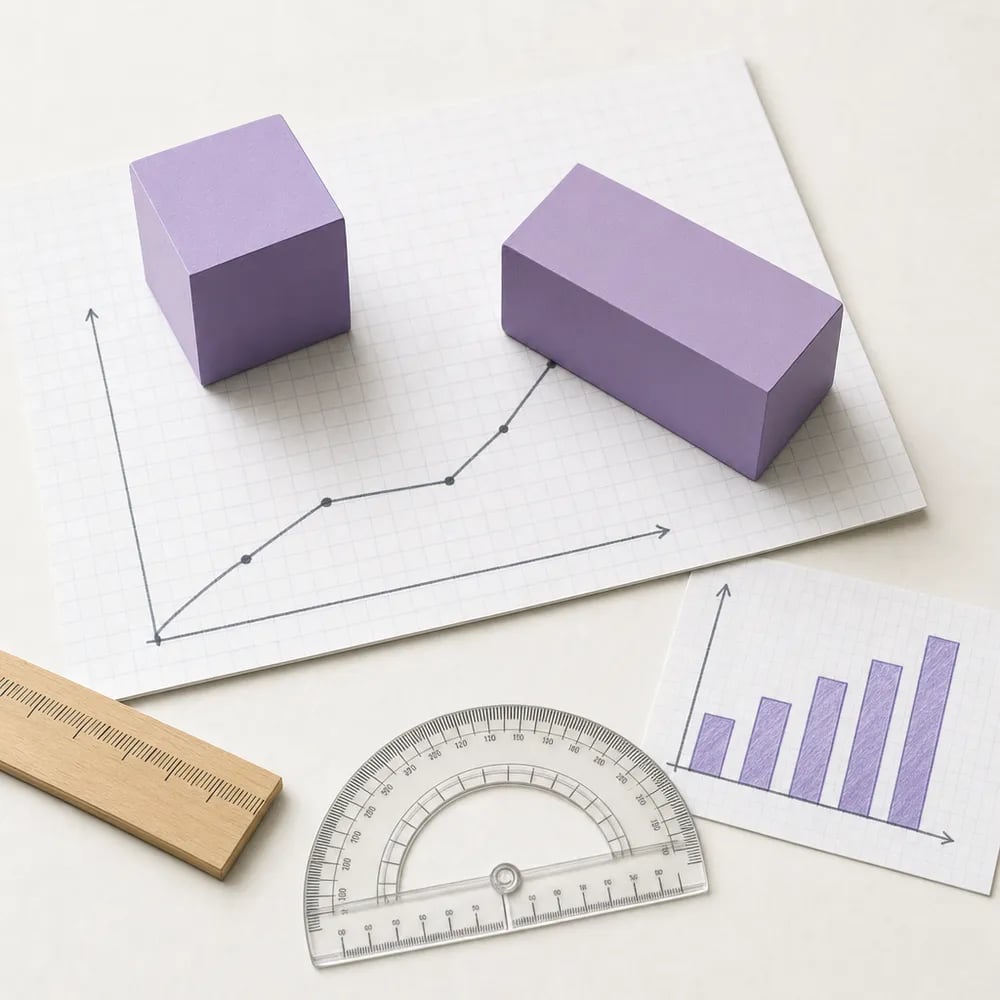
At home: measure and calculate the area of a room or the volume of a box together. Use graph paper for battleship-style coordinate games. Cooking and home repairs are full of real measurement and conversion.
Children read and draw bar charts and pie charts, and, as a key Year 5 skill, find the average (mean) of a set of numbers. Year 6 adds a first, informal look at likelihood: whether an event is certain, likely, unlikely or impossible.
At home: turn family data into a chart (weekly screen time, favourite food) and work out the average together. Talk about chance with dice and weather forecasts: "how likely is rain today?"
Most Year 5 and Year 6 difficulties trace back to a handful of gaps: fractions that never became solid, times tables that are still not automatic, and the leap from single-step sums to multi-step problems that mix topics. Percentages and ratio then feel impossible, not because they are hard in themselves, but because the fraction foundation underneath is shaky.
The trap is piling on more worksheets before finding the real gap. A child who cannot do "find 15% of RM80" usually does not need more percentage drills, they need to rebuild fractions and division first. Seeing the exact missing skill is what makes support actually work.
Year 6 is a bridge. Since UPSR was abolished in 2021, there is no single high-stakes national exam at the end of primary, and progress is now measured through school-based assessment such as UASA. That is good news, because it means the goal is genuine understanding rather than last-minute cramming. What matters most for a smooth start to Form 1 is confidence with fractions, decimals, percentages and multi-step reasoning, the exact foundations Year 5 and 6 build. If your child finds any of this stressful, our guide on helping a child with math anxiety has calm, practical steps, and parents preparing for the year-end assessment may find our UASA Mathematics Year 6 guide useful.
By Year 6, maths is less about getting the answer and more about explaining your reasoning. That shift is exactly what secondary school and real life reward.
Algonova Math Team
Algonova runs live, small-group online math classes with certified teachers, not pre-recorded video, aligned with the Malaysian Sekolah Rendah KSSR curriculum. The approach is visual and project-based: concepts come before formulas, and reasoning is valued over memorisation. An AI diagnostic first finds your child's real gaps, the shaky fractions or the missing times tables hiding under the percentages, so lessons rebuild only what is actually needed.
If you would like to see where your child stands against KSSR Year 5-6 expectations, book a free 60-minute Master Class, with no obligation, and you will leave with a clear picture of strengths and gaps. Algonova teaches 1,000,000+ students across 97 countries, with 10+ years of experience and a 4.9-star rating.
By the end of Year 5, most children work with whole numbers to 1,000,000, use all four operations including mixed operations, add and subtract fractions and handle mixed numbers, convert between fractions, decimals and percentages, find the average of a set of numbers, and calculate area and the volume of cubes and cuboids.
Percentages are introduced in Year 5 and developed through Year 6. The key idea is that a percentage is just another way of writing a fraction or a decimal, so 25% equals one-quarter equals 0.25. Children who are secure with fractions usually pick up percentages quickly, while those who are not tend to struggle.
No. UPSR was abolished in 2021. Year 6 progress is now measured through school-based assessment, including the year-end UASA. The focus has shifted from one big exam to steady understanding, which suits the reasoning-heavy maths of Year 5 and 6.
This is very common in Year 6. Word problems are usually multi-step and mix several topics, so they test reading, planning and reasoning, not just calculation. Practising how to break a problem into steps, and explaining the plan out loud, helps far more than extra sums.
Keep it real and connected to daily life: work out discounts and change while shopping, double a recipe to practise ratio, measure and convert while cooking, and read big numbers from the news. Ask your child to explain their thinking, and focus on understanding rather than speed.
Start by finding the exact gap rather than adding worksheets. Most Year 6 struggles trace back to shaky fractions, times tables or multi-step reasoning. A free AI diagnostic can pinpoint the missing skill so support targets the real problem, and rebuilding that one foundation usually lifts everything above it.
Start your child's tech journey
Book your free 60-minute trial class with an Algonova certified tutor. No payment, no obligation, just discover what your child can build.

Algonova worldwide
Contact us
Email: int_legal@alg.team
Visit us
Suite 8634, 1021 E Lincolnway, Cheyenne, WY, Laramie, US, 82001
Algonova online LLC International tech school for kids and teens