

Online Math Tutoring for Primary & Middle Schoolers: Options & Pricing 2026
Math Education8 min
Coding Education

Maya Putri
Early Childhood Education Specialist
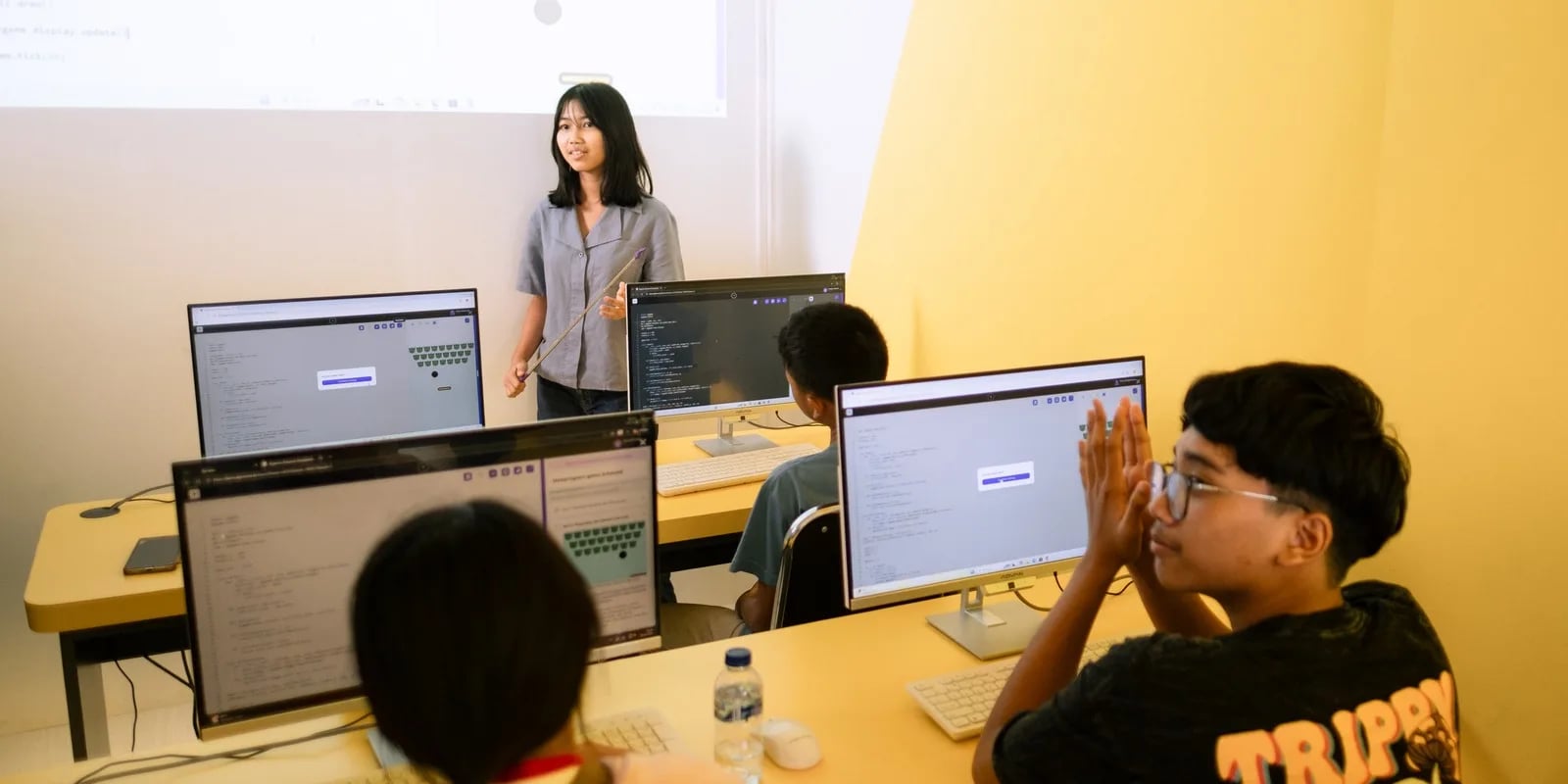
Coding for kindergarten kids means introducing programming logic through visual play without typing any code, for children aged 4-6. Kids arrange picture-based command blocks (like in ScratchJr) to move a character, learning sequencing, cause-and-effect, and problem-solving while they play.
Algonova is an online coding, math, AI, and design course platform for children aged 5-17, with 1,000,000+ alumni across 97 countries since 2016. Classes are taught live by certified teachers in Private (1 student), Mini (2-4 students), and Group (up to 10 students) formats - not recorded videos.
Coding for kids aged 4-6 is not about writing lines of code, but about training computational thinking through concrete activities and icon-based visual apps. At this age children can't read fluently yet, so "code" is replaced with pictures and coloured blocks.
The core of coding for kindergarten age is three simple ideas:
For a fuller picture of the basics, read our guide on what coding for kids is.
At this stage kindergarten kids learn through play, not through complicated screens. The ideal session is short - 15 to 20 minutes - and always alongside a parent or teacher.
Yes, kindergarten kids can learn coding as long as the material is visual and play-based, not text and syntax. Children aged 4-6 are already able to grasp sequences, patterns, and "if-then" logic - the same foundation as programming, just delivered through pictures.
Labour-market research shows analytical and problem-solving skills will only grow in importance. According to the World Economic Forum Future of Jobs Report 2025, analytical thinking is one of the core skills employers value most.
What matters for kindergarten kids:
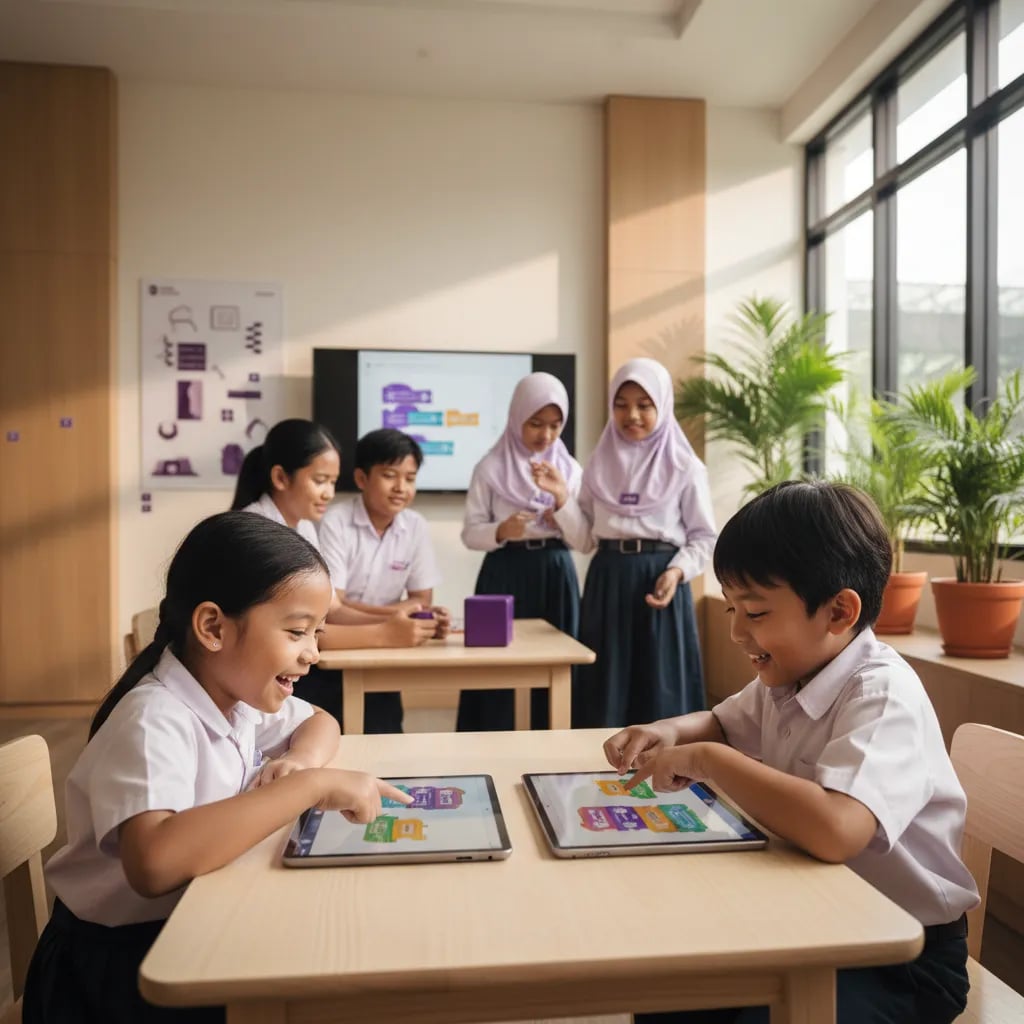
If your child is meeting a computer for the first time, start from the very basics. See our guide to coding for beginners so the first steps don't feel confusing.
For children ages 4-7, the three most effective apps are ScratchJr, Code.org Pre-Reader, and Kodable. All are free or have a free version sufficient for the early foundation.
| App | Age | Platform | Language | What the child learns |
|---|---|---|---|---|
| ScratchJr | 5-7 years | iPad, Android, ChromeOS | Wordless, icons | Sequence, loop, event |
| Code.org Pre-Reader | 4-6 years | Web browser | Wordless, drag-and-drop | Sequential logic |
| Kodable | 5-7 years | iPad, web | Few words, mostly visual | Patterns, conditions |
| Lightbot Jr | 4-7 years | iPad, Android | Wordless | Cause-and-effect, commands |
How to choose: start with ScratchJr. It's the most diverse (kids can make stories, games, or animations), and a large international community means many free YouTube tutorials. After 2-3 months with ScratchJr, you can add one other app for variety.
For the transition to the next stage (full Scratch + Python), see Coding for Primary School Kids: Complete Guide. Starting from the 2025/2026 school year, the Indonesian Ministry of Education also includes coding and AI as elective subjects at primary and middle school levels - making preparation from kindergarten increasingly relevant so the child is ready for primary school.
At kindergarten age, coding is not about building apps - it's about building a way of thinking that will stay for life.
Bayu Nugraha, Children's Coding Specialist
A kindergarten child doesn't need to be able to read or write yet - just able to follow three-step instructions and show interest in screens. Four signs of readiness:
If three out of four signs are present, the child is ready. The most honest way to confirm is a free trial session at Algonova - our teachers assess your child's readiness level in 60 minutes and give an honest recommendation without any package selling.
Four practical rules that make at-home coding sessions work for kindergarten kids: short, together, exploratory, and without targets. Children ages 4-7 learn best when they don't feel tested.
1. Short - 15-20 minutes per session. A kindergarten child's brain isn't ready for long sessions. Four 15-minute sessions per week are better than one long session that ends in a tantrum.
2. Together - sit next to the child, not watch from the sofa. Ask: "What are you trying to build?" "What if we try this block?" Parents don't need to understand coding - just be actively present.
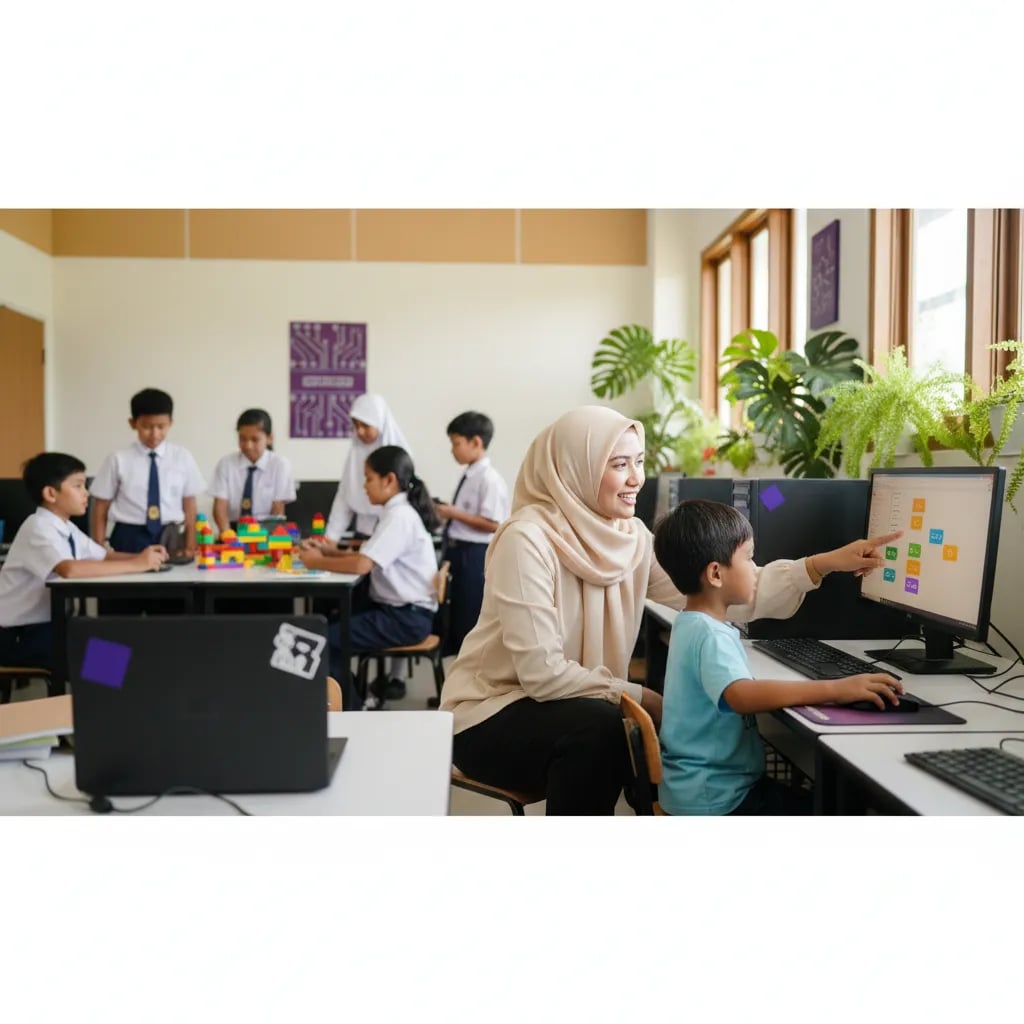
3. Exploratory - let the child press all the buttons. There's no "wrong" in ScratchJr. If the character moves in a strange direction, that's a lesson. Avoid correcting every step.
4. Without specific targets at first. Don't say "today we have to finish the game". Say: "Let's see what we can make with this cat today."
A setup that works in many Indonesian homes: a small table in a corner of the living room, a tablet with ScratchJr, small chairs for child and parent, sufficient lighting, no TV playing nearby.
For children already in primary school who need a more structured approach, see our guide How to Teach Your Child to Code at Home.
For independent practice at home, 1-2 sessions per week of 15-25 minutes each is enough for a kindergarten child. More than that doesn't give additional benefit - it's often counterproductive because the child gets tired and loses interest.
The home practice pattern we recommend:
Weekly consistency matters far more than long duration. A child doing 20 minutes every Saturday for 6 months will be much more ready for primary school than one doing intensive 2-hour sessions once a month.
An Algonova class for ages 5-7 lasts 90 minutes, broken into short blocks with movement breaks so it fits a kindergarten child's attention span. The anatomy of one lesson:
Before entering regular classes, the child goes through a Master Class - a free 60-minute trial session where our teacher gets to know your child's level and interests. No package selling - just an honest recommendation about which class fits best. For the full overview of our Algonova Kindergarten Coding program (ages 5-7), visit the program page.
Parents don't need to be programmers to teach kindergarten kids to code - just being a curious companion sitting beside them is enough.
Bayu Nugraha, Children's Coding Specialist
For children ready to move to the next level, see Coding for Primary School Kids: Complete Guide.
Try it directly with the free Master Class - no credit card, no commitment, one session to see if your kindergarten child enjoys the process.
To see the class format and available time slots, open the try a free coding class page. If your child is already 8-12, see the coding course for primary school kids.
Kindergarten children (ages 4–6) can start coding through unplugged activities and block-based apps like ScratchJr, without needing to read or write code. The focus is on logic, sequencing, and patterns - not typing.
Isn't it too early? No. At this age children actually absorb logical thinking patterns very quickly through play.
How much screen time is safe? Keep it to 15–20 minutes per session and balance it with physical activity. For an age-appropriate learning path, see Algonova coding classes starting from age 5, or try a free coding class to see whether it fits.
Children can begin to recognise coding logic from age 4-5 with simple visual apps, but formal sessions with a teacher are most effective from age 5. The deciding factor is not calendar age but three basic abilities: being able to follow three-step instructions, focus for 10-15 minutes, and engage with a screen actively (not just passively watching). Example from Algonova classes: in a first session a child typically makes a jumping ScratchJr cat, and after 3 sessions can put together a 4-scene short story. A 4-year-old usually needs shorter sessions (10-15 minutes) and more parental guidance. The most honest way to confirm readiness is a free Master Class trial - an Algonova teacher will assess your child's level and interests in 60 minutes before any decision.
ScratchJr is officially designed for ages 5-7, but a 4-year-old PAUD child already familiar with a tablet can start with full parental supervision. For a 3-year-old, ScratchJr is usually too complex - an offline approach like sequence cards or "human robot" games works better. General PAUD advice: tablet sessions max 15 minutes, and always with a parent at the start. Alternative apps for ages 3-4: Lightbot Jr (very simple, just arrows) or Code.org Pre-Reader Express (browser, with Angry Birds characters). At PAUD age, physical logic games (puzzles, blocks, sequence cards) are usually a better fit than screens. Tablets and ScratchJr can be introduced gradually starting at 4.5-5 years old when focus and fine motor skills are sufficient.
For kindergarten kids ages 5-7, the healthy total screen time limit is 30-60 minutes per day, with coding counting as a "high-quality" activity - still limited but more valuable than passive consumption. For PAUD kids 3-4, international paediatric organisations recommend a maximum of 30 minutes total per day. A pattern that works: 1 coding session of 20-25 minutes in the morning or afternoon, and non-screen activities for the rest of the day (reading, outdoor play, crafts). Signs the child needs less time: cranky when the session ends, difficulty transitioning to other activities, or excessive eye blinking. Signs of good capacity: they stop on their own when time is up, and proudly show their project. Coding turns screen time from passive consumption into active production - but the total duration is still capped.
No. A kindergarten child doesn't need to be able to read before learning to code - one of ScratchJr's main strengths is that it's designed specifically for pre-readers (children who can't read yet). All commands are shown as picture icons: an arrow for movement, a mouth icon for talking, an eye icon for "see". The child recognises function from icon shape, just like recognising buttons on a TV remote. Reading skills often come FASTER for kids who actively code, because they get curious about each block's name and want to read tutorials themselves. A child who starts ScratchJr at age 5 while still learning letters often becomes more interested in reading, because they want to understand their own game's instructions. Coding and literacy reinforce each other at kindergarten age.
Four free and safe apps for kindergarten kids: ScratchJr (most comprehensive, from MIT, no ads), Code.org Pre-Reader Express (browser, with familiar characters), Kodable (limited free version but enough for the start), and Lightbot Jr (simple, free on Android and iOS). All without ads or in-app purchases targeted at children. Avoid apps that require a child's email or have pop-up ads - many "kids coding apps" on the App Store are low quality and designed for monetisation, not education. Safe way to choose: look for apps from academic developers (MIT, Code.org, Tynker) or those recommended by official education organisations. Minimum tablet specs: iPad 6th gen and up, or Android with 3 GB RAM and up, latest OS. Algonova also covers coding apps and games for kids in a separate article on our blog.
No. Parents don't need to understand coding to teach a kindergarten child - on the contrary, curious companionship matters more than technical expertise. Kindergarten kids learn ScratchJr intuitively - the colourful blocks are designed for them to explore on their own. The parent's job: sit next to the child (not watch from afar), ask "what are you building?", celebrate small wins, and resist correcting every step. Even parents who were previously afraid to touch the child's tablet can become a favourite exploration partner - the key is asking questions without judgement. If parents want more confidence, watch a 15-minute YouTube ScratchJr tutorial (many in Indonesian). For a structured approach with expert teachers, Algonova offers three class formats: 1-on-1 private, a mini-group of 2–4 kids, and a group of up to 10 students.
Coding for kindergarten focuses on exploration and basic logic through picture blocks on a tablet, while coding for primary school starts involving more complex projects with specific goals. Three key differences: (1) Duration - kindergarten kids are comfortable practising in short 15-25 minute sessions at home, while primary kids can already sustain a full 90-minute lesson. (2) Platform - kindergarten uses ScratchJr on a tablet, primary moves to full Scratch on a laptop and eventually Python. (3) Output - kindergarten kids build mini-stories or short animations, primary kids build games with scores, levels, and condition logic. Children who start in kindergarten usually excel when entering primary because computational thinking foundations are built earlier. Example of more advanced primary classes: transition from Scratch to Python at ages 10-12. For full details on the next stage, see the Coding for Primary School Kids article on the Algonova blog.
The ideal age to start coding for kindergarten kids is 4-6 years old, once a child can follow three-step instructions and shows interest in screens. At this age reading fluency is not required because apps like ScratchJr use icons and colours rather than text. The reason is developmental. Between ages 4 and 6, children are actively building cause-and-effect and sequencing patterns - the two core foundations of programming. Waiting until grade 3-4 is not wrong, but it also gives no extra benefit; the most productive play window is precisely kindergarten and PAUD. For example, in Algonova classes, 5-year-olds routinely finish their first ScratchJr mini-project (a dancing cat) in 20 minutes - something an 8-year-old just starting out often finds equally challenging. So if your kindergarten child shows interest in a tablet or logic games, the moment is right.
The three best apps for kindergarten and PAUD children are ScratchJr (ages 5-7), Code.org Pre-Reader (ages 4-6), and Kodable (ages 5-7). All are free or have a free tier sufficient for the first foundation, and all rely on icons rather than reading ability. The first choice should be ScratchJr because it is the most flexible - children can create stories, animations, or small games, not just clear levels. A large international community also means plenty of free YouTube tutorials in both Indonesian and English. As an example, in Algonova PAUD classes we begin with ScratchJr for 2-3 months, then add Kodable or Lightbot Jr for variety so the child does not tire of a single interaction style. The rule is simple: start with one app, stay consistent for 2-3 months, then add variety.
The ideal coding time for a kindergarten child is 15-25 minutes per session, 1-2 sessions per week, and no more than 60 minutes weekly in total. This matches the natural focus span of a 4-6 year old and aligns with educational screen-time guidance from the American Academy of Pediatrics. The reason is biological. A kindergarten brain is not yet ready for long concentration - after 25-30 minutes the quality of learning drops sharply and the child gets frustrated. Short, weekly consistent sessions are far more effective than a monthly marathon. One pattern that works in Algonova classes is two weekly sessions of 20 minutes each for beginners, moving to three 25-minute sessions once the child shows strong interest for 2-3 months. Key rule: coding screen time must be separate from entertainment screen time (YouTube, passive games) so the child does not overload.
No, a kindergarten child does not need to read or write to start coding. Early-childhood apps like ScratchJr, Code.org Pre-Reader, and Lightbot Jr use picture icons instead of text commands, so a pre-reader can build simple programs from day one. What matters more than literacy is three basic skills: following three-step instructions, recognising colours and shapes, and focusing for 10-15 minutes. If these three are present, the child is ready - even if the alphabet is only half-familiar. In Algonova PAUD classes, many 5-year-olds begin ScratchJr before they are fluent readers, and the coding sessions actually reinforce the symbol recognition and sequencing that support early literacy. So do not wait for fluent reading - start with a visual app right away.
Kindergarten kids usually do not get bored with coding as long as sessions are short and play-based rather than target-driven. The key to sustained interest is right-sizing duration (15-20 minutes), leaving room for free exploration, and celebrating each tiny project instead of chasing a specific level. A kindergarten child usually gets bored for three reasons: sessions are too long, parents correct too often, or the theme stays the same. Switch modes - from an animation this week to a simple game next week - and interest returns. For example, in an Algonova class a child who tired of solo ScratchJr immediately re-engaged when asked to build a story featuring a favourite character (like Upin Ipin or Baby Shark) as animation. Many parents report a child who seems "bored" after 3-4 sessions really just needs a theme change or a small class group.
Yes, active kindergarten kids often enjoy visual coding the most because apps like ScratchJr involve constant motion - dragging blocks, tapping icons, watching characters move. Short 15-20 minute sessions are deliberately designed to avoid demanding long stillness. The reason is that visual coding is not a passive activity like watching video. Active kids get dopamine from continuous interaction and immediate visual results, similar to Lego or puzzles - only on-screen. As a concrete example, in Algonova PAUD classes a 5-year-old who struggled to sit still for 10 minutes in regular class could focus for 25 minutes in ScratchJr because his hands kept moving and his eyes saw rapid changes. For very active children, add movement breaks (stand, stretch) every 10 minutes and let the child stand while coding if that feels more natural.
The first step is to download ScratchJr free on a tablet or iPad, open it together with your child, and spend 15 minutes exploring with no target at all. Just tap the blocks, watch the cat move, and let the child lead the direction of exploration. No tutorial needed yet. The reason is that a good start begins with curiosity, not curriculum. If the child enjoys the first 15 minutes, add a second session 2-3 days later. If there is no interest, wait 2-3 months and try again - never force it. A simple home setup: a tablet on a small table in the living room, parent sitting next to the child (not on the sofa), good lighting, no TV in the background. The first session is usually just making the cat walk from left to right. For a more structured start, join a free Algonova Master Class - a certified teacher will assess your child's readiness in 60 minutes, with no package selling.

Algonova worldwide
Contact
Whatsapp: +62 21 50996971
Email: info@algonova.id
Address
Coworking Area, Gedung IT 6 Lantai Dasar, Nongsa Digital Park, Jalan Hang Lekiu, Kelurahan Sambau, Kecamatan Nongsa, Batam, Indonesia Directorate General of Consumer Protection and Trade Compliance – Ministry of Trade of the Republic of Indonesia. WhatsApp Ditjen PKTN: 0853-1111-1010.
PT Algonova Indonesia Cerdas All rights reserved 2026
