

Online Math Tutoring for Primary & Middle Schoolers: Options & Pricing 2026
Math Education8 min
Math Education

Putri Anggraini
Head of Math Program, Algonova
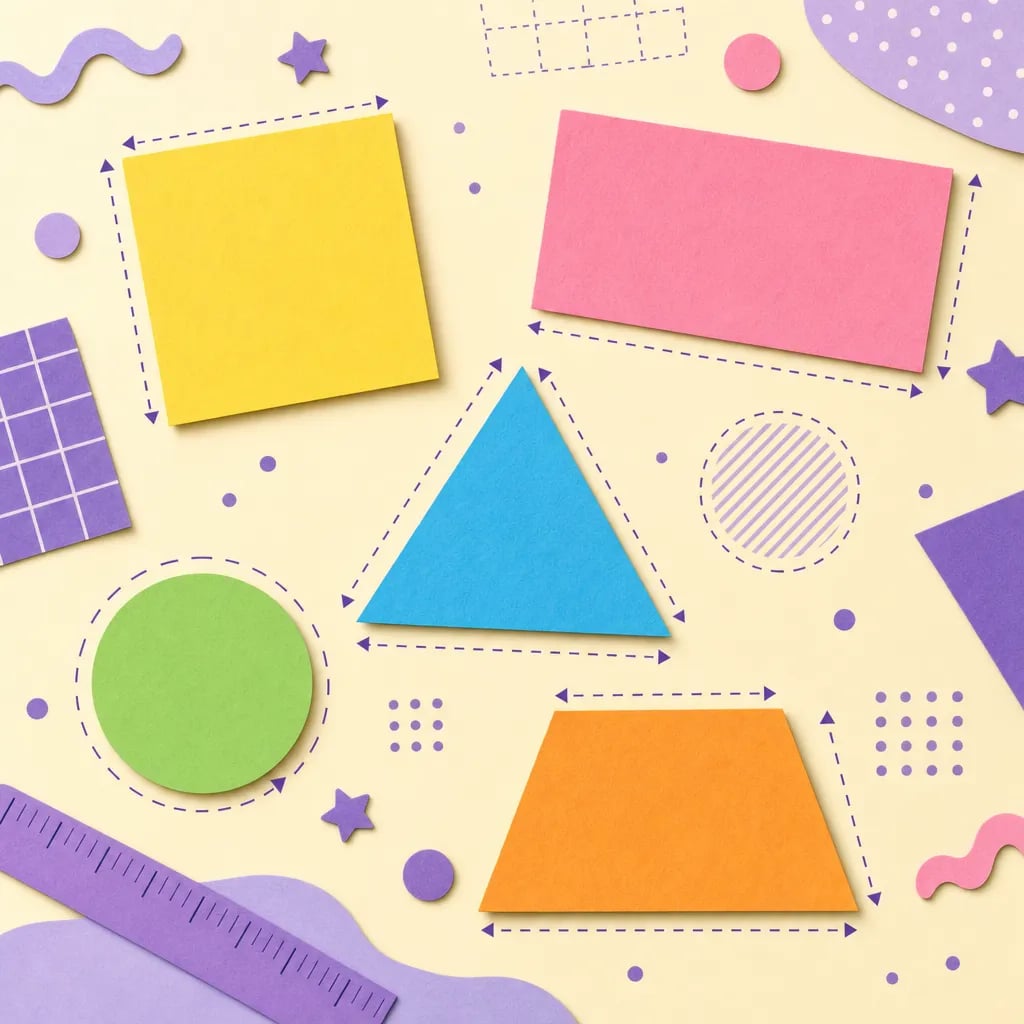
The perimeter and area of 2D shapes each use a different formula: the perimeter of a square equals 4 times the side, the area of a square equals side times side, while the circumference of a circle equals 2 times pi times the radius and the area of a circle equals pi times the radius squared. The full formulas for eight flat shapes are taught from grade 4 to grade 6 of primary school and become essential groundwork for math exams in secondary school.
For many primary school kids, "perimeter" and "area" get mixed up even after being memorized many times. Yet the two answer different questions: perimeter measures the length of a shape's outer edge, while area measures how much space is inside it.
Perimeter is the total length of all the sides surrounding a flat shape, found by adding up the length of each side. Picture a fence running around a rectangular garden, that is the perimeter.
Area is the measure of the space enclosed by that shape, usually in square units (cm², m²). If perimeter is the "outer edge", area is "what fills the inside" - for instance, how many floor tiles are needed to cover that garden.

This topic is first introduced in grade 4 through squares and rectangles, then expands to triangles, circles, parallelograms, trapezoids, rhombuses, and kites in grades 5-6. Once kids reach secondary school, the same formulas return in word problems and 3D shapes, so mastering this primary-school foundation properly, not just memorizing it, really matters.
In the Indonesian school curriculum, 2D shapes usually fall under the "Geometry" or "Flat and Solid Shapes" chapter. Teachers typically introduce the idea with classroom objects first - a whiteboard for a rectangle, a wall clock for a circle - before moving to the formulas in the textbook. When a child already understands perimeter and area from primary school, once they reach secondary school and meet exam word problems that build on flat shapes, they won't have to relearn the basics from scratch.
A child doesn't need to memorize eight separate formulas, just one pattern: area is always 'base times height', adjusted for the shape.
Putri Anggraini, Head of Math Program, Algonova
Here are a few tricks math teachers commonly use so kids do not just memorize formulas without understanding them:
These tips work better than memorizing eight separate formula lines, because a child builds understanding they can reuse for any 2D shape they haven't seen before. Parents can help at home too: every time you buy a new rug, tile, or fence, ask your child to work out the perimeter or area of the space needed before you buy it.
Kids who sketch the shape first rarely get the formula wrong, because they can see directly which sides get added and which get multiplied.
Dewi Lestari, Mathematics Specialist, Algonova
These formulas are not just exam material. Kids actually use them more often than they realize:
When kids see these formulas applied to things that actually happen at home, perimeter and area stop feeling like memorized schoolwork and start feeling like a useful tool.
Here are the perimeter and area formulas for eight flat shapes that show up most often in primary and secondary school problems:
| Shape | Perimeter Formula | Area Formula |
|---|---|---|
| Square | P = 4 x s | A = s x s |
| Rectangle | P = 2 x (l + w) | A = l x w |
| Triangle | P = a + b + c | A = 1/2 x base x height |
| Circle | C = 2 x π x r | A = π x r x r |
| Parallelogram | P = 2 x (a + b) | A = base x height |
| Trapezoid |
So the formulas above are not just theory, here are three example problems worked out step by step.
Example 1: Rectangle A rectangular garden has a length of 12 meters and a width of 8 meters. What are its perimeter and area?
Example 2: Triangle A triangular board has a base of 10 cm and a height of 6 cm, with three sides of 10 cm, 8 cm, and 7 cm. What are its perimeter and area?
Example 3: Circle A wheel has a diameter of 14 cm. What are its circumference and area? (use π = 22/7, radius = diameter/2 = 7 cm)
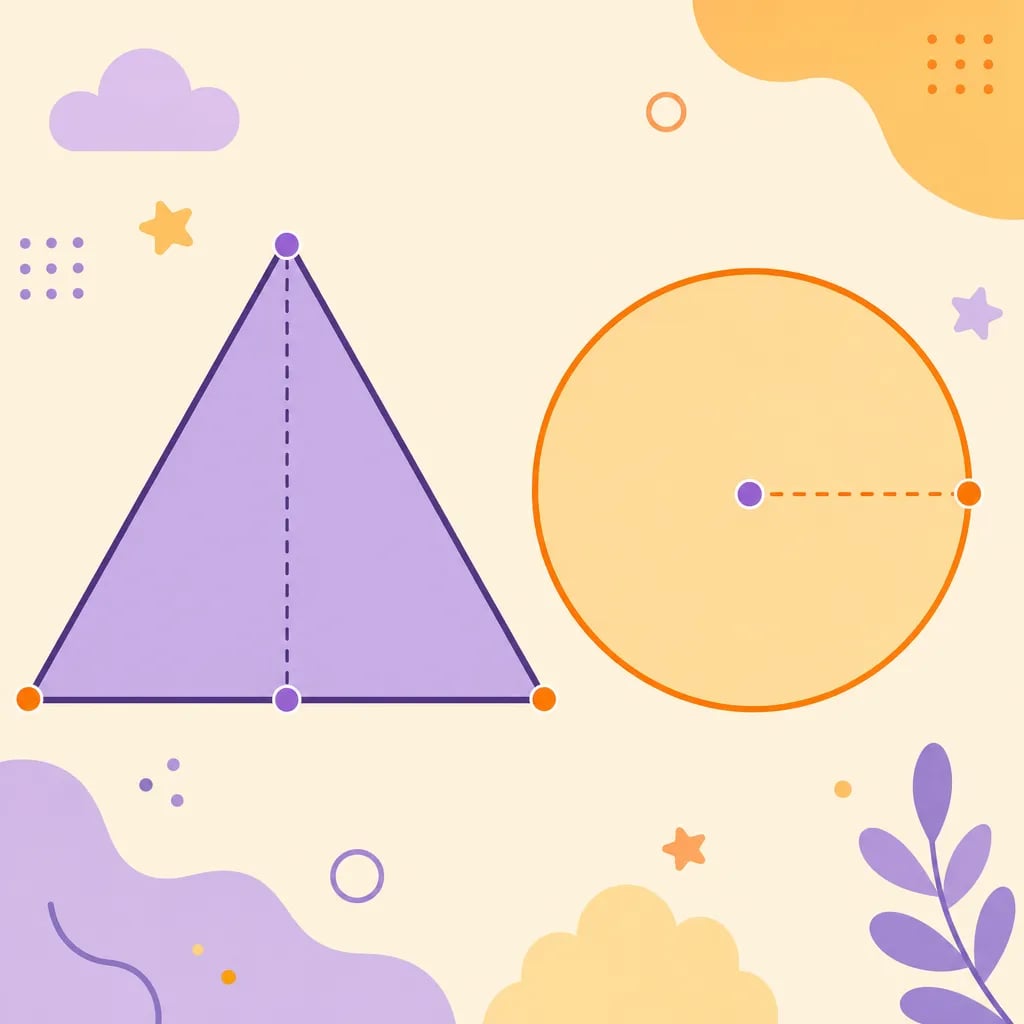
Once the base formulas above are solid, the next step is practicing with specific 2D shapes and a wider range of word problems. A child who is already comfortable with squares and rectangles usually picks up circles faster, because the pattern is the same: first identify what's known (side, base-height, or radius), then plug it into the right formula.
In big cities like Jakarta, Surabaya, and Bandung, many parents start looking for extra online math tutoring right around grade 4-5, exactly when 2D shape topics start feeling more demanding than basic addition and subtraction. Extra support at this stage helps a child avoid falling behind before moving on to 3D shapes and algebra in secondary school.
At Algonova, kids learn geometry not through memorized formulas but through visualization and step-by-step practice with experienced teachers. More than 1,000,000 children across 97 countries have learned with us, with a 4.9 out of 5 rating. If you want your child to feel more confident with perimeter and area problems,

Algonova worldwide
Contact
Whatsapp: +62 21 50996971
Email: info@algonova.id
Address
| P = sum of all sides |
| A = 1/2 x (parallel side a + b) x height |
| Rhombus | P = 4 x s | A = 1/2 x d1 x d2 |
| Kite | P = 2 x (side a + side b) | A = 1/2 x d1 x d2 |
Key: s = side, l = length, w = width, r = radius, d1 and d2 = diagonals, π (pi) is roughly 3.14 or 22/7.
One pattern that makes memorizing easier: almost every area formula for a 2D shape is really a variation of the rectangle formula (base x height), halved when the shape is a triangle or has diagonals. Once a child sees that pattern, memorizing all eight formulas at once feels much lighter.
Algonova Indonesia accepts students aged 5 to 17 for coding and math courses. Every age group has a dedicated program designed for their cognitive development stage and interests. For kindergarten kids aged 5-7, we offer ScratchJr (visual block-based coding requiring no reading) and fun basic math introduction. For primary school kids aged 8-12, the program covers Scratch, Roblox, Python Start, and complete math. For junior and senior high teens aged 13-17, focus is on Python, JavaScript, secondary school math, AI courses, full Web Development, UTBK SNBT preparation, and university portfolio. No prior experience is required. An Algonova certified teacher will recommend the right learning path during the free trial class.
Yes, all Algonova Indonesia courses are fully available online with live sessions taught by certified teachers — not recorded videos. Kids learn in real time in small groups, with two-way interaction and tasks worked on alongside the teacher. To join online class, a child only needs a computer or laptop with a camera, a stable internet connection, and a headset. The Algonova platform runs directly in the browser so no special software installation is required. Many families choose a mixed schedule: weekday classes for flexibility around school, and weekend sessions for a calmer pace outside school hours. Our team helps choose the format best suited to family needs.
Algonova Indonesia classes come in three formats: 1-on-1 private, a mini-group of 2–4 kids, and a group of up to 10 students. This small group format is deliberately chosen because it provides the optimal balance between social interaction and personal teacher attention. In a mini-group, every child averages about 10 minutes of direct teacher interaction in a single session. Compare with traditional offline bimbel of 20-40 students per class — direct interaction there is only 1-2 minutes per child, or none at all. For families wanting full attention, one-on-one private class is also available (1 student per teacher). This format is more intensive and suits kids with special needs, competition preparation, or specific topic depth.
Choosing the right course for your child depends on three main factors: age, interest, and previous learning stage. The best way to decide is by taking a free trial class at Algonova Indonesia. During the trial class, a certified teacher will talk with the child, understand their interests (games, art, mathematics, science experiments), and assess their ability level. Based on this diagnostic, the teacher recommends the most suitable learning path — perhaps visual coding for creative kids, Python for logic-loving kids, or math tutoring for kids wanting to improve school grades. After the trial, the Algonova team provides a transparent explanation of the recommended program, along with schedule and pricing. No pressure to enrol — we believe the best decisions come from full understanding. Contact our WhatsApp to book a trial.
The Algonova Indonesia trial class is 100% free, no credit card, no auto-subscription. You and your child can attend the entire 60-minute session with no obligation afterwards. Many families take a few days to decide, and that's completely fine. For regular programs, pricing starts from Rp 102,000 per lesson. The price includes a live session with a certified teacher, digital learning materials, platform access, and an official certificate upon completing each level. Final pricing depends on program (coding or math), child's age, and class format (private, mini-group, or group). Full pricing details are shared transparently after the trial class. No surprise fees, every cost component is explained before formal enrolment.
Algonova Indonesia uses Project-Based Learning methodology combined with modern cognitive science principles. Three main pillars: kids learn by creating (not memorising), small groups for personal attention, and a gradual curriculum matched to age. Every program level ends with a real project: kindergarten kids build animations, primary school kids build games or interactive stories, teens build Python applications or websites. Projects become concrete evidence of understanding, far more effective than theoretical exams. We also apply "scaffolded learning" principles — teachers provide full support at the start, then gradually reduce until the child is independent. This approach is inspired by Lev Vygotsky's work on the Zone of Proximal Development. The result: children master not just the material but also build confidence as independent learners willing to try new things.
Yes, Algonova Indonesia students receive an official certificate after completing each level of a coding or math program. The certificate lists the child's name, the program completed (for example Scratch Basics, Python Basics, or Primary School Math), the completion date, and is signed by the Algonova team. The certificate documents the child's learning journey, attaches to a school portfolio or coding competition application, and motivates kids to see the results of their hard work. Some primary and secondary schools in Indonesia accept Algonova certificates as evidence of digital extracurricular activity. Beyond the formal certificate, kids also take home a portfolio of real projects they built themselves: games, animations, websites, or running Python programs. This portfolio is concrete evidence of the child's ability that can be shown to family, teachers, friends, or even in university applications.
The perimeter of a 2D shape is the total length of all the sides surrounding it, while area is the measure of the space inside it in square units. Perimeter is found by adding up the side lengths, for example the perimeter of a square = 4 x side, while area is found by multiplying the shape's dimensions, for example the area of a square = side x side. This topic is first taught in grade 4 of primary school.
Each shape has a different formula: square (P=4s, A=s x s), rectangle (P=2 x (l+w), A=l x w), triangle (P=a+b+c, A=1/2 x base x height), circle (C=2 x pi x r, A=pi x r x r), parallelogram (P=2 x (a+b), A=base x height), trapezoid, rhombus, and kite (A=1/2 x d1 x d2). The full formula table is included in this article.
Perimeter measures the length of a 2D shape's outer edge in length units such as cm or m, like the length of fencing around a garden. Area measures the amount of space inside that shape in square units such as square cm or square m, like the number of floor tiles needed to cover that garden. Both are calculated with different formulas even though they use the same side measurements.
Perimeter and area of squares and rectangles are usually introduced in grade 4 of primary school, then expand to triangles, circles, parallelograms, trapezoids, rhombuses, and kites in grades 5-6. Once kids reach secondary school, the same formulas return in word problems and 3D shape calculations, so mastering them early really matters.
The most effective approach is having your child sketch the shape before calculating, connecting the formulas to real objects like a fence or a room floor, and grouping formulas by shared patterns, such as shapes that use height in their area formula. At Algonova, kids learn geometry through step-by-step visualization with experienced teachers, and the first class is free to try.
Coworking Area, Gedung IT 6 Lantai Dasar, Nongsa Digital Park, Jalan Hang Lekiu, Kelurahan Sambau, Kecamatan Nongsa, Batam, Indonesia Directorate General of Consumer Protection and Trade Compliance – Ministry of Trade of the Republic of Indonesia. WhatsApp Ditjen PKTN: 0853-1111-1010.
PT Algonova Indonesia Cerdas All rights reserved 2026
