Coding Competitions for Kids in Malaysia 2026/2027: List, Ages and How to Prepare
Checklists & Calendar7 min read
Checklists & Calendar

Priya Nair
Education Calendar Editor, Algonova Malaysia
An online holiday programme for kids in December 2026 has to fit a break of 27 or 28 days and give your child a live teacher in a group small enough to get a word in. Group A schools close on 4 December and Group B schools on 5 December. This guide is for Malaysian parents of children aged 6 to 14 who prefer a class at home to a camp.
Contents
The end-of-year break runs from 4 to 31 December 2026 for Group A and from 5 to 31 December 2026 for Group B, according to the Ministry of Education's Kalendar Akademik 2026. Group A is Kedah, Kelantan and Terengganu. Johor, Selangor, Penang, Sabah, Sarawak, the other states and the three Federal Territories are in Group B.
Both groups return on 4 January 2027, per the KPM calendar for 2027. That leaves about four weeks, minus Christmas Day on 25 December and whatever days your family spends on the road.
Take a household in Shah Alam that drives to Kota Bharu from 19 to 27 December. Before the trip they have two clear weeks at home, and after it four days. An online class on two fixed weekdays travels with them, as long as there is a laptop and a stable connection at the grandparents' house. For every break in the year, see our school holidays 2026 Malaysia calendar.
A good programme tells you up front what your child will finish and who will be teaching. Sort the options with these points:
Take two options at a similar price. Option A gives 20 pre-made videos and a worksheet pack. Option B gives 8 live lessons in a group of 8 with the same teacher. By 31 December, the Option A child has watched up to 20 videos with nobody checking the work. The Option B child has had a teacher look at their project 8 times and correct it.
A holiday programme earns its fee when you can say, before lesson one, what your child will have made by the last lesson.
Most online options for a school holiday program fall into five formats, and they differ mainly in whether a teacher is live and how much a parent has to supervise.
| Format | Live teacher | Group | Typical December schedule | Parent effort | Works best for |
|---|---|---|---|---|---|
| Live small-group course | Yes | Small group (ask the number) | 1-2 lessons a week, continues into term | Low | Starting a skill and keeping it |
| Online holiday intensive | Yes | Varies | 5 days in a row, 1-3 hours a day | Low | Trying a topic fast |
| One-to-one online tutor | Yes | 1 child | Flexible | Low to medium | Catching up on one school topic |
| Self-paced video course or app | No | None | Any time | High, you track progress | Self-driven children aged 12+ |
| Free tutorials and DIY projects | No | None | Any time | High | Curious kids with a parent who can help |
For most children aged 8 to 12, a live small-group course sits in the middle. It usually costs less per hour than one-to-one tutoring, and a teacher sees the work, which an app can't do.
Now compare two ways a 9-year-old might spend December. An intensive gives about 10 hours in one week and then nothing. A weekly course at 2 lessons a week gives 8 lessons in December, and lesson 9 lands in the second week of January.
Two lessons a week across four December weeks gives 8 lessons, which is 8 hours at 60 minutes each or 6 hours at 45 minutes. At Algonova's starting price of RM 48 per lesson, 8 lessons come to RM 384. Exact fees by course are on the coding class fees page.
The fairest way to compare providers is the price per live teacher hour. Divide the total fee by the hours a teacher is actually on the call with your child. A 5-day intensive at 2 hours a day gives 10 teacher hours. A video course gives 0, however many videos it has.
Leave room for movement. The World Health Organization advises children aged 5 to 17 to get at least 60 minutes a day of moderate to vigorous physical activity (WHO physical activity fact sheet, based on its 2020 guidelines). A one-hour class at 10 am still leaves the cooler early morning and evening for play. Our screen time limits by age guide helps you set the rest of the day, and our list of aktiviti cuti sekolah for kids covers the hours away from the laptop.

Ask these 10 questions on the trial call or by email. If a provider dodges two or three of them, that tells you more than the brochure does.
Question 3 catches a common mismatch. Some programmes start on 1 December, but Group A pupils are still in school until 3 December and Group B pupils until 4 December, so the first lessons clash with homework and end-of-year events. If you are comparing coding schools beyond the holiday, our guide to choosing a coding school in Malaysia goes deeper on teachers and curriculum.
Pick by age first, then by what your child already does for fun. Algonova Malaysia's online courses by age:
All coding tracks are on the online coding classes page. If you are unsure whether your child is ready, read what age to start coding.
A 10-year-old in Johor Bahru who plays Roblox every evening is a good match for Game Design. With 8 lessons in December, a realistic goal is a first playable level that a cousin can test over the Christmas weekend. The free trial for coding and design is a 60-minute online coding masterclass where the child builds a small project, so you see the teacher before you pay.
If your child asks to keep going after 31 December, the programme did its job.
The December 2026 school holiday starts on 4 December for Group A states (Kedah, Kelantan, Terengganu) and on 5 December for Group B, and ends on 31 December for both. The dates come from the Ministry of Education's Kalendar Akademik 2026, issued with Surat Siaran KPM Bil. 3 Tahun 2025. Group A breaks a day earlier because those states keep a Friday-Saturday weekend. In practice, a Group B child in Selangor has 27 days off and a Group A child in Kelantan has 28. Christmas Day on 25 December falls inside the break, and many families also travel in the last two weeks. Plan any online programme around your own travel dates rather than the full four weeks. School reopens on 4 January 2027 in both groups, so a course that continues into January needs to fit around the new school timetable too.
An online holiday programme is worth it when a live teacher works with your child in a small group and the course ends with something your child made. Video-only courses rarely meet that bar, because nobody checks the work or notices when a child stops. For example, 8 live lessons of 60 minutes give your child 8 hours of direct feedback in December, while an app can run for weeks without anyone looking at a single project. Online also saves travel time: a one-hour class costs one hour, not two and a half with traffic. The format suits children who can sit at a laptop for 45 to 90 minutes with a short break. Start with a free trial lesson, then decide based on whether your child wants to come back to the second lesson.
The cost of a holiday programme for kids in Malaysia depends on the format, so compare the price per hour of live teaching rather than the headline fee. Online group lessons at Algonova start from RM 48 per lesson. Two lessons a week across December gives about 8 lessons, which comes to RM 384 at the starting price. Holiday camps and one-to-one tutors set their own fees, and those vary a lot by city and subject. When you compare, ask what the fee covers: the live lessons, learning materials, platform access, and a certificate. Then divide the total by the hours a teacher actually spends with your child. A cheap video course with zero live hours can be worse value than a pricier course with 8 teacher hours. Check the coding class fees page for current prices by course.
Most children can start an online coding holiday programme at around 8, once they read comfortably and can use a mouse and keyboard on their own. At Algonova, Visual Programming in Scratch and Game Design with Roblox and Lua are for ages 8 to 12, AI for 8 to 17, and Python Year I and Year II for 12 to 17. Children aged 5 to 7 can begin with Digital Literacy, which covers basic computer skills first. Treat the age bands as a starting point. A 7-year-old who already builds in Minecraft may be ready for Scratch, while a shy 9-year-old may need a gentler start. The free 60-minute masterclass is the simplest test: your child builds a small project, and the teacher suggests a track afterwards.
One live class of 45 to 90 minutes a day, on two or three days a week, is enough for most children aged 6 to 14 during the school holiday. Longer daily blocks tend to tire younger children, and the extra screen time eats into play. The World Health Organization advises at least 60 minutes of moderate to vigorous physical activity a day for children aged 5 to 17, so build the class around outdoor time rather than the other way round. A simple pattern is outdoor play in the early morning, a 60-minute class at 10 am, a quiet afternoon, then sport or a walk in the evening. Children aged 6 to 8 usually do best with 45-minute lessons. Older children can handle 90 minutes with a short break in the middle.
An online holiday programme works anywhere your child has a laptop and a stable internet connection, so travel during cuti sekolah does not have to end the course. Search results for "holiday program kids near me" mostly show camps and venues in Kuala Lumpur, Petaling Jaya and Johor Bahru, which only help if you stay in town. With an online class, a child can join from the grandparents' house in Kota Bharu or from a hotel in Penang. Before booking, ask the provider what happens if you miss a lesson on a travel day and whether a make-up slot is offered. Check the connection at your destination a day before the lesson. A phone hotspot is a useful backup if the house Wi-Fi is weak. It also helps to keep the usual lesson time on travel days, because a fixed slot is easier to stick to than one that moves every week.
Choose one skill your child is already curious about and give it four weeks, rather than spreading the holiday across five short activities. A child who plays games can try coding a game. A child who draws can try digital design, and a child who struggled with numbers in Tahun 2 or 3 can rebuild maths confidence before the new year. For example, a 9-year-old who spends evenings in Roblox could take Visual Programming in Scratch twice a week. Four weeks with 8 lessons is long enough to finish a small project and see whether the interest lasts. The holiday is also a low-pressure time to try something new, because there is no homework competing for attention. Avoid turning December into extra school with daily worksheets. If the topic still interests your child in January, it can continue alongside the 2027 school term.
Yes, at Algonova your child can try a free class first: a 60-minute masterclass for coding and design, or a diagnostic of about 60 minutes for maths. In the coding masterclass your child sits at the keyboard and builds a small game or animation while the teacher guides. At the end you get a recommendation for which course fits. In the maths diagnostic, the teacher checks which topics are secure and which need work. The trial is free and needs no card, and if it isn't a fit you simply don't book more lessons. Book it before the holiday starts, ideally in November, so you can compare the teacher and the group with other options and still have the full December break for lessons. Parents rate Algonova classes 4.9 out of 5, and more than 1,000,000 students in 97 countries have learned with the school.
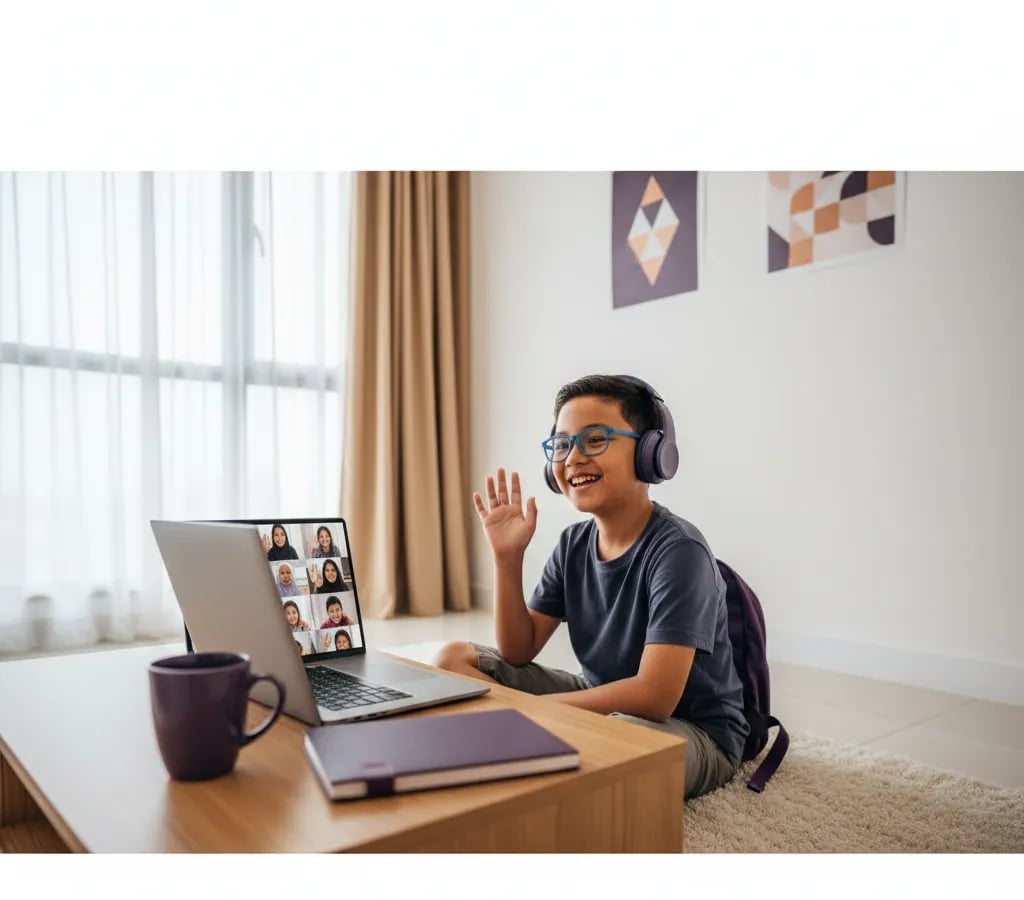
Your child needs a laptop or tablet, a stable internet connection, and a quiet spot for 45 to 90 minutes. A laptop with a mouse works better than a tablet for coding courses, because typing and dragging blocks is easier. Headphones with a microphone help in a shared house, especially during the holidays when siblings and cousins are home. Test the video call and the sound the day before the first lesson. Algonova's trial masterclass runs on Zoom, and you don't need to install course software or buy anything. An older laptop is usually fine if the video call runs smoothly. A fixed desk and a silenced phone help too. Children who start the class on time and settled usually get more out of the first 10 minutes, when the teacher explains the task.
Blog
Start your child's tech journey
Book your free 60-minute trial class with an Algonova certified tutor. No payment, no obligation, just discover what your child can build.

Algonova worldwide
Contact us
Email: int_legal@alg.team
Visit us
Suite 8634, 1021 E Lincolnway, Cheyenne, WY, Laramie, US, 82001
Algonova online LLC International tech school for kids and teens