Online vs Physical Coding Classes in Malaysia: Which Works Better?
Course Guides7 min read
Coding Education

Aina Rashid
Coding Education Specialist at Algonova Malaysia
SJKC students in Malaysia spend six primary years under KSSR with almost no real coding — the curriculum covers only basic electronics in RBT, not programming — yet with 1,303 SJKC schools serving 463,988 pupils in Mandarin, structured coding from age 5 to 17 closes that gap directly. Algonova is an international tech school with 10+ years experience, 1,000,000+ students in 97 countries, and a 4.9-star rating for our coding programmes.
Let's be precise, because there is a lot of confusion here. SJKC schools follow the national KSSR primary curriculum, delivered in Mandarin. Coding has technically been part of Malaysian schooling since 2016 — but in primary Years 4 to 6 it appears only as a small applied module inside RBT (Reka Bentuk dan Teknologi / Design and Technology). That module focuses on electronics and simple product design. It does not teach a real programming language or sustained coding projects.
Real programming only arrives in secondary school. Under the KSSM curriculum since 2017, Form 1 to 3 students study ASK (Asas Sains Komputer / Computer Science Fundamentals), which finally introduces Scratch, HTML and Python. So a typical SJKC child can spend the entire primary stage — six formative years — without writing a single line of real code.
| School stage | Subject / module | What's actually taught | Real programming language? |
|---|---|---|---|
| Primary Year 4–6 (KSSR) | RBT (Design & Technology) | Electronics, simple products, basic applied tech | No |
| Secondary Form 1–3 (KSSM) | ASK (Computer Science Fundamentals) | Scratch, HTML, Python — intro level | Yes (starts here) |
One clarification for parents: the UEC (Unified Examination Certificate) belongs to Chinese independent secondary schools, not to SJKC primary schools. SJKC pupils sit on the national SPM track. Coding readiness should be planned around the national curriculum, not the UEC.
The takeaway: in primary SJKC, structured coding with proper tools and projects barely exists. If you want your child to have real coding skill before secondary school, that has to come from outside the classroom. And no, that is not a knock on SJKC — these schools produce some of the strongest math results in the country. It is simply where the curriculum currently stops.
Ready to see where your child fits? A free Algonova Master Class includes an AI-assisted talent diagnostic that shows your child's natural strengths and recommends a best-fit starting point — no commitment, no pressure. You can also message us on WhatsApp.
SJKC pupils are, on average, drilled hard in mathematics — and it shows. But math fluency on paper and applied problem-solving are not the same thing. Coding is the bridge between them. When a child writes a Scratch script or a Python loop, abstract math concepts (variables, sequences, conditions, patterns) suddenly become tools to build something. The math stops being something to memorise and starts being something to use.
This is not just a feel-good claim. Multiple studies suggest coding can improve children's math performance when computational thinking is taught alongside it (SchoolAdvisor MY). Coding teaches the four pillars of computational thinking that math classes rarely make explicit:
There is a second advantage unique to SJKC families: bilingual leverage. Your child already has a strong Mandarin-academic base. Adding English-medium coding builds the English technical vocabulary that the global tech world runs on. Mandarin rigour plus English coding fluency is a genuinely rare, globally applicable combination — and it directly bridges the gap the school's RBT module leaves open.
Earlier than most parents expect — but with the right tool for the age. Children as young as 6 can begin with visual, block-based coding, where they drag and snap logic blocks together instead of typing syntax. There is no spelling to get wrong, no punctuation to debug, just pure logic. By ages 8 to 12, most children are ready to step toward text-based languages like Python.
The key is matching the tool to the stage rather than rushing or waiting too long. SJKC kids are academically loaded, so the goal is not to pile on more drilling — it is to give them a creative, project-based outlet where their logical strength gets to play.
| Age range | Best entry point | What they build |
|---|---|---|
| 6–7 | Block-based (Scratch / ScratchJr style) | Animations, simple interactive stories, first games |
| 8–12 | Scratch → early Python | Real games, quizzes, small apps with logic and data |
| 13–17 | Python → Roblox Studio & real projects | Playable games, portfolio-worthy projects, real tools |
Algonova teaches every stage of this path, right through to 17, so a child can enter at the right point and keep progressing through one coherent path. You can see the age-specific tracks at coding for kids age 6–7 and coding for kids age 8–12.
This is what separates a real coding education from a one-off school module. A child should not learn "coding" as an abstract idea — they should progress through actual, industry-relevant tools, building harder projects at each stage. Algonova's philosophy is Discover → Develop → Master: discover the talent, develop it through real projects, master in-demand modern skills.
This is not a school worksheet. It's the same progression a young developer would follow — visual logic first, real language next, real platform last. The point is measurable transfer: better problem-solving, better grades, and a skill the child can actually see themselves doing professionally one day.
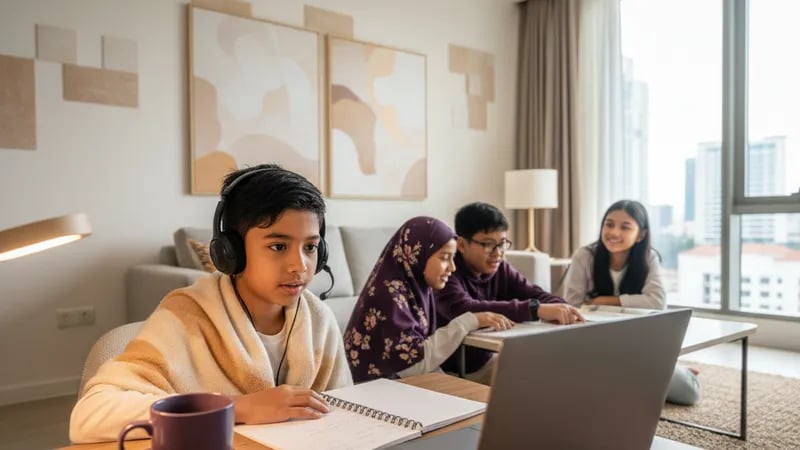
Classes run in private 1-on-1, mini groups of 2–4, or groups of up to 10 students, live and online with certified teachers — not pre-recorded videos. For families weighing options, our Algonova vs KidoCode comparison breaks down the differences, and why Malaysian kids should learn coding in 2026 gives the bigger picture.
A child with a strong Mandarin academic base plus English-medium coding has a genuinely rare, globally portable combination — and it directly bridges the gap the school's RBT module leaves open.
Aina Rashid · Education Content Lead, Algonova
SJKC children are among the most academically scheduled kids in Malaysia — between school, homework and tuition, the calendar is full. That reality shapes the online-versus-offline decision more than anything else.
There is also a geography problem. The big paying audiences sit in the Klang Valley (KL and Selangor/PJ), Penang and Johor Bahru — but around 47% of SJKC schools have fewer than 150 students, many of them small or rural, where a quality offline coding centre simply does not exist. For those families, online is not a compromise; it is the only realistic route to a real programme.
For a sense of how online coding compares with traditional offline tuition on cost and value, our math tuition cost per hour in Malaysia guide is a useful reference point.
Algonova is an international tech school with 9+ years teaching modern tech, 1,000,000+ alumni worldwide and a presence in 97 countries. For SJKC families specifically, the fit comes down to four things — and to our knowledge, no competing school in Malaysia has built a programme angle around the Chinese-school audience, which is exactly why this matters.
Everything starts with one low-stakes step: a free Master Class with an AI-assisted talent diagnostic. Your child shows what they enjoy, you share your goals, and we recommend the best-fit course — often not the one you arrived expecting. Explore the full coding programme or book directly below.
Book your child's free Master Class → algonova.com/mys/en/trial-class or message us on WhatsApp. No cost, no obligation — just a clear picture of your child's talent and the right next step.
Most children can start coding from age 6 with visual, block-based tools like Scratch, where they drag-and-drop logic instead of typing syntax. By ages 8 to 12 many are ready to move toward text-based languages such as Python. Algonova teaches an age-matched path that runs through to 17, so the starting point depends on the child rather than a fixed cut-off.
Start with a no-pressure trial so you can see what your child actually enjoys before committing. A free Algonova Master Class includes an AI-assisted talent diagnostic that suggests a best-fit course based on your child's interests and strengths. From there, a structured online path moves from Scratch to Python to Roblox Studio in private 1-on-1, mini groups of 2–4, or groups of up to 10 students.
For younger primary children, block-based Scratch is widely recommended because it teaches logic without the frustration of typing exact syntax. As children mature, Python is a strong next step because it reads almost like English and is used in real industry. A good programme sequences these rather than picking just one, so the child progresses from visual blocks to real text code.
Not much in primary years. SJKC schools follow the national KSSR curriculum in Mandarin, where coding in Years 4 to 6 sits as a small applied module inside RBT (Reka Bentuk dan Teknologi / Design and Technology) and does not use a real programming language. Proper programming with Scratch, HTML and Python only begins in secondary school under the ASK subject (Form 1 to 3). This leaves a real gap in the primary years.
It is for both. Enrolment data shows the Bumiputera share in SJKC rose from about 11.67% in 2014 to 18.52% in 2024, so SJKC classrooms are increasingly bilingual and mixed. English-medium coding suits any SJKC family — Chinese or Malay — that wants their child to add an applied, globally portable tech skill on top of a strong academic base.
Yes. Around 47% of SJKC schools have fewer than 150 students and many sit outside the big urban clusters, so an offline coding centre is often not an option. Live online classes with certified teachers remove the location barrier — families in the Klang Valley, Penang and Johor Bahru, as well as smaller towns, get the same small-group programme.
Start your child's tech journey
Book your free 60-minute trial class with an Algonova certified tutor. No payment, no obligation, just discover what your child can build.

Algonova worldwide
Contact us
Email: int_legal@alg.team
Visit us
Suite 8634, 1021 E Lincolnway, Cheyenne, WY, Laramie, US, 82001
Algonova online LLC International tech school for kids and teens