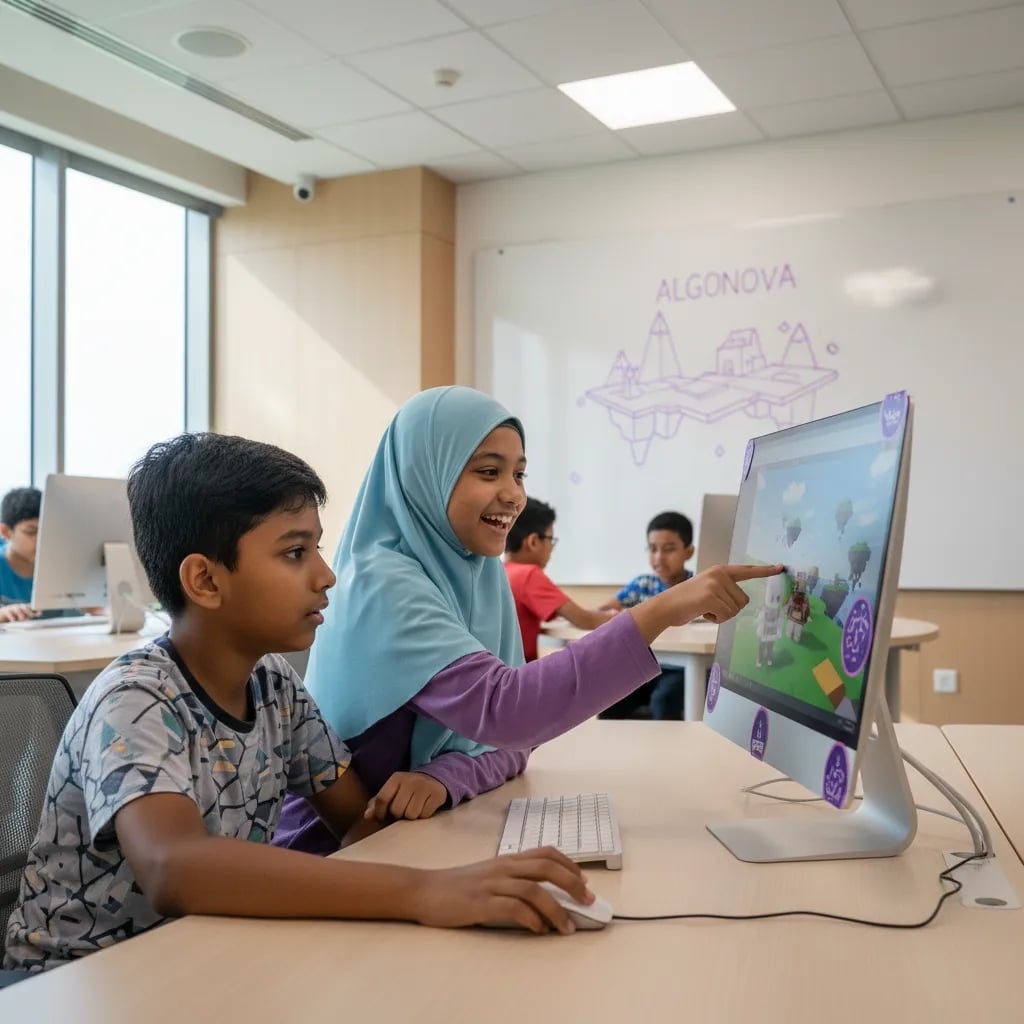
Hakim was the kid who couldn't sit through homework. Now he sits through 90 minutes of coding because the teacher actually engages him. The school benefit is real — focus transferred.

Rohaya Mansor
Mother of Hakim, 9 · Shah Alam
Junior Coders · Ages 8-12
Coding for kids Darjah 3-6 in Malaysia, a STEM-aligned after-school bootcamp. Three tracks: Visual Programming (Scratch), Graphic Design Junior, and Game Design with Roblox + Lua. Trusted by families across Kuala Lumpur, Selangor, Penang and Johor Bahru. Whether your child is a curious 8-year-old beginner or a 10-year-old who loves Roblox, we have the right path, with a clear way into Python at 12.
1,000,000+
students worldwide
97
countries
10+ years
teaching kids to code
4.9★
average parent rating
Why this age
Old enough for real tools
Scratch · Roblox Studio · Lua
8–12 year-olds can handle the same game design software real developers use — Roblox Studio with Lua scripting and the full Scratch programming environment.
Young enough to fall in love with it
Discover, then develop
By 13, kids usually have a strong sense of 'I'm good at this' or 'I'm not.' We use the 8–12 window to help them discover whether tech is their thing — before that self-assessment hardens.
Built around their interests
Games and design, not theory
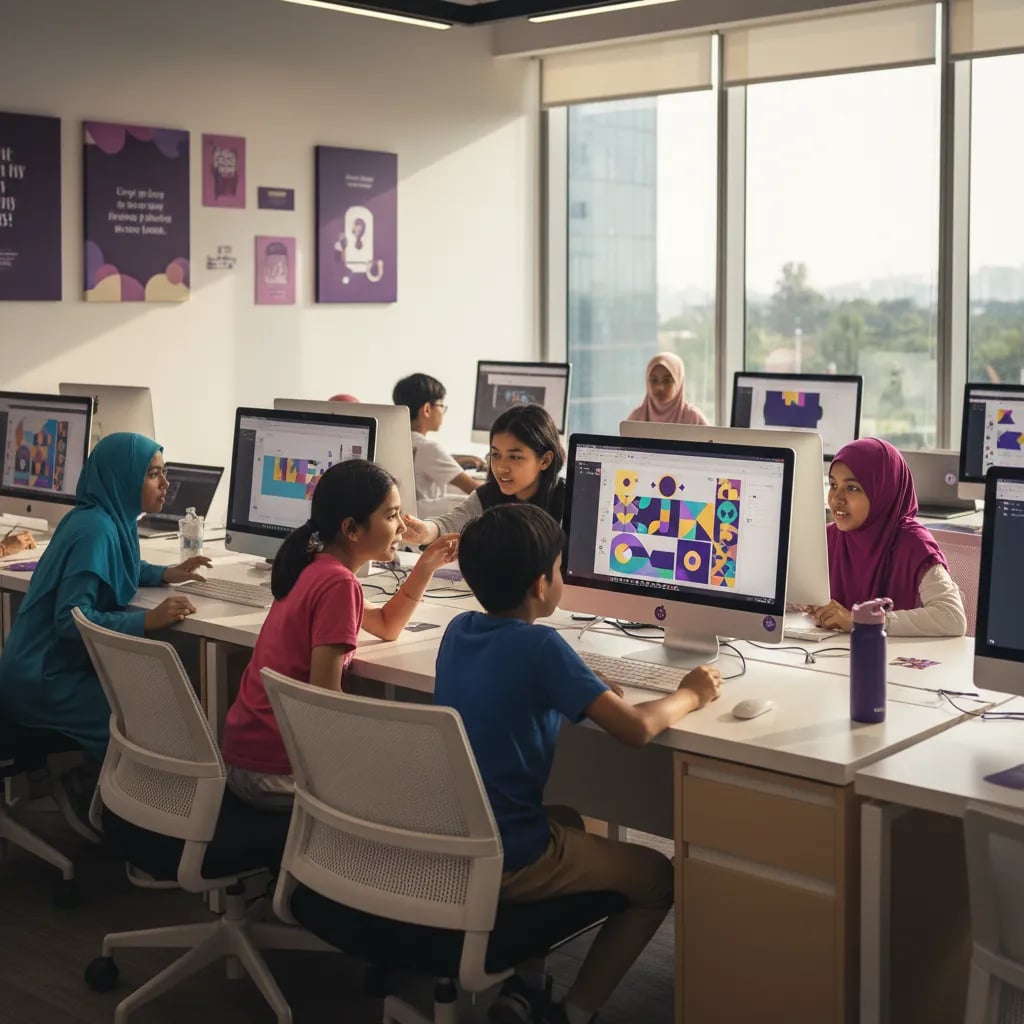
Most kids this age love games, drawing or both. We turn that into skill. They build games, design posters and create digital art — not just consume them.
About the program

Reza F. · Coding Teacher · 4.9★ from parents
One teacher, all year
Your child learns with the same coding teacher the whole year — no rotation. That continuity is what turns 'I'm stuck' into a child who debugs on their own and shows you what they built.
Real tools, not toy apps
From age 8 kids build in Scratch, then move to Roblox Studio and Lua — the same tools real creators use. They leave able to make things, not just watch tutorials.
Projects they actually want to build
Every course is built around games, animations and designs your child chooses. Motivation stays high because they're making something they care about, not abstract exercises.
Progress you can see within a term
Most children go from playing games to building their own in a few months, and start asking for class instead of avoiding it. You see the change at home.
Algonova Teaching Team
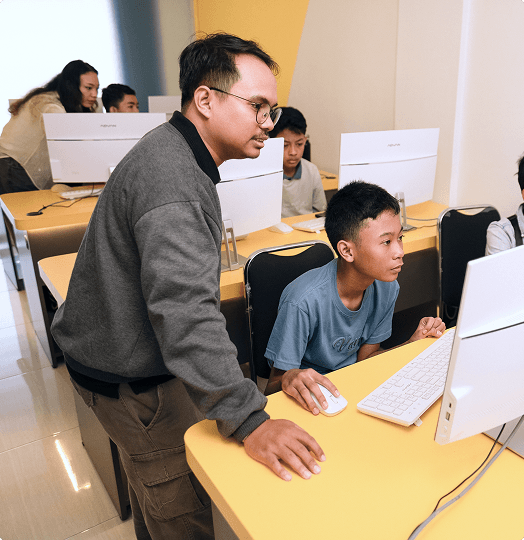
Dimas stayed with me even when I was struggling with my project. Without him, I wouldn’t have been able to finish it. I want to keep getting better with him.

Satria Wiguna
Python student

Farah A.

Reza F.

Ibnu S.

Friska M.

Muhammad S.

Esti H.

Dimas F.
How it works
01
1. Concept (15 min)
Teacher introduces today's idea with a real example — not abstract theory.
02
2. Live build (50 min)
Whole group codes alongside the teacher. Each child has their own project. The teacher catches errors in real time.
03
3. Present (15 min)
Each child briefly shows what they made. Public speaking practice, gentle.
04
4. Optional homework
A small 'keep going' challenge. Not required, but most kids do it because they want to.
Free 60-min trial · Laptop required
Program
Typical coding app vs Algonova
From parents of 8–12 year-olds
Hakim was the kid who couldn't sit through homework. Now he sits through 90 minutes of coding because the teacher actually engages him. The school benefit is real — focus transferred.
Rohaya Mansor
Mother of Hakim, 9 · Shah Alam
We tried a self-paced coding app first. He quit in 2 weeks. With live teachers in a small group, he stuck with it — now he's six months in and building his own Roblox game.

Wong Kah Hin
Father of Marcus, 11 · Penang
The trajectory is the difference. They don't just teach — they show my daughter what's next, so she has a reason to push through the hard parts.

Kavitha Raj
Mother of Meera, 11 · Johor Bahru
FAQ
Visual Programming uses Scratch (block-based) and is the foundation: algorithms, logic, game design fundamentals. Graphic Design Junior teaches photo editing, vector and raster design, posters and portfolios. Game Design uses Roblox Studio + Lua for 3D worlds and multiplayer games. Most kids start with Visual Programming, then add one of the others.
Yes, sequentially, and most families do. Most start with Visual Programming first (around Darjah 3-5), then add Graphic Design or Game Design depending on the child's interest. Each course is 32-36 live sessions, roughly 8-10 months at a once-weekly pace, so there is no rush to combine them. Classes are live online with a certified teacher, in a small group, a mini group, or one to one, and the free trial class helps us suggest the best order for your child.
Roblox Studio is the same software professional game developers use, so kids learn real skills, not toy ones. They write Lua scripts, a genuine programming language used in many commercial games, and design 3D environments, multiplayer mechanics and in-game economies. These skills transfer to any game engine and lay the groundwork for Python later. Classes are live online with a real teacher, in a small group, a mini group, or one to one, so kids get guidance while they build their first playable games.
Yes. By age 12, kids who have completed Visual Programming and Game Design are ready for Python Year I. They already understand algorithms, conditions, loops and the basics of object-oriented programming. The progression is deliberate: block-based and Lua scripting build the thinking, then Python adds professional text-based coding. Classes are live online with a certified teacher, so each step is guided. The free trial class helps us confirm exactly where your child should begin.
Common, and completely normal. The trial class is designed to show kids what 'making' actually feels like, which is very different from playing. Most kids who try Roblox Studio in the trial want to build their own game by the end of the session. Because classes are live online with a real teacher, in a small group, a mini group, or one to one, the teacher turns that first spark into a real project, guiding your child from player to creator step by step.
For Visual Programming and Graphic Design, any laptop from the last 5 years is fine: the work runs comfortably in a browser. For Game Design with Roblox Studio, a mid-range laptop is best. Most family laptops handle it, but very old machines might struggle with 3D building. You will need a stable internet connection and a quiet spot, since classes are live online with a real teacher. The free trial class is a good way to check your setup works.
Yes, classes are fully live online with a real, certified teacher, in a small group, a mini group, or one to one, so every child gets attention and quick feedback. There is nothing complicated to install: the work runs in a browser or in Roblox Studio. Live means your child builds alongside the teacher and classmates in real time, asking questions as they go, rather than watching recordings. The flexible weekly schedule fits around school, and you can try the format first in a free trial class.
Yes, your child earns a certificate after each completed course, which is useful for school portfolios and applications. Each course covers 32-36 live sessions with a certified teacher, so the certificate reflects real, project-based work rather than just attendance. Everything they build along the way is theirs to keep and show. You can see how the classes work before committing by booking a free 60-minute trial class, with no card needed and no obligation.
Free trial · 60 minutes · No card
60 minutes with a teacher. They walk out with a small finished project. You decide if it's a fit.

Algonova worldwide
Contact us
Email: int_legal@alg.team
Visit us
Suite 8634, 1021 E Lincolnway, Cheyenne, WY, Laramie, US, 82001
Algonova online LLC International tech school for kids and teens