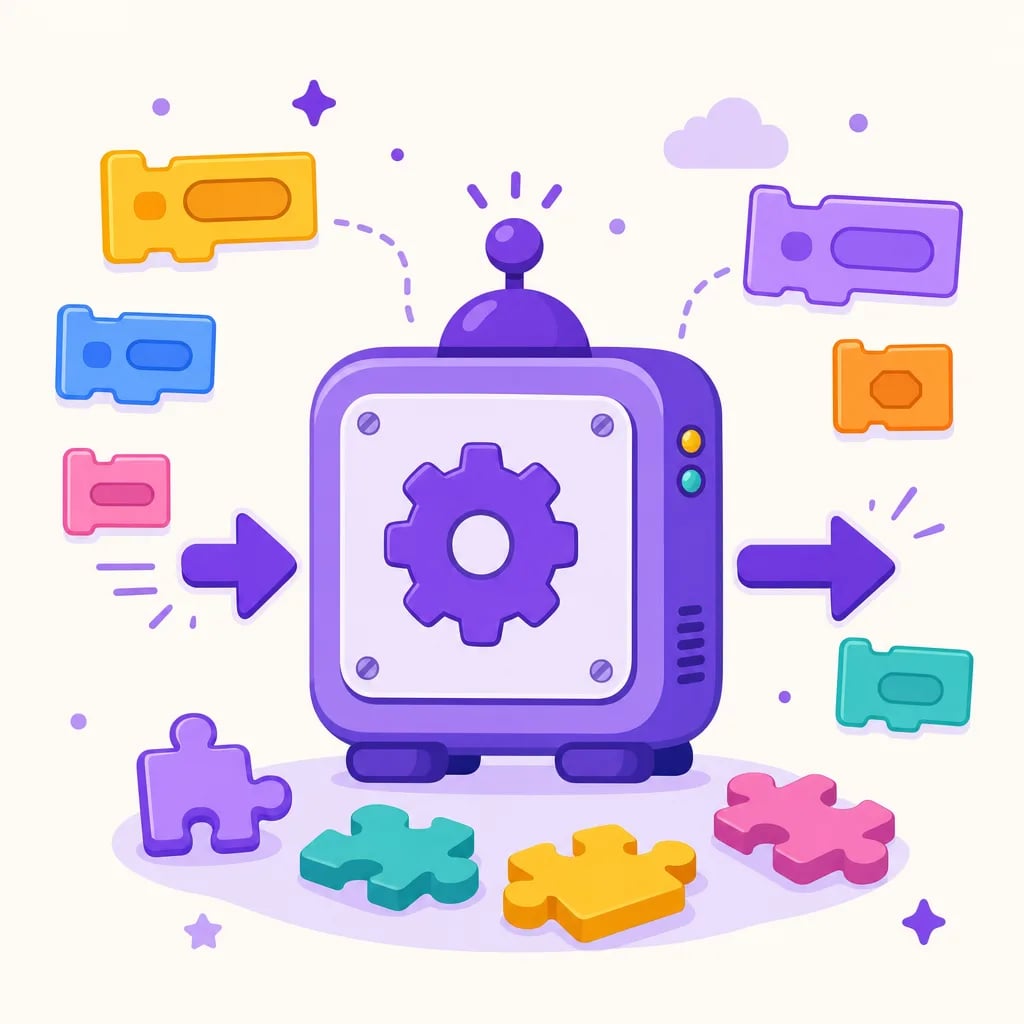
A function in programming is a reusable block of code that performs a specific task: you give it a name, define it once, and can run (or "call") it as many times as you want. Don't confuse it with a mathematical function; in programming it's more like a "recipe" of instructions the computer follows every time you invoke it.
How a Function Works
A function groups several instructions under a single name. Instead of repeating the same code over and over, you write it once inside the function and then call it by name. Many functions take input data (called parameters) and can return a result.
Here's an example kids grasp instantly: in Scratch, a "jump" block can be defined as your own function using "My Blocks". Every time the character needs to jump, you don't repeat ten blocks: you just call your "jump" block. In Python it looks like this: you define def jump(): once and write jump() whenever you need it. A real program can call the same function thousands of times without rewriting it.
Why It Matters for Kids
Functions teach children to break a big problem into small, reusable parts, a core skill of computational thinking. In Algonova's coding courses, kids build their first functions from their very first Scratch and Python projects. It's also a great moment to review what an algorithm is, since a function almost always contains one.
Want your child to write their first function? Book a free trial class and they'll see how it works in practice.