December School Holiday 2026 Coding Plan for Kids 7-12: 4 Weeks From Scratch to Roblox

Learn Coding13 min read
Which Is Better?

Arjun Menon
Education Analyst, Algonova Malaysia
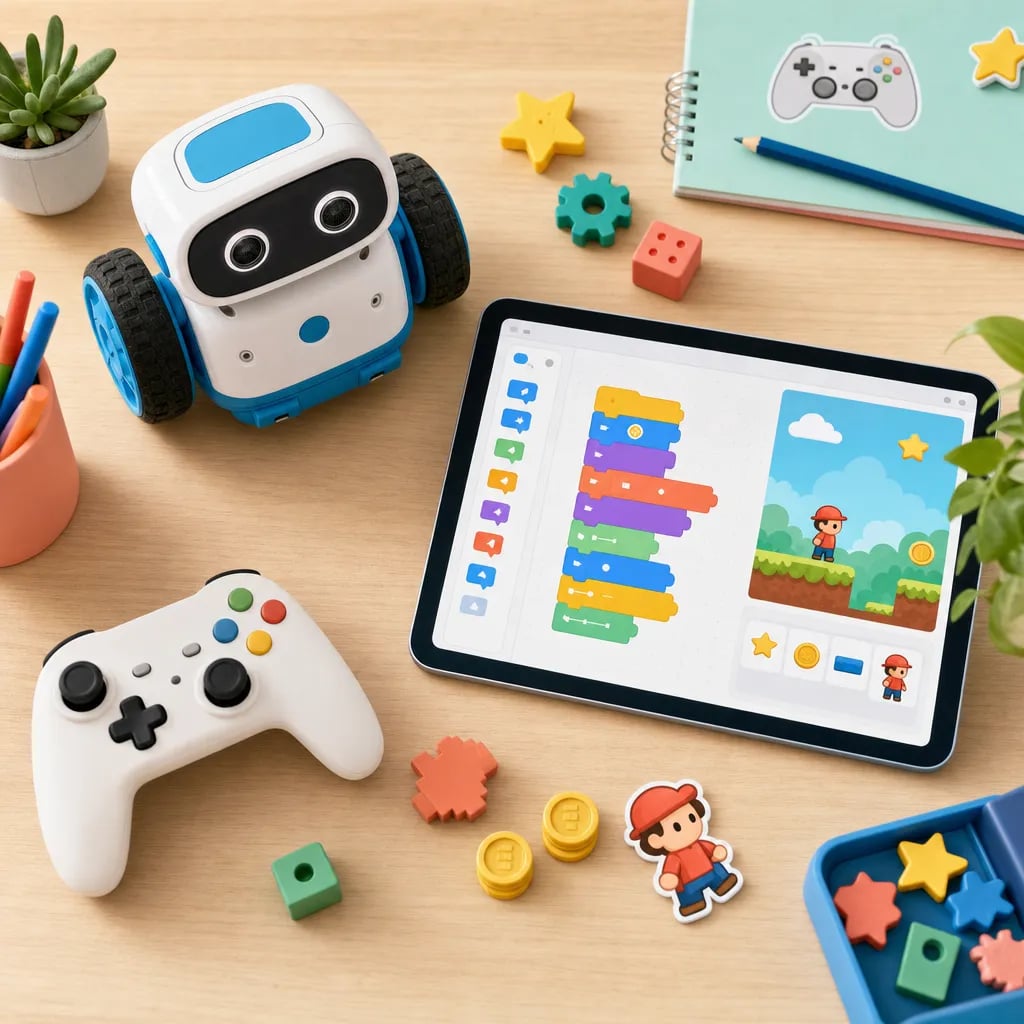
There is no single "best" track — the right choice depends on your child's temperament, not a ranking. The core difference is simple: coding is pure software logic, robotics for kids adds physical hardware you can touch (sensors, motors, wheels), and game design blends both with visual storytelling and creativity. Algonova teaches all three online across Malaysia, in live classes — private 1-on-1, mini groups of 2–4, or groups of up to 10 students — so your child can start with one and explore the others.
The three tracks share a common root — logical thinking — but they express it very differently, and understanding that difference is the first step to choosing well.
Coding is the foundation. Younger children usually begin with Scratch, a block-based visual language where they drag colourful command blocks to make characters move, react, and tell stories. As they mature, they progress to text-based languages like Python, writing real code that solves problems, automates tasks, and eventually powers websites or apps. Coding is invisible and abstract: the reward is watching an idea in your head come alive on screen. Our coding classes for kids follow exactly this Scratch-to-Python arc.
Robotics takes that same logic and gives it a body. Children build a physical machine, then write code to control it — telling a motor to spin, a sensor to detect a wall, a robot to follow a line or avoid obstacles. The magic is cause and effect you can hold in your hands. It's hands-on, tactile, and immediately satisfying for kids who love to tinker and see something move in the real world.

Game design sits between the two. Children learn game mechanics (rules, scoring, levels), storytelling, and visual creativity, building playable worlds using tools like Roblox Studio and, later, Unity. It rewards imagination as much as logic — you can explore game design for kids if your child dreams in characters and worlds.
While all three develop problem-solving, each strengthens a distinct set of muscles.
Coding builds abstract reasoning, patience, and the ability to break a big problem into small, ordered steps — the skill computer scientists call decomposition. It also teaches debugging: the quiet resilience of trying, failing, and fixing without giving up. Children who code learn that mistakes are information, not defeat.
Robotics builds spatial reasoning and engineering intuition. Because a robot exists in the physical world, kids confront real constraints — friction, gravity, wobbly wheels, a sensor that reads the light wrong. They learn iterative testing and hands-on troubleshooting, and because robotics projects are often built in teams, it strengthens collaboration and communication too.
Game design builds creative confidence and systems thinking. To make a game fun, a child has to imagine how a player will feel, balance difficulty, and connect many moving parts — art, rules, and code — into one coherent experience. It's a powerful bridge for children who might resist "plain" coding but light up when the goal is to build something playable.
Crucially, none of these skills is wasted if your child later switches tracks. Logical thinking, persistence, and creativity transfer everywhere — including school subjects and adult careers that don't yet exist. If you're deciding between the two most common first languages, Scratch vs Python breaks it down.
Not sure which track fits your child? Book a free Master Class — 60 minutes, live with a teacher, no commitment. Your child tries real coding while we spot their strongest track.
Age matters, but temperament matters more.
By age, a rough map helps. Children in Darjah 1–6 (roughly 7–12) thrive with visual, playful entry points: Scratch coding, simple robotics kits, and Roblox-style game building. Students in Tingkatan (13–17) are ready for deeper, text-based work: Python programming, more advanced robotics logic, and richer game engines like Unity. Younger children need shorter feedback loops and tangible results; teenagers can hold a longer, more abstract goal in mind.
By temperament, ask what already energises your child:
None of these are boxes. A shy child can blossom in robotics teamwork; a hyperactive one can find deep calm in coding. If you're still unsure, our diagnostic Master Class (more below) is designed to reveal which spark is already there. For a deeper timing guide, see what age to start coding.
Every one of these tracks points toward the future Malaysia is actively building.
Under the MyDIGITAL Blueprint, the national ambition is a digitally-driven economy, with digital skills forecast to underpin a large share of new high-value jobs. Coding, robotics, and game design all feed directly into that pipeline — and they do so as foundations, not narrow trades.
Coding opens the widest door: software engineering, data science, AI, cybersecurity, fintech. It's the literacy beneath almost every modern profession. Robotics connects to engineering, automation, manufacturing 4.0, and the Internet of Things — fields where Malaysia's industrial base is modernising fast. Game design feeds a growing creative-tech and interactive-media industry, plus transferable UX and product skills valued far beyond games.
For families thinking about university, these interests map cleanly onto strong local pathways — computer science and engineering faculties at UM, USM, and UTM among them. Importantly, we never promise that any single class guarantees a career. What we promise is that early, genuine competence gives your child real options later. The goal isn't to manufacture a programmer at age nine; it's to keep the door to that future wide open.
We don't teach children to memorise code — we teach them to think in code, so the tool can change and the thinking stays.
The Algonova learning approach
If you're weighing the three, work through these questions honestly — they cut through the noise faster than any feature list.
At a glance:

Still torn? That's normal — and it's exactly why trying before committing beats guessing. For a focused side-by-side, read a closer look at coding vs robotics.
Yes — and in fact, the strongest learners usually do. These tracks aren't rival camps; they're branches of the same tree.
Coding is the shared foundation. Both robotics and game design run on code, so almost every child benefits from starting with core programming logic — even just the block-based Scratch stage. Once that logic clicks, branching out becomes natural rather than overwhelming.
A common, healthy progression looks like this: a child begins with Scratch to grasp sequencing, loops, and events. From there they can move into robotics (applying that logic to a physical machine) or game design (applying it to interactive worlds), depending on what excites them. Later, as they mature, they graduate to Python — the language that deepens all three tracks and unlocks serious projects.
Combining tracks isn't scattered or unfocused; it's how real technologists actually work. The engineer who builds a robot also programs it. The game developer who designs a world also codes its rules. Letting a child sample more than one track early doesn't dilute their learning — it helps them discover where their deepest interest lives, and builds a more flexible, transferable skill set along the way.
Algonova was built precisely so families don't have to gamble on a single track. With 9+ years of experience and more than 1,000,000+ alumni across 97 countries, our programme spans coding, robotics, and game design under one roof — so a child can start where they fit and explore sideways as their interests grow.
Classes are live and online, taught as private 1-on-1 lessons, mini groups of 2–4, or groups of up to 10 students, which means real attention from a teacher rather than a video your child watches alone. Because everything runs online, families in Kuala Lumpur, Petaling Jaya, Penang, and Johor Bahru — and anywhere with a stable connection — learn from the same expert teachers, no commute required.
The best first step is our free Master Class, a talent-diagnostic session that lets your child try real coding hands-on while our teachers observe which track fits their temperament best. It's low-pressure, genuinely useful, and often the moment parents finally see the spark clearly.
Ready to see which track lights your child up? Try a free Master Class and get a recommendation based on how your child actually engages — not a sales pitch.
I didn't want to push my child into something just because it 'looks good' on a CV. I wanted her to actually enjoy it — that's when the real learning started.
A Malaysian parent
Coding is usually the best starting point for a complete beginner, because it builds the logical foundation the other two tracks rely on. Most young beginners start with Scratch, a visual block-based language that feels like play, before touching anything more advanced. That said, "better" depends on the child. A restless, hands-on beginner may engage faster with robotics, while a highly imaginative child may prefer building simple games. All three are beginner-friendly when taught at the right level. The safest approach is to let a young child try coding first, since that logic transfers directly into robotics and game design later. At Algonova, a free diagnostic Master Class helps identify which track suits your specific beginner before committing to anything.
Children can begin as early as age 6, starting with visual, play-based tools rather than text code. From roughly Darjah 1 to Darjah 6 (ages 7–12), kids thrive with Scratch coding, beginner robotics kits, and Roblox-style game building, all designed for small hands and short attention spans. From Tingkatan level (13–17), students are ready for text-based Python, more advanced robotics logic, and professional-grade engines like Unity. There is no single "too late" age — teenagers who start later often progress quickly because they can handle abstraction. The key is matching the tool to the age: tangible and visual for younger children, deeper and text-based for teens. Algonova's classes are grouped by age and level so every child starts at the right point.
Not strictly, but it helps enormously, because both robotics and game design are built on top of code. A child who understands basic programming logic — sequences, loops, and events, often first learned in Scratch — will find robotics and game design far easier and more rewarding. Many children learn the coding foundation and the applied track almost together, picking up logic while building a robot or a simple game. So you don't need to complete a long coding course first. Think of coding as the shared language underneath both tracks: a little goes a long way. At Algonova, robotics and game design courses naturally weave in the coding concepts a child needs, so no one is left behind on the logic.
Coding tends to open the widest range of careers in Malaysia, feeding into software engineering, data science, AI, cybersecurity, and fintech — fields central to the MyDIGITAL Blueprint's digital-economy goals. Robotics connects to engineering, automation, and manufacturing 4.0, while game design supports the growing creative-tech and interactive-media sector, plus transferable UX and product skills. All three align with strong university pathways at institutions like UM, USM, and UTM. Honestly, no single childhood class guarantees a career — what matters is building real, transferable competence and keeping options open. Rather than chasing the "best" track for jobs, choose the one your child will stick with, since sustained interest produces the deep skill that careers actually reward later.
Yes, and trying before committing is strongly recommended, because a child's genuine interest is hard to predict on paper. The best way is a low-pressure trial that lets them experience real hands-on activity while a teacher observes their engagement. Algonova offers a free Master Class — a talent-diagnostic session where your child tries actual coding and our teachers assess which track fits their temperament best. You leave with a concrete recommendation based on how your child actually responded, not a guess. Because Algonova teaches coding, robotics, and game design together, a child can also shift between tracks later as their interests develop, without starting over. Sampling first almost always leads to a better, longer-lasting choice than committing blind.
Blog
Start your child's tech journey
Book your free 60-minute trial class with an Algonova certified tutor. No payment, no obligation, just discover what your child can build.

Algonova worldwide
Contact us
Email: legal@algonova.com