Carrying in addition (also called addition with regrouping) is the method used to add multi-digit numbers when the sum of a column reaches 10 or more and a unit must be carried over to the next column. It's the standard column-addition method taught in elementary school, usually starting around 2nd or 3rd grade.
How to add in columns with carrying
To add two numbers with this method, always follow the same order:
Line up the numbers by place value: ones under ones, tens under tens, hundreds under hundreds.
Start adding from the rightmost column (the ones).
If that column's result is less than 10, write it down and move to the next column.
If the result is 10 or more, write only the ones digit of the result and carry 1 to the tens column, adding it together with the other numbers in that column.
Repeat the same process for each column, from right to left, until you're done.
Why we "carry" a unit
Every time a column adds up to 10 or more, a new group of the next higher unit is actually being formed: 10 ones make 1 ten, 10 tens make 1 hundred, and so on. Carrying 1 isn't a trick, it's regrouping ten small units into a single one of the next order. That's why this method is also called "addition with regrouping": kids are really reorganizing quantities, not memorizing a mechanical step.
Example 1: two-digit addition with one carry
Let's add 48 + 27.
Ones: 8 + 7 = 15. Write 5 and carry 1 to the tens.
Tens: 4 + 2 = 6, plus the 1 we carried = 7.
Result: 48 + 27 = 75.
Example 2: two-digit addition with carrying in the tens
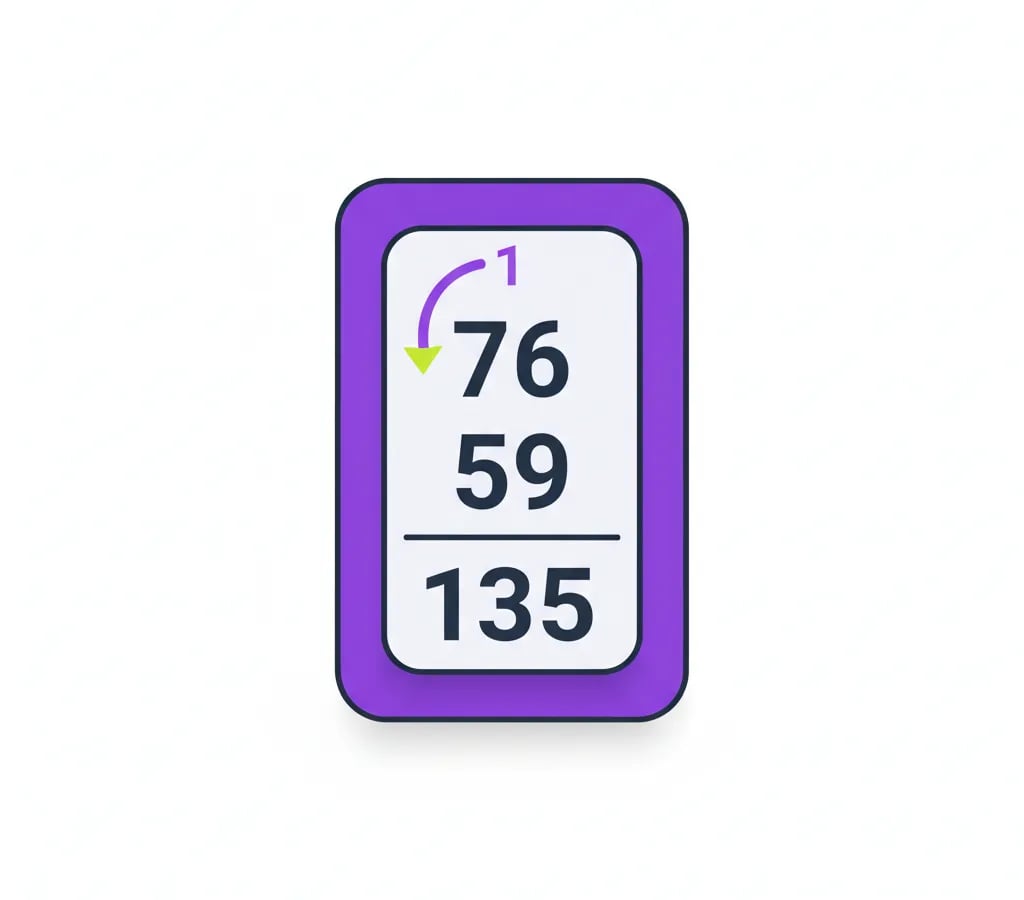
Now let's add 76 + 59.
Ones: 6 + 9 = 15. Write 5 and carry 1.
Tens: 7 + 5 = 12, plus the 1 we carried = 13. Since that's also 10 or more, write 3 and carry 1 to the hundreds.
Since there are no more columns, that 1 becomes a new hundred.
Result: 76 + 59 = 135.
This second example shows something important: carrying can repeat across more than one column, even when neither original number has three digits.
Example 3: three-digit addition with two carries
Let's add 458 + 367.
Ones: 8 + 7 = 15. Write 5 and carry 1.
Tens: 5 + 6 = 11, plus the 1 we carried = 12. Write 2 and carry 1.
Hundreds: 4 + 3 = 7, plus the 1 we carried = 8.
Result: 458 + 367 = 825.
Example 4: addition with money
Maria has 1,780 more. How much money does she have now?
Ones: 0 + 0 = 0.
Tens: 5 + 8 = 13. Write 3 and carry 1.
Hundreds: 2 + 7 = 9, plus the 1 we carried = 10. Write 0 and carry 1.
Thousands: 3 + 1 = 4, plus the 1 we carried = 5.
Result: 1,780 = $5,030.
Common mistakes when carrying
Forgetting the carried unit: the most common mistake is adding the next column without including the 1 that needs to be carried.
Writing the carry in the wrong column: the 1 always goes to the column immediately to the left, never two columns further.
Misaligning the numbers: if the ones aren't exactly lined up under the ones, the whole sum comes out wrong even if the procedure itself is correct.
Adding from left to right: carrying addition always starts with the ones column (the rightmost one), never with the highest place value.
How to check the sum is correct
There are two simple ways for a child to check their own result:
Round and estimate: round each number to the nearest ten or hundred and add those round values. The real result should land close to that estimate. For example, in 458 + 367, rounding to 460 + 370 = 830, which is close to the actual result of 825.
Use the inverse operation: subtraction undoes addition. If 48 + 27 = 75, then 75 − 27 should equal 48. If the subtraction doesn't match, there's an error in one of the carries.
Practicing these two checks helps kids catch their own mistakes without needing an adult to review every single exercise.
In summary
Carrying is the foundation of all multi-digit arithmetic: without mastering it, it's hard to move on to subtraction with borrowing, column multiplication, or problems involving money and measurements. At Algonova kids practice this kind of addition online through real coding projects, not just repetitive worksheets. If you want to reinforce related topics, check out our article on decimal numbers or try a free coding class.
Frequently asked questions about carrying in addition
What is carrying in addition?
Carrying in addition, also called addition with regrouping, is the method used to add numbers with two or more digits when the result of a column reaches 10 or more. In that case, only the ones digit of that result is written down, and 1 is carried over to the next column, added together with the other numbers in that column. For example, when adding 48 + 27, the ones give 8 + 7 = 15: write 5 and carry 1 to the tens, which become 4 + 2 + 1 = 7, giving a final result of 75. This method is taught in elementary school, usually starting in 2nd or 3rd grade, and it's the foundation for adding any multi-digit number without a calculator.
Why do we carry 1 to the next column instead of leaving the full number?
We carry 1 because each column in the sum represents a different place value: ones, tens, hundreds, and so on. When a column adds up to 10 or more, ten units of the same order are actually being formed, and those ten units are exactly equal to one unit of the next higher order. So instead of writing a two-digit number inside a single column, the amount is regrouped: the ones digit stays in place, and the ten that was formed gets added in the next column. This is the same principle that explains why 10 tens make a hundred or why 10 hundreds make a thousand, and it's why this method is also called addition with regrouping.
What are the most common mistakes kids make when carrying?
The most frequent mistake is forgetting to add the carried unit in the next column, which leaves the result a ten, hundred, or thousand short of the correct value. Another common error is writing the carry in the wrong column, for example carrying it two columns over instead of the one immediately to the left. It's also common for numbers to end up misaligned, so the ones don't line up exactly with the ones and the tens with the tens, throwing off the whole operation even when the procedure itself is applied correctly. Practicing on grid paper helps keep each digit in its correct column and reduces these mistakes considerably.
How can a child check whether their carrying addition is correct?
There are two simple checks that don't require redoing the whole calculation. The first is rounding each number to the nearest ten or hundred and adding those round values: the actual result should land close to that estimate, and a big difference usually signals a carrying error. The second is using subtraction as the inverse operation: if 48 + 27 equals 75, then 75 minus 27 should equal exactly 48. If the subtraction result doesn't match the first number, some carry was applied incorrectly in one of the columns. Practicing both checks helps kids catch their own mistakes without needing an adult to review every single exercise.
At what age or grade do kids learn carrying in addition?
Carrying in addition is usually introduced in 2nd grade with two-digit numbers, and reinforced in 3rd and 4th grade with three- and four-digit numbers, including examples with money and measurements. Before learning this method, kids typically already master addition without carrying and understand basic place value for ones and tens. Mastering carrying is a requirement for moving on to subtraction with borrowing, column multiplication, and multi-step problems that combine different operations. At Algonova, kids practice this kind of addition online through real coding projects, which helps cement the concept through hands-on exercises rather than just mechanical repetition.