
Free Coding Trial Class for Kids in Malaysia: What Happens in 60 Minutes and How to Judge It

Coding Education7 min read
Coding Education

Hafiz Rahman
Lead Coding Instructor at Algonova Malaysia
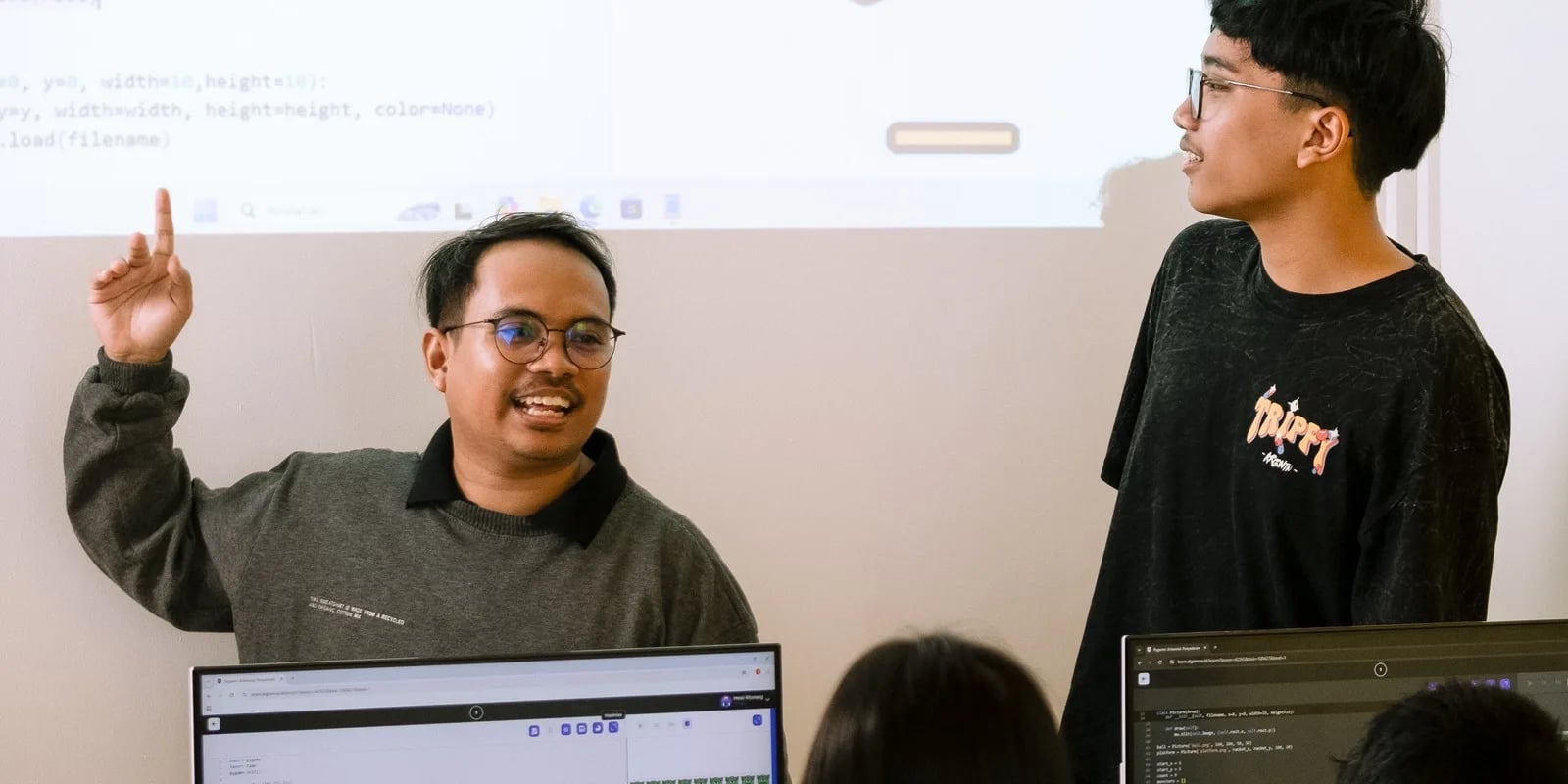
A bug is an error or flaw in a computer program that makes it behave in a way its creator did not intend — producing a wrong result, freezing, or crashing. Bugs are a completely normal part of coding: every programmer, from a child writing their first Scratch script to a professional engineer, creates them and fixes them every day.
Table of Contents
A bug appears whenever the instructions in the code do not match what the programmer actually wanted. Common causes include a typo, a missing step, the wrong number, or blocks placed in the wrong order. The word "bug" became famous in 1947, when computer scientist Grace Hopper's team found a real moth trapped inside the Harvard Mark II computer and taped it into their logbook as the "first actual case of a bug being found."
Imagine a child makes a Scratch game where the dog sprite should bark when it is clicked, but nothing happens — the bug might be a missing "when this sprite clicked" block. In Python, typing prnt("Hello") instead of print("Hello") is a bug too: one missing letter stops the whole program. Fixing bugs is called debugging — you find the mistake, correct it, and run the code again to check.
Learning that bugs are normal helps children stay calm and think logically instead of giving up — the same persistence valued in Malaysia's KSSR curriculum and STEM education. Hunting for a bug turns a frustrating moment into a puzzle to solve, one small step at a time. Structured Algonova coding classes guide kids through spotting and fixing their own bugs.
A coding bug and a programming bug mean exactly the same thing: an error that makes a program behave in a way the coder did not intend. A bug in a code can be as small as one wrong letter or a single misplaced block, yet it can stop the whole program from working. Finding and fixing these bugs is an everyday part of programming, not a sign that something has gone badly wrong.
Curious how your child handles their very first bug? A free trial lesson is an easy place to start.
A bug is a mistake in code that makes a program work incorrectly — showing the wrong result, freezing, or crashing. Finding and fixing bugs is a normal, everyday part of coding.
The term spread in 1947, when Grace Hopper's team found a real moth inside a computer and logged it as a bug. Today "bug" means any error in software or hardware.
A bug is the error itself; debugging is the process of finding and fixing it. You cannot have debugging without a bug to fix first.
Yes. Children as young as 6 can find bugs in simple Scratch projects by checking their blocks one at a time. It builds patience, logic, and confidence.
Blog

Start your child's tech journey
Book your free 60-minute trial class with an Algonova certified tutor. No payment, no obligation, just discover what your child can build.

Algonova worldwide
Contact us
Email: int_legal@alg.team
Visit us
Suite 8634, 1021 E Lincolnway, Cheyenne, WY, Laramie, US, 82001
Algonova online LLC International tech school for kids and teens

