Coding Competitions for Kids in Malaysia 2026/2027: List, Ages and How to Prepare
Checklists & Calendar7 min read
Learn Coding

Hafiz Rahman
Coding Curriculum Team, Algonova Malaysia
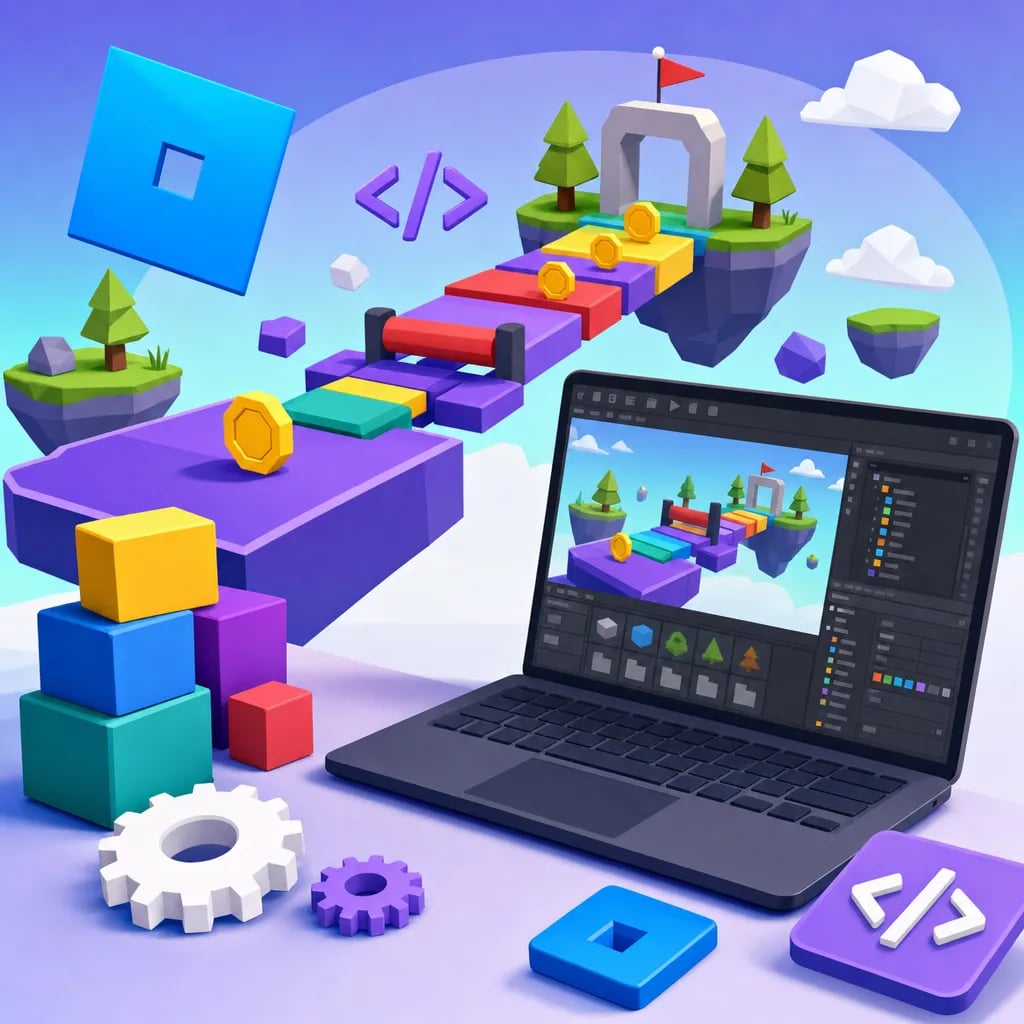
Roblox for kids is more than a game: with Roblox Studio, children aged 8–14 design and build their own 3D games, learning real coding (Lua), logic, and game design. Used safely — with parental controls on — it turns screen time into a creative, skill-building activity, no expensive software required.
Algonova has taught 1,000,000+ students across 97 countries over 10+ years, with a 4.9★ average rating. Our Game Design course uses Roblox Studio to teach kids to build, not just play.
Roblox Studio is the free tool behind Roblox that lets children create their own games instead of only playing others'. A child can build a 3D obby (obstacle course), a role-play world, or a tycoon game — then publish it for friends to play. It's the difference between watching and making.
Unlike just playing Roblox, Studio puts the child in control: they place objects, set rules, and script how the game behaves. Even a beginner can assemble a simple playable game in an afternoon.
Roblox can be safe for kids when parents switch on the built-in controls. Roblox offers account restrictions, chat limits, screen-time caps, and a Parent PIN. For accounts set to under 13, chat and content are filtered more strictly by default.
The practical rule for Malaysian parents: enter the child's real age at sign-up, turn on Account Restrictions, add a Parent PIN, and review privacy settings together. This covers the main concerns — strangers and unsuitable content — while keeping the creative side open. Building games in Studio is a safe, focused activity; the safety questions mostly concern the public, online play side.
Roblox teaches two real skills at once: coding and game design. Building a game means writing logic in Lua (a real programming language), planning levels, and thinking about what makes play fun and fair — structured thinking that transfers far beyond games.
For example, a child who wants their obby to get harder each level is learning difficulty balancing — the same idea real game studios use. If your child leans toward visuals over mechanics, graphic design for kids and digital drawing for kids build closely related creative skills.
Most children can start building in Roblox Studio around age 8–9, and ages 10–12 are ideal — the stage where they can plan a game and reason through cause and effect. Younger children enjoy playing and making small edits; from about 9, a child can intentionally design levels and write basic scripts with guidance.
Roblox needs a laptop or desktop computer (not just a phone or tablet), so it suits school-age children who can use a keyboard and mouse comfortably.
Scratch is the gentlest first step; Roblox suits kids who want 3D games and real code; Minecraft sits in between. The best choice depends on the child, not the brand.
| Scratch | Roblox Studio | Minecraft (Education) | |
|---|---|---|---|
| Best age to start | 6–9 | 8–14 | 8–12 |
| Coding | Blocks | Blocks → Lua (real code) | Blocks → JavaScript |
| Strength | Easiest first step | 3D games + publishing | Familiar and creative |
| Leads toward | Foundations | Game dev & real coding | Creative computing |
For a child who already loves Roblox, starting where their interest already is keeps motivation high — and the Lua they learn is a genuine stepping stone to text-based programming.
The difference between a child who plays Roblox and one who builds it is a single skill: coding. Studio is where playing becomes making.
Aina Rashid · Coding Education Specialist at Algonova Malaysia
Getting started is free: download Roblox Studio on a laptop or PC and follow the built-in tutorials. The gap most Malaysian parents notice is guidance — kids hit a wall alone and give up before finishing anything. A structured class or a mentor turns scattered tinkering into steady progress and a finished, playable game the child is proud to share.
Algonova teaches Roblox through a structured Game Design course for ages 10–12, where children design, script, and publish real games step by step with a live teacher — private 1-on-1, mini groups of 2–4, or groups of up to 10 students, project-based. It also sits alongside our broader coding classes for kids in Malaysia, so a child can grow from Roblox into Python and beyond.
Algonova has taught over 1,000,000 students across 97 countries over more than 10 years, with a 4.9★ average rating. To see if it fits your child, start with a free trial class or message us on WhatsApp at +60 16-255 3382.
Yes. Roblox Studio is completely free to download and use on a PC or Mac. Children can build and publish games at no cost; Roblox only takes a share if a published game earns Robux.
It can be, with controls on. Enter the child's real age, enable Account Restrictions and a Parent PIN, and limit chat. For under-13 accounts these filter content and contacts by default.
No. Children can start by placing objects and using templates, then move to Lua scripting gradually as they are ready. Building teaches the coding along the way.
Some do, through Robux, but it is rare and not the point for young learners. The real value is the coding, design, and problem-solving skills they build.
Around 8–9 to begin building, and 10–12 to design and script seriously with guidance. Roblox needs a laptop or desktop, so it suits school-age children.
The recommended age for Roblox is 8 years and above, matching Roblox Corporation's own guidance, with active parental supervision until roughly age 12. Children below 8 can technically play, but the social features and open user-generated content are calibrated for older primary-school kids who can recognise when a stranger is being inappropriate. The reason is that Roblox is a platform, not a single game. It hosts millions of user-made experiences with very different tones - from calm building games to fast-paced shooters. A younger child cannot easily judge which experiences are age-appropriate on their own. In our Malaysian classes we usually see kids reach the sweet spot around Standard 3-4, when they can also start using Roblox Studio to build their own games rather than only play. If your child is under 8, restrict to a curated list of experiences and keep sessions in a shared room.
Roblox can be reasonably safe for kids when parents enable four core controls: Account Restrictions, Chat filters set to Everyone Off or Friends Only, Content Maturity set to Minimal or Mild, and a Parental PIN to lock settings. All four live inside Settings > Parental Controls once you verify a parent email. The reason is that Roblox's default settings are open by design. Without configuring the account, children can chat with strangers, join any experience, and see in-app purchases. Locking these down takes about 10 minutes and eliminates most of the risk parents worry about. For Malaysian families, we also recommend enabling Spend Restrictions so Robux top-ups need a PIN. Many parents report unexpected charges when a child links a family payment card without controls. Revisit the settings every 3-4 months because Roblox updates the parental menu regularly.
Playing Roblox means consuming experiences other people built, while Roblox Studio is the free desktop tool where kids create their own games using Lua scripting and 3D building blocks. Studio turns Roblox from entertainment into a real learning platform for coding, design, and problem solving. The reason this matters is that a child who only plays learns very little transferable skill, but a child who builds in Studio picks up genuine programming logic (variables, loops, events) plus 3D modelling and game design. This is the version of Roblox that belongs on a CV in ten years' time. In Algonova Roblox Studio classes, a 10-year-old typically builds their first playable obby (obstacle course) in about 4 weeks, then progresses to Lua scripting for game mechanics. Our rule of thumb: for every hour spent playing Roblox, aim for at least 20 minutes building in Studio.
A healthy limit is 45-60 minutes of Roblox play on school days and up to 90 minutes on weekends, ideally split into 20-30 minute chunks with breaks. That pacing keeps sessions purposeful and prevents the tunnel vision Roblox easily creates. The reason Roblox needs stricter limits than passive screen time is its variable-reward loop - new experiences, in-game currency, and social interactions keep the brain in an anticipatory state that is harder to walk away from than a film. One pattern many Malaysian families use: 30 minutes right after homework, break for dinner, then 30 more minutes before bedtime routine. Building time in Studio can be counted separately because it uses different cognitive muscles. Avoid Roblox in the 60 minutes before sleep - the arousal makes wind-down harder.
A child using Roblox Studio picks up four concrete skills: Lua programming, 3D spatial design, project planning, and basic user-experience thinking. These are the same building blocks used in professional game studios, just at an age-appropriate level. The reason Studio teaches so much is that publishing a working game requires every piece to fit - a scripting bug crashes the game, a poor layout drives players away, and unclear objectives kill engagement. Kids receive immediate feedback from their own creation, which is far more motivating than textbook exercises. For example, an Algonova student in Kuala Lumpur built a simple tag game in his first term and iterated it seven times based on friend feedback. By the end he could explain player-flow diagrams - concepts secondary-school computing students often struggle with. Roblox Studio is one of very few tools where a Standard 5 child can ship a real product used by strangers.
Roblox itself is free to download and play, and Roblox Studio is free to use. Robux is the in-game currency needed for cosmetic items, game passes, and premium experiences - and yes, without controls it can become a recurring expense for Malaysian families. The reason Robux feels pressuring is social. Kids often ask for Robux because their friends have a specific avatar item or game pass, not because the game requires it. Nothing in Roblox gameplay actually needs Robux to progress. A practical approach many parents use in Malaysia is a fixed monthly Robux allowance (RM20-30) tied to chores or reading goals, plus a hard rule that any additional purchase needs a PIN. This keeps the platform free from spiralling costs while letting the child participate socially. If your child is building in Studio, Robux is entirely optional - creators earn Robux rather than spend it.
Yes, Roblox Studio is one of the strongest on-ramps to real coding in Malaysia because Lua is a genuine programming language and Studio's project-based flow mirrors professional development. Many children who start with Roblox at age 9-10 move naturally to Python by age 12-13, then to broader software or game development in secondary school. The reason this pathway works is that Roblox rewards persistence with visible results, which builds the intrinsic motivation textbooks rarely provide. Once a child has shipped a game friends can play, learning a second language feels like an upgrade rather than a chore. At Algonova we see a typical progression: Roblox Studio (ages 9-11) to Python (ages 11-13) to web or app development (ages 13+), with kids keeping their Roblox portfolio as a first showcase. Roblox is not the destination - it is the doorway that shows the child coding can be fun.
Blog
Start your child's tech journey
Book your free 60-minute trial class with an Algonova certified tutor. No payment, no obligation, just discover what your child can build.

Algonova worldwide
Contact us
Email: int_legal@alg.team
Visit us
Suite 8634, 1021 E Lincolnway, Cheyenne, WY, Laramie, US, 82001
Algonova online LLC International tech school for kids and teens