December School Holiday 2026 Coding Plan for Kids 7-12: 4 Weeks From Scratch to Roblox

Learn Coding13 min read
Parent Guides

Aina Rashid
Parent Education Editor, Algonova Malaysia
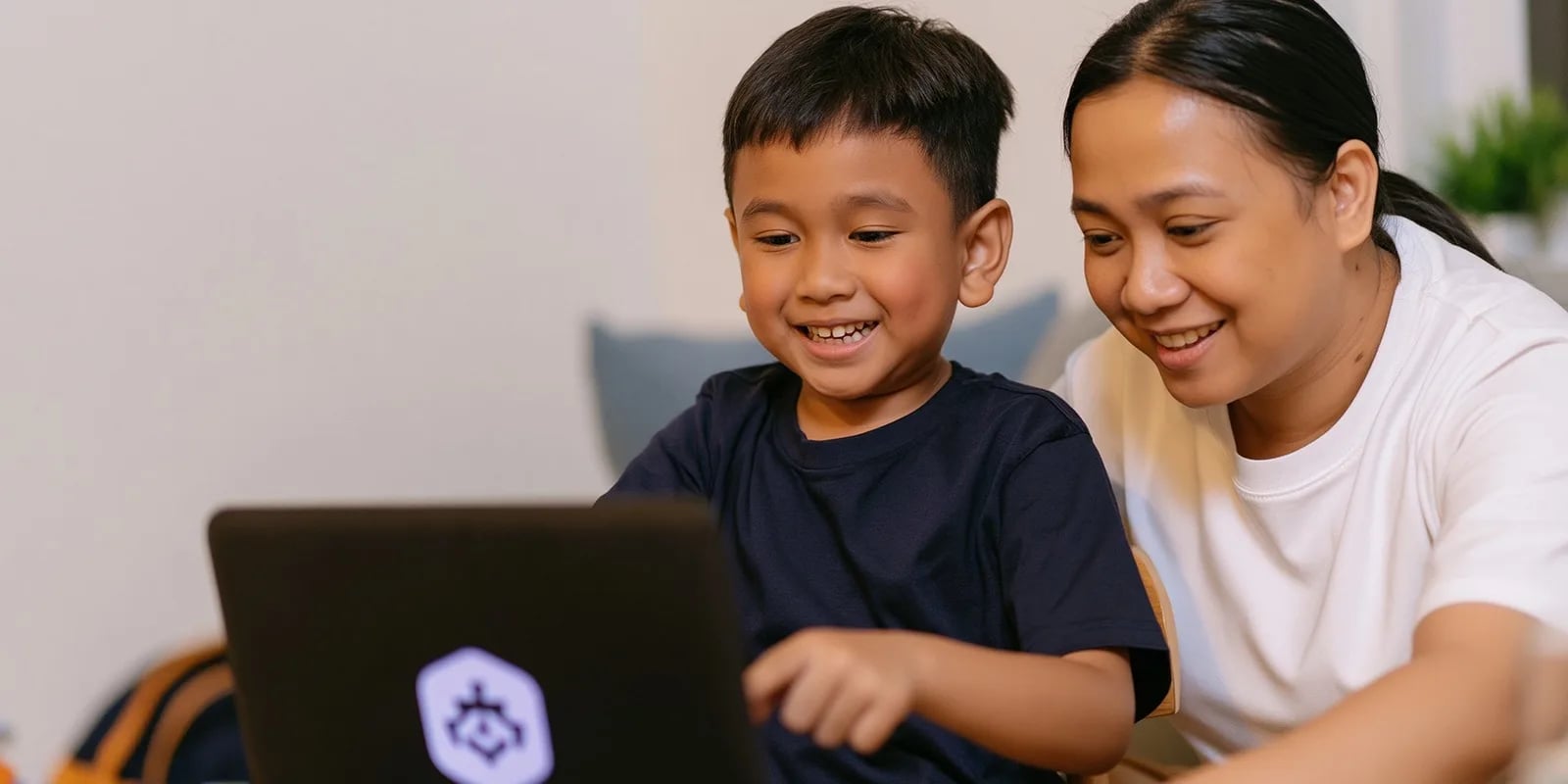
AI classes teach children how artificial intelligence works through hands-on projects: training image classifiers, building chatbots, and creating AI-powered games. In Malaysia, structured AI courses are available for children as young as 7 years old, with prices starting from RM 48 per lesson. This guide compares 7 programs by age range, tools used, and what children actually build, so you can pick the right fit without trial-and-error.
Algonova is an online coding, math, AI, and design course platform for kids aged 5-17, with over 1,000,000 alumni across 97+ countries since 2016. Classes are live with certified teachers in groups of up to 10 students — not pre-recorded videos. Offline learning centres are also available in Malaysia.
AI classes for kids focus on three core skills: understanding how AI makes decisions, training simple machine learning models, and building projects that use AI tools responsibly.
The word "AI" sounds advanced, but children's AI courses break it down into age-appropriate concepts. Here is what each age group typically covers:
Ages 7-9: AI awareness
Ages 10-13: AI creation
Ages 14-17: AI programming
The key difference from regular coding classes is that AI courses emphasise data and decision-making, not just writing instructions for a computer.
No single program fits every child. The right choice depends on your child's age, existing coding experience, and whether you want online or in-person classes.
Here is a comparison of structured AI programs available to Malaysian children:
1. Algonova AI & Data Science
2. MDEC AI Literacy Program
3. Telebort AI Academy
4. Koding Next Malaysia
5. Logiscool Malaysia
6. Samsung Innovation Campus
7. AI4Youth by Taylor's University
The programs range from free government initiatives to structured weekly courses. For sustained learning (not one-off workshops), look for programs that run at least 12 weeks with weekly sessions.
The biggest misconception about AI classes for kids is that children need to know programming first. Most AI awareness courses for ages 7-10 use visual tools like Teachable Machine and Scratch — no typing code at all. Children who can drag and drop can start learning AI concepts today.
Hafiz Rahman, Tech Education Specialist
Ask three questions before signing up: what will my child build, how small is the class, and does the teacher have a technical background or just a teaching certificate?
Many programs use "AI" as a marketing label for basic coding classes. Here is how to tell the difference:
Red flags:
Green flags:
Questions to ask during a trial class:
Algonova's free trial masterclass lets your child experience a live session before committing. The teacher assesses your child's current level and recommends the appropriate track.
Children aged 7-10 do not need any coding experience to start AI awareness classes. Children aged 11 and above benefit from basic Scratch or Python knowledge, but most structured programs teach the prerequisites in the first 4 weeks.
Here is a practical readiness checklist:
Ready for AI awareness (ages 7-10) if your child can:
Ready for AI creation (ages 10-13) if your child can:
Ready for AI programming (ages 14-17) if your child can:
If your child wants to start AI but lacks coding fundamentals, consider a coding course first. Four to six months of Scratch (ages 7-10) or Python (ages 11+) provides enough foundation for any AI program. If you are still deciding which comes first, we compare both routes in AI vs coding for kids.
For children interested in the creative applications of AI (image generation, design tools), Algonova also offers graphic design classes that incorporate AI design tools alongside traditional skills.
Malaysia's KSSR and KSSM curricula introduced computational thinking elements in 2017, but dedicated AI content remains limited to pilot programs through MDEC and selected schools.
The Malaysian government has taken steps toward AI education:
However, these initiatives are uneven. Rural schools have limited access, and most school-based AI content covers awareness rather than hands-on creation. This is why structured extracurricular programs remain the primary path for children who want to build AI projects.
The 2025 World Economic Forum Future of Jobs Report ranks AI and big data skills among the top 5 most in-demand capabilities through 2030. Children who start learning AI fundamentals now will have a practical advantage when entering university or the job market.
Parents ask me whether AI will replace their children's future careers. I tell them: AI will not replace people, but people who understand AI will replace those who do not. Teaching your child how AI works is not about becoming an AI engineer — it is about making sure they are not blind to the technology shaping every industry they might enter.
Hafiz Rahman, Tech Education Specialist
Children as young as 7 can start AI awareness classes that use visual tools like Google's Teachable Machine and Scratch AI extensions. These courses require no coding experience and teach concepts through hands-on projects like training an image classifier to recognise different fruits or building a Scratch game that responds to voice commands. Amir started Algonova's coding track at age 8 and transitioned to AI concepts at age 10. By then, he understood variables and loops, which made learning about datasets and model training intuitive rather than abstract. His first AI project was a chatbot that recommended books based on genre preferences. The ideal starting age depends on your child's comfort with technology and ability to follow multi-step instructions, not their math or coding level.
Prices range from free (government programs like MDEC and Samsung Innovation Campus) to RM 500 per workshop (university holiday programs). Structured weekly courses cost RM 48-150 per lesson depending on group size and format. Algonova charges from RM 48 per lesson for live online classes in groups of up to 10 students. Puan Siti compared three options for her 12-year-old: a free school workshop (one-off, 2 hours), a holiday camp (RM 400, 5 days), and Algonova's weekly classes (RM 192/month, 4 classes). She chose weekly classes because sustained practice over 3 months delivered better retention than one-off exposure. Consider cost per hour of actual learning. A RM 400 workshop over 10 hours equals RM 40/hour. Weekly 60-minute classes at RM 48 per session equal RM 48/hour but include homework, project reviews, and continuous progression.
AI classes develop transferable skills that improve school performance: logical reasoning (mathematics), data interpretation (science), structured argumentation (essays), and project management (group work). However, they do not directly cover KSSR or KSSM exam content, so they complement schoolwork rather than replace tuition. Danish's Sains Komputer teacher noticed he could explain algorithms to classmates after 4 months of AI classes. He did not learn school syllabus content in AI class, but the thinking patterns transferred: breaking problems into steps, testing hypotheses with data, and debugging when something went wrong. If your primary goal is exam results, pair AI classes with subject-specific tuition. If your goal is long-term skill development and university preparation, AI classes build a foundation that no exam-focused tuition provides.
Both formats work if the class is small (10 students or fewer) and interactive. Online classes offer wider access to specialist teachers and save commute time. In-person classes provide hands-on robotics components and social interaction. For pure AI and ML (no robotics), online is equally effective. Hafiz lives in Seremban where no in-person AI classes exist. Online classes at Algonova connected him with an AI teacher who previously worked at a tech company. He completed the same curriculum as students in KL centres, with the added flexibility of joining from home after school. Try one session of each format if possible. Some children focus better with a physical teacher present, while others prefer the comfort and convenience of learning at home.
AI literacy is a foundational skill comparable to computer literacy in the 2000s. The World Economic Forum projects that 97 million new roles will emerge from human-AI collaboration by 2030. In Malaysia, demand for AI talent outpaces supply by a factor of 3 according to TalentCorp data. These numbers point to sustained demand, not a passing trend. Consider how computer literacy evolved: in the 1990s, "computer classes" were optional enrichment. By 2010, every job required basic computer skills. AI is following the same trajectory. Children who understand how AI systems work, their limitations, and how to use them ethically will have an advantage in any field, not just technology. The question is not whether your child needs AI skills, but when they start building them. Earlier exposure creates comfort and familiarity that is harder to develop as an adult.
Typical projects by level: beginners (7-9) train image classifiers and build voice-controlled Scratch games. Intermediate students (10-13) create chatbots, recommendation systems, and AI-powered quizzes. Advanced students (14-17) build sentiment analysers, predictive models, and computer vision applications using Python. Nurul (age 11) built a chatbot for her school library that recommended books based on reading preferences. The project used a simple decision tree, not neural networks, but it solved a real problem: librarians spent less time on recommendations, and students discovered books they would not have found themselves. Ask the program to show you 3-5 projects from previous students before enrolling. If they cannot provide examples, the curriculum may be more theoretical than practical.
Most AI classes for kids use cloud-based tools that run in a web browser: Google Colab, Teachable Machine, Scratch, and ChatGPT require only a stable internet connection and a laptop or tablet with a modern browser. No special hardware, GPU, or software installation needed. Minimum requirements: a laptop or desktop with at least 4GB RAM, a webcam (for image classification projects), a microphone (for voice projects), and a stable internet connection of at least 5 Mbps. Chromebooks work fine for ages 7-13. Students aged 14-17 using Python may benefit from 8GB RAM, but it is not mandatory since Google Colab provides free cloud computing. If your child is using a family tablet, ensure it has a keyboard attachment for typing code. Touch-screen typing slows down programming significantly.
Three indicators of real learning: (1) your child can explain what they built and why it works, not just show the finished product, (2) they encounter and solve problems during the project (if everything works perfectly, the task is too easy), (3) they can modify their project when given a new requirement. After each class, ask your child three questions: "What did you build today?", "What went wrong and how did you fix it?", and "What would you change if you had more time?" Children who are genuinely learning can answer all three. Children who are just following instructions can only answer the first one. Good programs send parents a summary after each session with what was covered, how the child performed, and what to practise before the next class.
AI projects strengthen university applications for STEM, business, and social science programs in Malaysia and abroad. A portfolio showing real AI projects demonstrates technical capability, problem-solving skills, and initiative that grades alone cannot convey. Aisyah included her AI sentiment analysis project in her UCAS application for Computer Science at a UK university. The admissions tutor specifically asked about it during her interview. She explained how she cleaned the dataset, chose her model, and handled edge cases where the AI made wrong predictions. This real-world experience distinguished her from applicants with higher grades but no practical projects. Start building a project portfolio from age 13-14. By the time university applications are due at 17, your child will have 3-4 substantive projects to discuss. Programs that include project presentations and documentation (not just coding) prepare students better for this purpose.
AI classes focus on software: how machines learn from data, make decisions, and generate content. Robotics classes focus on hardware: building physical machines that move, sense their environment, and perform tasks. Some programs combine both, but they are distinct disciplines with different skill outcomes. Think of it this way: AI is the brain, robotics is the body. A robot that follows a line uses sensors and motors (robotics). A robot that recognises objects and decides what to pick up uses a camera and a trained model (AI + robotics). Pure AI classes are entirely screen-based and produce software projects like chatbots, classifiers, and generators. If your child enjoys building physical things and seeing them move, robotics might be a better starting point. If they are fascinated by how apps "know" what they like or how ChatGPT generates text, AI classes are the better fit. Many children eventually learn both.
Blog

Algonova worldwide
Contact us
Email: legal@algonova.com