Future careers in the AI era: what to prepare now

AI Education8 min
Coding Education

Bayu Nugraha
Children's Coding Specialist
Coding, robotics, and game design are three popular STEM tracks for kids — and all three teach the same computational thinking. But their goals, costs, and entry points differ. Coding is the most flexible foundation; robotics adds physical hardware; game design adds creativity and narrative. For most Indonesian families, starting with coding and later adding robotics or game design based on the child's interests is the most sensible path.
Algonova is an online coding, maths, AI and design school for children aged 5–17, with 1,000,000+ students across 97 countries and 10+ years of teaching experience. We offer all three tracks, all online in Private (1 student), Mini (2-4 students), and Group (up to 10 students) formats with certified teachers.
Coding is a general skill — the digital foundation that applies across almost every tech domain. Robotics and game design are more specialist, built on top of a coding foundation. A child who starts with coding keeps options open; a child who jumps straight into robotics or game design without a coding foundation often stalls as complexity rises.
Robotics fits kids who love building physical things and are curious how machines work. Game design suits kids who spend hours on Roblox or Minecraft and want to make their own version. Coding fits kids who don't yet know what they love — a foundation that opens every door.
Costs also differ. Coding and game design need a laptop and internet. Robotics requires a physical kit (Rp 500K–Rp 5M) and is often only available in-person in big cities.
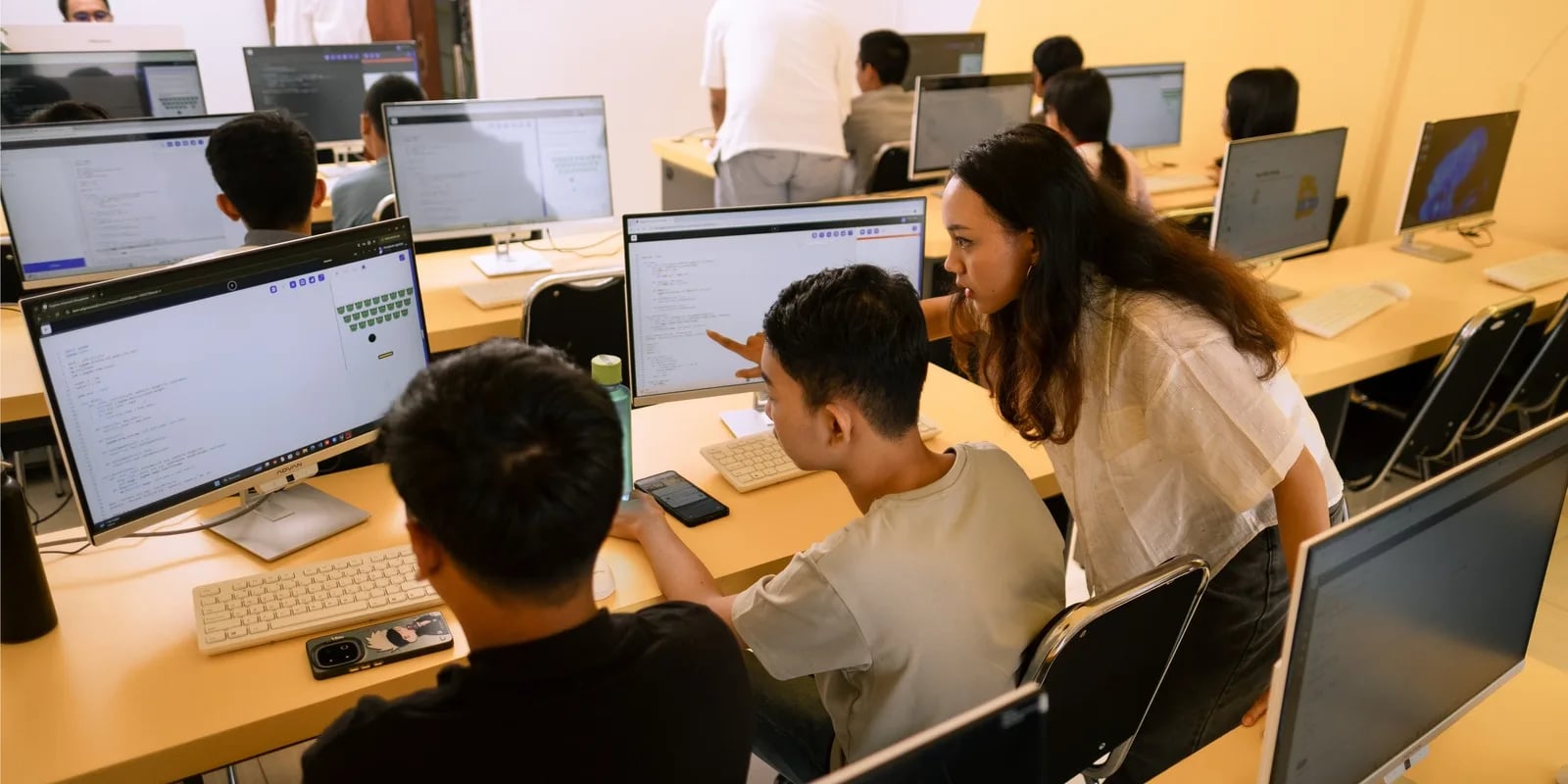
Coding is writing instructions (commands) for computers in a programming language. For kids, it usually starts with Scratch (ages 8–11, visual blocks) and moves to Python (12+, text code). Children learn universal concepts: loops, conditions, variables, functions.
Coding needs no physical hardware. All that's needed is a laptop and internet. Learning outcomes usually include: simple games, calculator apps, chatbots, data visualisations — depending on the child's creativity.
Advantages: the most flexible foundation (applies to AI, web, data, automation, and even robotics/game design later), low cost, mature curriculum. Drawback: less "tangible" for kids who need to see physical results.
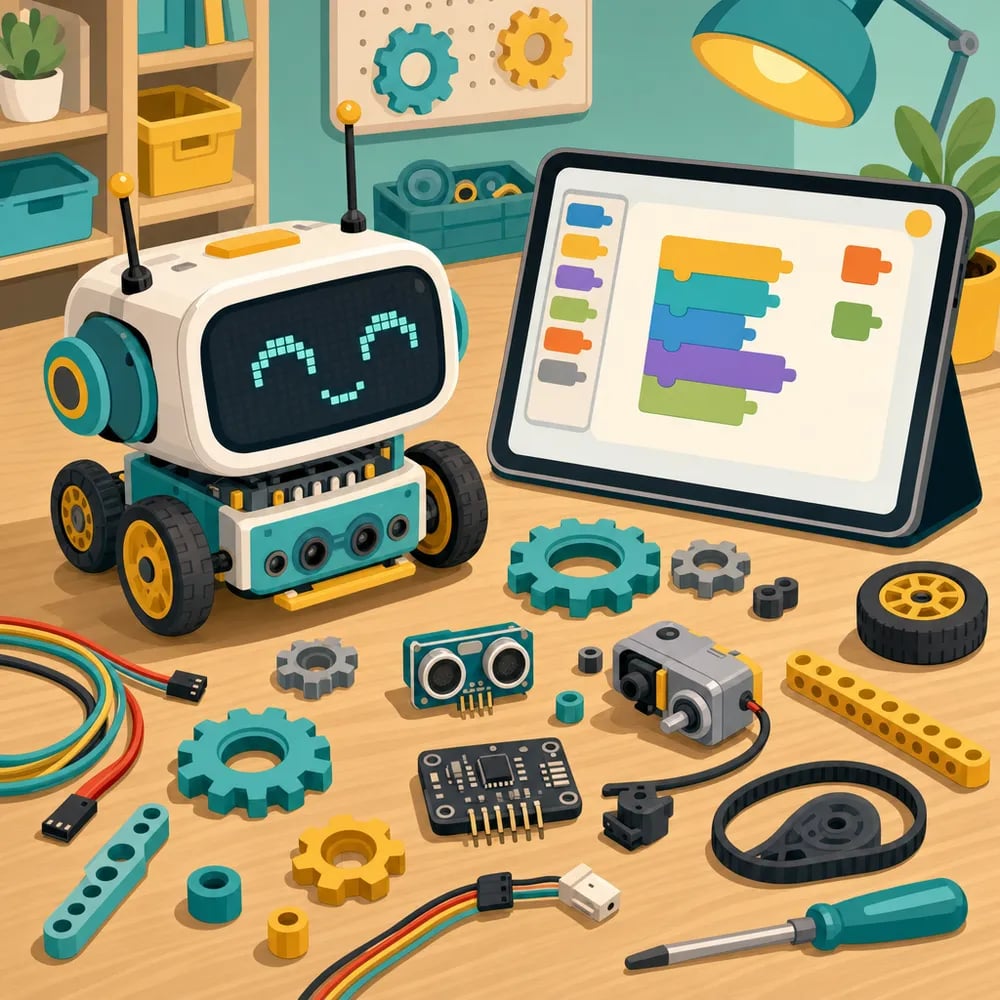
Robotics is building and programming physical robots that move, sense their environment, and interact with the world. Kids use kits like LEGO WeDo (ages 7–10), mBot (8–12), VEX IQ (10+), or Arduino (12+), combined with sensors, motors, and programming software.
Beginner robotics kits (LEGO WeDo, mBot) cost around Rp 500K–2M. Advanced kits (VEX, full-sensor Arduino) can reach Rp 3–5M. Because they need hardware, robotics classes are usually in-person — the child attends a centre that provides the kits.
Advantages: very visual and tactile, blends coding with physics/mechanics, has competitions (WRO, First Lego League). Drawbacks: higher cost, limited availability outside big cities, hardware can break or become obsolete.
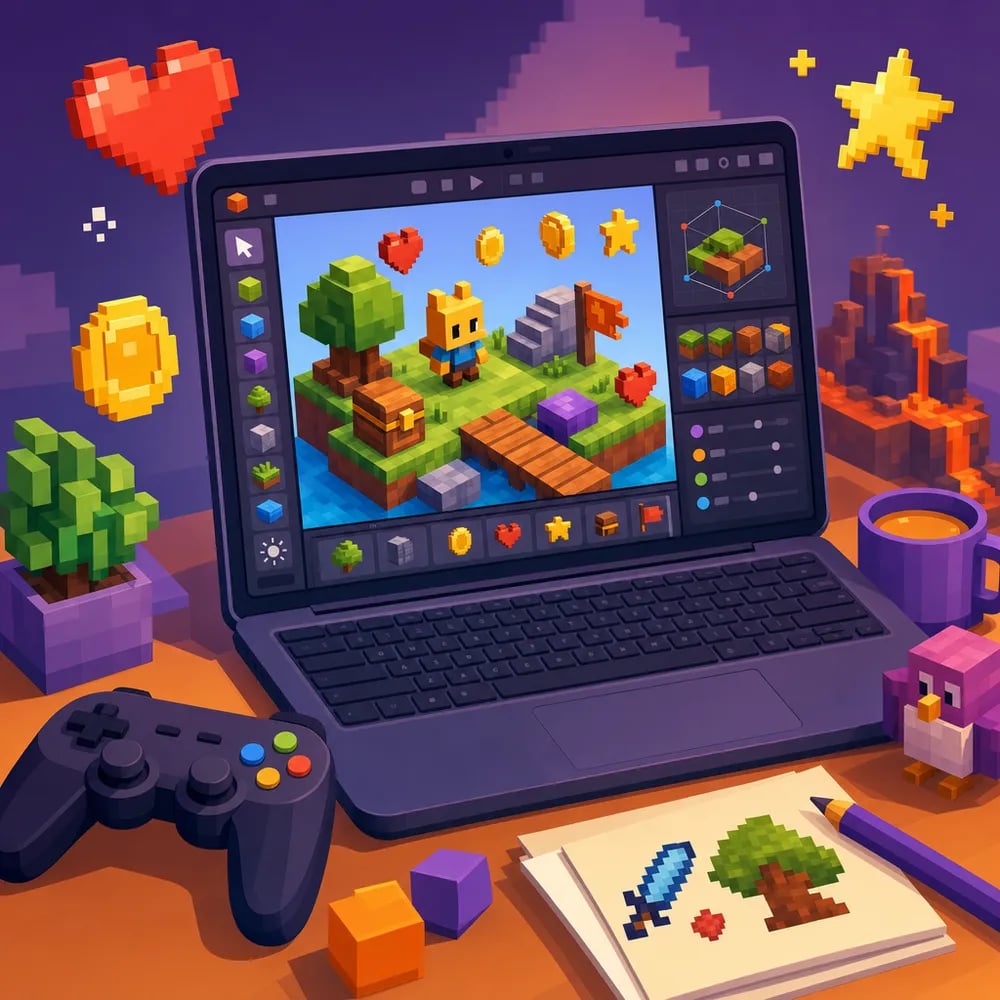
Game design is creating video games — including mechanics, story, characters, art, and coding. For kids, it typically uses Roblox Studio with the Lua language (ages 10–14) or Unity 2D with C# (12+). Children learn not just coding, but narrative design, digital art, and player psychology.
Game design runs on a regular computer — no special hardware needed. A child can build a full multi-level game at home and publish to Roblox to be played by millions.
Advantages: highly motivating (kids often already love games), combines technical with creative skills, results are immediately shareable. Drawbacks: can become a "rabbit hole" (child fixates on one favourite game), touches less on non-game fields like data/AI.
Coding is the broadest foundation; robotics wins for hardware-focused kids; game design wins for creative-driven kids. The table below is the fastest way for Indonesian parents to see each track's trade-offs.
| Coding | Robotics | Game Design | |
|---|---|---|---|
| Start age | 8 years | 7 years | 10 years |
| Startup cost | Laptop + internet | Kit Rp 500K–5M | Laptop + internet |
| Format | Online or in-person | Usually in-person | Online or in-person |
| Availability outside big cities | High (online) | Low | High (online) |
| Skills built | Loops, conditions, algorithms | Coding + physics/mechanics | Coding + art + narrative |
| Learning outcomes | Apps, chatbots, text games | Functional robots | Playable games |
| Kid competitions | Hackathons, olympiads | WRO, First Lego League | Game jams, Roblox community |
| Career paths | AI, data, web, developer | Robotics, IoT, embedded | Game dev, animation, UX |
| Needs coding foundation? | This is the foundation | Yes (via block-based) | Yes (via Scratch/Lua) |
Algonova groups children into three age stages:
Many Indonesian parents ask "which is best for the future?" The answer: depends on the imagined career. For AI/data science/software engineering — coding is the best foundation. For engineering/robotics/manufacturing — robotics is more relevant. For the digital creative industry — game design gives an edge.
The kids who know what they love have usually tried two or three tracks. Switching from coding to game design at 10 isn't failure — it's part of exploration. A parent's job is to open the doors, not decide the destination.
Bayu Nugraha · Children's Coding Specialist, Algonova Indonesia
Algonova sequences all three tracks progressively — kids aren't forced to choose at the start. A child begins with the coding foundation, then tries a specialisation aligned with interests once the base is solid. This avoids two common mistakes: jumping straight into robotics/game design without a foundation (complexity rises fast), or getting stuck in beginner coding with no progression.
Our progression:
For robotics, we recommend a hybrid approach: coding foundation and algorithmic thinking with Algonova online, then a school robotics club or a competition like WRO Indonesia for the hardware component. This is lower cost and broader in reach.
Each stage runs live in Private (1 student), Mini (2-4 students), and Group (up to 10 students) formats. A free trial class helps the teacher recommend the right starting point based on age, interest, and experience. See full programmes on the Algonova Indonesia coding courses hub.
Ask three things: What is your child playing/watching now? How old are they? What's your budget? These give better direction than speculation about "what's best for the future."
If your child spends time on Roblox or Minecraft — game design is the easiest entry because they're already motivated. If your child loves taking toys apart and asking how things work — robotics will absorb them. If the child hasn't shown a specific interest — coding is the best foundation, keeping every door open.
On budget: coding and game design need a laptop and internet. Robotics adds Rp 500K–5M for a kit, plus often more expensive in-person class fees. If budget is tight, start with online coding and add specialisation later.
For more detail on coding languages, see our Scratch vs Python guide. On class format, see the online vs in-person guide.
For most children, coding is the best foundation to start with, because it trains the logic used in robotics and game design alike. Robotics suits children who love physical devices, while game design appeals to those who enjoy storytelling and visuals. All three complement each other, and the best choice depends on the child's interests and age. To see which path fits best, look at the programme options on the coding classes page, or try a free coding class so your child can go through an interests-and-aptitude diagnostic before deciding.
Yes, Algonova Indonesia runs a full coding program for kids aged 5 to 17, covering kindergarten through senior high. It splits into three age tracks: Little Coders for ages 5 to 7 using visual block based coding, Junior Coders for ages 8 to 12 using Scratch and the fundamentals of programming logic, and Teen Coders for ages 13 to 17 using Python and game development. Every class is live online with certified teachers in small groups of up to 10 students. Kids build a real project from the first session rather than memorising syntax. Algonova has taught more than 1,000,000 students across 97 countries since 2016.
Yes. For the coding track Algonova Indonesia offers a free 60 minute master class with no commitment. No credit card is needed and there is no auto subscription afterwards. Note that these 60 minutes are an introductory master class, not a regular lesson. A regular coding class runs 90 minutes. During the master class the child works directly with a certified teacher, tries the online learning platform, and finishes a first small project matched to their age. After the session parents receive a personal learning track recommendation plus a transparent explanation of program, schedule, and pricing from Rp 102,000 per lesson. To book, fill in the form on the website.
Algonova Indonesia coding classes come in three formats: Private with one student per teacher, Mini group of 2 to 4 kids, and Group of 6 to 10 kids of similar age and level. The small group format exists because coding gets stuck on very specific lines of code, and a child needs a teacher who can look at their screen when it happens. In a Mini group the teacher checks each child's screen several times per session. The Private format is the most intensive and suits competition preparation, independent projects, or a child who wants to move faster than the group.
Kids coding at Algonova Indonesia starts from Rp 102,000 per lesson. The price covers the live session with a certified teacher, digital learning materials, online platform access, and an official certificate once the child completes each program level. The starting rate is the same across all age tracks. The final quote depends only on class format, meaning Private, Mini, or Group, and on how many sessions per week you choose. Group is the most affordable option and Private is the most intensive. Full pricing is shared after the free master class and before formal enrolment, with no surprise fees. To get a quote, fill in the form on the website.
Yes, every Algonova Indonesia coding program runs fully online with live sessions taught by certified teachers, not recorded videos. Kids learn in real time in small groups, with live Q&A and code written alongside the teacher during the class. To join, a child needs a computer or laptop with a camera, a stable internet connection, and a headset. The Algonova platform runs directly in the browser, so no special software installation is required and no expensive machine is needed. Because everything is online, families anywhere in Indonesia can join and easily fit lessons around school.
Three things make Algonova coding effective for Indonesian kids: project based learning, a staged track, and small groups. Every session produces something that runs and can be shown to a parent, which keeps motivation alive far longer than theory alone. The track climbs gradually from visual block based coding to Python, so a child never jumps into a text language before their logic is ready. Small groups of up to 10 students let the teacher adjust pace: faster kids get extra challenges and stuck kids get help inside the same session. The material also lines up with coding and artificial intelligence entering the Indonesian school curriculum.
That is fine, most Algonova students start from zero with no coding experience at all. Every new child begins with the free master class, where the teacher watches how they solve problems and picks the right starting point. Kids aged 5 to 7 start with visual block based coding and do not need to type fast yet. Older kids can start with Scratch and move up to Python once their logic is solid. All that is required is basic reading and curiosity. Parents do not need to understand programming to support the child, because every task is explained by the teacher during class.

Algonova worldwide
Contact
Whatsapp: +62 21 50996971
Email: info@algonova.id
Address
Coworking Area, Gedung IT 6 Lantai Dasar, Nongsa Digital Park, Jalan Hang Lekiu, Kelurahan Sambau, Kecamatan Nongsa, Batam, Indonesia Directorate General of Consumer Protection and Trade Compliance – Ministry of Trade of the Republic of Indonesia. WhatsApp Ditjen PKTN: 0853-1111-1010.
PT Algonova Indonesia Cerdas All rights reserved 2026