Future careers in the AI era: what to prepare now
AI Education8 min
Course Guides
Maya Putri
Early Childhood Education Specialist
Teaching a child to read quickly follows a seven-step sequence: introduce letters (starting with the child's own name), teach syllables, play word games, read whole sentences, read aloud daily for 10–20 minutes, let the child pick books, and give small rewards. Most kids are ready for letters at ages 3–4. This guide is for parents of children aged 3–7.
Teaching a child to read can start with letter recognition. Begin with the letters in your child's own name — this makes learning more engaging because they feel like they're getting to know themselves. Then move on to the letters in their parents' names, and finally introduce vowels and consonants. To make it more fun, use songs to pronounce the letters.
You can also play "letter hunt" using everyday objects around the house. For example, while drinking a packaged milk, ask your child to find a specific letter on the packaging. Doing this helps them remember letters much faster!
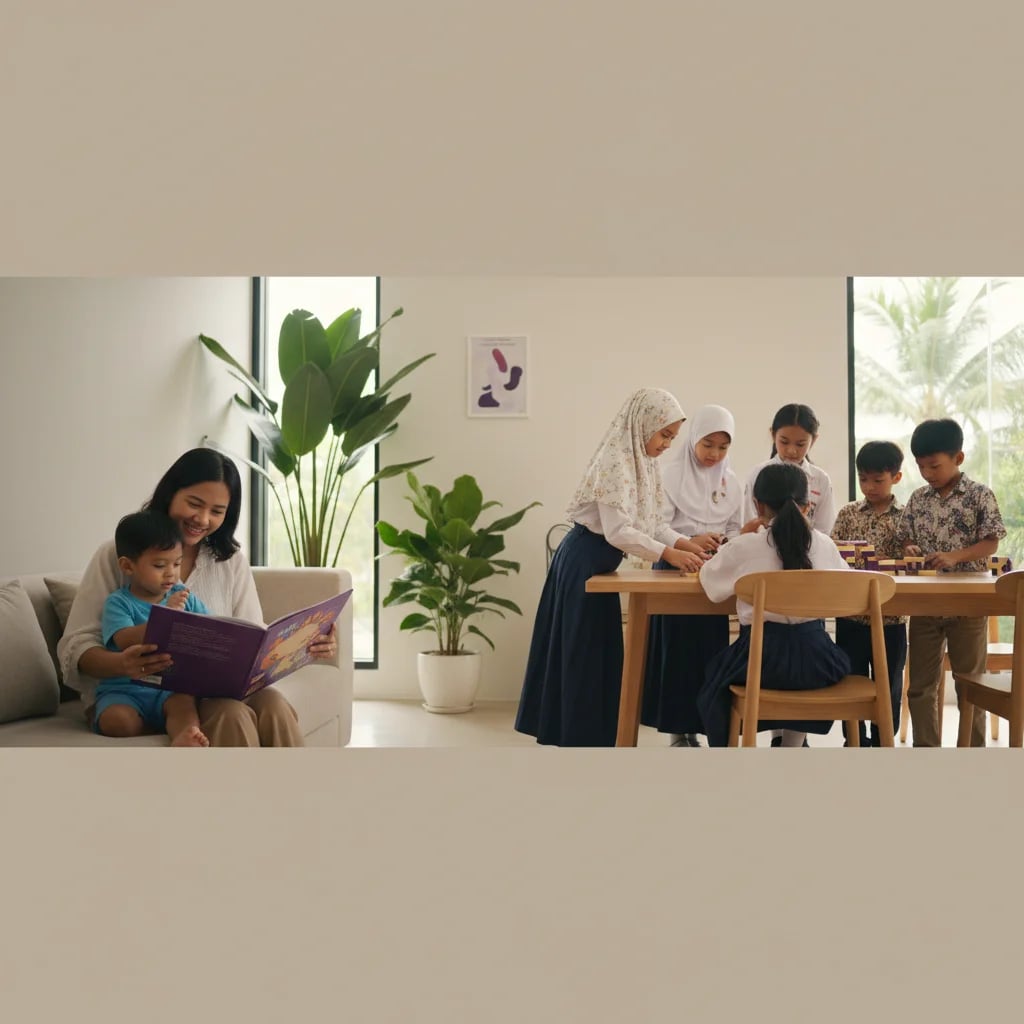
Parent and young child reading a picture book together at home
Once your child knows the letters, you can move on to syllables. Start with simple, easy syllables like ma, mi, mu, me, mo. When they have those down, move on to more complex 3-letter syllables like ban, pan, tan.
Don't forget to use engaging materials so that syllable learning becomes a fun activity. Today there are many resources available for learning syllables with appealing illustrations.
The next approach is to use games. There are many word games you can try at home. One example is "Complete the Word" — write down a word and remove one letter, then ask your child to fill in the blank. For instance, H_USE.
There's also the card-matching game. Prepare cards with pictures and cards with words, then ask your child to match them. If you have plenty of free time, try making the cards yourself instead of buying them — cut pictures out of old newspapers or magazines you no longer need.
Teaching your child to read entire sentences is one of the most effective methods. Not only does the child understand the full meaning, but reading complete sentences also helps them practice reading fluently. Once they can connect words within a sentence smoothly, their reading speed will improve naturally.
At first, choose short, easy sentences with everyday vocabulary, such as "Dad is watching football." or "This food is delicious." Then ask comprehension questions like "Who is watching football?" or "What is delicious?"
Reading aloud can start from infancy! Books are the earliest medium for introducing children to writing and words — which is why this method is so effective. Besides boosting imagination, reading aloud enriches vocabulary. Your child also exercises critical thinking, as they will often ask questions or share opinions about the story. This activity is also important for building closeness with your child.
Every child has their own preferences. By letting them choose their own books based on what they like, they'll see reading as something enjoyable and exciting. For example, if your child loves princesses in fairy tales, reading a princess story will make them eager to read the whole book to find out how the story ends. Teaching a child isn't hard if parents know how to spark their interest through what they love.
Take some time to stick reading papers in places your child sees often — on the wall near their bed or on the inside of a wardrobe door. If your child is still learning words, stick papers with words like "table", "book", "house".
If they're already reading sentences, make simple mini-comics from cut-out magazines. Use your child's name and the names of their friends or siblings as the characters, then stick the comic in a prominent spot. Because the mini-comic features their name and their friends' names, your child will be very excited to read it.
Parents need to set aside time to read with their child every day. Reading plays a vital role in language development. Beyond enriching vocabulary and improving grammar, children who love reading also develop strong communication skills. Most importantly — be the example. Show that reading is enjoyable by reading at home often. Reading habits frequently become a family tradition: a child who grows up surrounded by books will naturally become curious about every book in the house.
Appreciate every success your child achieves, no matter how small. On special days like birthdays, when they finish a particularly difficult book, or when they get a good grade in class, give them a reward to motivate continued growth. If your child loves books, give a book as a reward — they'll be thrilled! Remember to give age-appropriate reading material so they don't feel overwhelmed and continue to see reading as enjoyable and rewarding. It doesn't have to be expensive either — taking them to a reading hub or library is one of the best rewards you can give. Any form of appreciation will keep motivating them to learn new things.
There will be times when your child wants to play Lego, watch their favourite cartoon, or hang out with friends. Give them the freedom to choose the activities they enjoy — don't force them to keep practicing reading. A love for books will appear on its own once parents consistently apply the tips above.
Which tips would you like to try? Or have you already been doing some of them? Share your experience in the comments!
A love for books can also help shift your child's attention away from gadgets. In today's digital age, gadget addiction is a constant worry for parents. Instead of banning screen time, reading can become an enjoyable alternative. And once your child reaches age 5, you can also introduce them to a free coding class. In these classes, kids learn to create their own stories through the animations they build — they can even create apps for reading e-books. Pretty cool, right? If you're interested in signing up, click below.
The fastest way to teach a child to read is consistent phonics (learning letter sounds) with short daily sessions, not memorising whole words. Reading aloud together every day speeds up progress.
At what age is a child ready to learn to read? Most children are ready between 4 and 6, but readiness varies from child to child.
Once they read fluently, what comes next? Reading opens the door to other thinking skills, and logic and problem-solving through coding is a natural next step. See Algonova coding classes for ages 5-17, or try a free coding class.
Algonova Indonesia accepts students aged 5 to 17 for coding and math courses. Every age group has a dedicated program designed for their cognitive development stage and interests. For kindergarten kids aged 5-7, we offer ScratchJr (visual block-based coding requiring no reading) and fun basic math introduction. For primary school kids aged 8-12, the program covers Scratch, Roblox, Python Start, and complete math. For junior and senior high teens aged 13-17, focus is on Python, JavaScript, secondary school math, AI courses, full Web Development, UTBK SNBT preparation, and university portfolio. No prior experience is required. An Algonova certified teacher will recommend the right learning path during the free trial class.
Yes, all Algonova Indonesia courses are fully available online with live sessions taught by certified teachers — not recorded videos. Kids learn in real time in small groups, with two-way interaction and tasks worked on alongside the teacher. To join online class, a child only needs a computer or laptop with a camera, a stable internet connection, and a headset. The Algonova platform runs directly in the browser so no special software installation is required. Many families choose a mixed schedule: weekday classes for flexibility around school, and weekend sessions for a calmer pace outside school hours. Our team helps choose the format best suited to family needs.
Algonova Indonesia classes come in three formats: 1-on-1 private, a mini-group of 2–4 kids, and a group of up to 10 students. This small group format is deliberately chosen because it provides the optimal balance between social interaction and personal teacher attention. In a mini-group, every child averages about 10 minutes of direct teacher interaction in a single session. Compare with traditional offline bimbel of 20-40 students per class — direct interaction there is only 1-2 minutes per child, or none at all. For families wanting full attention, one-on-one private class is also available (1 student per teacher). This format is more intensive and suits kids with special needs, competition preparation, or specific topic depth.
Choosing the right course for your child depends on three main factors: age, interest, and previous learning stage. The best way to decide is by taking a free trial class at Algonova Indonesia. During the trial class, a certified teacher will talk with the child, understand their interests (games, art, mathematics, science experiments), and assess their ability level. Based on this diagnostic, the teacher recommends the most suitable learning path — perhaps visual coding for creative kids, Python for logic-loving kids, or math tutoring for kids wanting to improve school grades. After the trial, the Algonova team provides a transparent explanation of the recommended program, along with schedule and pricing. No pressure to enrol — we believe the best decisions come from full understanding. Contact our WhatsApp to book a trial.
The Algonova Indonesia trial class is 100% free, no credit card, no auto-subscription. You and your child can attend the entire 60-minute session with no obligation afterwards. Many families take a few days to decide, and that's completely fine. For regular programs, pricing starts from Rp 102,000 per lesson. The price includes a live session with a certified teacher, digital learning materials, platform access, and an official certificate upon completing each level. Final pricing depends on program (coding or math), child's age, and class format (private, mini-group, or group). Full pricing details are shared transparently after the trial class. No surprise fees, every cost component is explained before formal enrolment.
Algonova Indonesia uses Project-Based Learning methodology combined with modern cognitive science principles. Three main pillars: kids learn by creating (not memorising), small groups for personal attention, and a gradual curriculum matched to age. Every program level ends with a real project: kindergarten kids build animations, primary school kids build games or interactive stories, teens build Python applications or websites. Projects become concrete evidence of understanding, far more effective than theoretical exams. We also apply "scaffolded learning" principles — teachers provide full support at the start, then gradually reduce until the child is independent. This approach is inspired by Lev Vygotsky's work on the Zone of Proximal Development. The result: children master not just the material but also build confidence as independent learners willing to try new things.
Yes, Algonova Indonesia students receive an official certificate after completing each level of a coding or math program. The certificate lists the child's name, the program completed (for example Scratch Basics, Python Basics, or Primary School Math), the completion date, and is signed by the Algonova team. The certificate documents the child's learning journey, attaches to a school portfolio or coding competition application, and motivates kids to see the results of their hard work. Some primary and secondary schools in Indonesia accept Algonova certificates as evidence of digital extracurricular activity. Beyond the formal certificate, kids also take home a portfolio of real projects they built themselves: games, animations, websites, or running Python programs. This portfolio is concrete evidence of the child's ability that can be shown to family, teachers, friends, or even in university applications.
Most children are ready to start recognising letters at ages 3–4, and can begin reading simple words by age 5. However, every child develops at their own pace. The key is to make learning playful and pressure-free — if you follow the tips in this article, your child will naturally reach milestones when they're ready.
With consistent, daily practice of 10–20 minutes, most children can recognise all letters within 1–2 months and start reading simple sentences within 3–6 months. The speed depends on the child's age, readiness, and how engaging the learning environment is. Patience and positivity make a bigger difference than intensity.
A combination of phonics (learning letter sounds and syllables) and reading whole sentences in context usually works best. Starting with familiar words — like the child's own name — and using games, songs, and real books keeps motivation high. The tips in this article follow exactly that approach.
Yes, significantly. Children who read fluently before starting school have stronger vocabulary, better comprehension, and higher academic achievement across all subjects — not just language arts. Early reading also builds critical thinking and communication skills that carry through their entire education.
Never force it — resistance is a signal to change the approach, not increase the pressure. Try switching to a different format: games, picture books on their favourite topic, or audiobooks paired with print. Children who connect reading with enjoyment become lifelong readers. If your child is 5 or older, our free coding class is another great way to build logical thinking through a subject they find exciting.

Algonova worldwide
Contact
Whatsapp: +62 21 50996971
Email: info@algonova.id
Address
Coworking Area, Gedung IT 6 Lantai Dasar, Nongsa Digital Park, Jalan Hang Lekiu, Kelurahan Sambau, Kecamatan Nongsa, Batam, Indonesia Directorate General of Consumer Protection and Trade Compliance – Ministry of Trade of the Republic of Indonesia. WhatsApp Ditjen PKTN: 0853-1111-1010.
PT Algonova Indonesia Cerdas All rights reserved 2026